
· Blog
Did the Tree Make a Stimulation? Berkeley, Sound and the Phenomenal State
The falling-tree riddle read through Model L: Locke and Berkeley on sound, Kimani White's Phenomenal State, and Observation versus Stimulation.
Read the postUpdate Archive
The complete running list of TetraTypes additions.
Essays, videos, tools, games, and structural additions from across the site.
Complete List
The homepage keeps the newest twelve. This page keeps the full archive.
· Blog
The falling-tree riddle read through Model L: Locke and Berkeley on sound, Kimani White's Phenomenal State, and Observation versus Stimulation.
Read the post
· Blog
Socionics as folk psychology made explicit: Theory Theory, Simulation Theory, and an LII–SEE typing disagreement. Written for Ethan's relaunch of Beat's Hovel.
Read the post
· Site
A new Videos page gathers the whole channel by series: Conjectures, In Motion, the Video Guides, Conceptual Foundations, In Depth, Atlas of Ideas and the songs.
Browse the videos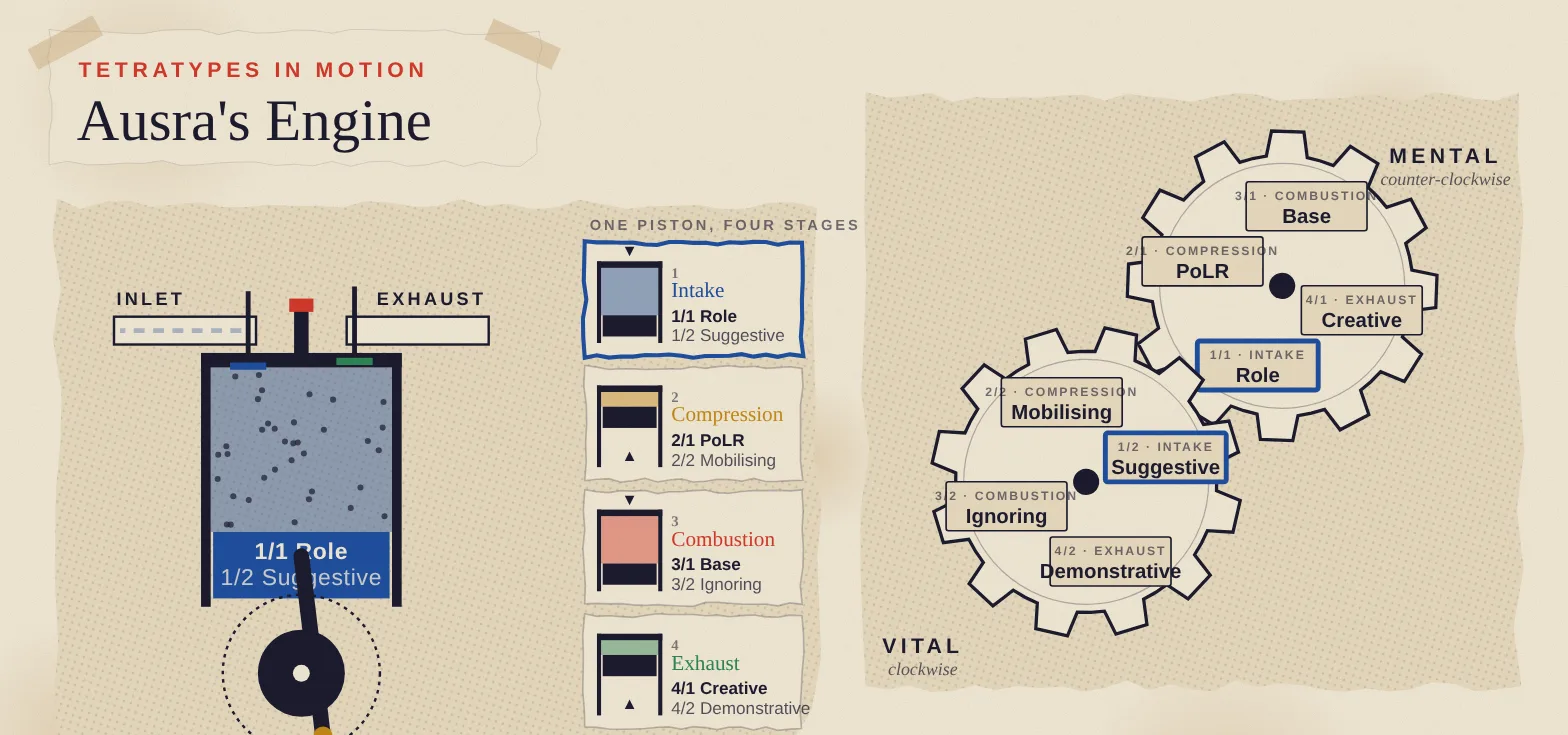
· App
Mesh two types' engines together and watch all sixteen intertype relations turn: which strokes meet, which gears drive each other, and where they grind.
Mesh two engines· App
Explore all sixteen types through a four-stroke engine cycle, with mental and vital gears, element codes, and controls for stepping through dichotomy poles.
Open Ausra's Engine
· Blog
Wollstonecraft's Scandinavian letters judge commerce by the independence and obligations it leaves to households, friends and dependants.
Read the post
· Blog
Coriolanus can take a city gate but cannot turn his wounds into a request for votes; his last decision answers Rome through the mother who formed him.
Read the post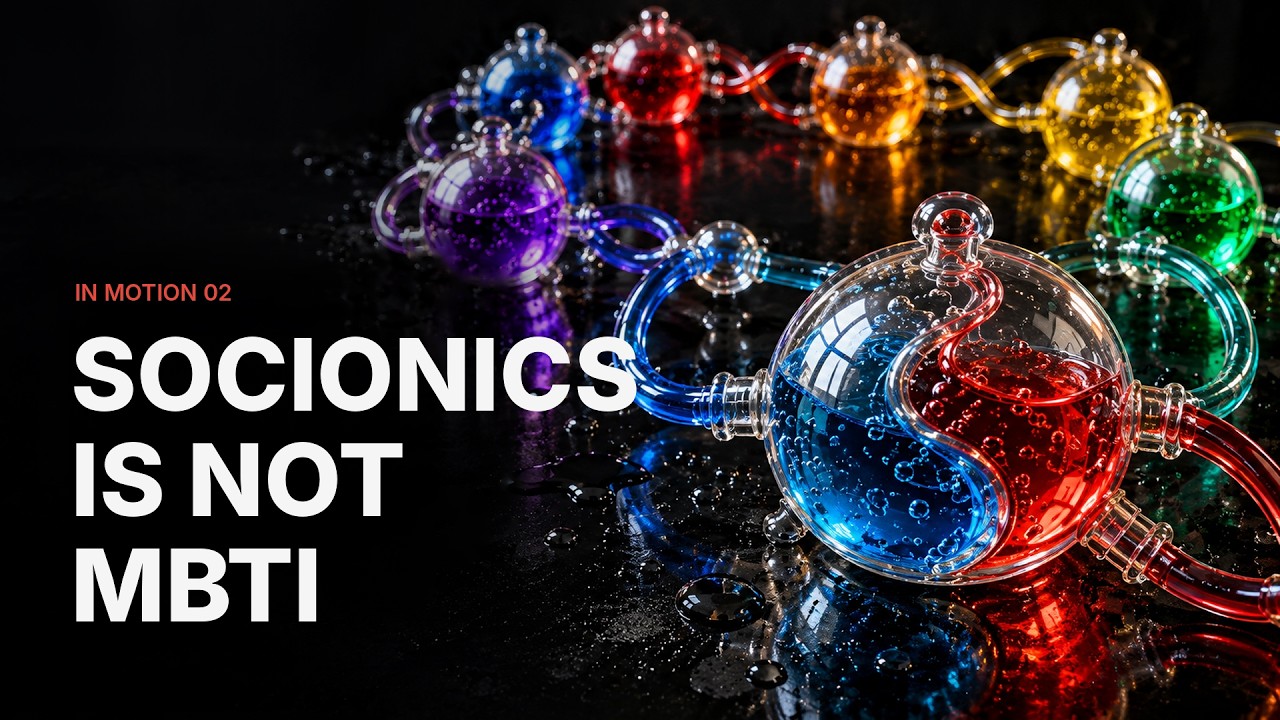
· Video
An animated comparison of socionics and MBTI: type letters, Model A, Beebe's archetypes and intertype relations.
Watch In Motion 02
· Video
A TetraTypes song that imagines socionics as channels broadcasting through the night.
Listen to Eight Signals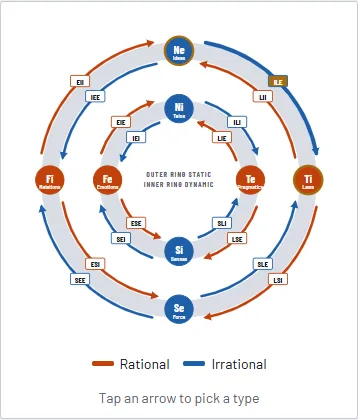
· App
Compare Model A Supervision Rings and Model G Benefit Rings, explore dichotomies and orbit signs, filter either pole, animate orbits, compare types, and save a picture.
Open Orbital Rings
· Blog
Antigone covers Polyneices twice after Creon's guards remove the first burial; her loyalty becomes a deed the city must undo and finally perform.
Read the post
· Video
One rainy street, four houses and sixteen ways of seeing: a TetraTypes song about different perspectives.
Listen to Sixteen Ways of Seeing
· Blog
Isabel imagines a future for Osmond, then answers Pansy's own choice and her request not to be deserted.
Read the post
· Interactive
Explore Jared's seven Model A function grids. Change the axes and weighting, fill a type, and tap a function to inspect its scores.
Open Function Grids
· Blog
Stockmann carries a poisoned-water report into public speech, then reclaims the room that condemned him as a school.
Read the post
· Blog
Seacole turns an unfinished store into a base for reaching particular soldiers; peace reveals the cost of that work.
Read the post
· Video
Jared Vaughan's seven element grids in motion: how one swap transforms Model A's quadras and clubs into Model G element groups.
Watch One Swap
· Blog
Clarissa brings separate lives into one room; Septimus makes the offering answer to a life beyond it.
Read the post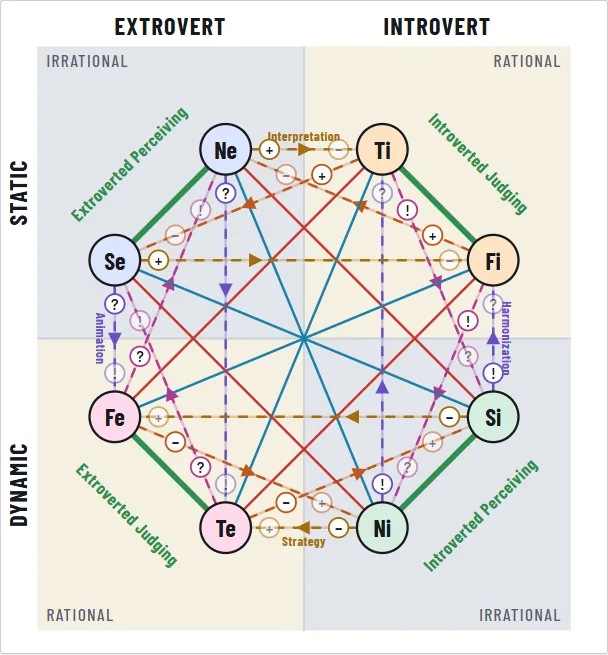
· Interactive
Jared's seven grids in one phone-friendly diagram. Change the axes, tap elements and lines, and explore the currents and pairings.
Open Element Grids
· Blog
Prospero seizes an accidental opening, arranges its encounters, and decides when the power holding them should end.
Read the post
· Blog
Socrates tests a charge, a penalty and an escape against a principle that must also govern his own act.
Read the post
· Blog
Thoreau's house ledger buys time for the bean field and pond; SLI Observation gives his practical economy its purpose.
Read the post
· Blog
Lopakhin's childhood debt to Ranevskaya becomes a bid for her estate; his SEE drive wins the orchard without resolving the relations inside it.
Read the post
· Blog
Ahab's quarter-deck oath, chart and doubloon make one man's injury the Pequod's course; the Rachel reveals the other future it refuses.
Read the post
· Blog
Holmes reads the Red-Headed League's paid busywork as an engineered absence, then reconstructs the tunnel it conceals.
Read the post
· Essay
Why a typing is a reading of a person, not a measurement: what makes that reading good, and why the explanation matters more than the verdict. Now readable on the site as well as in PDF.
Read the essay
· Blog
Lydgate's medical ambition takes its real form through Middlemarch's votes, clinical encounters, household costs and public trust.
Read the post
· Quiz
Choose a type and one of its sixteen positions for a phone-friendly reading of its element, groupings, derivation and Model A connection.
Open the position reader
· Blog
Jane Eyre's two proposals and chosen return show ESI fidelity as the active making of a relation that can hold affection and independence together.
Read the post
· Blog
Douglass exposes the dependencies behind authority and changes its practical terms; SLE Actuation and Habitus clarify the shape of his resistance.
Read the post
· Blog
Bergson's musical phrase shows how a pause changes the meaning of a whole scene; IEI and ILI bring different temporal readings to its revision.
Read the post
· Quiz
Compare central and block readings of Model G across sixteen Model L lattices, with Gulenko's signs, eight theses and a phone-friendly drill.
Open the concordance
· Blog
Jane Addams made immigrant mothers’ textile knowledge publicly visible at Hull-House, changing who could teach and who was prepared to listen.
Read the post
· Blog
Nightingale's Notes on Nursing makes care durable through practical arrangements tested by exact attention to the patient's condition.
Read the post
· Blog
Lovelace's distinction between operation and object lets her imagine music as a subject for the Analytical Engine; LII's Ti and Ne clarify the order of her invention.
Read the post
· Blog
LIE and LII show how a project may rely on what the present supplies or prepare the conditions a future demand will need.
Read the post
· Blog
Williams, ESI and EII show why loyalty, tact and betrayal are descriptions of a relation, not feelings added to neutral facts.
Read the post
· Blog
Collingwood, EIE and ESE show how a public feeling becomes articulate without being engineered as an effect.
Read the post
· Blog
Anscombe, ESE and LIE show how a practical undertaking takes shape under different descriptions of what it is for.
Read the post
· Blog
Model L Occupation shows how a concern can hold a type deeply without becoming its declared priority.
Read the post
· Blog
LSE and EII show why a decision may be governed in public or changed by a quieter hand.
Read the post
· Blog
EIE and ILI show how Supervision turns a demanding public question into a strategic route through a shared piece of work.
Read the post
· Blog
Kępiński’s information metabolism gives Socionics a world that enters a life and receives an answer.
Read the post
· Blog
Montaigne shows why a rule becomes humane only when it answers to the condition in which someone must live it.
Read the post
· Blog
Johnson’s dictionary shows LSE practical judgement turning living use into a shared instrument.
Read the post
· Blog
ESI and EII show why personal allegiance and social affiliation are different kinds of information.
Read the post
· Blog
Wodehouse turns IEE/SLI duality into a comedy of divided authorship: Bertie creates the human claim; Jeeves makes it executable.
Read the post
· Blog
LIE and ILI show how Affirmer and Denier attention build two rigorous inventories: what is present and what failed to appear.
Read the post
· TetraTypes: Atlas of Ideas
An 81-second Atlas film in which eight rotating cubes assemble into Model A's four functional blocks.
Watch on YouTube
· Blog
The history of Model A shows that the individual type and the relation system were constructed together.
Read the post
· TetraTypes: Atlas of Ideas
An eight-function visual study of the Presence Cube: Strength, Value and Boldness; Dimensionality and Priority; and the four derived levels of Presence.
Watch on YouTube
· TetraTypes: Atlas of Ideas
A sculptural Model L study of LII: sixteen fixed elements, four Capacity groups, and four ways an element can be foregrounded or held in reserve.
Watch on YouTube
· Blog
LII and SEE show how a Conflict relation can begin with two incompatible definitions of the problem itself.
Read the post
· TetraTypes: Atlas of Ideas
A sculptural visualisation of the fifteen Reinin dichotomies: sixteen types, structural divisions, and the relations that link them.
Watch on YouTube
· Blog
LSE and IEE show how Model L Ensemble gives a decision its frame, its next act, and its route into reality.
Read the post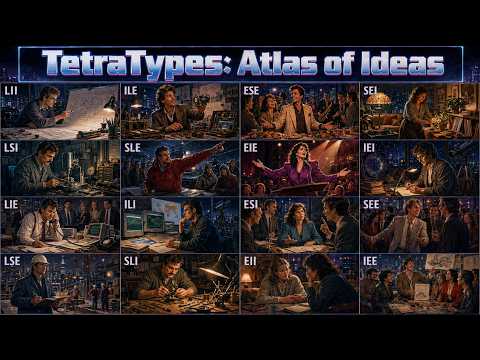
· TetraTypes: Atlas of Ideas
A 3D journey through all sixteen Model L configurations, cycling through Capacity, Vergence, Current, Ensemble, Array, Interest and Occupation.
Watch on YouTube
· Blog
LSI and ESI show how a method becomes answerable through different structural routes.
Read the post
· TetraTypes: Between Types
The first Between Types video follows an LII and an EIE through a cancelled event, showing how Model L positions organise different criteria, forms of support, and real adjustment.
Watch on YouTube
· Blog
LII and EIE show how Model G names public contribution without assigning a career fate.
Read the post
· Blog
LII and EIE show how Model L Vergence and Interest alter the same planning-room problem.
Read the post
· Blog
Jane Austen on social initiative, relational judgement, and the attachment a clever arrangement fails to see.
Read the post
· Blog
Henry James on the catastrophe of waiting for a future that keeps life at a distance.
Read the post
· Blog
George Eliot’s heroine shows conviction seeking a form of life large enough to serve it.
Read the post
· Blog
Cervantes’s knight shows why possibility needs a world that can be acted upon.
Read the post
· Blog
Raymond Williams on the historical atmosphere that a type cannot explain alone.
Read the post
· Blog
Isaiah Berlin and Tolstoy on the evidence a self-description can leave out.
Read the post
· Blog
Why a good type reading resembles criticism and biography more than a personality measurement.
Read the post
· Blog
A TetraTypes essay on Kindred Relations: shared orientation, divergent practical direction, and the EII/ESI comparison.
Read the post
· Blog
A TetraTypes reading of David Deutsch: explanatory architecture, LII, and the discipline of comparing alternatives.
Read the post
· Blog
A TetraTypes guide to two Ni-leading types: shared attention to unfolding, different Model L orientations, and two questions that time can ask.
Read the post
· Blog
A TetraTypes guide to Socionics Semi-Duality: real complementarity at the information-element level, and a register that does not quite meet the need.
Read the post
· Blog
A TetraTypes guide to EIE and ESE: a shared Fe Base in Model A, different Creative functions, and two ways public atmosphere can serve a next step.
Read the post
· Blog
A TetraTypes guide to Socionics Quasi-Identity: similar conclusions, different starting concerns, and the discipline of asking how an agreement was reached.
Read the post
· Blog
A TetraTypes guide to Socionics Extinguishment relations: recognition, absorption, and the difference between taking up an idea and hearing it on its own terms.
Read the post
· Blog
A TetraTypes guide to Socionics Business relations: task-focused cooperation, different leading priorities, and the value of a clear shared task.
Read the post
· Quiz
Browse every Model L position through seven grouping systems, then practise placing monadic elements in three quiz modes.
Open the explorer quiz
· Blog
A TetraTypes guide to Delta quadra: shared valued information elements, two clubs, and different ways of making a project workable.
Read the post
· Blog
A TetraTypes guide to Socionics Activity relations: shared quadra values, a lively change of information domain, and why energy is not a prediction.
Read the post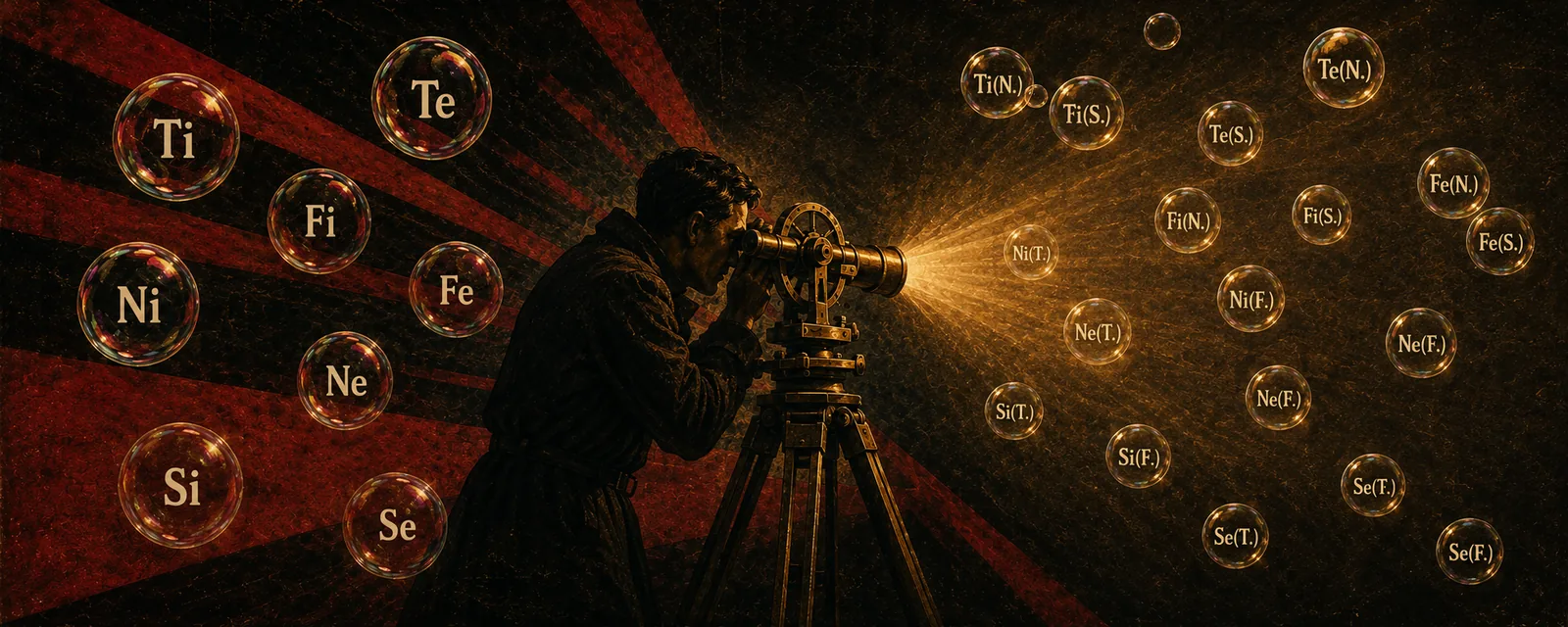
· Quiz
A two-scale Model L test: rate facility and draw for all sixteen monadic elements, then inspect a structured type hypothesis, its alternatives, and the mismatches.
Open the inventory
· Blog
A source-led TetraTypes guide to changing Socionics labels, translation, and the Model A structure that a label is meant to name.
Read the post
· Quiz
An interactive atlas of seven element pairings: flip the eight information elements, trace relation rings, draw every pair, and test the structure.
Open Element Plates
· Quiz
Set four type switches, inspect all 35 Socionics small groups, cross dichotomies, and practise recognising the hidden third diagonal.
Open the drill
· Quiz
A browsable atlas of all 35 Socionics tetrachotomies, showing four-cell group charts, their diagonals, Model A levels, and source notes.
Open the plates
· Blog
A TetraTypes guide to Socionics Mirror relations: shared Ego functions in reverse order, and the useful disagreement about what should lead.
Read the post
· Blog
A source-led TetraTypes account of the four quadra complexes: signed valued aspects, Reinin structure, and social pressure without personality-test shortcuts.
Read the post
· Mobile Game
A phone-first practice tool for signed quadra aspects, the closed Reinin triad, the succession cycle, and the four named complexes in Stratievskaya's account.
Open Quadra Complex Drill
· Blog
A TetraTypes type-pair analysis of LIE and LSE: both lead with Te in Model A, while Model L distinguishes Te(N.) Reason from Te(S.) Praxis.
Read the post
· Blog
A TetraTypes essay on why a Socionics type may explain a recurring style without excusing its consequences.
Read the post
· Blog
A TetraTypes essay on beginning a Socionics typing inquiry with the pattern that needs explaining, rather than with a preferred type label.
Read the post
· Blog
A TetraTypes essay on the typing bias created when a Socionics type feels like praise, and how to return from a flattering label to evidence.
Read the post
· Tetratypes In Depth Video
TetraTypes In Depth 06 reconstructs Mironov's 140-aspect proposal and asks what must connect a formal Reinin subgroup, a shared semantic field, and a genuine information aspect.
Watch on YouTube
· Blog
A TetraTypes essay on revisiting a Socionics type hypothesis: why a useful account should become clearer, not merely more familiar, on a second reading.
Read the post
· Tetratypes In Depth Video
TetraTypes In Depth 05 reconstructs Vladimir Ermak's attempt to derive the eight aspects from objects, space, energy, and time.
Watch on YouTube
· Blog
A TetraTypes essay on the Model A Leading function: why its clearest evidence is a recurring orientation rather than one vivid performance.
Read the post
· Tetratypes In Depth Video
TetraTypes In Depth 04 examines Oleksandr Bukalov's Model B, its sixteen-component architecture, subtype claims, and the limits a bigger model must meet.
Watch on YouTube
· Blog
A TetraTypes essay on the Model A Creative function: why a type's second function is a practical instrument for shaping situations, not a second Leading function.
Read the post
· Blog
A TetraTypes essay on silence, absence, and incomplete evidence in Socionics typing: why what a person does not say is not yet a type clue.
Read the post
· Tetratypes In Depth Video
TetraTypes In Depth 03 considers Grigory Reinin's account of knowledge, information, and the world a person brings to experience.
Watch on YouTube
· Blog
A TetraTypes essay on the Model A Vulnerable function: why correction can feel disproportionately exposing, and why better typing begins with restraint.
Read the post
· Tetratypes In Depth Video
A TetraTypes In Depth episode on Viktor Gulenko, Humanitarian Socionics, and Model G.
Watch on YouTube
· Blog
A TetraTypes essay on the Model A Suggestive function: why the right kind of support can feel clarifying rather than controlling.
Read the post
· Tetratypes In Depth Video
The first Tetratypes In Depth episode: a source-led historical reading of Talanov's account of the Reinin tetrachotomies, Model T, Russian terminology, and the limits of the available evidence.
Watch on YouTube
· Research Edition
A 30-page bilingual Russian-English research edition of Victor Talanov's work on four Reinin tetrachotomies, with translations, commentary, glossary, bibliography, and source notes.
Read or download the edition
· Mobile Game
A phone-first practice tool for constructing types, checking all fifteen Reinin dichotomies, drilling poles, and tracing the derivation rules behind the grid.
Open Reinin Drill
· Blog
A TetraTypes essay on the Model A Role function: why looking capable can feel effortful, situational, and unlike a person's centre of gravity.
Read the post
· Conceptual Foundations Video
The third Tetratypes Conceptual Foundations episode introduces Model L's four metabolic worlds: meaning, significance, purpose, and value—and the routes by which each turns experience into an outcome.
Watch on YouTube
· Blog
A TetraTypes essay on why vivid crises and dramatic anecdotes should be handled carefully in Socionics typing, and why ordinary patterns often carry better evidence.
Read the post
· Blog
A clear explanation of Jared Vaughan's radial-priority question through the LII case.
Read the post
· Game
A timed drag-and-drop companion to the Presence Cube on the About page: place a type's eight functions on the cube by strength, value, and boldness. Playable with touch, mouse, or keyboard, with optional sound.
Play the quiz
· Blog
A TetraTypes essay on testing a Socionics type hypothesis against the awkward facts as well as the convenient ones.
Read the post
· Blog
A TetraTypes essay on the Demonstrative function as background competence: real capacity without the need to make it central.
Read the post
· Blog
A TetraTypes essay on why rival Socionics type hypotheses can improve the evidence instead of ending the inquiry.
Read the post
· Blog
A TetraTypes essay on explanatory restraint: how a type hypothesis can clarify a pattern without pretending to contain a whole person.
Read the post
· Blog
Why responsible Socionics typing needs evidence from several contexts, not one convincing performance.
Read the post
· Blog
Why Model A position 7 can be genuinely capable without becoming the information a person wants to lead with.
Read the post
· Blog
A practical Model A essay on position 6: why the Mobilising function is weak, valued, aspirational, touchy, and easily mistaken for strength.
Read the post
· Blog
A Model L follow-up to the Super-Ego firewall and Super-Id recharge essays, showing how exact monadic elements sharpen the reading across all sixteen types.
Read the post
· Blog
A follow-up to the Super-Ego firewall essay: how Suggestive and Mobilising functions receive valued support and recharge the psyche.
Read the post
· Blog
A clearer Model A account of the Role and Vulnerable functions as defensive filtering, not simply weakness or failure.
Read the post
· Feature
A new public directory of Socionics type hypotheses for well-known people, with published profiles, sources, and complete analysis kept visible.
Open the database
· Blog
A reflection on whether a Socionics database of famous people helps people learn the system or encourages overconfident labelling.
Read the post
· Blog
Why Ethics and Logic are information domains rather than measures of kindness or intelligence.
Read the post
· Blog
A practical guide to reading type descriptions as hypotheses rather than identity mirrors, with cautions about recognition, near misses, and self-image traps.
Read the post· History
A source-led history tracing the precursors, Aushra's early texts, Model A, later schools, Western Socionics, translation, visual typing, and open research questions.
Read the history
· Model L
A new Model L section introduces Kimani White's block terminology: Leading, Trailing, Consultative, Delegative, Correlative, Supportive, Diverting, and Dovetailing.
Read the section
· Blog
A Model L view of all eight dual pairs: Ego strengths, Super-Id demand, and quadra values as a shared world.
Read the post
· Blog
Hume, Kant, Wittgenstein, and Socionics as a philosophy of what counts as information for a mind.
Read the post
· Game
A timed phone-friendly game: identify the exact Model L element for the highlighted slot before the timer runs out.
Play the sprint
· Blog
Husserl, Merleau-Ponty, and Schutz offer a careful way to read Socionics as patterned differences in how a shared world becomes meaningful.
Read the post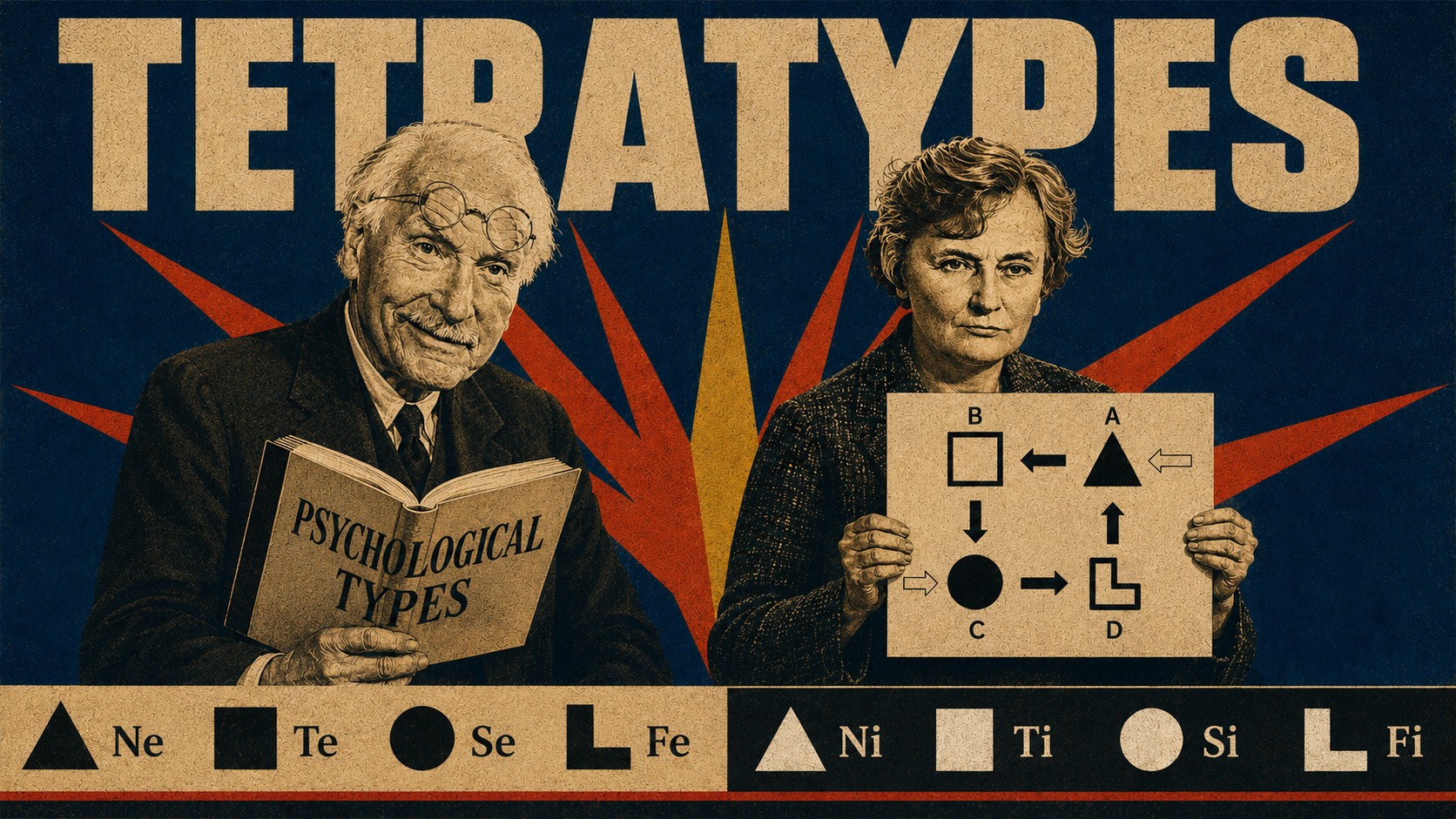
· Blog
A slow, source-led reading of the TetraTypes image: the ILE mental ring, Aushra's energy-metabolism metaphor, blockings, and duality.
Read the post
· Conceptual Foundations Video
The second Conceptual Foundations short: Model L separates dimensionality from priority, then shows how their difference creates demand.
Watch on YouTube
· Custom GPT
A conversational ChatGPT guide for exploring possible socionics type through Model A, Model L, everyday patterns, and relationships.
Open in ChatGPT
· Blog
A reflection on agentic AI, Joscha Bach's simulation view, and whether artificial minds could have structured phenomenal worlds.
Read the post
· Blog
Behaviour is evidence rather than verdict: the visible act has to be routed through the metabolism that produced it.
Read the post
· Conceptual Foundations Video
The first Conceptual Foundations short: Model L shifts from reading functions as stack positions to reading them as coordinates in a generated field.
Watch on YouTube
· Blog
Why fluency is not devotion: strong functions can be low-priority, and valued functions may matter even when they are hard to use.
Read the post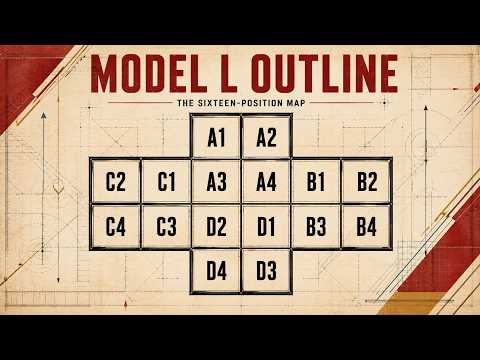
· Video
A dense structural map showing how Reinin dichotomies, Model A function dichotomies, and Model L tetrachotomies fit together.
Watch on YouTube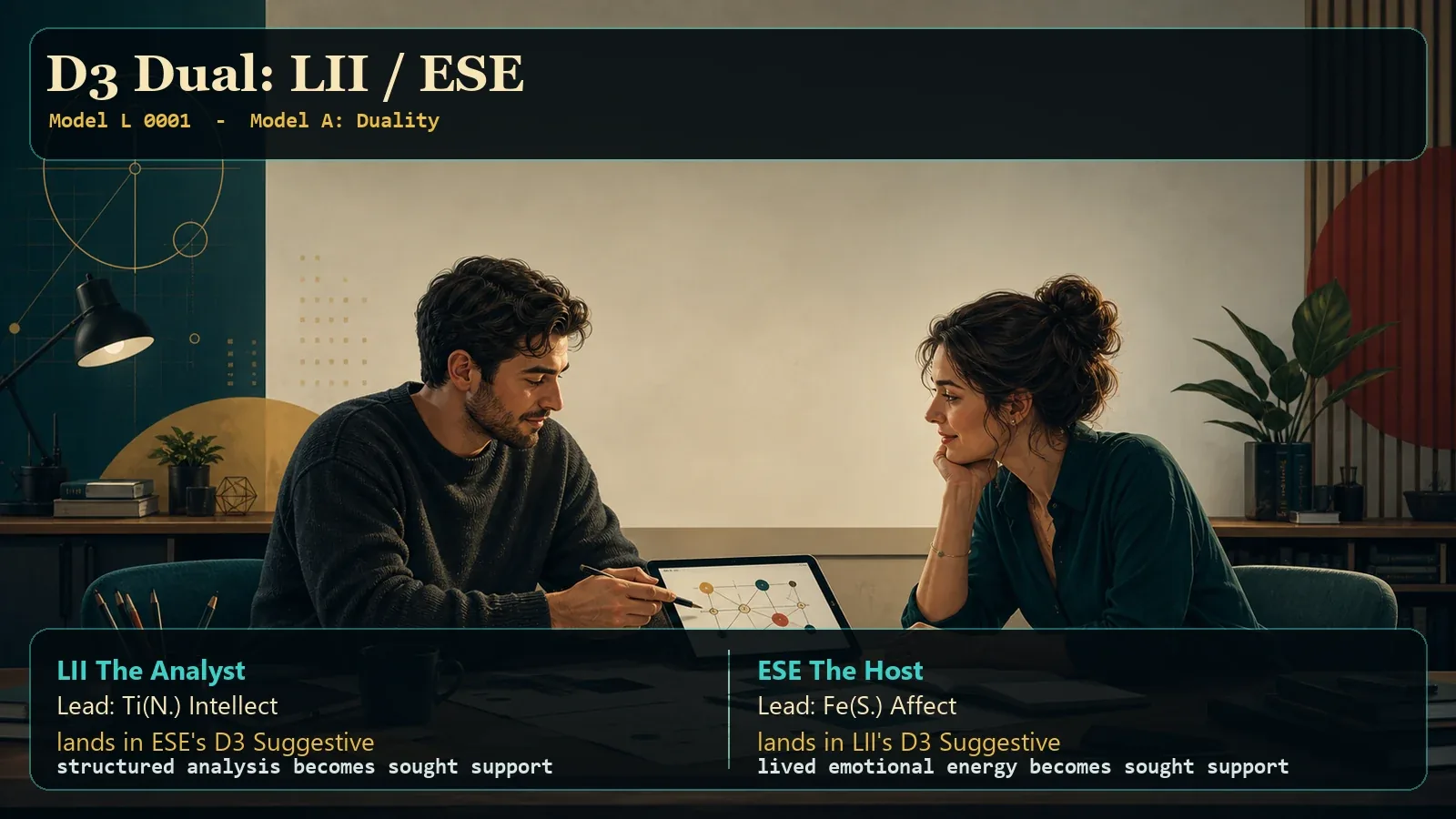
· Model L Intertype
Sixteen contemporary Model L intertype pairing images now show exact lead-function landings for LII across every symmetric relation.
Explore the browser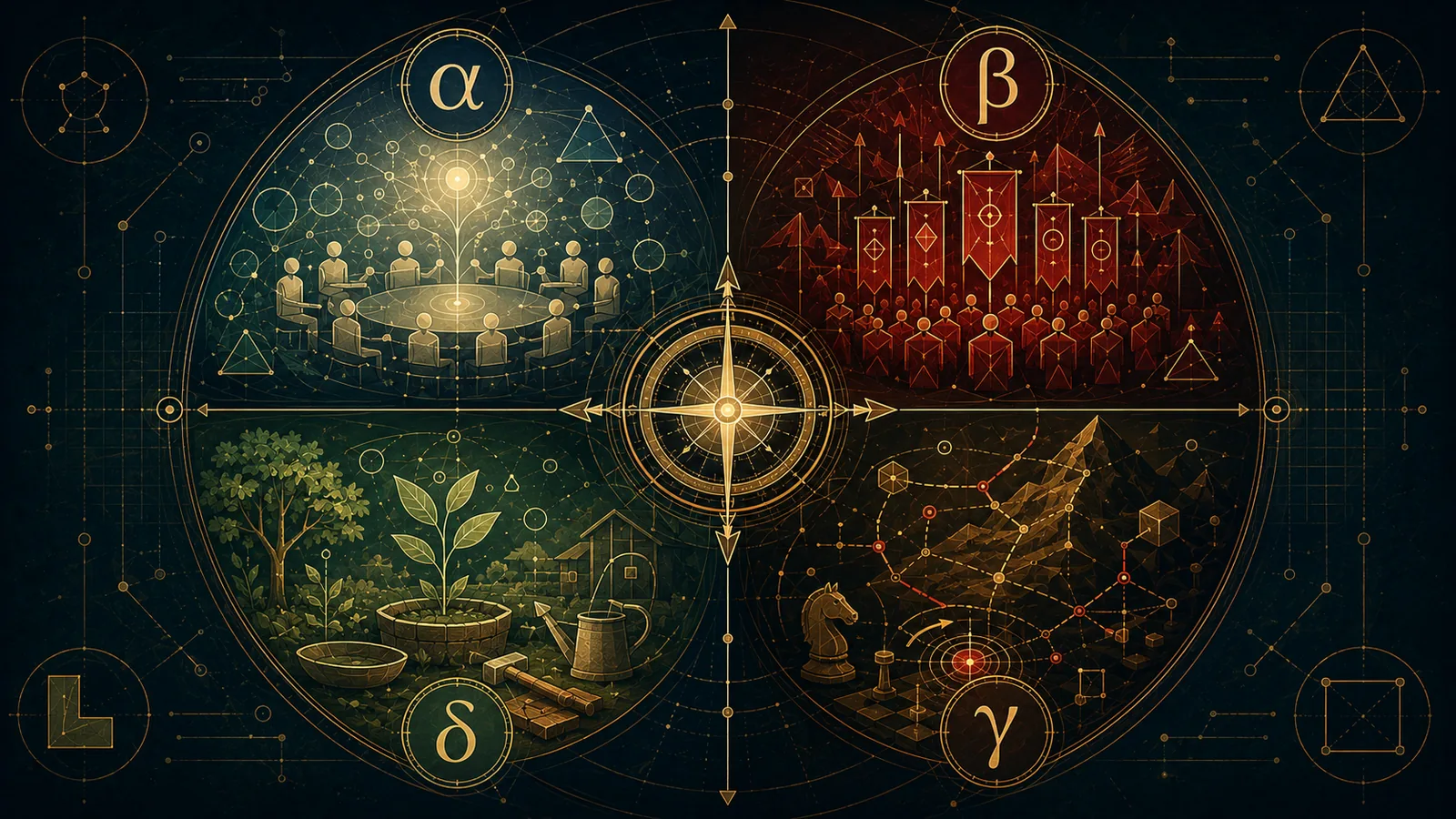
· Blog
Quadras as adaptive logics for peace, pressure, density, and self-reliance.
Read the post
· Revised Video
Corrected account of Bold/Discreet, Pertinent/Incidental, and their Reinin correspondences.
Watch on YouTube
· Model L Intertype
Relation codes, matching pairs, base-function landings, and Model A correspondences.
Open the browser
· Game
A case-file game about structural evidence, uncertainty, and typing discipline.
Open the case