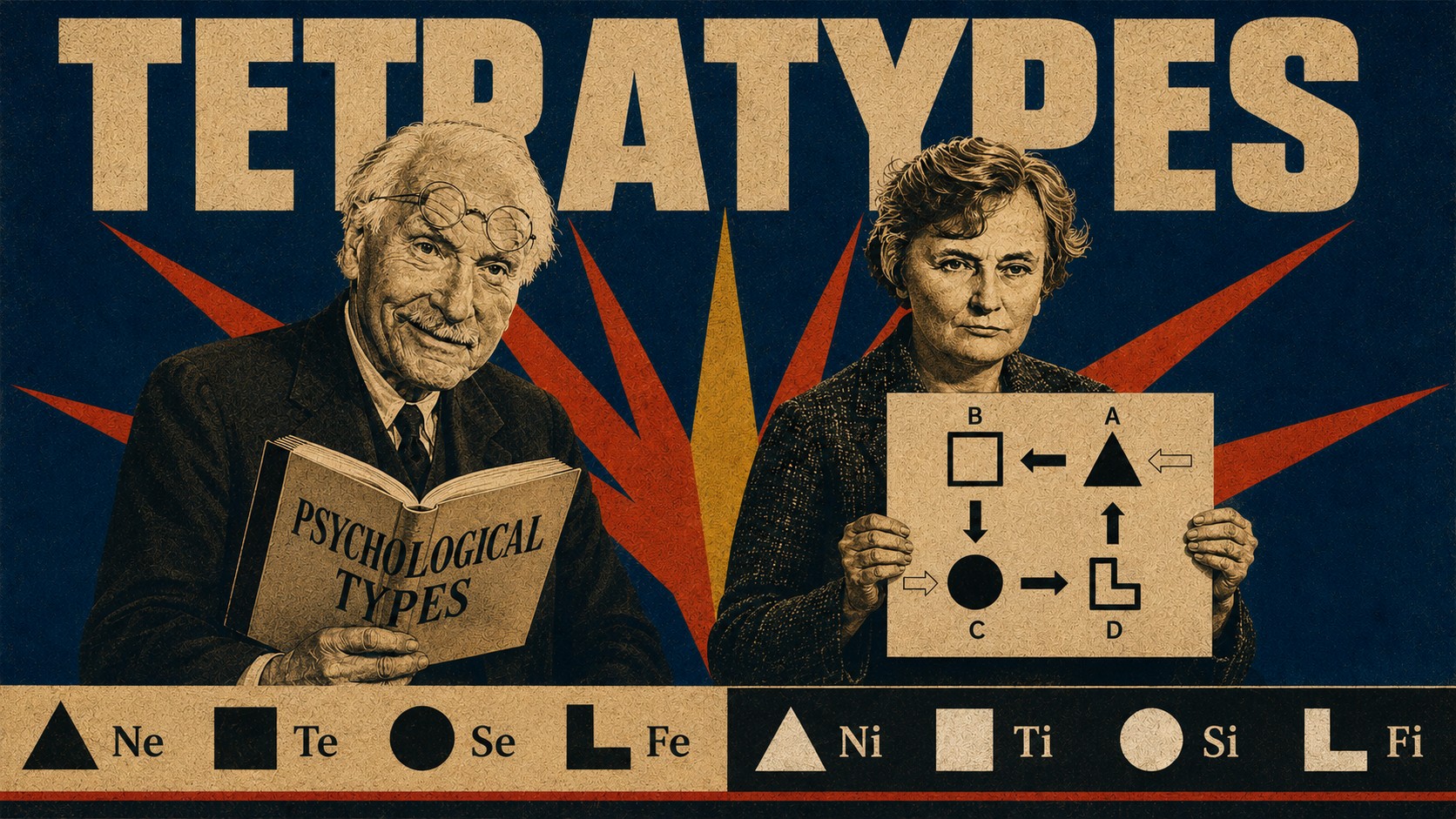
Guide One
Introduction To TetraTypes
A first visual route into the project: what TetraTypes is, how the site is arranged, and why the fourfold structure matters.
Now live Watch the introductionA Guided First Route
One path through the system, from names to structure.
TetraTypes has become a reference library. This page gives you a first route through it: what to read first, what to leave until later, and how the pieces fit together.
The Short Version
Socionics can become abstract very quickly. The easiest entry point is usually not the theory in full detail, but the sixteen types as recognisable patterns of attention, strength, need, and relation.
Start with the type pages. Then return to Model A to understand why the type descriptions have the shape they do. Once Model A is familiar, the Bridge and Model L pages make more sense: they add resolution rather than replacing the classical frame.
If you want the background before the mechanics, the history page traces how the system emerged through Jung, Kępiński, Aushra, Model A, later schools, and translation.
The Explorer is best treated as a companion. Use it when you want to see the structure moving, compare types, or test how the elements rearrange across the system.

Video Guides
The channel is growing into a set of visual guides for the site. The introduction, two Model A deep dives, and the main Model L technical sequence are now available, with conceptual foundations and intertype material developing alongside them.
Guide One
A first visual route into the project: what TetraTypes is, how the site is arranged, and why the fourfold structure matters.
Now live Watch the introductionGuide Two
A 37-minute deep explanation of the seven aspect dichotomies: how the information elements are split, derived, and made intelligible.
Now live · 37 min Watch the Model A deep dive Read the companion noteGuide Three
A deep dive into the architecture of the Model A stack: blocks, dimensionality, function dichotomies, approach types, positions, interactions, and transitions.
Now live Watch the function positions video Read function mechanicsGuide Four
A visual introduction to the Model L sub-variant split: how eight classical elements become sixteen monadic elements.
Now live Watch the Model L video Read Model LGuide Five
A deeper Model L explanation of central and radial structure, the four capacities, and how the positions organise the sixteen monadic elements.
Model A AnchorCapacity expands Strong / Weak and the classical position regions into A, B, C, and D.
Now live Watch the capacities video Read Model LGuide Six
A further Model L guide focused on the four vergences and how they help organise the higher-resolution structure of the system.
Model A AnchorVergence expands Mental / Vital into four modes of directness, appearance, persistence, and tacitness.
Now live Watch the vergences video Visit the channelGuide Seven
A Model L guide to the Four Currents: Primary, Complementary, Supplementary, and Ancillary.
Model A AnchorCurrent expands Valued / Unvalued into four kinds of functional flow and alignment.
Now live Watch the currents video Read Model LGuide Eight
A Model L guide to the Four Perspectives: Necessitating, Accepting, Producing, and Supplying.
Model A AnchorEnsemble expands Accepting / Producing, while its group label Accepting remains one specific radial term.
Now live Watch the perspectives video Read Model LGuide Nine
An orientation to Array as a function's assessment style and decision-making approach, connecting expressive emphasis with selective approach.
Model A AnchorArray expands Inert / Contact into four assessment styles and decision-making approaches.
Now live Watch the arrays video Read Model LGuide Ten
A revised Model L guide to Interest, correcting Bold/Discreet and Pertinent/Incidental and their Reinin correspondences.
Model A AnchorInterest separates Bold / Discreet from Pertinent / Incidental, corresponding to Intensive / Extensive and Constructive / Corrective.
Now live Watch the interests video Read Model LGuide Eleven
A Model L guide to Purview and the Occupation groups: Engrossing, Peripheral, Collateral, and Attendant.
Model A AnchorOccupation expands Evaluatory / Situational into four ways a position becomes an ongoing field of activity.
Now live Watch the occupations video Read Model LGuide Twelve
A dense synthesis video showing how the Reinin dichotomies, Model A function dichotomies, and Model L tetrachotomies fit together.
Model A AnchorModel L expands the seven Model A function dichotomies into seven four-part fields: Capacity, Vergence, Current, Perspective, Array, Interest, and Purview.
Now live Watch the tetrachotomies video Read Model LNew Playlist
A shorter sequence focused on the conceptual shift beneath Model L: not another catalogue of positions, but a way of reading functions as coordinates in a generated field.
New Atlas Film
An 81-second visual route into the eight positions and the four blocks they form: Ego, Super-Ego, Super-Id, and Id.
Now live · 81 sec Watch Constructing Model A Read Model AFoundation One
This opening short frames the deeper shift: Model L does not merely double Model A from eight functions to sixteen. It changes the reading from stack position to generated coordinate.
Now live Watch the foundation short Open the foundations hub Read Model LFoundation Two
The next step separates dimensionality from priority: being highly capable in an area is not the same as treating it as psychologically central.
Now live Watch the foundation short Open the foundations hub Read about demandRecommended Route
This sequence is meant for a first visit. It avoids the deepest reference material until the basic map is already in place.
The Cast
Meet the sixteen types first. Read a few profiles, notice which descriptions feel vivid, and do not worry yet about memorising the whole system.
Open the type pagesThe Frame
Model A explains the eight elements, the eight functions, the four blocks, and why each type has a distinct arrangement of strengths and needs.
Read Model A Read the historyThe Pattern
Once the types are familiar, the dichotomies and small groups explain how the sixteen divide into recurring structural families.
Read the type dichotomiesThe Resolution
The Bridge shows why Model L was introduced: each classical element can be resolved into more specific sub-variants without discarding Model A.
Cross the BridgeThe Expansion
Model L adds capacities, positions, and high-resolution element variants. It is richer, but it lands better once the classical stack is already clear.
Read Model L Open conceptual foundations Follow the Model L learning path Use the Model L glossaryThe Application
Before using the model on real people, read the typing method: how to gather evidence, test alternatives, and keep the result provisional.
Read typing method Open worksheet Read worked exampleThe Dynamics
Finish by looking at intertype relations and the Explorer. This is where the model becomes social: not just what a type is, but how types meet.
Read intertype relationsChoose Your Depth
Read this page, the type index, and one or two type pages. That gives you the human shape before the technical structure.
Use the Model A reference pages after the main Model A page: dichotomies, dimensions, and mechanics each handle a different layer.
Use the Explorer alongside the type pages. Switch between types, watch the element positions change, and then return to the written profiles.
After The First Route
If you want more theory, read the Model A reference pages in this order: information dichotomies, dimensions and presence, then mechanics. If you want more human texture, stay with the type pages and intertype relations. If you want to test a typing, keep the page open but let the person in front of you remain the evidence.