Jabez Wilson is paid four pounds a week to copy the encyclopedia under a rule that he must remain in the office from ten until two. He has no idea why anyone values this work. The hours suit his pawnbroking business, his new assistant offers to mind the shop, and the wages arrive exactly as promised. Eight weeks later the League vanishes. In Arthur Conan Doyle's “The Red-Headed League,” Holmes solves the case by asking a question Wilson has had no reason to ask: what did those four hours make possible somewhere else?
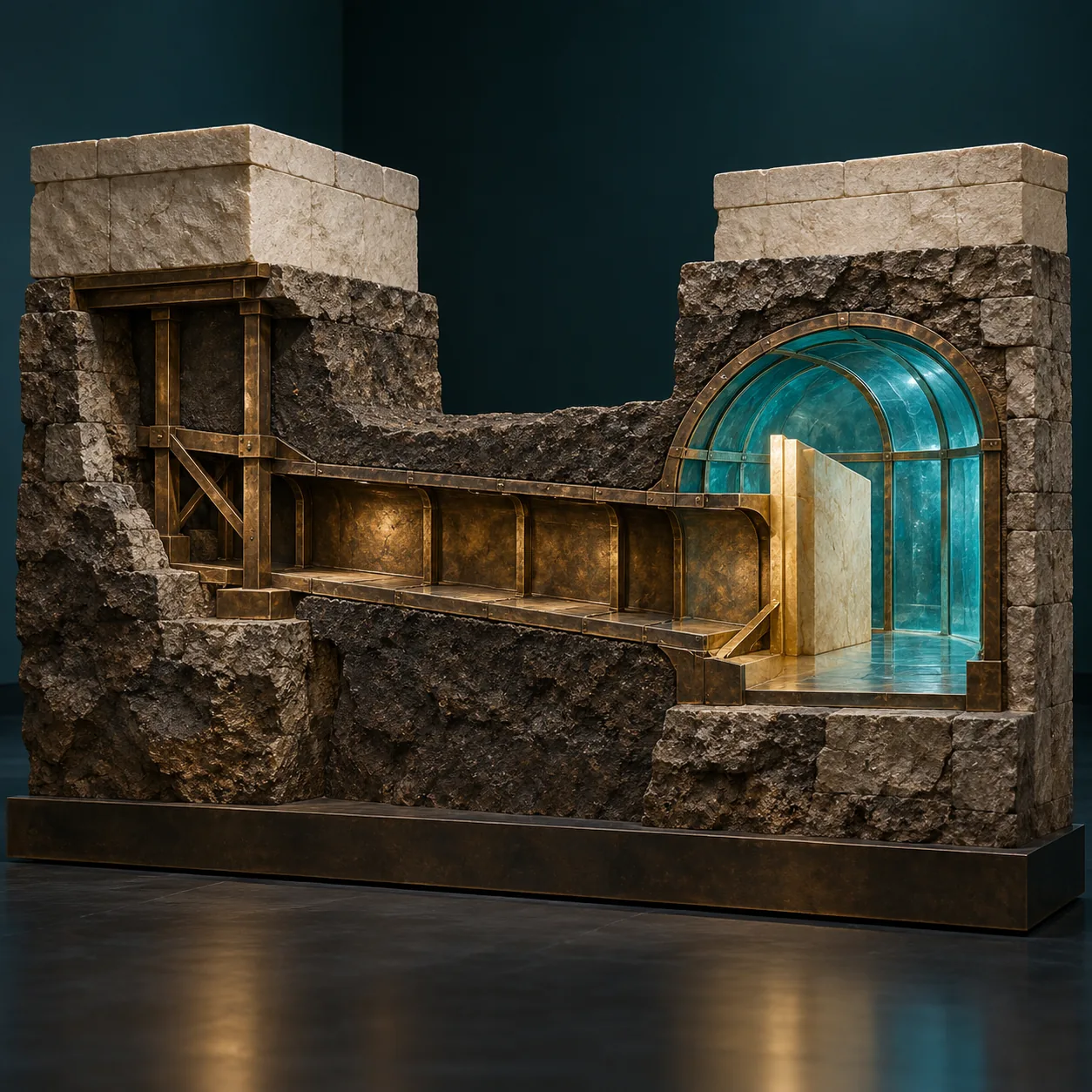
The answer is a tunnel from the pawnbroker's cellar to a bank vault. But the tunnel does not merely sit behind a comic disguise. The extravagant hiring ritual, the restriction on leaving the office, the cheap assistant, the copied pages and the abrupt dissolution all have a part in its construction. Doyle gives Holmes an absurd social invention and lets him recover the practical design inside it. As an ILE reading, the movement is unusually clear. Model A puts Ne, Ideas, at Base and Ti, Logic, at Creative; Model L names their forms Ne(T.) Ideation and Ti(N.) Intellect. Holmes first opens the peculiar arrangement to a different use, then works out the ordered relations that make that use intelligible.
A job whose product is absence
Wilson begins with the terms of the apparent job. An American benefactor, he is told, left money to support red-haired men. Wilson's vivid hair qualifies him. Hundreds of candidates crowd the street, and a manager pulls his hair to establish that its colour is genuine. The comic thoroughness gives the invention the look of an institution. Even the objection that Wilson is unmarried is ceremoniously considered and waived. There is an advertisement, a selection process, a workplace and a weekly payment. Each detail helps him accept that somebody really wants the copied pages.
Yet the condition that matters is his presence at the distant office. He cannot leave it even briefly without forfeiting the position. The task is so empty that he needs to supply his own ink and paper; the manager gradually stops attending. Wilson keeps coming because the money is real. His assistant, Vincent Spaulding, is free to work downstairs at the shop. The League is a purchased interval in another man's day.
Wilson is neither simply foolish nor merely greedy. Trade has been poor, the extra income is useful, and the arrangement leaves his profitable evening hours intact. He even reasons himself out of believing it before deciding to try. Doyle makes the trap effective by fitting it to an ordinary working life. Wilson has good reasons, from inside that life, to accept the offer. Holmes's first change of perspective is to treat the same reliable payment as an expense somebody willingly incurs for a different return. The supposed benefaction becomes the cost of keeping the proprietor away.

That is where Ne(T.) Ideation earns its place in this reading. The unusual offer is interesting to Holmes before he knows whether a crime exists. He is drawn to combinations life has produced beyond the expected script of a case. The opening conversation with Watson makes that appetite explicit: he asks for every detail because this sequence is unlike the thousands he can recall. Once Wilson finishes, Holmes sees that the £4 wage, the absurd copying and the prohibition on departure could all serve one unspoken purpose. He has changed the question from what the League says it does to what conditions its rules create.
From a possibility to an address
An ingenious guess would still leave most of the case unsolved. The assistant has arrived recently and accepted half wages. He has been willing to spend long periods in the cellar, ostensibly developing photographs. Holmes asks about his appearance, recognises signs of a criminal he has encountered before, and goes with Watson to Saxe-Coburg Square. There he knocks on the pawnbroker's door to see the assistant's trouser knees: they are worn, wrinkled and stained. He sounds the pavement with his stick. Then he walks around the block to find what lies behind the shop.
Those actions can look theatrical until the final explanation restores their order. If Spaulding has spent the paid hours below the shop, the wear on his knees matters. If he is digging, the direction of the cellar matters. The pavement tells Holmes the passage does not run forward. Behind the shabby square stands a busy commercial street, including the City and Suburban Bank. What appeared to Wilson as two separate environments—the quiet shop he owns and a grand bank he scarcely concerns himself with—becomes one continuous piece of ground. The culprit's work is intelligible only at that larger scale.
This is Ti(N.) Intellect serving the opening made by Ideation. Holmes can propose that the paid absence conceals work in the cellar; he then gives the proposal joints. The assistant's economic oddity, his dirty knees, the depth and direction of the foundations, the bank's position and the timing of the dissolved League must hold together. If the passage ran under the front pavement, if there were no valuable adjacent cellar, or if the assistant had had no hours to dig, the account would lose its shape. Doyle makes the spatial test visible to Watson while withholding its purpose. The reader sees each fact placed before seeing the structure they compose.

The neighbourhood itself contributes to the trick. Doyle contrasts the tired square with the commercial artery around the corner. The visual and social difference makes their physical adjacency easy to miss. Holmes does not let the contrast decide the map. He walks it. His knowledge of London is not ornamental erudition; it tells him how a concealed passage might join two worlds that appear unrelated at street level.
The case changes tense
The League closes on a Saturday. Wilson experiences the loss as a broken promise and arrives at Baker Street wanting to know who took away his income. Holmes hears an ending to the cover operation. If Wilson need no longer be kept out, the tunnel is probably finished. Its builders must move before discovery or removal of the bullion. Saturday gives them the following day as well. An apparently retrospective inquiry into a vanished employer has become an urgent account of what will happen that night.
Holmes does not announce all this to Watson. They visit the square, then go to hear Sarasate play. Watson sees his friend absorbed in music while the threat is already taking form. That interval resists a flat portrait of the detective as a relentless machine for practical action. Holmes's pleasure in an unusual problem is real; he later admits that such cases rescue him from boredom. But after the concert he arranges with Scotland Yard and the bank director to occupy the vault, while officers guard the shop. He has used the afternoon to complete the map, and he uses the evening to make a position from it.
The confrontation is built around the same interval Wilson sold without knowing it. Holmes waits in the dark cellar until the thieves break through the floor. His party can hear but must not reveal itself; the criminals have only one retreat, now covered at the other end. The route conceived to bypass the shop has been turned into a trap whose openings are known. Holmes's account has become an arrangement of bodies and timing without requiring him to explain it first to every participant. Watson waits, the director holds the place, the officers cover the exit. The conceptual structure has acquired a practical form.
Two inventions face one another
John Clay, the assistant, has invented the League. His accomplice poses as its manager. The crowded application, the hair inspection, the ridiculous copying, and the regular sovereigns are designed with considerable skill. At the arrest Holmes compliments the novelty of Clay's idea. That recognition prevents the story from becoming a simple display of a clever man seeing through dull men. The adversary is inventive too. His invention works on Wilson because he understands the proprietor's habits and finances, and because he gives his fiction the mundane reliability of paid employment.
Holmes's counterwork is distinct. Clay starts with the physical goal and engineers a social story that will clear the ground. Holmes starts with the social story and reconstructs the concealed physical goal. He reads a surplus of apparent meaning—the odd inheritance, the eligibility rules, the pages copied—as the carefully made surface of a simple requirement: Wilson must be elsewhere every morning. Ne-leading attention refuses to dismiss the extravagance as mere nonsense; Ti-creative articulation shows how each extravagance fits the requirement. The two men meet in the vault because Holmes has walked the fiction backwards into its structure.
Doyle lets Wilson leave the story with his pay and his grievance, neither of which is imaginary. The money bought him real mornings, and the dissolved League really did end them. What he could not see from inside the bargain was the value of his absence to someone standing beneath his shop. Holmes's achievement is to make that absent view present before the thieves act. A red-headed charity, a cheap employee, worn knees, a bank around the corner, a Saturday notice: separate oddities become the form of one undertaking. The case shows an ILE orientation at its most exact when possibility is followed far enough to disclose the architecture hidden inside an apparently ordinary week.