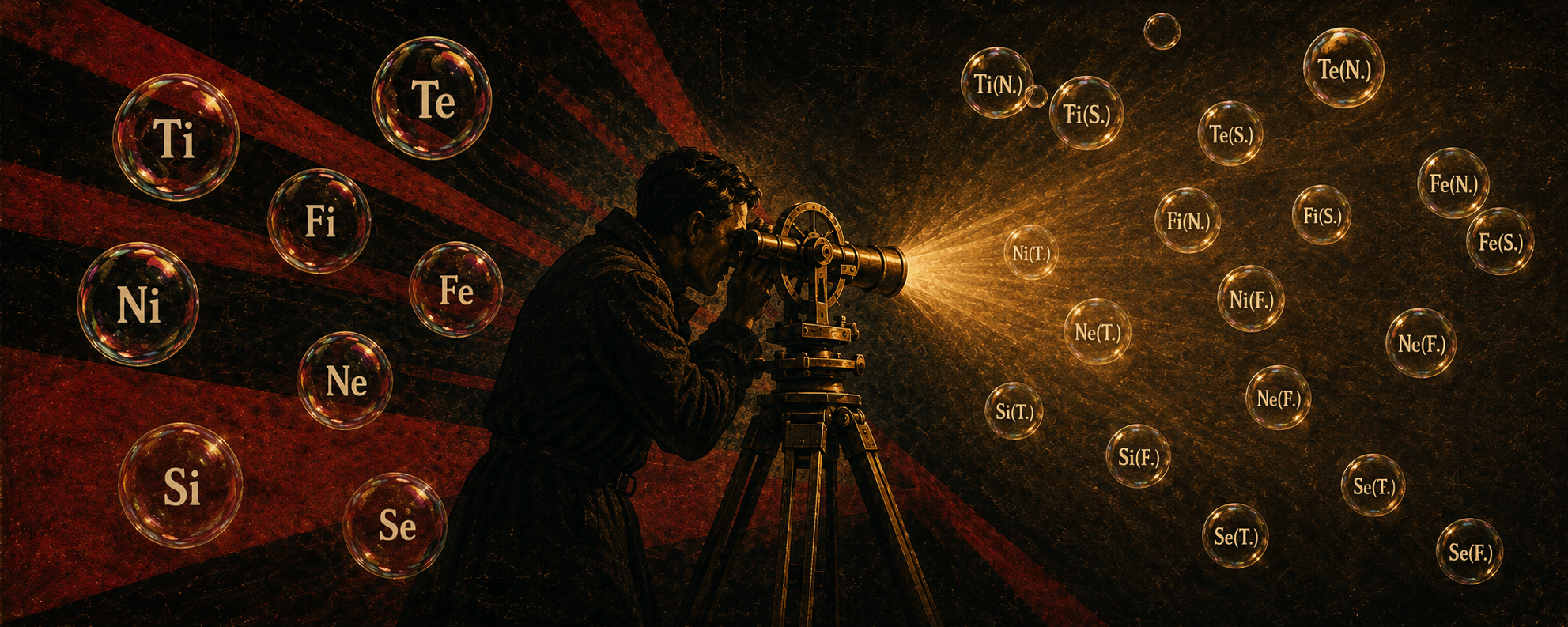
Conceptual Foundations
A separate home for short videos on the deeper shift beneath Model L: from stack positions to generated coordinates.
Open the foundations hubModel-L · Kimani White
Animae fines non invenies — “You will not discover the limits of the soul”Heraclitus, On Nature, Fragment 45
Kimani White's Model-L document presents a modern socionics extension of Model A: a sixteen-function layout that maps the full Reinin dichotomy space. Where Model A assigns eight information elements to eight functional positions, Model L divides each element into two sub-variants and adds eight radial positions — producing a richer account of how each type actually processes information.
A separate home for short videos on the deeper shift beneath Model L: from stack positions to generated coordinates.
Open the foundations hubA dedicated route through the prerequisites, bridge, monadic elements, capacities, dichotomies, typing use, and intertype reading.
Open the learning pathA compact reference for the codes, poles, positions, derived groups, and monadic element names used across the site and Explorer.
Open the glossary Open the source mapA focused drill for base values, A/D capacities, sub-variant rules, and exact Model L monadic element placement.
Open the practice drillOrigins
Model A gives socionics its foundational structure: eight information elements assigned to eight functional positions. For most analytical purposes this is sufficient. Kimani White's Model-L document argues that the familiar eight elements are not the fundamental endpoint: several Reinin dichotomies further subdivide them into sixteen monadic elements, one corresponding to each type. A Perceiving element carries the influence of a Judging quality — T. for the objective, detached influence of Logic; F. for the subjective, involved influence of Ethics. A Judging element carries the influence of a Perceiving quality — N. for the abstract, intuitive influence; S. for the concrete, sensing influence. The element's informational territory doesn't change. What changes is the character it takes on from its structural partner.
The solution was precise: subdivide each of the eight Model A elements into two sub-variants, one for each cross-influence. This produces sixteen monadic elements — the same eight elements of information, each now described with twice the resolution. The sub-variant notation makes the cross-influence explicit: Ne(T.) is Ne shaped by a logical, objective quality; Ne(F.) is Ne shaped by an ethical, subjective one. Ti(N.) is Ti shaped by an intuitive, abstract quality; Ti(S.) is Ti shaped by a sensing, concrete one. The full cross-influence argument, with worked examples, is on the Bridge page.
Model L does not replace Model A. It extends it. Every Model A type stack remains valid; Model L adds a second layer of resolution, specifying not just which element occupies each position but which sub-variant of that element — and therefore exactly how that position actually operates for that type.
One consequence matters especially for intertype relations: each Model A aspect resolves into two distinct monadic elements that stand in a Kindred relation to one another. A same-aspect match in Model A is therefore not automatically an exact monadic match in Model L. Sometimes it is exact; sometimes it is a same-aspect displacement into a different sub-variant, and the relation has to be read through the position where that exact monadic element actually lands.
Source baseline: Kimani White's Intro to Socionics establishes the Model A foundation behind this page: Perception and Preception, the eight information metabolism elements, and the eight functional positions. His Socionics: Model-L document then frames Model-L as a modern socionics layout: a sixteen-function extrapolation from Model A that extends the central functions with radial positions.

The 16 Elements
The sixteen monadic elements are the raw material of Model-L. Each derives from one of the eight Model A elements, distinguished by its sub-variant. The names below are Kimani White's own published descriptions. The type shown in brackets is the type for which this element serves as the Base — its most natural, archetypal expression.

Classical Element
One Model A element resolves into two concrete modes.

External Sensation: selective attention to functional sensory detail.

Involved Sensation: bodily vitality and charged physical experience.

Classical Element
Force separates into controlled leverage and visceral mobilisation.

External Drive: regulatory force used to shape the environment.

Involved Drive: somatic impulse converted into concrete exertion.

Classical Element
Temporal awareness separates into strategic implication and inner narrative.

Detached Insight: trends, implications, and likely development.

Internal Insight: narrative significance, subtext, and aspirational reflection.

Classical Element
Possibility separates into conceptual generation and personally vivid inspiration.

Detached Imagination: active generation and manipulation of concepts.

Internal Imagination: spontaneous impulses toward creative expression.

Classical Element
Structure separates into embodied form and abstract interpretative schema.

External Structure: embodied forms, disciplines, and codified habits.
Detached Structure: linguistic formatting and coherent conceptual framing.

Classical Element
Efficiency separates into fact-based strategy and practical experimentation.

Detached Application: facts, propositions, productive ends, and strategy.

External Application: methods, tools, resources, and physical workflow.

Classical Element
Personal relation separates into abstract values and visceral bonds.

Internal Character: ideals, convictions, and what is inherently worthwhile.

Involved Character: stable affinities, aversions, and concrete attachments.

Classical Element
Expression separates into physical affect and symbolic passion.

Involved Emotion: physiological mood and aesthetic emotional atmosphere.

Internal Emotion: passion, rhetoric, symbolism, and collective feeling.
External Sensation. A subject's controlled intake of external data, selectively focusing one's receptive sensory faculties and attention on functional details.

Involved Sensation. One's subjective experience of incoming bodily stimuli and physical vitality. Such experiences are usually charged with the subjective valences of somatic feelings.
External Drive. The regulatory leveraging of force to control and shape one's physical environment, bringing it into conformity with the bounds of circumscribed parameters.

Involved Drive. The generation of viscerally felt, mobilising somatic impulses which convert one's vital reserves into vigorous exertion towards specific, concrete aims.

Detached Insight. Nonverbal understanding of concepts and awareness of temporal trends. Insight into events in terms of their strategic implications and how they are likely to play out over time.

Internal Insight. Fantasising scenarios and aspirational daydreaming. One's inner reflection on the flow of events in terms of narrative significance and subtext.
Detached Imagination. The active generation and creative manipulation of concepts, as well as other uses of one's imaginative capacities to brainstorm and explore semantic possibilities.

Internal Imagination. One's inner sense of potentiality and spontaneous impulses for creative expression. Drawing upon previous experience to imagine novel ways of doing things, activities to explore, and other opportunities for personal growth.
NOTE for display: Ne(F.) describes a mode of engagement — personally vivid, involved, charged with significance — not a fixed subject matter. It can attach to any domain: science, music, craft, nature, mathematics, or people. The F. sub-variant specifies how the engagement feels, not what it is directed at.

External Structure. Embodied physical structures and codified behavioural habits. The tangible, defining forms of individual subjects, groups, objects and other organised systems.

Detached Structure. The linguistic formatting and interpretative schema of one's mind. Used to frame and articulate concepts into coherent, communicable ideas.

Detached Application. Informal logic and articulation of fact propositions. Uses of available data to figure out productive end goals and formulate workable strategies.

External Application. Informal methodologies and practical experimentation. The flexible use of hands-on techniques and material resources to improve the workflow of one's physical environment.

Internal Character. Inner values and ideals. The totality of one's foundational convictions, moral inclinations and abstract notions of what is inherently worthwhile in life.
Involved Character. Volitive preferences and relational bonds. The totality of a subject's stable, visceral attitudes of affinity and aversion towards particular individuals and concrete objects of experience.

Involved Emotion. Physiological moods and expression. The physical conveyance of somatic feelings that mediate sensory experiences through aesthetic signals, creating atmospheric vibes.

Internal Emotion. Inner opinions and passions. Deeply felt emanations of emotion which are conveyed through dramatic rhetoric and symbolic gestures, often inciting others to feel and act accordingly.
Capacity Groups
Model L organises its sixteen positions into four capacity groups — A, B, C, and D — each containing four positions. The capacity groups describe the psychological relationship a type has with its positions: how naturally they operate, how much conscious effort they require, and how the type experiences them.
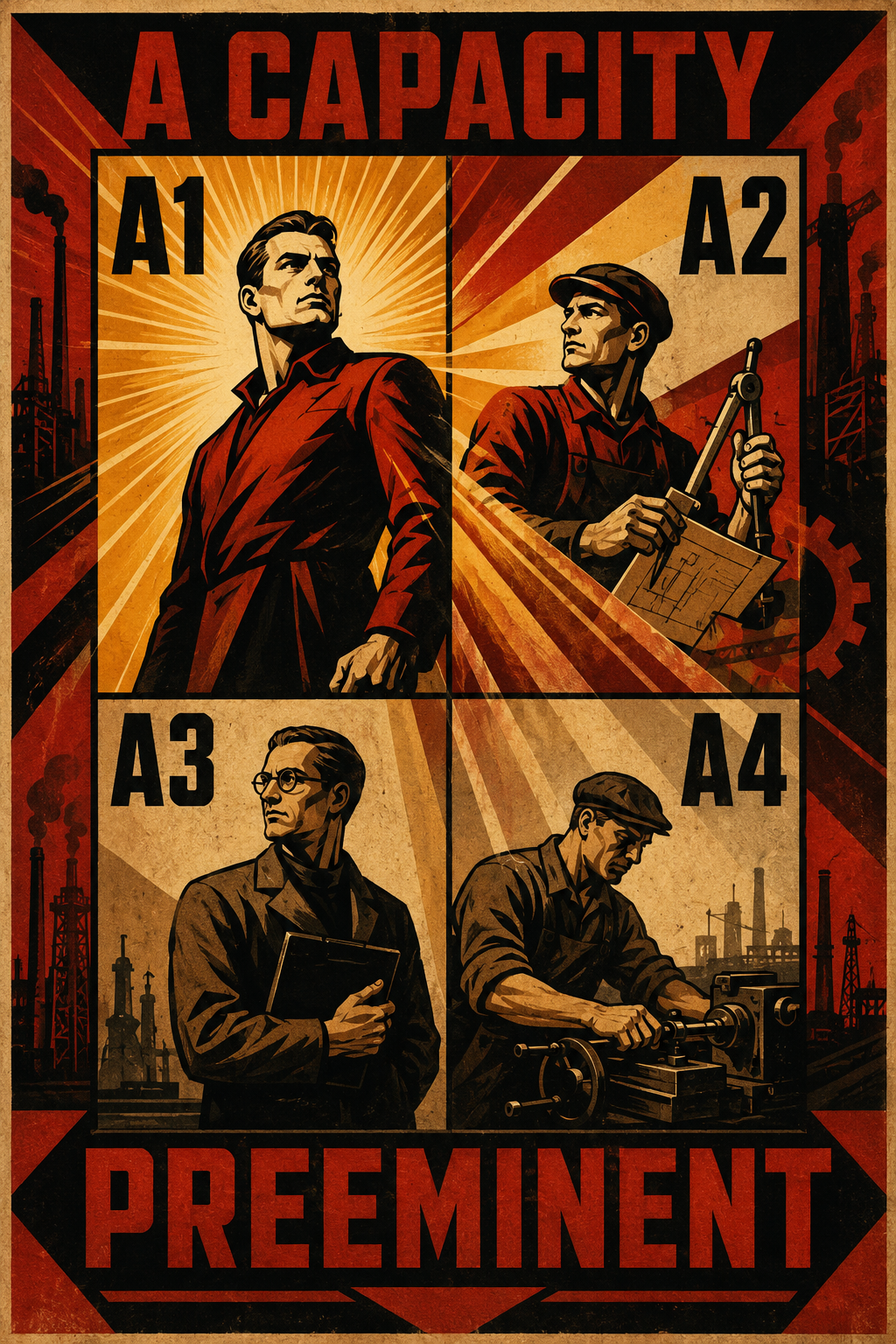
The A capacity contains the type's most natural and automatic positions. The Base (A1) is the leading element — the type's primary mode of engaging with the world, operated with effortless confidence. The Creative (A2) is the tool the Base deploys: flexible, inventive, responsive. The Ignoring (A3) and Demonstrative (A4) operate in the background — competent and available, but deployed selectively. All four A positions share the same rational or irrational club orientation, whether Judging or Perceiving depending on the type.
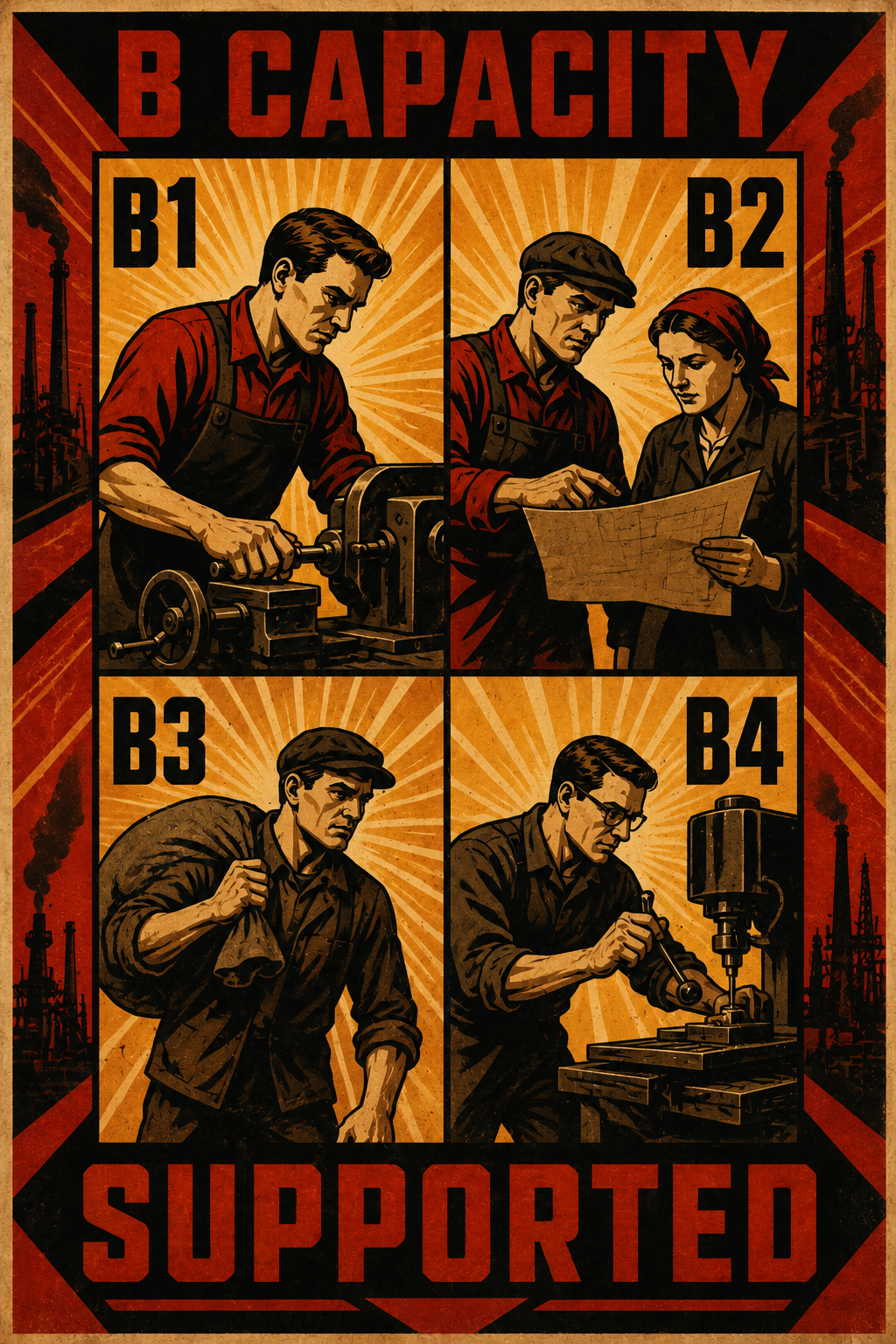
The B capacity shares the same rational or irrational club orientation as A. Where A operates automatically, B operates as auxiliary support — the type can perform these positions reliably but with more deliberate attention. B positions feel structurally familiar: they belong to the same club as A, so their informational territory is a continuation of the type's leading orientation. They are not effortless but they are not alien.

The C capacity takes the opposite club orientation to A — if A is rational, C is irrational, and vice versa. These positions operate as contributive background support from the contrasting informational territory: the axis the type does not lead with. C positions are radial functions, easier to maintain than the D positions, but usually filtered through the type's foreground A and B material.
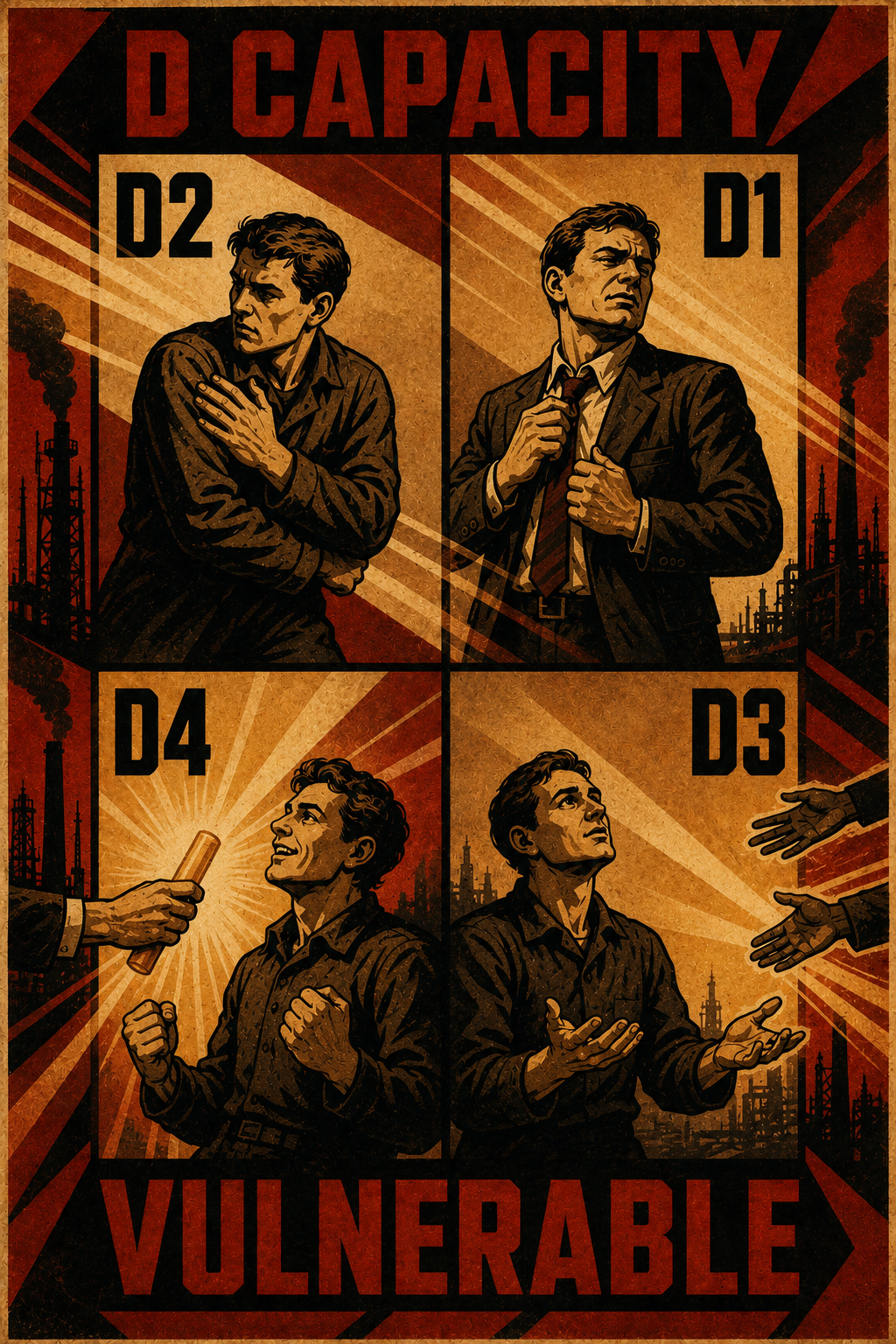
The D capacity is the inferior counterweight to A. It contains the type's Vulnerable position (D2) — the point of greatest sensitivity, where criticism lands hardest and excessive demands produce stress. It also contains the Suggestive (D3) — what the type most needs and responds to most powerfully when it appears in others — and the Mobilising (D4), which energises and uplifts. Inferior does not mean worthless; it names the background-resistant region where strain, need, and interpersonal complementarity become most visible.
A critical precision: B shares the Rational (J) club with A when A is Rational, and the Irrational (P) club with A when A is Irrational. C always takes the opposite club to A. This means the A and B capacities always draw from the same club, while C and — in a different way — D provide the contrasting element domains. This rule was confirmed by Kimani White directly and is essential for correctly reading any Model L cross.
Kimani White and Aleesha Lowry's later Socionics Tweaks document frames A and B as the type's foreground facet, and C and D as its background facet. In that framing, B is the auxiliary "right-hand" of A, while C is background material that can be used more readily than D but tends to be expressed through the foreground perspective.
Model-L Functions
Kimani White's Socionics: Model-L does not move straight from four capacities to sixteen isolated positions. The functions are also paired into eight named blocks. This layer matters because each block describes how two neighbouring positions cooperate: where one position sets a frame, supplies a tool, diverts attention, or dovetails with need.
The four central blocks preserve the Model A bridge: Leading, Trailing, Diverting, and Dovetailing. The four radial blocks are the genuinely Model-L additions: Consultative, Delegative, Correlative, and Supportive. Together they make the sixteen-position cross easier to read as paired machinery rather than as sixteen separate labels.

A1 Base + A2 Creative
The main world-interface: the type's leading centre and its flexible means of producing from that centre.

A3 Ignoring + A4 Demonstrative
Strong central material that trails behind the leading orientation: capable, available, and often taken for granted.

B1 Correspondent + B2 Collaborative
Foreground radial support that consults with the central orientation: visible, useful, and effortful to sustain.

B3 Compensatory + B4 Instrumental
Foreground radial material that can be delegated into service: compensating for gaps and supplying workable instruments.

C1 Subsidiary + C2 Negligent
Background radial material that correlates with the type's field from the opposite club: easy enough to run, but rarely central.

C3 Prompting + C4 Galvanizing
Background radial support that gives cues and momentum: prompting movement and galvanising output without becoming the centre.

D1 Role + D2 Vulnerable
The overt inferior block: a place of diversion, strain, exposure, and defensive effort around low-resource central material.

D3 Suggestive + D4 Mobilizing
The receptive valued inferior block: what dovetails with the Base from outside and becomes crucial in duality, need, and growth.
This block layer is easy to miss because the individual position names are memorable. But the paired block names are doing real work: they show why B1 belongs with B2, C3 belongs with C4, and Suggestive belongs with Mobilizing rather than floating alone as a generic "weak spot."
Model L Dichotomies
The four capacities are only the first layer. Model L also reads the sixteen positions through fifteen structural dichotomies. Each dichotomy divides the cross into two poles: Central or Radial, Foreground or Background, Explicit or Implicit, and so on. When two or three of these dichotomies are combined, they generate the named fourfold lenses used in the Explorer: Capacity, Vergence, Current, Ensemble, Array, Interest, and Occupation.
Several of these names deliberately preserve Kimani's updated Model A function vocabulary. Salient and Tangential, Governing and Compliant, Engrossing and Attendant, Primary and Ancillary, and Necessitating and Supplying all begin as Model A position dichotomies before Model L expands them into fourfold readings of the sixteen-position cross.
Model A AnchorCapacity expands Strong / Weak; Vergence expands Mental / Vital; Current expands Valued / Unvalued; Ensemble expands Accepting / Producing; Array expands Inert / Contact; Interest separates Bold / Discreet and Pertinent / Incidental; Occupation expands Evaluatory / Situational.
The animation below cycles through all fifteen dichotomies. Gold marks one pole, crimson marks the other. The point is not to memorise every label immediately, but to see that each Model L position is built from repeated structural splits rather than from a loose list of traits.
Position Dichotomies
The sixteen positions can be viewed through a sequence of dichotomies. Each lens below recolours the cross, showing which positions share a structural pole and how paired dichotomies generate the named fourfold groups.
The Cross
The Model-L cross represents all sixteen monadic element positions for one type, arranged as four capacity groups: A, B, C, and D. Each position carries an element notation, a position name, and a sub-variant, so a type profile is read through the whole cross rather than through the eight Model A functions alone.
The A and D capacities preserve the familiar Model A bridge: Leading, Creative, Role, Vulnerable, Suggestive, Mobilizing, Ignoring, and Demonstrative. The B and C capacities are radial positions derived inside the sixteen-position cross rather than direct Model A functions.
Each card below gives the position name, its source capacity, dimensionality, priority, and the main structural reading used by the original reference tool. The interactive Explorer lets you compare the full cross across all sixteen types.
Central, foreground, and facile. This is the type's most equipped and most attended-to position: the leading pattern through which the type naturally processes reality.
The Base is the position of maximum capacity and maximum relevance. It is not just a strength but the type's default way of making sense of things: confident, immediate, identity-forming, and difficult for the person to step outside of.
Central, foreground, and facile. This position supports the Base with capable, flexible production, but with less total reach and priority than A1.
The Creative is the active instrument of the Base. It is highly usable and usually confident, but it serves the lead rather than replacing it. It improvises, translates, and applies the Base orientation into movement.
Central, foreground, and facile, but low priority. It is highly capable yet barely attended to, running as a strong background competence rather than a valued focus.
The Ignoring position can handle its material, often better than the person cares to admit, but it is treated as nonessential. It is a capable bypass: available when necessary, then quickly dismissed because it does not feel worth centring.
Central, foreground, and facile. It has full dimensionality but only moderate priority: powerful, automatic, and often expressed without becoming the centre of attention.
The Demonstrative is a strong automatic resource. It may appear impressive from outside, but the type rarely treats it as a project. It demonstrates, supplies, or proves a point, then returns attention to what is more personally relevant.
Radial, foreground, and resistant. It sits close to awareness as a ready liaison to the Base: capable and fairly confident, but tiring to hold in focus for long because it runs against the type's main metabolic flow.
The Correspondent function answers the Base from the radial side. It can correspond, translate, and keep pace with the lead orientation, but it does so with more friction. It is useful and fairly competent, yet not the place the psyche wants to live.
Radial, foreground, and resistant. It is taken seriously and can direct B1 once engaged, but it has less native facility than its priority suggests. It therefore often welcomes feedback, cooperation, or constructive support.
The Collaborative function is foreground and important, but not fully self-sufficient. It wants to be worked with. Pressure here is felt openly because the type recognises the area as relevant while also sensing that outside input can complete what it cannot easily finish alone.
Radial, foreground, and resistant. It is engaged in short, necessary bursts to shore up weaker areas and make B4 more available. It is not usually dwelt on, but it can receive more careful use than Ignoring.
The Compensatory function is used to make up for imbalance. It is not effortless, but it is important enough to be called upon when the system needs correction, backup, or stabilisation. It often appears as a deliberate patch rather than a natural centre.
Radial, foreground, and resistant. It is strong, confident, and often automatically useful while attention stays elsewhere. It is not valued as an end in itself, but it is a reliable tool in service of favoured ends.
The Instrumental function is a tool-bearing support. It can be competent and productive, but its importance is practical rather than central. The type uses it to get something done, especially when another preferred aim requires it.
Radial, background, and facile. It is easy enough to use, but its work is often subsumed by the Base because it shares the same phase and polarity while lacking the same value status. It supports the agenda rather than setting it.
The Subsidiary function assists from the background. It can run smoothly and intelligently, but it is folded into the Base agenda rather than experienced as a separate mission. It supplies useful material while remaining subordinate to the lead orientation.
Radial, background, and facile. It is easier than Vulnerable, but it can still be handled with careless indifference because the type does not usually treat its expression as important for its own sake.
The Negligent function is background-easy but under-attended. It may be available enough to use, yet the type can fail to notice when it needs refinement. It is less helpless than the Vulnerable, but more liable to casual omission.
Radial, background, and facile. It is analogous to Suggestive but less helpless: it can provide background feedback, prompt the Base field, and direct access to its stronger C4 partner.
The Prompting function gives cues rather than command. It nudges attention, supplies hints, and helps the psyche notice what would support movement, but it remains background material. It is receptive and useful without becoming the central desire of the Suggestive.
Radial, background, and facile. It has more mastery than Mobilizing and can rev up the Creative function from behind the scenes. It often comes forward when another person requests the Collaborative function.
The Galvanizing function energises from behind the scenes. It can bring motion, confidence, or activation to the system without needing to become the main focus. It often awakens when another person draws on the related Collaborative material.
Central, background, and resistant. This is the socially performed role pattern: usable, but effortful and not a preferred centre of gravity.
The Role function is a necessary performance. The type can enter it when the situation demands, especially for social or contextual adequacy, but it feels managed rather than owned. It is a costume of competence, not a home base.
Central, background, and resistant. The source tool marks this as minimum dimensionality and minimum priority: the least equipped and least accessible point.
The Vulnerable function is both structurally central and poorly resourced. Demands here can feel exposing because the type has little flexible capacity and little natural appetite for the field. It is a point of sensitivity, not simply ignorance.
Central, background, and resistant. It has low dimensionality but high priority, creating the Super-Id pull: strongly wanted, but difficult to generate independently.
The Suggestive function is wanted more than it is mastered. It has a strong pull because the psyche recognises its value, but it is difficult to produce with confidence. Help here can feel unusually relieving, nourishing, or convincing.
Central, background, and resistant. It has moderate dimensionality and maximum priority: an energizing desire that motivates growth and responds strongly to outside support.
The Mobilizing function is a growth engine. The type is highly responsive to it and often wants to develop it, but the process can be uneven. Encouragement here activates energy, aspiration, and forward motion.
Function Rankings
Kimani White and Aleesha Lowry's later Socionics Tweaks material makes the 4D / 3P notation more explicit by separating facility, attention, and need for outside support.
Aptitude is dimensionality: how much facility the type has with a position. The levels run from 4D masterful use through 3D proficient, 2D adequate, and 1D poor or draining.
Priority is attentional weight: how much a position matters in judgement and decision-making. The levels run from 4P paramount through 3P relevant, 2P discretionary, and 1P trivial.
Demand is priority minus dimensionality. A positive demand score means the position matters more than the type can easily supply on its own, so help from others becomes especially meaningful.
| Demand | Positions | Reading |
|---|---|---|
| +2 | D3 Suggestive, D4 Mobilizing | High need: strongly important but not independently easy. |
| +1 | B2 Collaborative, B3 Compensatory, C2 Negligent, C3 Prompting | Moderate need: worthwhile enough to invite support, correction, or prompting. |
| 0 | A1 Base, A2 Creative, D1 Role, D2 Vulnerable | Balanced priority and facility: either well supplied, or not strongly sought. |
| -1 | B1 Correspondent, B4 Instrumental, C1 Subsidiary, C4 Galvanizing | Surplus facility: more capable than prioritised, often usable as support material. |
| -2 | A3 Ignoring, A4 Demonstrative | Strong surplus facility: powerful but not treated as a central concern. |
The Relationship

Model-L is built on Model A's foundations and cannot be read without them. The function stack, block structure, quadra membership, club, and temperament of any type are all Model A concepts that Model-L inherits unchanged. What Model-L adds is sub-variant resolution — the T./F. and S./N. distinctions that specify exactly which mode of each element a type leads with in each position.
A type described in Model A terms is not incomplete; it is described at a different level of resolution. Model A tells you that LII leads with Ti and supports it with Ne. Model-L tells you that LII's Ti is specifically Ti(N.) — Intellect, the detached linguistic schema of the mind — and that their Ne is Ne(T.) — Ideation, the architecturally directed generation of conceptual structure. The extra resolution matters when distinguishing LII from LSI, or ILE from IEE, in cases where leading element alone does not settle the question.
For a full comparison of how the two frameworks approach each type, see the Bridge section.
The BridgeAttribution

Model-L was developed by Kimani White and Aleesha Lowry, beginning in late 2018 through collaboration on the WSS diagnostic team.
Primary sources:
— Kimani White, Socionics: Model-L (presentation document)
— Kimani White, "The 16 Elements of Socionics (Model L)", Simple Socionics, July 2025
— "Introducing Model L with Kimani White", YouTube interview with Jack Aaron, September 2025
This site presents Model-L for educational purposes only. It is not affiliated with Kimani White, Aleesha Lowry, or the World Socionics Society. All interpretation is the author's own. Errors belong to the site.
Full credit to Kimani White for the Model-L framework.