
TetraTypes now has a small public database of famous people typed as Socionics hypotheses. That word matters. A public figure profile is not a verdict about the person. It is a structured claim about the available evidence.
There is an obvious temptation in any typology project: collect names, attach labels, and let the list feel like proof. Famous people make that temptation stronger because they already function as cultural shorthand. If someone says "Alan Alda" or "Audrey Hepburn" or "Albert Einstein", a whole public image arrives before the evidence does. The person has become a convenient handle. The type label can then become a second handle. Two simplifications stack on top of one another, and suddenly the human being has been reduced to a tidy index card.
That is the danger. But it is not the whole story. Used carefully, a database of public type hypotheses can also solve a real teaching problem. Socionics is abstract. It asks learners to think in terms of information metabolism, values, function positions, quadras, intertype structure, and recurring attentional patterns. Those ideas become easier to grasp when they are anchored to concrete examples. Not because the examples prove the system by themselves, but because they give the learner a place to ask: what kind of evidence would make this typing stronger? What would count against it? Which behaviours are merely public persona, and which patterns recur across different settings?
Why examples help
Type descriptions are necessary, but they can become circular. An ILE is described as exploratory, therefore exploratory people look ILE; exploratory people look ILE, therefore the description feels true. Real examples interrupt that circle. A good profile has to show its work. It has to say which sources were used, which traits are being treated as evidence, which rival types were considered, and why the final hypothesis explains the pattern better than the alternatives.
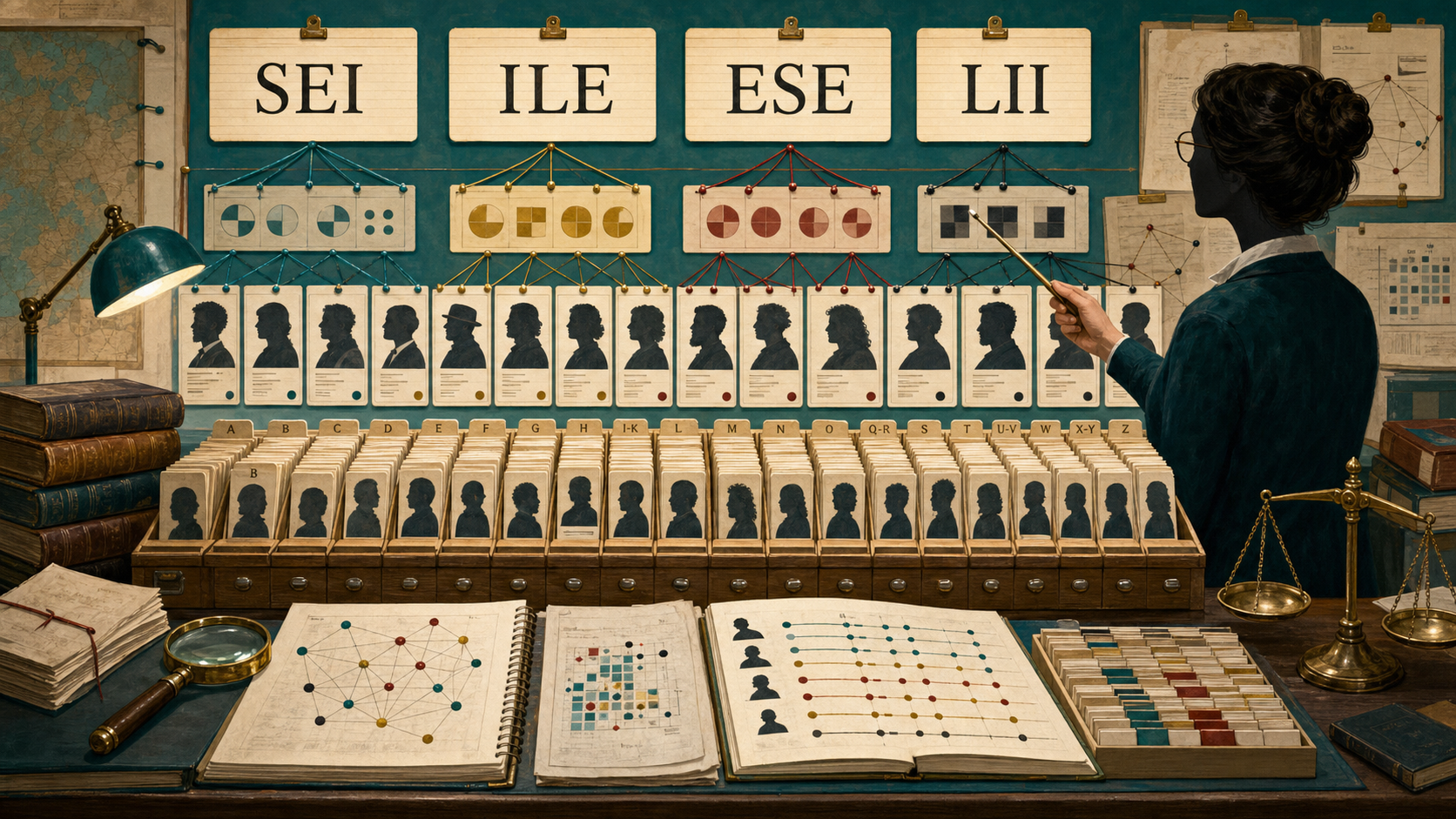
A database also makes comparison easier. One profile teaches a single argument. Several profiles let readers compare arguments across types. What keeps showing up in Delta profiles? What differs between an ILE hypothesis and an IEE hypothesis when both people are imaginative, verbal, and publicly charming? How do we separate performance style from information metabolism? The value is not in memorising famous-person labels. The value is in watching the reasoning become explicit.
That is why the TetraTypes database keeps the complete analysis visible rather than hiding it behind a neat type badge. The type code is the least interesting part of the entry. The interesting part is the chain of reasoning: sources, evidence, rival explanations, confidence, and uncertainty. If the evidence is thin, the profile should feel thin. If the evidence is strong but still indirect, it should remain a hypothesis. Public typing should never borrow the emotional certainty of a diagnosis.
The strongest argument against it
The strongest objection is ethical and epistemic at the same time: we do not know these people. Even when the sources are good, they are usually public performances, interviews, biographies, edited appearances, remembered anecdotes, and work products. That is not nothing. Public evidence can be rich. But it is not the same as knowing someone's inner life, long-term relational pattern, private stress response, or full developmental history.
There is also a special danger with fame. Famous people are unusually legible because they have been made legible. They are branded, edited, mythologised, defended, attacked, and repeatedly narrated. A performer may be typed from a persona. A politician may be typed from rhetorical strategy. A scientist may be typed from intellectual product rather than psychic metabolism. A musician may be typed from artistic atmosphere. These are useful clues only when treated as clues. They become misleading when treated as direct windows into structure.

The database therefore has to resist its own format. Lists imply certainty. Tables imply authority. Search filters imply that a person has been sorted. To use a database ethically, the page has to keep reminding the reader that the entry is a conjectural hypothesis based on public-domain evidence. It should invite revision rather than fandom wars. It should make disagreement productive by showing exactly where the argument depends on interpretation.
How to read the entries
The best way to use the database is not as a scoreboard of "who is what type". Read it as a library of worked examples. Start with the sources. Notice the repeated patterns. Look for alternative explanations. Ask whether the typing is doing real explanatory work or merely matching a public stereotype. If a profile says someone is SEI, the useful question is not "Do they seem cosy?" It is: does the evidence suggest a stable pattern of valued Si and Fe, with the expected strengths, vulnerabilities, and relation to other information domains?
That discipline matters because Socionics is at its best when it increases perception rather than replacing it. A type hypothesis should make a person more interesting, not less. It should reveal tensions, trade-offs, recurring preferences, and limits in the evidence. If the label makes the person feel smaller, the label is being used badly.
So yes, I think a famous-people database can help people understand Socionics better. But only if the database is built against the lazy version of itself. It needs sources. It needs complete analysis. It needs uncertainty. It needs to keep the person in view, not just the type. The aim is not to put famous people in boxes. The aim is to make the box visible enough that we can ask whether it fits, where it fails, and what the evidence actually supports.
That is the spirit of the new Famous People database. It is a public set of hypotheses, not a court of final appeal. Treat it as a workshop: useful when it sharpens observation, dangerous when it starts doing your thinking for you.