A machine can be read from its parts. The motor is intact; two shafts turn; the brass cam lifts a lever; the frame remains square. Each present component contributes a fact. Name enough of them and a working chain begins to appear.
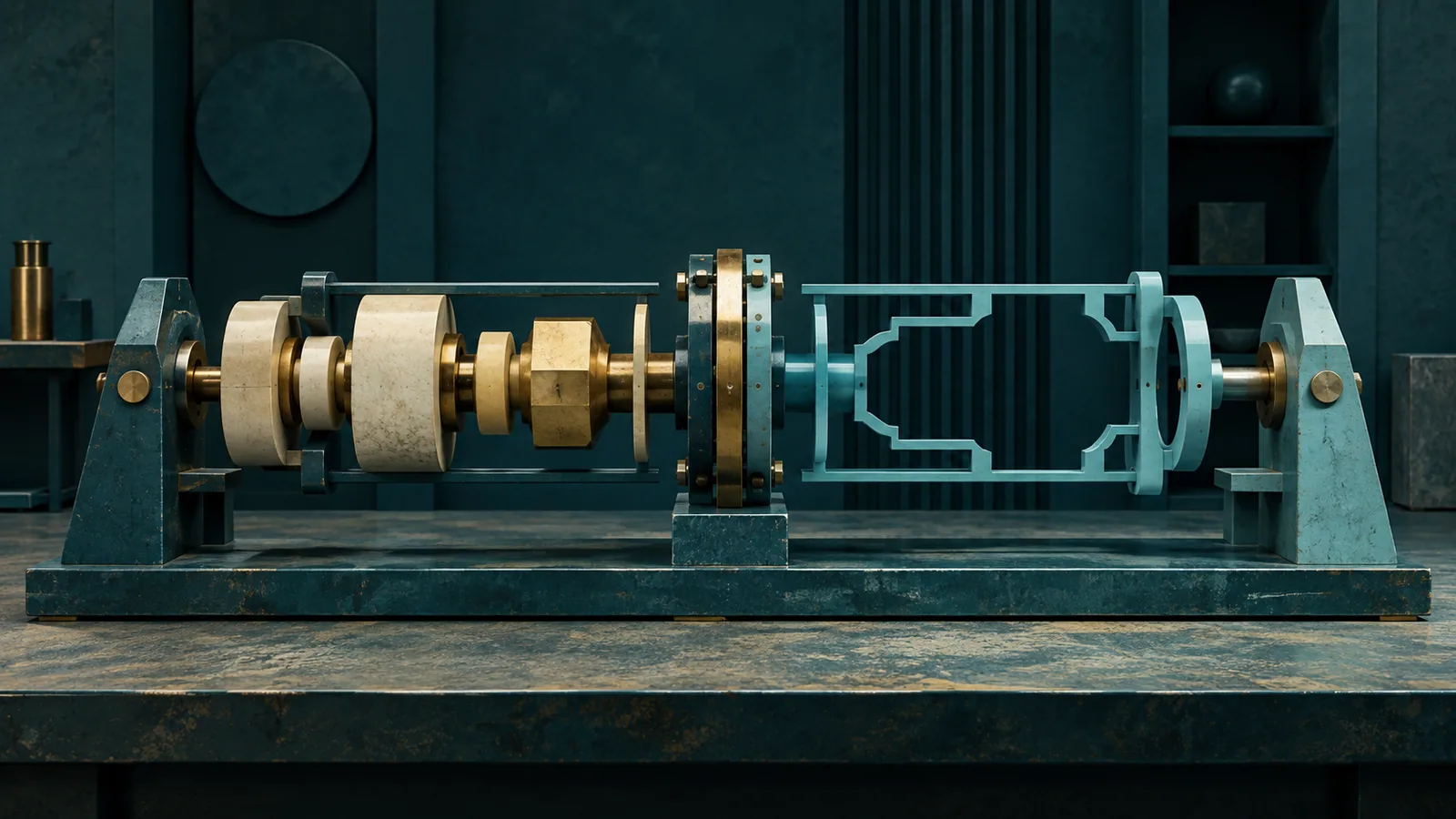
The same machine can be read from its gaps. A polished bearing carries no load. Two drilled plates face one another without a pin. A lever completes its stroke and meets nothing. The empty interval is not a blank in the evidence. Its size, position and consequences describe the part that should have been there.
The Reinin dichotomy usually called Positivism and Negativism gives Socionics a language for this difference. Its everyday names invite a shallow reading about sunny and gloomy temperaments. The more exact account concerns how a situation is formed as an object of attention. Positivist attention begins from associated properties: what exists, holds and can be affirmed. Negativist attention gives equal substance to non-associated properties: what is missing, excluded or unable to occur. One builds an inventory of presence. The other discovers that an absence can have a structure.

Two descriptions of the same object
The most useful source is the Dynamic Socionics Center’s study of the Reinin dichotomies, conducted under Vladimir Mironov and preserved in English translation by Wikisocion. Its strongest move is to set optimism and pessimism aside. A Positivist description denotes properties associated with the object. A Negativist description denotes properties that do not pertain to it. The researchers illustrate the difference with two sentences about shortcomings: one states that several shortcomings are present; the other says that their absence cannot be asserted. Both descriptions are critical. Their logical surfaces differ.
The study then proposes a deeper memory hypothesis. Positivists may retain events that occurred more readily, while Negativists may retain events that failed to occur. In the latter case, the source says, the absence “constitutes an event in itself”. That phrase deserves to be taken literally as an interpretive possibility. The missed train, the reply that never came, the safety check nobody performed and the promised component omitted from a machine can organise a situation as decisively as a visible occurrence.
These observations belong to a specific Socionics research tradition; the local Reinin drill translates its two poles into the structural names Affirmer and Denier. The formal Reinin scheme derives this division from the E/I, T/F and J/P foundations. The mathematical partition tells us which eight types fall on either side. Mironov’s study supplies a proposed content for the partition. TetraTypes’ Affirmer/Denier vocabulary brings the informational act to the foreground: one asserts the object through what belongs to it; the other bounds it through what does not.
This is not a scale from trust to suspicion. A Denier can notice the absence of a defect; an Affirmer can state the presence of a disaster. The polarity concerns the grammatical and attentional form in which the object first becomes graspable. What is there? What is not there? Both questions can produce good news, bad news or an exact technical description.
Shared elements, reversed priority
The contrast becomes sharper when two closely related types do the work. The LIE and ILI are both Gamma NT types. Their Ego blocks contain the same two Model A information elements, Te and Ni, in reversed order. They are also a Mirror pair: familiar machinery is present on both sides, but one function establishes the agenda while the other serves it.
For LIE, Te is Base and Ni is Creative. In the site’s Model L vocabulary these positions are Te(N.) Reason and Ni(T.) Apprehension. The LIE begins with articulated causal and productive relations: which facts hold, what the parts can do, what follows from the available evidence. Temporal apprehension extends that reasoning into consequences and trajectories. The local Reinin map places LIE on the Affirmer side.
For ILI, Ni is Base and Te is Creative: Ni(T.) Apprehension leads, while Te(N.) Reason gives the perceived trajectory an explicit causal account. The ILI begins with the configuration of unfolding events: where the process is tending, where continuity breaks, which expected consequence never arrives. Te then explains the gap. The local map places ILI on the Denier side.
It would be too neat to claim that the reversed Ego order causes the Reinin polarity. The classification is a separate structural partition. The pair is valuable because it controls so much of the comparison. Both types work with the same Gamma NT material, both can reason from facts, and both can track consequences through time. What changes is the opening grip on the object. The LIE finds the operative chain that is already available. The ILI finds the absent condition without which the chain cannot become what it appears to be becoming.
The signal-box demonstrator
Imagine a railway museum rebuilding a mechanical signal-box demonstrator. The frame survived in storage, along with several levers, a tray of brass fittings, two lengths of rodding and photographs taken before the exhibit was dismantled. The original assembly notes are gone. The museum wants one working route: pull a lever, set the points, clear the signal, then prevent an unsafe second movement. Opening day is six weeks away.
The LIE begins at the bench. The lever frame is sound. The surviving rodding can reach the points. Three fittings match holes visible in the photographs. A modern microswitch can replace a vanished electrical contact without altering the public mechanism. Te(N.) Reason turns these present facts into a programme: assemble the demonstrable chain first, measure the loads, commission the missing ordinary hardware, and use the first successful movement to settle what the exhibit can credibly promise. Ni(T.) Apprehension supports the programme by projecting lead times and identifying which decisions will close later options.
This is more than cheerfulness about making do. The LIE’s first object is a chain of actual affordances. Each confirmed component reduces uncertainty because it can already bear a relation to the next. The restored exhibit takes shape through propositions that can be stated positively: this lever moves; this rod reaches; this substitute meets the load; this order of work can finish by opening day.
The ILI watches the same first movement and stops at the moment of apparent success. The points change and the signal clears. Yet nothing prevents the second lever from clearing an opposing signal. In the photographs, a shadow between two locking bars has no surviving counterpart. Wear on one bar ends abruptly where no part now touches it. The missing interlock is not merely another item for the purchasing list. Its absence changes the identity of the whole apparatus. Without it, the machine demonstrates motion while failing to demonstrate signalling.
Ni(T.) Apprehension begins from that broken trajectory: after the first route clears, the unsafe second movement remains possible. The exhibit is heading toward a convincing falsehood. Te(N.) Reason then reconstructs the absent condition from hole spacing, wear marks and the logic of mechanical interlocking. The ILI can specify what the missing piece must prevent before anyone knows its original shape. The negative fact—the forbidden movement is not forbidden—becomes the most informative event in the room.

The disagreement is productive because both readings are exact. If the team follows absence alone, the project may remain a magnificent diagnosis on an empty bench. If it follows presence alone, it may finish a machine that turns while misrepresenting the principle it was built to show. The LIE gives the restoration an operative sequence. The ILI identifies the condition that makes the sequence truthful.
An audit with two inventories
Taken seriously, Affirmer and Denier attention suggest a practical discipline for analysis. First write the present inventory without apology: working parts, available evidence, actions already possible, relations that demonstrably hold. Then write the absent inventory with equal precision: expected replies that never arrived, constraints that fail to bind, dependencies with no owner, transitions whose necessary condition is missing.
The two lists are not mirror-image moods. They answer different questions about the object. An Affirmer account shows what reality has supplied and how those supplies can be composed. A Denier account gives contour to the counterfactual structure already exerting pressure on the situation. In the signal box, the empty space between locking bars is not nothing. It is the place where the museum’s claim about safety either becomes true or collapses.
This is the larger contribution of the Reinin distinction. Information does not enter thought only as a collection of positive items. A system can announce itself through its missing term. A promise can organise a relationship by going unkept. A failed transition can disclose the rule that ordinary success concealed. Negation is capable of building an object.
LIE and ILI make the contrast especially legible because neither is confined to one side of the evidence. Both possess Te(N.) Reason and Ni(T.) Apprehension in their Ego blocks. Both can name facts and follow trajectories. But the leading question changes the order of discovery. The Affirmer asks which present components already compose a route. The Denier asks which absent condition explains the route’s failure. Between them, the machine gains both a working chain and the missing joint that makes its work mean what it claims.
Source layers: the Dynamic Socionics Center’s Reinin study supplies the associated/non-associated property distinction and the hypothesis of absence as an event; the formal Reinin overview supplies the E/I × T/F × J/P derivation. The local Reinin drill, LIE page, ILI page and Mirror reference supply the structural mapping. The signal-box restoration and the two-inventory audit are TetraTypes editorial synthesis.