TetraTypes Blog ·
The Beetle, The Stream, And The Map
Socionics as a philosophy of information.
Starting Point
What Counts As Information?
Socionics is usually introduced as a theory of personality types. That is not wrong, but it is not the most interesting starting point. Before Socionics says that one person is ILE and another is SEI, it makes a more basic claim: conscious life can be divided into different kinds of information.
That claim is philosophical before it is typological.
It asks: what counts as information? Is information something public and measurable, like a result, a force, a temperature, a visible action? Is it something inwardly registered, like comfort, fear, affinity, memory, symbolic implication, or personal meaning? Is it a stream of perception before judgement has been made? Or is it already organised by concepts, values, categories, and decisions?
Model A gives us eight information aspects: Ne, Ni, Se, Si, Te, Ti, Fe, and Fi. But these eight aspects are not eight unrelated boxes. They are generated through repeated ways of dividing the informational world.
A Working Display
The Aspect Dichotomies
The following table is a working display of basic aspect-level cuts. It is not a moral hierarchy. External does not mean real while internal means imaginary. The point is not to divide the world into good and bad evidence, but to show the different ways in which something becomes information for a mind.
| Dichotomy | One Side | Aspects | Other Side | Aspects |
|---|---|---|---|---|
| Extraverted / Introverted | Object-facing, extensive, outwardly directed | Ne, Se, Te, Fe | Field-facing, intensive, relational or contextual | Ni, Si, Ti, Fi |
| Perceptual / Preceptive | Perception, registration, apprehension | Ne, Ni, Se, Si | Judgement, evaluation, formulation | Te, Ti, Fe, Fi |
| Static / Dynamic | Discrete states, stable forms, bounded objects | Ne, Se, Ti, Fi | Continuous processes, change, flow, modulation | Ni, Si, Te, Fe |
| Conclusive / Questionable | Closed, definite, arriving at fixed or settled outputs | Ti, Fe, Se, Ni | Open, generative, revisable, still gathering or refining | Te, Fi, Ne, Si |
| Attractive / Repulsive | Gathering, synthesising, appreciating, drawing information into relation | Ti, Fe, Si, Ne | Differentiating, separating, rejecting, pushing categories apart | Te, Fi, Se, Ni |
| Detached / Involved | NT: concept, structure, inference, possibility | Ne, Ni, Te, Ti | SF: embodied, affective, relational, concrete experience | Se, Si, Fe, Fi |
| External / Internal | ST: shared physical world, force, method, material condition | Se, Si, Te, Ti | NF: inner significance, possibility, symbolic value, personal meaning | Ne, Ni, Fe, Fi |
Si is a useful example. It is easy to misplace Si if we treat inner and outer too crudely. Si often concerns comfort, temperature, hunger, tiredness, pain, bodily ease, texture, noise, lighting, and the physical conditions of the present moment. These are not private fantasies. They belong to the shared world. Other people may not feel my discomfort directly, but the chair, the heat, the light, the stuffiness of the room, the quality of the food, and the strain in the body are not detached from reality. Si is better understood as the shared physical world as registered through lived bodily condition.
That is why Socionics becomes philosophically interesting. It does not merely ask what people think. It asks what kind of world their consciousness is most prepared to receive.
The Stream
Hume And The Stream Of Impressions

David Hume gives us one useful entry point. For Hume, the mind begins with impressions: vivid sensory and emotional givens. We do not first encounter a fully theorised world. We encounter colour, heat, pressure, pleasure, pain, succession, association, habit.
This sits naturally beside the perceptual side of Socionics. Before there is judgement, there is registration. Something appears. Something presses. Something attracts attention.
The sensing aspects make this especially clear. Se is not merely being physical; it is information about force, presence, pressure, resistance, and concrete exertion. Si is not merely liking comfort; it is information about bodily condition, sensory quality, ease, disruption, and the felt state of the immediate environment.
But Hume also helps with intuition. Ne and Ni move away from the strictly present object into possibility, association, expectation, memory, implication, and counterfactual imagination. The mind does not only receive what is here. It also generates what could be, what might have been, what may follow, and what this moment resembles.
The stream is never just raw data for long.
The Map
Kant And The Mind's Form-Giving Activity

Kant takes us a step further. The mind does not simply copy the world. It shapes experience. Space, time, causality, relation, unity, plurality, possibility, necessity: these are not just things lying around outside us. They are forms through which experience becomes intelligible.
This is where Socionics becomes more than a list of traits. Each information aspect can be read as a different form of intelligibility.
Te asks: what works, what follows, what result can be produced? Ti asks: what structure holds, what definition fits, what relation is logically coherent? Fe asks: what atmosphere is being generated, what emotion is moving through the shared field? Fi asks: what relation, value, affinity, distance, or loyalty is present?
Se asks: what force is real here, what can be acted on, what resistance must be met? Si asks: what is the condition of the body and environment right now? Ne asks: what possibilities are opening? Ni asks: what pattern is unfolding through time?
The aspects are not merely topics. They are ways the world becomes thinkable.
The Beetle
Wittgenstein And The Beetle In The Box
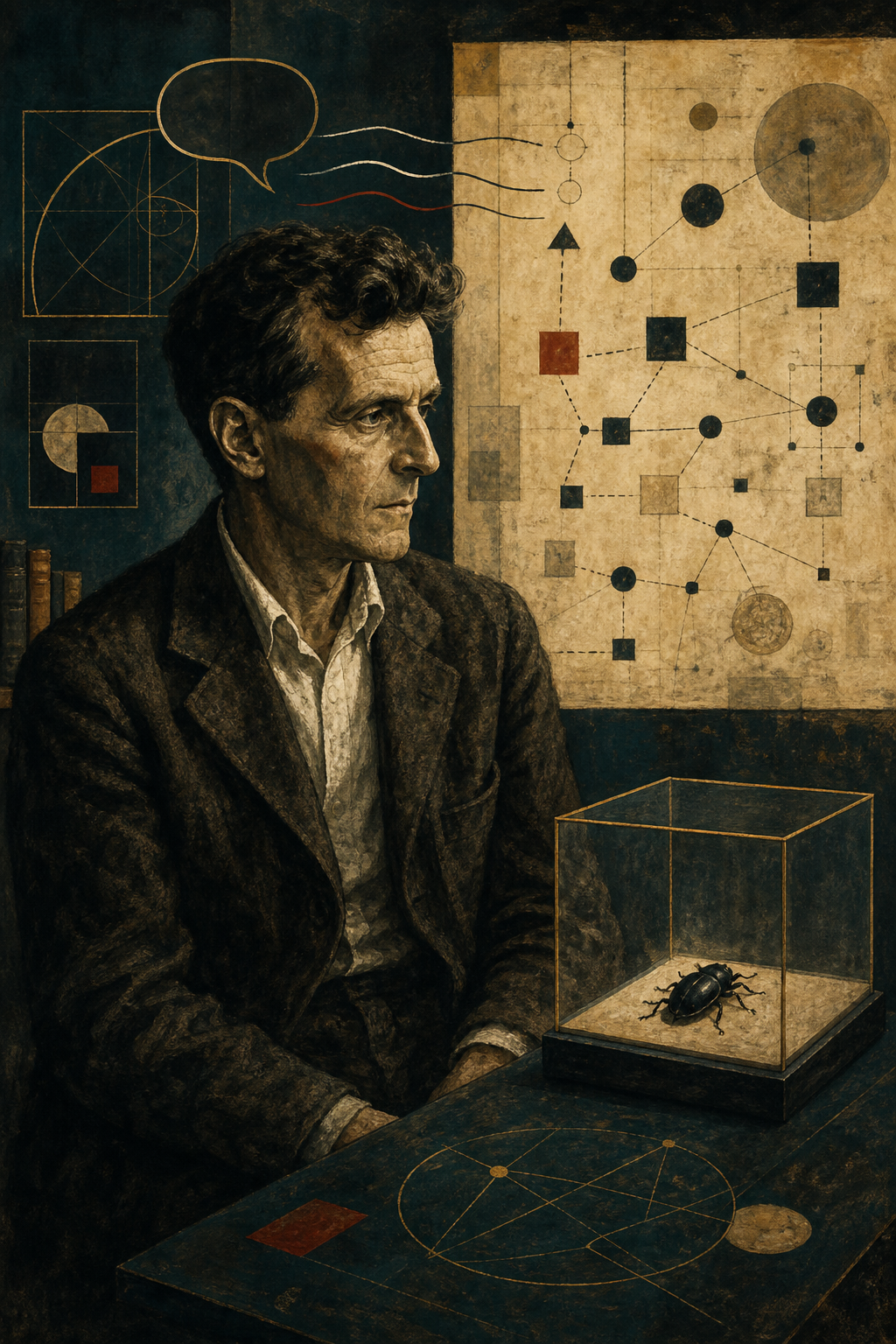
Wittgenstein's beetle is useful because it stops us from making a simple mistake about private experience.
Imagine everyone has a box. Everyone says there is a beetle inside their box, but no one can look inside anyone else's. In that case, the public meaning of the word beetle cannot depend only on the private object in the box. The word gets its meaning from public use.
This matters for Socionics because many aspects sit at the border between private registration and public criteria.
Pain is private in one sense: I feel my pain from the inside. But pain language is public. We learn when to say pain, how to recognise pain behaviour, how to ask for help, how to distinguish pain from pressure, discomfort, injury, fatigue, or fear.
Si lives exactly in this borderland. This room is too hot is not a detached measurement in the Te sense, but it is not a meaningless private beetle either. It is a bodily registration of a shared physical situation.
Fi has a different problem. I trust him, I resent her, this matters to me, that felt disloyal are not publicly measurable in the same way as temperature or weight. But they are not empty. They become intelligible through patterns of relation, conduct, loyalty, aversion, attachment, and personal history.
Wittgenstein helps us say: inner information is not unreal, but it cannot be understood apart from the forms of life in which it becomes expressible.
Philosophical Payoff
Socionics As A Philosophy Of Information
The aspect dichotomies show that Socionics is not simply sorting people into types. It is dividing experience into different modes of informational access.
Some information is immediate and sensory. Some is counterfactual and imagined. Some is public, procedural, and measurable. Some is relational, affective, and personally charged. Some is discrete and object-like. Some is continuous and process-like. Some is detached enough to be mapped. Some is involved enough to be lived.
A type, then, is not merely a style of behaviour. It is a patterned way of metabolising reality.
The ILE does not just like ideas. Ne is a way the world arrives as possibility. Ti is a way possibility is stabilised into structure. The SEI does not just like comfort. Si is a way the world arrives as bodily condition. Fe is a way bodily and social life becomes shared atmosphere.
The philosophical mistake would be to reduce all this to one privileged form of truth. Te is not the only real information because it can point to outcomes. Ti is not the only real information because it can define relations. Si is not trivial because it concerns comfort. Fi is not unreal because it is inwardly held. Ni is not fantasy because it moves through time and implication. Fe is not superficial because it travels through expression and atmosphere.
Each aspect answers a different question:
- What is possible?
- What is unfolding?
- What is forcefully present?
- What is the bodily condition?
- What works?
- What is coherent?
- What is being felt between us?
- What matters?
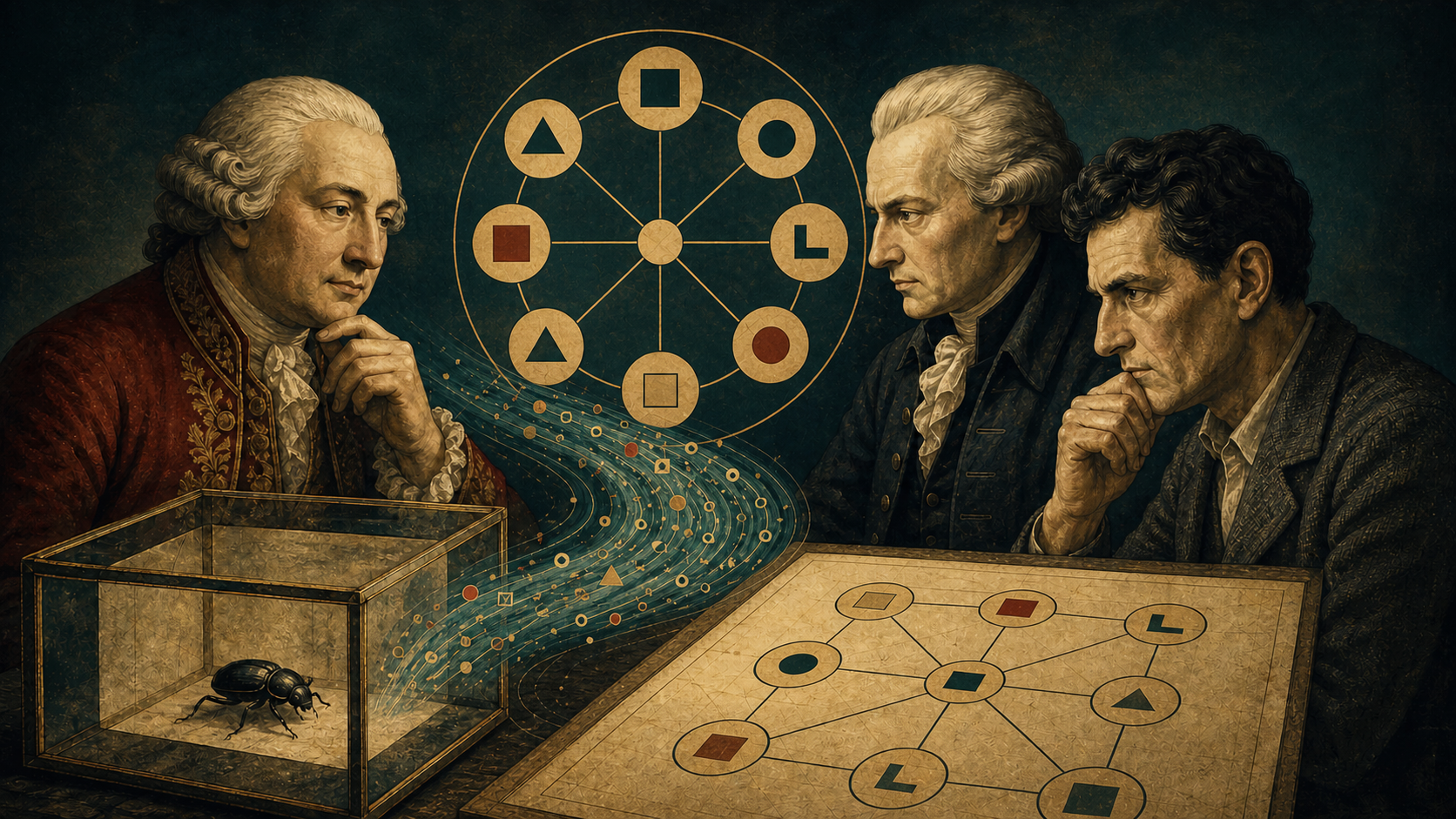
The beetle, the stream, and the map are all needed. The beetle reminds us that private experience must find public expression. The stream reminds us that consciousness begins in the flow of impressions. The map reminds us that the mind organises what it receives.
Socionics belongs in the space between them. It is a theory of how reality becomes information, and how different minds learn to live by different parts of the map.
Sources
- David Hume and impressions/ideas: Stanford Encyclopedia of Philosophy.
- Immanuel Kant and transcendental idealism: Stanford Encyclopedia of Philosophy.
- Wittgenstein's private-language argument and beetle example: Stanford Encyclopedia of Philosophy.
- For the TetraTypes context: Model A, From Model A To Model L, and the wider philosophy of TetraTypes.
This essay uses philosophy as an interpretive lens. It does not claim that Hume, Kant, or Wittgenstein endorsed Socionics, nor that their work validates Socionics as an empirical theory.
Conversation
Responses
Loading comments...