TetraTypes Blog ·
Reading Aushra's Sign
ILE, the four-stroke engine, and the part of Model A I had not yet learned to see.
Starting Point
The Image Was Ahead of Me
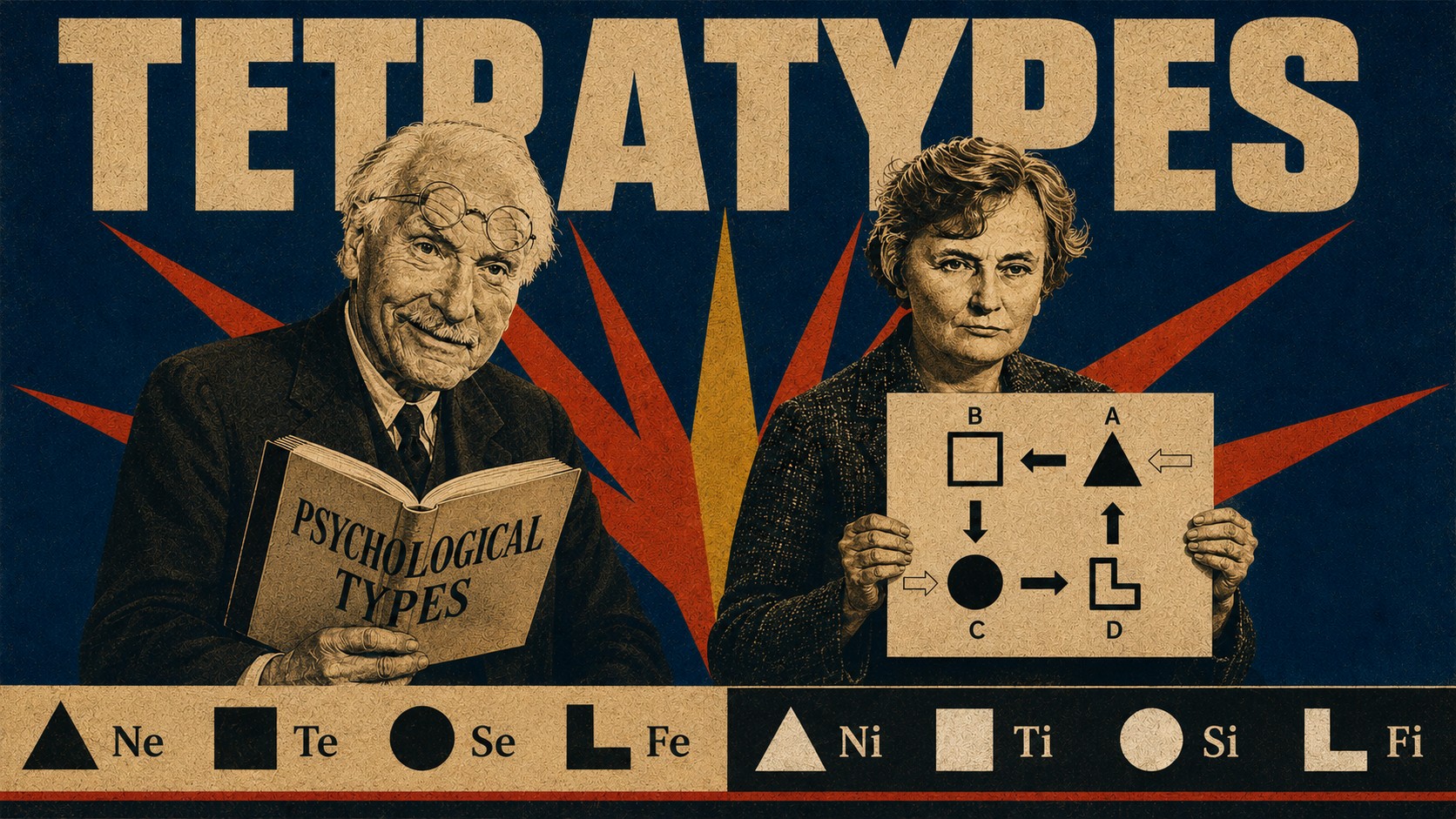
I made this image as a compact statement of the site's inheritance: Jung on one side, Aušra Augustinavičiūtė on the other, and between them the strange visual language that socionics added to typology. For a while I understood the image only in the broadest sense. Jung supplied the functions; Aushra supplied the system. The sign looked convincing because it looked technical.
That was not a sufficient reading. A diagram is not made meaningful by looking like a diagram. It has to be read.
The sign is not decorative. It contains four of Aushra's information-element symbols, ordered by arrows. More specifically, it contains the public or mental ring of an ILE: Ne → Ti → Se → Fi → Ne. Once that is visible, it becomes possible to separate three things that are often blurred together: the symbol system, the Model A ring, and Aushra's separate four-stroke metaphor for energy metabolism.
Notation
First Read the Shapes
Aushra did not begin with the familiar letter codes. In her early notation, intuition is a triangle, sensing a circle, logic a square, and ethics a square with one corner removed. The black form denotes the extraverted element; the white or empty form denotes the introverted counterpart. The direct source is The Dual Nature of Man, in the paragraph beginning "A few words about the origin of graphic symbols": the circle suggests the full contact of extraverted sensing; the triangle fits inside it as intuition; logic and ethics are presented as outer and inner sides of one process. Read the translated source
| On the sign | Element | What the mark tells us |
|---|---|---|
| Filled triangle | Ne | Extraverted intuition |
| Empty square | Ti | Introverted logic |
| Filled circle | Se | Extraverted sensing |
| Empty notched square | Fi | Introverted ethics |
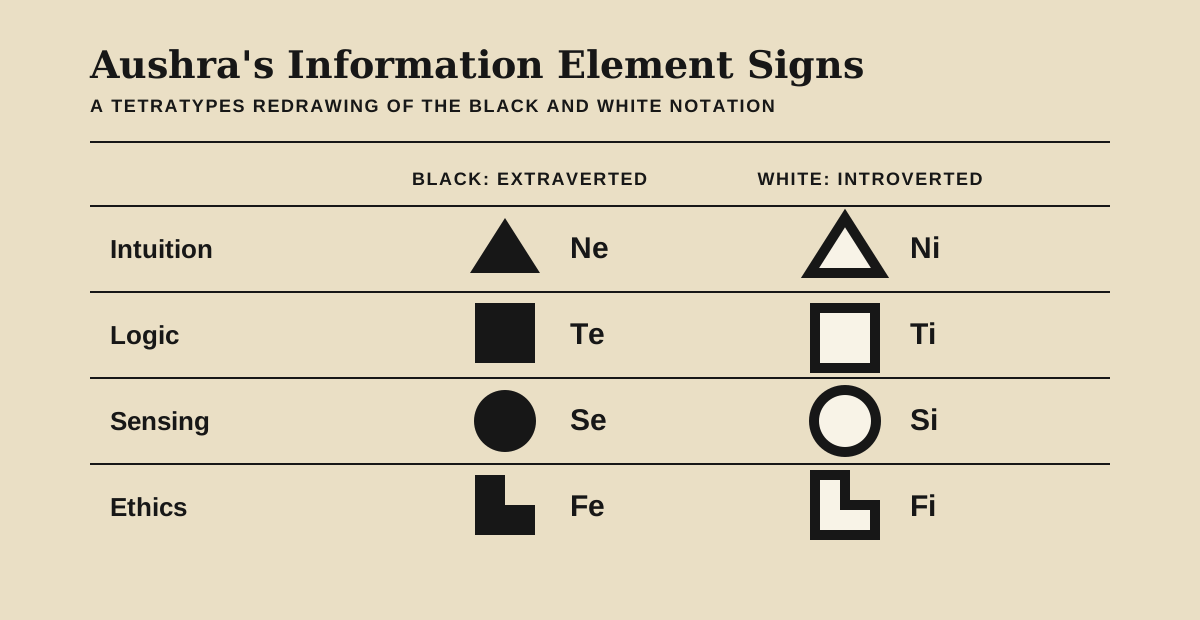
The empty square identifies the second sign as Ti. That matters because the image cannot be the four-stroke body cycle, which uses the four extraverted elements Ne, Fe, Se, and Te. The sign is a ring of four static elements, alternating extraversion and introversion: Ne, Ti, Se, Fi.
There are also two small pale outline arrows on the sign. They are not part of the black ILE ring and do not have a sourced explanation in this composition. I am therefore not assigning them a classical meaning. They may suggest input, output, or a later current-based reading, but that would be inference from an artwork rather than an account of Aushra's text. The source-led claim of this essay is limited to the four black arrows.
Model A
The Sign Is an ILE Mental Ring
In the TetraTypes Model A convention, the ILE is arranged as follows:
| Block | Positions | ILE elements | Plain reading |
|---|---|---|---|
| Ego | 1-2 | Ne - Ti | Possibility read through structure |
| Super-Ego | 3-4 | Se - Fi | Force and relation under conscious strain |
| Super-Id | 5-6 | Si - Fe | Comfort and activation received as need |
| Id | 7-8 | Ni - Te | Time and practical output in the background |
The first four positions form the conscious, public, or mental ring: Ne → Ti → Se → Fi → Ne. This is exactly the route on the sign. It begins where the ILE is most at home: possible structures, alternatives, and latent capacity in Ne; then it gives those possibilities a logical form in Ti. It then enters the more effortful territory of Se and Fi: force, boundaries, personal valuation, and the social consequences of acting among particular people.
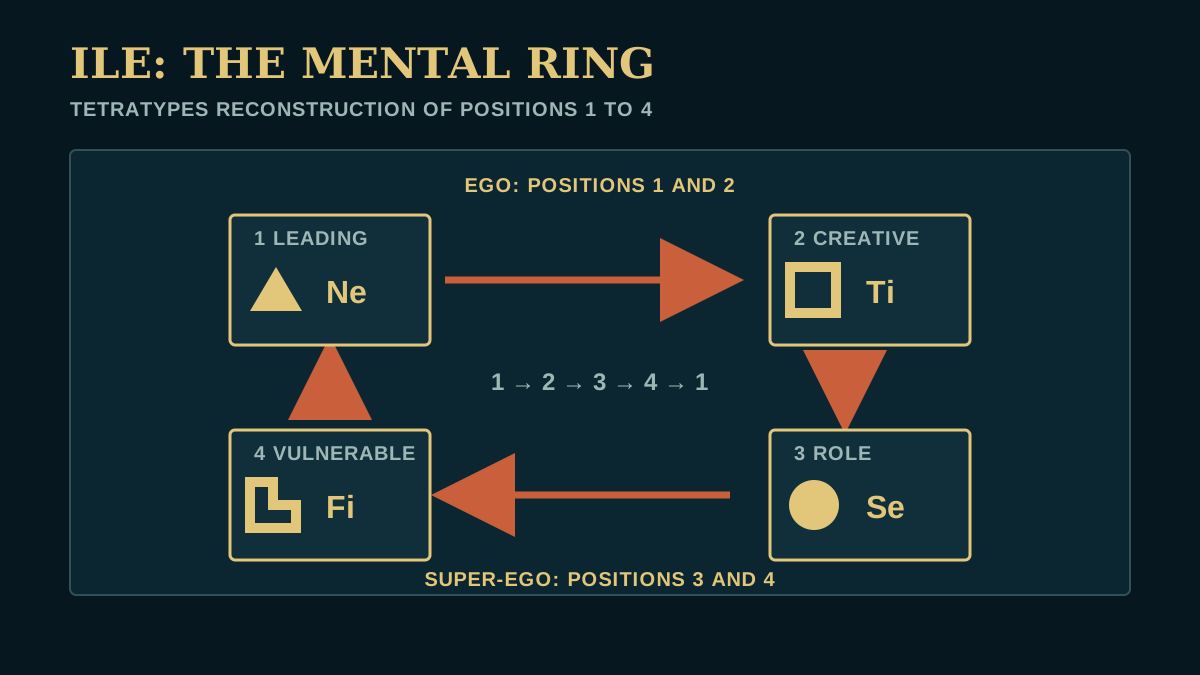
That does not mean an ILE simply moves through four cartoon stages in ordinary life. Model A is not a behavioural storyboard. It is a structural claim about how the same eight elements are arranged into positions of strength, strain, need, and background competence. But the ring tells us that the image is describing one type's conscious route, not four independent symbols floating around a portrait.
Aushra's own writings are the origin of the claim that Model A works through mental and vital rings, with information circulating through the first four and second four positions. Later presentations differ over the exact mechanics, so this article stays with the modest point the image can support: the sign is an ILE mental-ring reading, not a generic emblem of "socionics." Read the Model A source overview
Aushra is conventionally reported to have identified herself as an ILE. That reported self-typing makes the choice of ring fitting, but it should not be treated as proof of her theory or as a shortcut around reading the theory itself.
Energy Metabolism
The Four-Stroke Metaphor Is a Different Diagram
Here is where I had been conflating two levels of the system. Aushra compares four phases of bodily activity to a four-stroke internal-combustion engine. In Socion, or The Foundations of Socionics, she calls this a metaphorical matching. The phase-element assignment is direct, not an extrapolation: see the chapter "Human Condition," Figure 4, "Body Phases." Her sequence is:
| Energy phase | Element | Her broad meaning |
|---|---|---|
| Potential energy | Ne | Latent capacity, internal structure, what an object may become |
| Conversion to kinetic energy | Fe | Excitation, compression, activation, internal change |
| Kinetic energy | Se | Mobilisation, force, readiness, external form |
| Work | Te | Expenditure, movement, practical output, return toward rest |
That cycle is Ne → Fe → Se → Te → Ne. It is a theory about the four body phases through which energy is understood, not a label for the ILE mental ring. Aushra then pairs body phases with field phases: Ne with Ni, Fe with Fi, Se with Si, and Te with Ti. Her larger claim is that information metabolism reflects this energy metabolism: a change in an organism's state is also information available to a psyche and to other organisms. Read "Human Condition" and "Four Phases of Energy Metabolism and Four Phases of Information Metabolism"
This is ambitious speculative theory, not accepted thermodynamics or neuroscience. That caveat matters. But if we read it on its own terms, the metaphor is doing real conceptual work. It prevents us from treating the elements as a static filing system. Ne is not merely "ideas," Fe not merely "emotion," Se not merely "force," and Te not merely "facts." In this classical frame, they are four distinct kinds of information about potential, activation, mobilisation, and work.
Putting Them Together
How the Engine Is Distributed Through an ILE
The four body-phase elements do appear in the ILE model, but they are not adjacent in the public ring. They are distributed across the whole structure:
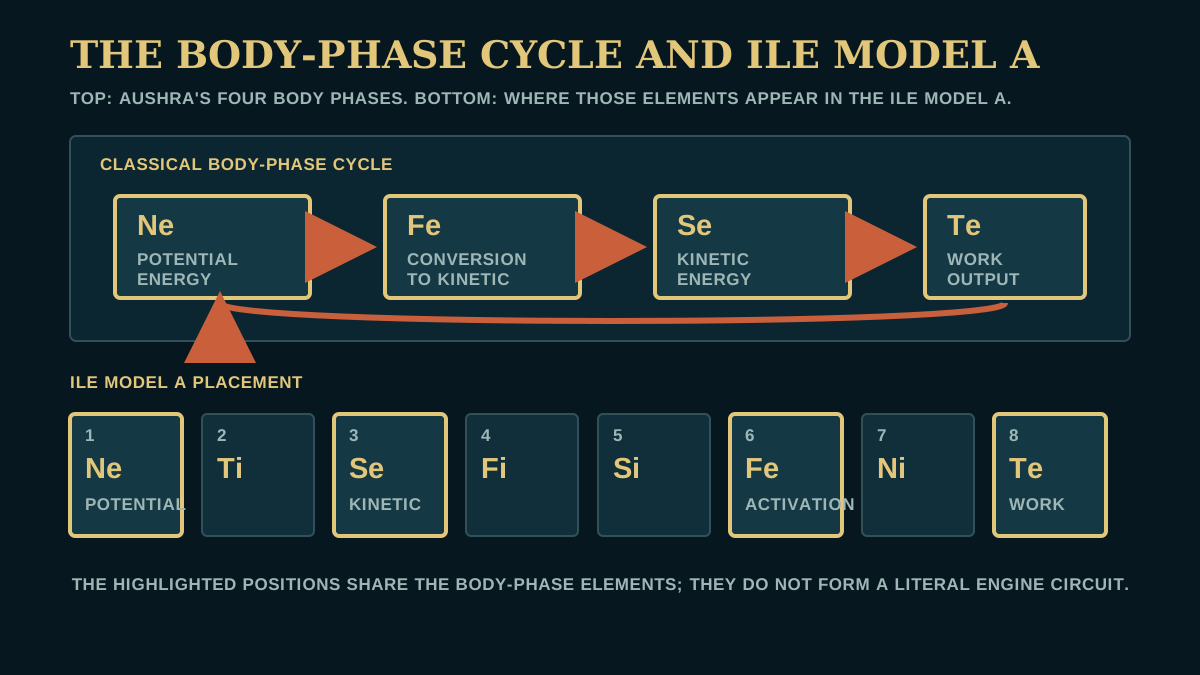
| Engine phase | ILE position | What that makes visible |
|---|---|---|
| Ne: potential | 1, Leading | Possibility is the ILE's confident starting point. |
| Fe: activation | 6, Mobilizing | Emotional activation is welcome and growth-charged, but not self-sustaining. |
| Se: kinetic force | 3, Role | Direct force and territorial assertion can be performed, but carry conscious pressure. |
| Te: work | 8, Demonstrative | Practical output can be supplied in the background without becoming the ILE's central identity. |
This is a reconstruction from Aushra's phase vocabulary and the ILE Model A placement, not a claim that she drew these four positions as a literal mechanical loop. It nevertheless gives the model a useful depth. The ILE begins from potential, is stirred by activation, can meet force under pressure, and can produce practical action without making practical production its deepest organising aim.
The paired field elements complete the picture. Ti is the ILE's creative structural counterpart to Ne; Fi is the vulnerable relational counterpart to Se; Si is the suggestive bodily and spatial counterpart to Fe; Ni is the background temporal counterpart to Te. The four blocks therefore are not four arbitrary pairs. In Aushra's language, each joins information about bodies and information about fields.
That is why the sign is worth taking slowly. It opens into a Model A rather than merely illustrating it.
Intertype Relations
From One Metabolism to Another
Intertype relations matter here because Aushra did not intend Model A to be a private portrait. A type is a partial metabolism. It has confident territories, exposed territories, needs it cannot easily meet alone, and background capacities it does not especially value. Relations matter because another type can meet the same information field from a different position.
For the ILE, the classical dual is the SEI. The SEI's Ego block is Si-Fe, precisely where the ILE has Super-Id need. In the plainest possible terms: the ILE is receptive to help with lived comfort, rhythm, embodied ease, and emotional animation; the SEI is comparatively at home producing those things. This is the classical intuition behind duality. The point is not that a particular person must become dependent on a designated partner, nor that a relationship can be predicted from a four-letter code. It is that the models are arranged as complementary patterns of information and energy exchange.
Aushra's account goes further, proposing that the active and passive rings of duals can charge and steady one another. That is one of the strongest and most contestable claims in classical socionics. It is best read as the original theory's explanation of why certain interactions feel relieving, activating, or settling, not as settled psychological science. Read Aushra on the interaction of duals' rings
Model A therefore gives the little sign on the poster a social horizon. Ne-Ti is not only an ILE's way of beginning a conscious inquiry. It is part of a broader arrangement in which what one person confidently generates may be useful, neutral, abrasive, or desired by another. That is the move from psychology to socionics proper.
Method
Sources and Limits
The primary texts used here are English translations of Aushra Augustinavičiūtė's The Dual Nature of Man and Socion, or The Foundations of Socionics. For the two load-bearing claims, the locations are explicit: the symbol account is in The Dual Nature of Man, "A few words about the origin of graphic symbols"; the body-phase assignment is in Socion, "Human Condition," Figure 4, followed by "Four Phases of Energy Metabolism and Four Phases of Information Metabolism." They are community translations, and the latter identifies its Russian original and translators. That is not ideal source access, but it is better than treating contemporary function stereotypes as if they were Aushra's own theory.
The article has also kept three levels distinct: what Aushra explicitly says about symbols, phases, blocks, and rings; what the TetraTypes ILE Model A arrangement shows; and the cautious reconstruction that connects the two. Where the final step is interpretation rather than a direct quotation, I have said so.
That distinction is the real point of the exercise. I began with an image that knew more than I did. The remedy was not to make the image more impressive. It was to read its signs carefully enough that the image became answerable to the writing that inspired it.