TetraTypes Blog ·
Peace, Pressure, Density, and Self-Reliance
The Environmental Logic of the Quadras
A Model-L essay on quadras as adaptive environmental logics: peace, pressure, density, and self-reliance.
Quadra Ecology
Opening Frame
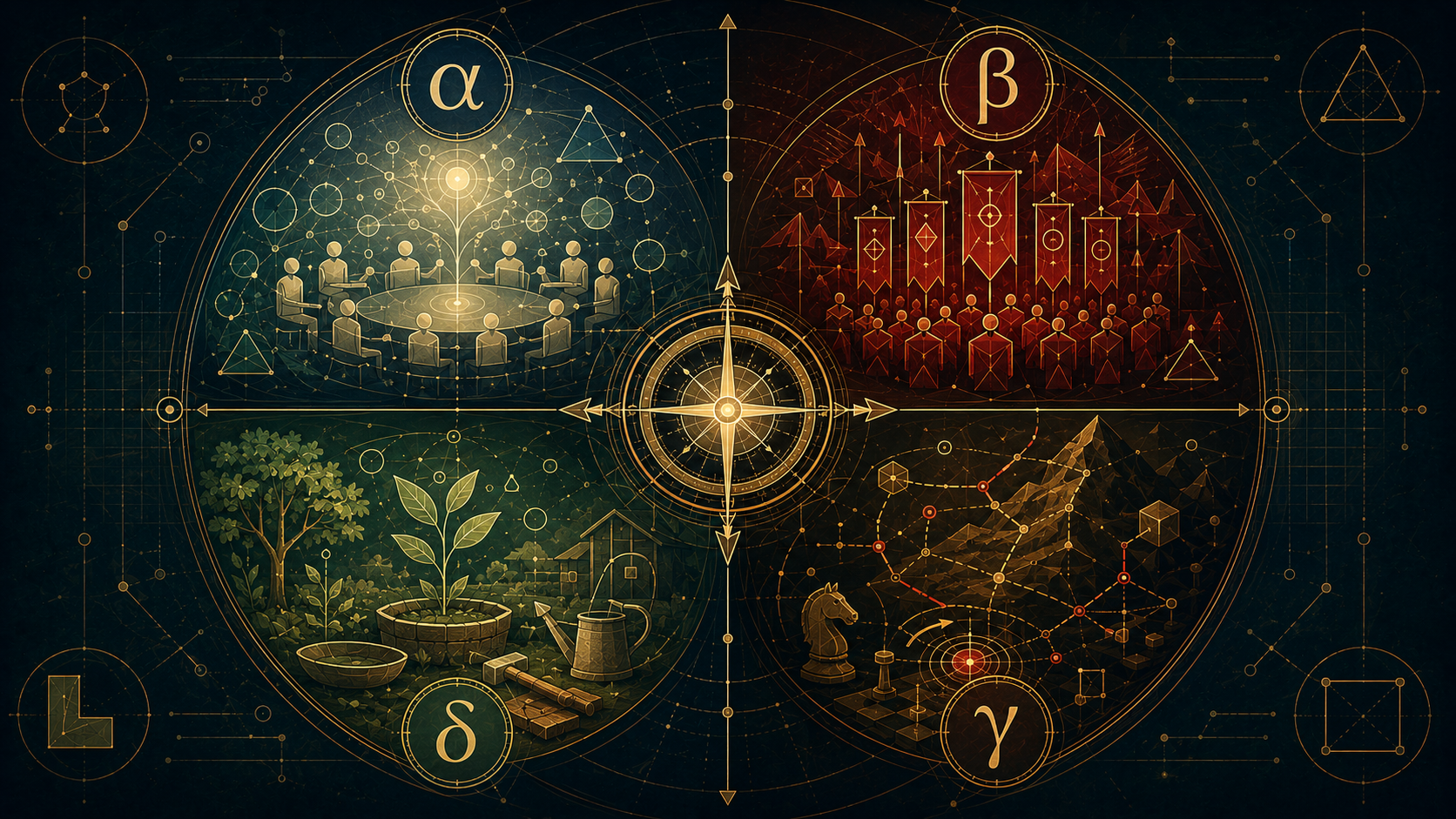
Quadra descriptions often collapse into atmosphere.
Alpha is playful. Beta is dramatic. Gamma is intense. Delta is practical.
There is some truth in those descriptions. Enough truth to make them sticky. Not enough truth to make them good theory.
Model-L gives us a sharper way to think about the quadras. A quadra is not just a social mood, a cultural style, or a list of valued functions. It is a metabolic current: a preferred way of converting one kind of information into another.
Kimani White and Aleesha Lowry describe four cardinal flow-pairs beneath the quadras: Si→Ne Abstracting, Ni→Se Concretizing, Fe→Ti Synergizing, and Te→Fi Optimizing. These are not merely function-pairs. Each one implies a different kind of world.
That gives us a better question.
Not: Which quadra has the best vibe?
But: What kind of environment does this metabolism seem built to handle?
Quadra Ecology
Four pressures on human life
Human beings do not process information in a vacuum. We process it under conditions.
Some environments are peaceful enough for exploration. Others are hostile enough to demand force.
Some environments are socially dense: many people must coordinate, often without deep personal bonds. Others are sparse or local: people rely more heavily on practical competence, close relationships, and their own reserves.
This gives us four basic environmental pressures:
Peace: the world is safe enough to take in, enjoy, explore, and elaborate.
Pressure: the world pushes back; danger, scarcity, competition, or opposition must be anticipated and met.
Density: many people must be synchronised through shared moods, codes, rituals, institutions, or rules.
Self-reliance: life depends on workable habits, practical skill, personal judgement, and trusted bonds.
These are not literal habitats. They are adaptive emphases. A person can live in London, a village, an office, a family, a bureaucracy, or a battlefield and still need all four logics at different times. But each quadra leans toward one combination.
Alpha: peace plus density. Beta: pressure plus density. Gamma: pressure plus self-reliance. Delta: peace plus self-reliance.
That is the environmental logic of the quadras.
Quadra Ecology
Abstracting: peace and possibility
The first flow-pair is Si→Ne, or Abstracting.
Si receives concrete experience: bodily state, sensory feedback, ease, discomfort, texture, atmosphere. Ne opens that experience into possibility: alternatives, experiments, new directions, recombinations, paths not yet taken.
Kimani and Aleesha connect this flow with psychophysiological growth and the exploration of potential. It favours a less contentious approach to the world: taking life in, expanding horizons, and flourishing under relatively peaceful conditions.
This is peace as a metabolic condition.
Peace does not mean passivity. It means the absence of constant threat. When the organism is not forced to brace, defend, dominate, or survive, it can explore. It can notice. It can play. It can imagine alternatives.
The Abstracting question is:
What else could grow from this?
Quadra Ecology
Concretizing: pressure and force
The second flow-pair is Ni→Se, or Concretizing.
Ni narrows possibility into trajectory, intention, timing, implication, and long-range consequence. Se mobilises energy into concrete exertion: force, impact, pressure, will, resistance, action.
Kimani and Aleesha link this flow with mobilising psychophysiological resources to contend with challenge and threat. It is better suited to harsh or hostile conditions, where foresight and force become critical.
This is pressure as a metabolic condition.
Pressure does not always mean war or violence. It may mean competition, conflict, scarcity, institutional struggle, reputational danger, crisis, or the need to act before the window closes. The world is not merely interesting. It is consequential.
The Concretizing question is:
What is coming, and how do we impose our will on it?
Quadra Ecology
Synergizing: density and synchronisation
The third flow-pair is Fe→Ti, or Synergizing.
Fe generates shared emotional current: mood, expression, arousal, symbolic charge, collective feeling. Ti gives that current form: categories, roles, rules, codes, principles, structures, common language.
Kimani and Aleesha associate Fe→Ti with high population density. When many people who do not necessarily know one another must coordinate, shared feeling and shared structure reduce confusion. People need to get on the same page.
This is density as a metabolic condition.
Density creates a coordination problem. The larger the group, the less one can rely on private trust, tacit familiarity, or direct personal knowledge. Something has to scale: ritual, language, law, mood, status, doctrine, expectation, atmosphere.
The Synergizing question is:
How do we get many people into a shared pattern?
Quadra Ecology
Optimizing: self-reliance and close bonds
The fourth flow-pair is Te→Fi, or Optimizing.
Te improves workability: data, method, technique, resources, efficiency, practical adjustment. Fi gives that effort direction: values, preferences, loyalties, bonds, character, personal priority.
Kimani and Aleesha connect Te→Fi with lower population density, where people rely more heavily on themselves and those close to them. Practical self-sufficiency and direct interpersonal reliability matter more than mass synchronisation.
This is self-reliance as a metabolic condition.
Self-reliance does not mean isolation. It means life cannot be solved mainly by getting the whole crowd into rhythm. You need skills that work. You need tools that hold up. You need people whose character you trust. You need to know what matters enough to spend effort on.
The Optimizing question is:
What works, for whom, and at what cost?
Quadra Ecology
Alpha: peace plus density
Alpha combines Abstracting and Synergizing.
This is why Alpha is so easily caricatured as playful. The caricature points at something real, but names it badly. Alpha is not “fun” as a personality decoration. Alpha is what happens when the world feels safe enough for possibility and socially open enough for shared exploration.
Kimani and Aleesha describe Alpha as converting Involved aesthetic stimulation into Detached formative articulation: from «Si»‹Fe› toward «Ne»‹Ti›. The result is a Conceptualizing flow.
Alpha begins in atmosphere. The room matters. The mood matters. Sensory ease matters. People need to feel relaxed enough to participate. Then the current moves toward articulation: ideas, distinctions, jokes, models, reframings, theoretical play.
The Alpha question is:
What can we discover together when nobody has to fight?
This is the quadra of the seminar room, the café conversation, the comedy table, the puzzle, the light but serious exchange where a joke can become a model and a model can become another joke. Alpha does not need every idea to serve a campaign, a profit, a loyalty test, or a survival aim. It wants conceptual movement in a breathable social field.
At its best, Alpha civilises curiosity. It creates the conditions in which thought can move without fear.
At its worst, Alpha underrates pressure. It may assume that if people relax, explain themselves, and keep the atmosphere open, the problem will become discussable. Sometimes it will. Sometimes the problem is not waiting to be discussed.
Quadra Ecology
Beta: pressure plus density
Beta combines Concretizing and Synergizing.
The social field is still dense, but now it is under pressure. Many people must not merely exchange ideas; they must align, mobilise, endure, enforce, or overcome. Mood becomes morale. Structure becomes command. Narrative becomes destiny.
Kimani and Aleesha describe Beta as converting Internal narrative aspiration into External formative action: from «Fe»‹Ni› toward «Ti»‹Se›. The result is an Externalizing flow.
Beta begins with charged meaning. Something is happening. It has a story. It has stakes. It requires loyalty, courage, sacrifice, discipline, or confrontation. That inner narrative then seeks outer form: rank, law, doctrine, role, visible action, collective force.
The Beta question is:
What must we become together in order to act?
This is the quadra of the movement, the theatre, the army, the institution under strain, the rally, the order, the dramatic collective. Beta does not merely want people to get along. It wants them formed into something.
At its best, Beta turns scattered fear into courage. It gives form to chaos. It can make people stand up when private comfort would make them fold.
At its worst, Beta manufactures pressure. It can mistake disagreement for betrayal, ambiguity for decadence, softness for weakness, and peace for cowardice. The machinery that mobilises people against danger can also trap them inside permanent emergency.
Quadra Ecology
Gamma: pressure plus self-reliance
Gamma combines Concretizing and Optimizing.
The world is still pressurised, but the answer is no longer mass synchronisation. The answer is strategy, leverage, timing, resources, loyalty, and effective action. Gamma does not ask how to get everyone into the same story. It asks what is really happening and what move will secure the aim.
Kimani and Aleesha describe Gamma as converting Detached strategic insight into Involved motive efficacy: from «Ni»‹Te› toward «Se»‹Fi›. The result is a Grounding flow.
Gamma begins by reading the field. What are the incentives? Where is this going? What does the data imply? Who benefits? What is the risk? What is the opening? Then the current grounds itself in will, possession, loyalty, impact, and concrete result.
The Gamma question is:
What is really happening, and what can I do about it?
This is the quadra of the deal, the crisis plan, the strategic alliance, the hard choice, the family business, the trusted circle, the realistic assessment. It does not expect goodwill, shared mood, or public ritual to solve the problem. It wants the lever that moves the situation.
At its best, Gamma cuts through fantasy. It sees that reality has teeth. It knows that aims require timing, resources, and resolve.
At its worst, Gamma over-detects threat. It may treat openness as naivety, generosity as leverage, ideals as camouflage, and trust as something to be rationed until proven safe.
Quadra Ecology
Delta: peace plus self-reliance
Delta combines Abstracting and Optimizing.
Here the world is peaceful enough for growth, but not so socially dense that life must revolve around mass coordination. The emphasis falls on practical competence, personal development, trusted relationships, health, craft, repair, and sustainable improvement.
Kimani and Aleesha describe Delta as converting External practical experience into Internal motive potential: from «Te»‹Si› toward «Fi»‹Ne›. The result is an Internalizing flow.
Delta begins with what works. What improves the situation? What reduces waste? What makes the body, home, tool, habit, process, or livelihood function better? Then that practical experience becomes personal growth: better judgement, stronger character, deeper values, new activities to explore, a more worthwhile life.
The Delta question is:
How can life be made workable, humane, and worth continuing?
This is the quadra of the workshop, the garden, the clinic, the craft, the long friendship, the small business, the repaired house, the hard-won habit, the vocation. Delta does not need every improvement to become a crusade. It wants life to become more inhabitable.
At its best, Delta builds conditions for sustainable flourishing. It improves the world without theatrical inflation.
At its worst, Delta can become too private, too suspicious of collective drama, too quick to treat necessary confrontation as needless unpleasantness. It may underestimate the moments when peace has ended and mobilisation is required.
Quadra Ecology
The axes beneath the quadras
The four quadras also divide into two broader axes.
Alpha and Gamma belong to Transduction. Kimani and Aleesha describe this axis as concerned with perceived “is” conditions: felt somatic experience and detached conceptualisation. Alpha maps the world through descriptive ideas; Gamma navigates the world in pursuit of imperative aims.
Delta and Beta belong to Conduct. This axis concerns “ought” conditions: inner ideals and behavioural standards. Delta centres on how one should be through personal growth and cultivated values; Beta centres on how the world should be through promulgated codes and formative action.
This explains a lot of quadra conflict.
Alpha and Gamma often clash over pressure. Alpha wants to keep the field open enough for thought to move. Gamma wants to know what the actual stakes are and who is positioned to win or lose. One suspects cynicism. The other suspects naivety.
Beta and Delta often clash over scale. Beta wants shared form, visible commitment, and collective force. Delta wants personal integrity, practical workability, and trusted local bonds. One suspects withdrawal. The other suspects intrusion.
Alpha and Delta often share the assumption that life should be allowed to grow. They differ over whether growth happens through shared conceptual play or through practical cultivation.
Beta and Gamma often share the assumption that pressure is real. They differ over whether pressure is met through collective mobilisation or strategic self-reliance.
The axes do not erase the quadras. They show why some disagreements feel strangely familiar.
Quadra Ecology
Quadras are ecological biases
The point is not that one quadra is right.
The point is that each quadra tells the truth about a different condition.
Alpha sees that people think better when the atmosphere is open and safe enough for play.
Beta sees that groups under pressure need story, form, morale, and coordinated will.
Gamma sees that reality pushes back, and that aims require leverage, timing, and trusted bonds.
Delta sees that life must be made workable at the scale of actual bodies, actual tools, actual relationships, and actual days.
Each truth becomes a distortion when universalised.
Alpha can forget that not every threat dissolves under discussion.
Beta can forget that not every disagreement is a crisis of loyalty.
Gamma can forget that not every open hand hides a knife.
Delta can forget that not every disruption is waste.
Quadra maturity means knowing when your preferred environmental assumption no longer fits the environment you are actually in.
Quadra Ecology
The world gets a vote
No real life belongs permanently to one condition.
A peaceful household can enter crisis. A dense workplace can become playful, coercive, strategic, or practical depending on the day. A trusted local network can be dragged into institutional conflict. A movement can start as necessary mobilisation and become a machine that feeds on pressure.
Healthy people borrow from all four logics.
Sometimes Alpha is right: lower the stakes, warm the room, and let ideas breathe.
Sometimes Beta is right: name the crisis, gather people, and act in formation.
Sometimes Gamma is right: stop pretending, read the incentives, and secure the aim.
Sometimes Delta is right: reduce waste, restore trust, and build something sustainable.
A type does not tell us what the world is. It tells us what kind of world a person is most ready to interpret.
That distinction matters.
Socionics should not become identity theatre. It works better as conjectural ecology: a map of the adaptive assumptions a psyche tends to bring to changing conditions.
The world still gets a vote.
Quadra Ecology
Conclusion: the four worlds of quadra
The quadras are not four stereotypes.
They are four answers to the problem of living.
Alpha answers a world of peace and density: shared exploration, conceptual play, social ease.
Beta answers a world of pressure and density: collective mobilisation, symbolic force, coordinated action.
Gamma answers a world of pressure and self-reliance: strategy, leverage, loyalty, grounded consequence.
Delta answers a world of peace and self-reliance: practical cultivation, trusted bonds, sustainable growth.
The usual quadra slogans are not entirely wrong. They are just too small.
Alpha is not merely playful. It protects the conditions for free exploration.
Beta is not merely dramatic. It turns pressure into collective form.
Gamma is not merely intense. It grounds aims in a world that resists us.
Delta is not merely practical. It cultivates life where people must actually live it.
The question is no longer, “Which quadra has the best values?”
The question is sharper:
What kind of world does this value-system prepare you to inhabit?