
People remember the moments when the ordinary rules failed: the resignation delivered at midnight, the friendship that exploded, the sudden move, the public argument, the year in which nothing felt normal. These stories are vivid for good reason. They often matter. They are also treacherous raw material for typing.
At high stakes, a person is answering more than the question of what usually interests them. They may be frightened, grieving, protecting a livelihood, responding to someone else's demands, or improvising with information they did not choose. The visible act can be real and still be a poor guide to the pattern that usually organises attention.
Vividness borrows authority
A dramatic anecdote arrives with its own lighting. It has a beginning, a turn, and a consequence. That makes it easy to retell and easy to overvalue. A long sequence of quieter choices has no comparable theatre: what someone repeatedly notices in conversation, the sort of problem they volunteer to solve, the distinction they keep making when no one requires it.
Yet those quieter repetitions are often where a typing hypothesis gains traction. They show up before the pressure, after it, and in circumstances too mundane to reward performance. A person who becomes commanding during an emergency may simply be doing what the emergency demands. The more useful question is what they return to when the room is calm again.
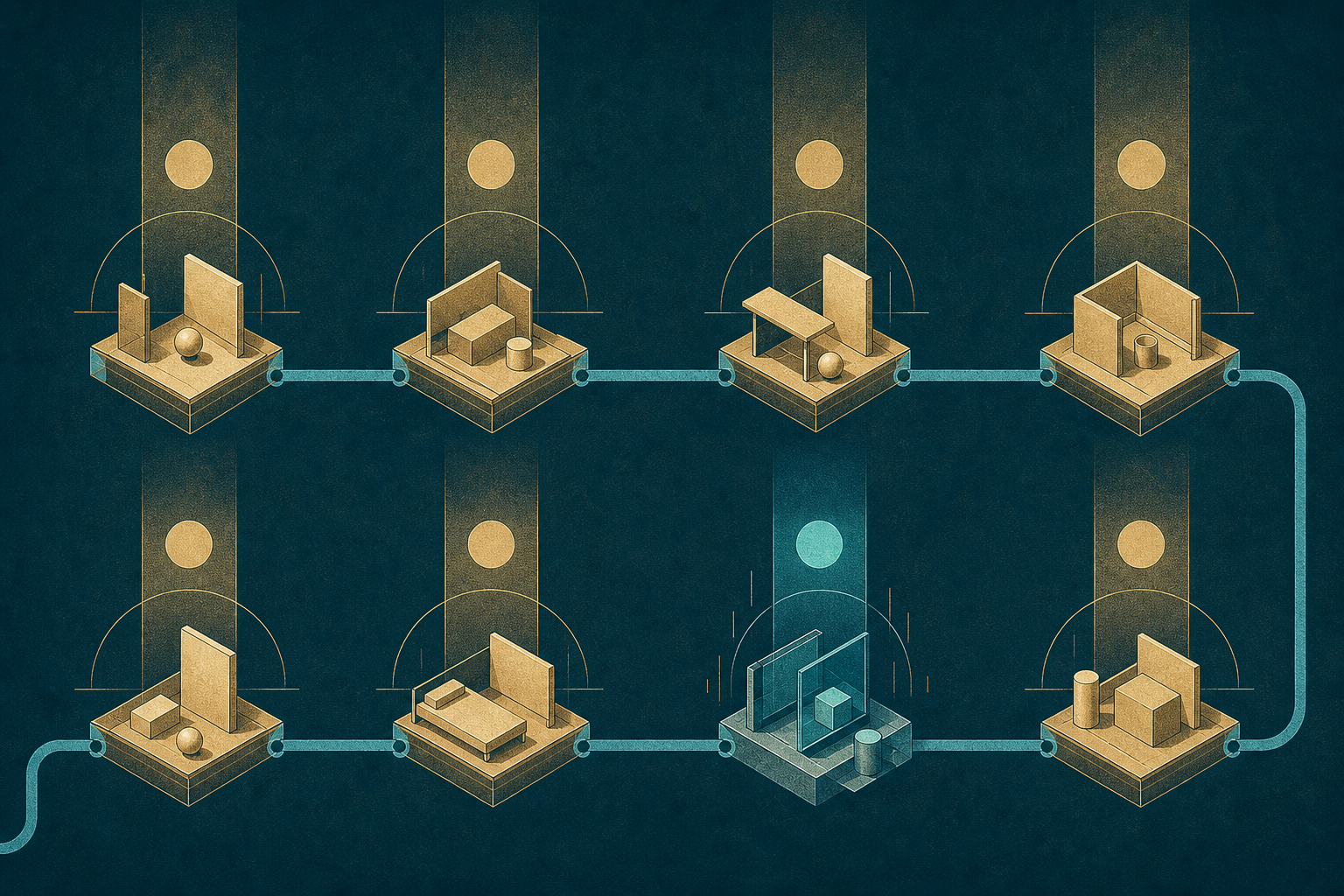
Look for the return path
One event can show capacity, stress, courage, confusion, training, or obligation. It rarely sorts those possibilities by itself. A typist does better to ask what the person does on the return path: after the deadline, after the conflict, after the audience has gone home.
Do they keep revisiting the same kind of question? Do they restore order, test an interpretation, check on a relationship, refine a method, search for an opening, or step away from the whole affair? The wording of these questions matters less than the habit of asking them across several unremarkable situations. The aim is not to turn daily life into surveillance. It is to give repetition a fairer hearing than spectacle.
Context changes the weight of a story
There is no rule that says a crisis is useless evidence. Sometimes it exposes a recurring priority with unusual clarity. The point is proportionality. A single intense story should be held beside its conditions: what was at risk, what roles were assigned, what skills had been learned, who else was involved, and whether the response resembles the person's conduct elsewhere.
This also protects against a common mistake in self-typing. We are understandably drawn to the episodes that explain why we became who we are. But an explanation of a turning point is not automatically an explanation of a stable orientation. A type hypothesis needs both history and recurrence; it should not confuse the force of an event with the force of an inference.

Ask a smaller question
When an arresting anecdote appears, resist the urge to make it carry the whole diagnosis. Ask what it establishes. Perhaps it shows that someone can act decisively under pressure. Perhaps it shows a sensitivity to betrayal, chaos, unfairness, or uncertainty. Perhaps it only shows that this particular situation was difficult. Each answer is more useful than a premature conversion from story to type.
Then ask for nearby evidence. What happened in less charged versions of the same problem? What did the person notice before the crisis began? What did they describe as satisfying, irritating, or unfinished once it was over? A hypothesis becomes more precise when it has to account for the plain days as well as the consequential ones.
Let the noise settle
Socionics is interested in patterned differences in how information becomes important. That makes ordinary attention valuable evidence: the small, repeatable acts of selection that rarely become a story. Drama may reveal something important, but it also introduces noise—fear, urgency, role, and the pressure to act before reflection is possible.
The better practice is neither to dismiss the dramatic story nor to enthrone it. Keep it in the file. Describe its conditions. Return later to the slower record of what the person repeatedly seeks, avoids, develops, and notices. The pattern may confirm the story. It may complicate it. Either way, the type claim will have become harder to impress and easier to trust.