

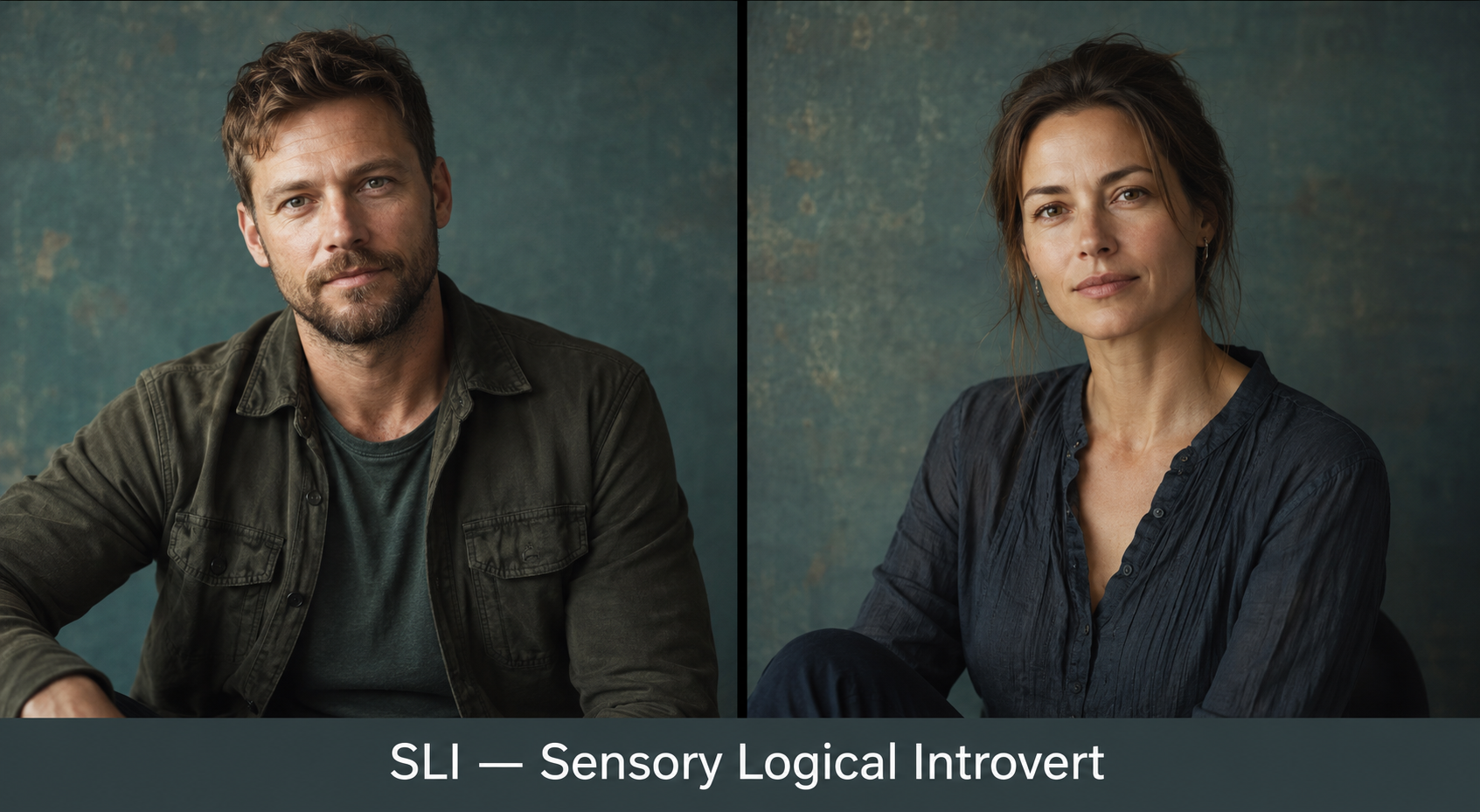
Delta Quadra · Sensory Logical Integrator

SLI

The Craftsman

Delta quadra · SLI

Sensory Logical Integrator

The Craftsman

Club
ST Pragmatists
Temperament
IP — Receptive-Adaptive
Dual
IEE — The Explorer
Model A Base
Si — Senses
Model L Base
Si(T.) — Observation

The SLI is a type of quiet, refined, practical precision. At their best they are the person who notices exactly what is wrong before anyone else has registered that something is wrong, and who addresses it with the minimum of fuss and the maximum of competence. They are not interested in drawing attention to themselves or in performing warmth they do not feel — they are interested in the real condition of real things and in making those things work as well as they possibly can.

Their Delta quadra membership means they value sincerity, earnestness and the desire to understand others on their own terms. Their IP temperament makes them receptive and adaptive — they do not impose their will on the environment but attend to it, gradually adjusting rather than dramatically transforming.

The SLI-IEE dual captures something essential about both types. The SLI sees what is; the IEE feels what could be. The IEE's natural Inspiration is precisely what the SLI's Observation yearns to be pointed toward. The SLI provides the grounded present reality — the accurate observation, the practical competence — that the IEE's inspired vision needs in order to inhabit a real world rather than merely an imagined one. Each makes the other's contribution complete.

Torn-paper collage portrait: an older man planing a length of oak at a workbench

Type profile

SLI In Depth

The eight Model A positions, each with its Model L element. Open any position to read it.

Ego

Conscious and valued: what this type leads with and creates from.

1BaseObservationSi(T.)

The SLI's fundamental mode of engaging with reality is through careful, discriminating, objective attention to the actual state of physical things. This is not passive reception but active, refined noticing — the SLI registers what is genuinely there with quiet precision, evaluating quality, tracking condition, attending to the real sensory facts of the physical world with an accuracy that others rarely match. The world as it actually is, in its present physical condition, is the SLI's primary territory. Observation is automatic, effortless and essentially unshakeable — the SLI cannot help noticing what most people walk past.

2CreativePraxisTe(S.)

In service of Observation, the SLI deploys practical operational logic — the flexible use of hands-on techniques and material resources to improve the workflow of the physical environment. Te(S.) is more visible in behaviour than Si(T.) — more externally expressed, more conversational — and SLIs are often experienced as practically capable, knowledgeable and matter-of-fact. The Praxis serves the Observation: the SLI's accurate assessment of what is actually there is deployed in service of making those things work as well as they possibly can.

Super-ego

Conscious but unvalued: performed for others, or a sore point.

3RoleReverieNi(F.)

The SLI's performance function — the inward narrative imagination and felt sense of temporal significance they are called upon to deploy in certain contexts but find tiring to sustain. Ni(F.) sits uncomfortably against the SLI's naturally grounded, present-focused, physically-attentive register. They can access the dreamlike personally-inflected reading of events when the situation demands it but will not maintain this inward temporal mode a moment longer than necessary — the concrete present calls them back.

4VulnerableSentimentFe(N.)

The SLI's point of greatest sensitivity. Fe(N.) is deeply felt emotion expressed through dramatic rhetoric and symbolic gesture — the kind of emotional intensity that moves crowds and charges shared feeling with collective significance. This is the furthest territory from the SLI's natural register. Criticism of their emotional expression lands hard; excessive demands for passionate collective feeling produce stress and defensiveness. The SLI is not without feeling but is not built for this kind of performance, and they know it.

Super-id

Unconscious and valued: what this type seeks and responds to.

5SuggestiveInspirationNe(F.)

What the SLI most wants and responds to most positively in others. Ne(F.) — Inspiration — is the inner sense of potentiality and spontaneous creative impulse, the vivid personal charge of possibility and discovery. The SLI cannot easily produce this themselves — their attention is anchored in what is rather than what could feel personally alive and extraordinary — but they experience it as a gift when it appears in others. Their dual IEE leads with exactly this element: the IEE's natural Inspiration is precisely what the SLI's Observation yearns to be pointed toward. Where the SLI sees what is, the IEE feels what could be.

6MobilisingSoulFi(N.)

Energising and uplifting when present in others. Fi(N.) — Soul — is the deep inner landscape of personal values, moral convictions and abstract notions of what is inherently worthwhile. The SLI cannot easily generate this themselves but responds warmly when they encounter it in those around them — it enlivens them, affirms something they care about but cannot fully articulate. Together with the Suggestive it defines the SLI's interpersonal chemistry.

Id

Unconscious and unvalued: capable, but kept in the background.

7IgnoringActuationSe(T.)

Capable but uninteresting. Se(T.) — the tactical deployment of physical force and environmental control — is something the SLI can do but finds unrewarding to dwell in. It is suppressed by the Si(T.) base, which takes a different approach to the physical world — observation and quality rather than tactical dominance. The SLI can act with force when the base has genuine need of it but returns this function to its cage promptly and without regret.

8DemonstrativeHabitusTi(S.)

The SLI's strong background competence — real formal structural logic operating automatically without the type fully registering it. Ti(S.) — the tangible defining forms of organised systems and codified behavioural habits — runs quietly in the background feeding the creative Praxis function and producing structural solidity that others may notice before the SLI does. Used to relax; returned to when confidence is low.

Dual relationship

SLI and IEE

SLI's dual is IEE — The Explorer. SLI's Suggestive is Ne(F.) — Inspiration: inner potentiality, spontaneous creative impulse, and imagined paths for growth. IEE leads with exactly this mode of imagination.

IEE's Suggestive is Si(T.) — Observation: selective intake of external sensory data and attention to functional detail. SLI leads with that mode effortlessly. The exchange gives SLI novelty and gives IEE grounding.

The type in life

The Craftsman

Four fictional sketches of the type in an ordinary day.

SLI original portrait set fictional type portrait

Male story

Finn

Finn notices what other people walk past. The angle of the afternoon light through a particular window. The way the machine sounds different when the bearing needs replacing. The texture of a material that is close but not correct for the job. He does not call this sensitivity; he would call it accuracy. He works slowly only by the standards of people who are not watching what he is watching. He is a craftsman without the affectation — the quality is for the work's sake, not for display. He will not rush. He will not apologise for not rushing. He trusts what has been handled, tested, repaired, and quietly improved. His intelligence is tactile: he notices wear, balance, temperature, fit, the small physical truth of things that theories often overlook until something breaks.

Female story

Mei

Mei knows her own body's rhythms with the precision of long observation. She trains in the morning because that is when her concentration is cleanest. She eats what she knows works. She is not precious about comfort — she simply attends to it rather than ignoring it. In her work she is exacting in a way that resists explanation: she can tell, from small signals, when something is right and when it is not quite right, and she does not confuse the two. The people who work alongside her either trust this or don't. She does not spend energy on the ones who don't. She works with patient precision, adjusting a material, a process, or a room until it feels right in use. She dislikes fuss, but she loves refinement, especially the kind no one notices because it simply removes resistance from the day.
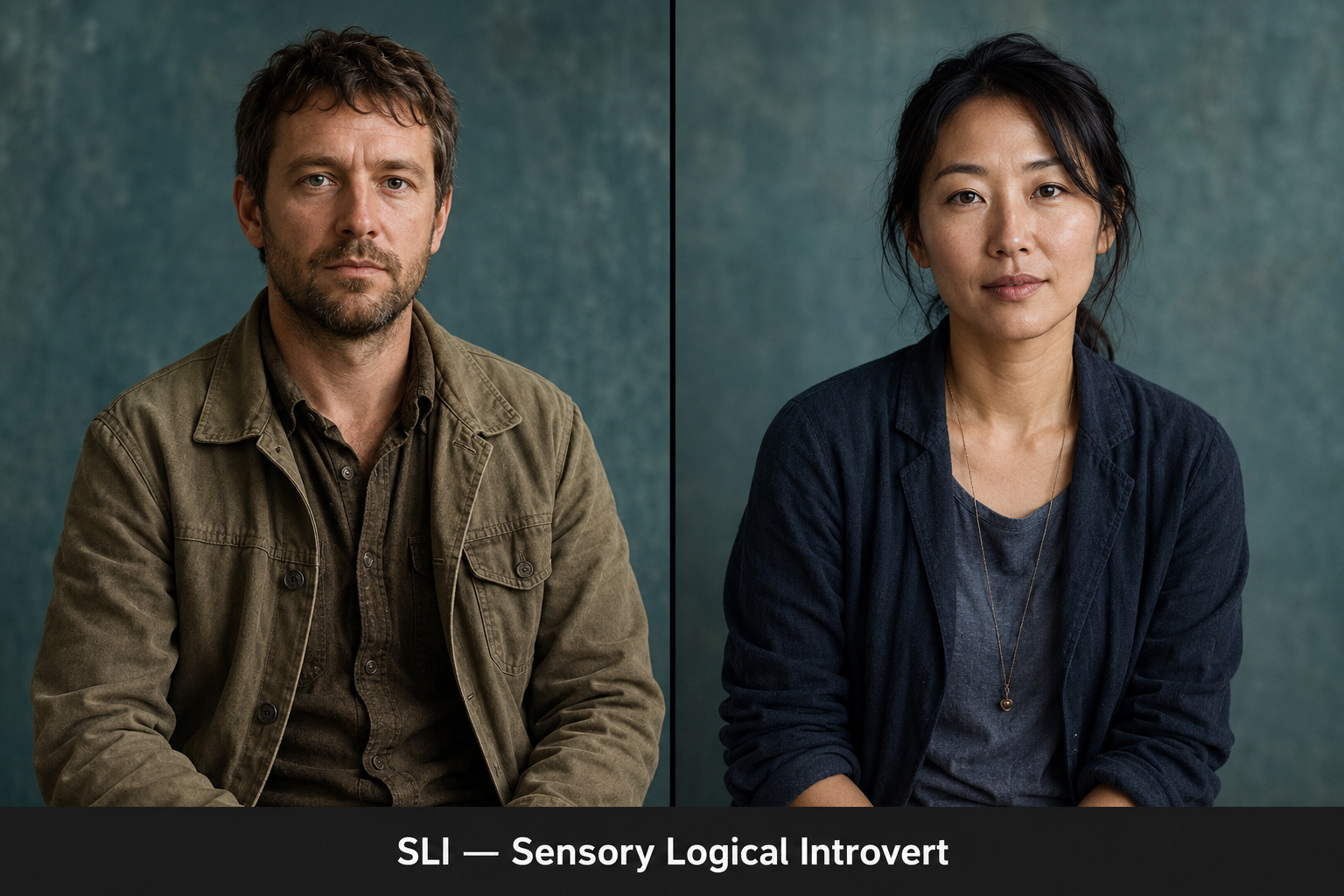
SLI diverse portrait set fictional type portrait

Male story

Hiroshi

Hiroshi restores antique woodworking tools in a workshop in Kyoto and brings to this a quality of attention so granular that visitors to the workshop sometimes find it quieting, like being near something very old and very still. He is not demonstrating anything. He is working. He learns the history of a tool before he touches it — not because the history changes the metalwork, but because it is important to know what he is handling. The restoration aims at original function, recovered. He does not add. He removes what is wrong and leaves what is right. He can look idle while his senses are doing serious work. A machine sound, a dull knife, a change in weather, a strained posture: these details tell him what condition the world is in and what quiet intervention will restore it.

Female story

Amina

Amina is a ranger in a national park in northern Kenya and reads landscape with the precise attention of someone who knows its normal state — which means she also knows, immediately, when something is off. A track cutting the wrong angle. A waterhole with altered sediment. She does not romanticise the work. The environment requires management as much as it requires presence, and she manages it methodically, without sentimentality about either the difficulty or the beauty. She finds both useful. The beauty tells her what is working. The difficulty tells her what isn't. Her practicality is graceful because it does not announce itself. She improves things by touch and timing, making a garment sit better, a tool work cleaner, a schedule breathe more naturally, then stepping back before anyone can turn it into a performance.

Intertype relations

SLI In Relation

How SLI meets each of the sixteen types. Open a relation to read it; each links to the full relation page.

Dualitywith IEE — The Inspirer

The IEE figure is doing Ne(F.) — Inspiration. Possibilities arrive with a personal felt charge of significance and excitement rather than being deliberately constructed. The creative impulse is spontaneous — animated, gestural, the ideas experienced as personally vivid and meaningful from the inside rather than built as conceptual architecture from the outside. The IEE is not generating a systematic map of possibilities. They are feeling the aliveness of what could be, and that felt charge is genuine information about what is worth pursuing. The inspiration is real. What it lacks, on its own, is a precise account of what is actually present to work with.

Without that account the IEE's felt possibilities remain personally vivid but practically unanchored — charged with significance but not yet in contact with the specific functional reality of the situation. The inspiration points somewhere. It needs to know what is actually there when it arrives.

Read the full Duality section
Identitywith SLI — The Craftsman

Two SLI types encounter in each other a sensory precision that mirrors completely. Every instance of controlled selective attention on functional physical detail by one is immediately recognised by the other — the observation deepens in both directions, each attending to the same physical material with the same quality of disciplined receptive precision.

What doubles: Si(T.) controlled external sensory observation, disciplined receptive focus on functional physical detail, the careful attention to what is actually present in the physical environment. Te(S.) practical method — the applied technique that makes observation actionable — also doubles. Two instances of the same precisely observant physical mode attending in parallel.

Read the full Identity section
Mirrorwith LSE — The Director

Same structural rule. LSE leads with Te(S.) and creates with Si(T.). SLI leads with Si(T.) and creates with Te(S.). Same two functions, same S./T. sub-variant, reversed priority.

LSE leads with Te(S.) Praxis and creates with Si(T.) Observation. The LSE draws on controlled sensory attention in service of practical experimentation — precise sensory perception as the instrument by which methods are tested and results evaluated. The Si(T.) reads what is actually there; the Te(S.) extracts from it what works. Observation is the instrument. Praxis is the point.

Read the full Mirror section
Activitywith EII — The Humanist

Same structural rule. SLI's Ego fills EII's Super-Id with inverted priority; EII's Ego fills SLI's Super-Id with inverted priority.

SLI leads with Si(T.) Observation and creates with Te(S.) Praxis. The EII's Super-Id seeks Te(S.) as Suggestive — what EII most deeply wants — and Si(T.) as Activating. SLI's controlled selective sensory attention energises the EII, giving the abstract principled conviction precise physical grounding and contact with what is actually present; the practical hands-on effectiveness that flows from SLI's careful observation is what the EII most wants — it gives the moral idealism concrete method and the capacity to produce real outcomes.

Read the full Activity section
Kindredwith SEI — The Mediator

The SLI and SEI are both doing Si. Both are grounded, quality-oriented, and attentive to the physical present with a care and precision that marks them out from other types. The Kindred recognition between them is one of the most immediately legible in the system — both inhabiting the sensation domain with genuine seriousness, both valuing the concrete here and now in a way that other types rarely match.

The SLI's Si(T.) operates through controlled selective observation — a rational and detached deployment of an irrational element. Sensory faculties are directed deliberately, filtered for functional relevance, attending to specific external details of what the environment is actually showing. The body is slightly withdrawn from direct contact in order to observe more precisely. The physical present is known through careful directed external attention.

Read the full Kindred section
Semi-Dualitywith ILE — The Inventor

Same structural rule. Each type's leading function provides the right element, wrong sub-variant for the other's Suggestive.

ILE leads with Ne(T.) Ideation — detached conceptual imagination, architectural generation of concept space from outside it. The SLI's Suggestive is Ne(F.) — felt aliveness to possibility, inspiration experienced from inside as personally vivid and significant. ILE provides Ne(T.) instead: conceptual architecture mapped with analytical detachment, possibility space explored as structure. The element is right — the SLI genuinely values and seeks Ne — but the SLI most deeply wants the personally felt charge of inspiration, the sense of possibility that arrives with inner significance, and what arrives is concept generation that is structurally rich but analytically distanced. Genuinely stimulating. Slightly outside itself rather than felt from within.

Read the full Semi-Duality section
Businesswith ILI — The Critic

The SLI and ILI can work alongside each other. Both are composed. Both are analytically precise. Both are externally directed in their engagement with their respective domains and neither operates from personal felt charge or visceral internal drive. The shared T. sub-variant means both are in the detached objective register — cool, measured, producing accurate assessments through careful external attention rather than through inner conviction or somatic engagement. From the outside they can appear very similar — two quietly precise analytical types who observe carefully and arrive at accurate conclusions without emotional colour or visceral drive. This surface resemblance is genuine and creates the Business/Lookalike quality. They can function alongside each other in the same environment, recognise each other as operating with genuine precision, and engage with each other's assessments even while finding them consistently oriented in the wrong direction.

The SLI figure is doing Si(T.) — Observation. Sensory faculties are directed with controlled precision at the specific functional details of what is actually and immediately present — the physical system examined carefully, the quality parameters assessed against what is concretely here, the attention deliberately filtered for functional relevance. The SLI is not immersed in the felt quality of the physical present from the inside. The observation is controlled and externally directed — a precise account of what is actually here right now, in this specific physical situation. The present is the point. What is not immediately present is not the SLI's primary concern.

Read the full Business section
Illusionarywith SEE — The Politician

Same structural rule.

SEE leads with Se(F.) Impetus — visceral mobilising drive, full-body somatic exertion toward concrete aims. In SLI's Model L stack, Se(F.) sits at the A3 Ignoring position. SLI finds it uninteresting and unrewarding to engage directly.

Read the full Illusionary section
Quasi-Identitywith LSI — The Inspector

Same structural rule. LSI's Si sits at position 8 — strong, naturally deployed, not what LSI orients toward as primary. SLI's Ti sits at position 8 — equally strong, equally natural, equally not oriented toward.

Of all eight Quasi-identical pairings, this one produces the most surface similarity. Both are physically present. Both are precise. Both are quiet and practically engaged with material reality. Both share the S./T. sub-variant — embodied, externally directed, detached in their mode of engagement. From any distance they can appear to be doing the same thing.

Read the full Quasi-Identity section
Super-Egowith IEI — The Mystic

Same structural rule. SLI's Si sits at IEI's Role position. IEI's Ni sits at SLI's Role position. Full strength on both sides, landing where the other strains most.

SLI leads with Si(T.) Observation — controlled selective external attention. The SLI directs receptive sensory focus onto functional physical detail: what is this material actually like, what does controlled attention reveal about its sensory qualities, what is present here that undirected perception would miss. The engagement is outward but governed — disciplined intake, not somatic immersion. The SLI is present to physical reality with precision.

Read the full Super-Ego section
Extinguishmentwith SLE — The Marshal

Same structural rule. SLI's Ego block Si(T.)/Te(S.) sits exactly in SLE's Contributive capacity. SLE's Ego block Se(T.)/Ti(S.) sits exactly in SLI's Contributive capacity.

Read the full Extinguishment section
Conflictwith EIE — The Orator

Same structural rule. EIE's base Fe(N.) sits exactly at SLI's D2 Vulnerable. SLI's base Si(T.) sits exactly at EIE's D2 Vulnerable.

EIE leads with Fe(N.) Sentiment — inner passion expressed through dramatic rhetorical address, deeply felt conviction conveyed through symbolic gesture aimed at inciting others to feel and act. In SLI's Model L stack, Fe(N.) sits at the Vulnerable position. SLI is genuinely inept with inner emotional rhetoric, treats it with careless indifference. When EIE's dramatic address fills the shared space — passion shaped into inciting symbolic form, the rhetorical charge impossible to ignore — SLI has no functional register to receive it. The emotional incitement does not translate into anything the SLI's sensory mode can attend to or ground.

Read the full Conflict section
Supervision: Supervisorwith LIE — The Entrepreneur

SLI leads with Si(T.) Observation and creates with Te(S.) Praxis. The Te(S.) creative flows naturally as the practical hands-on method that makes SLI's careful sensory observation actionable — concrete applied technique in service of sensory understanding. The SLI is not trying to ground LIE's strategic reasoning in practical technique. The applied method simply makes sensory findings usable.

Read Supervision in the Model A library
Supervision: Superviseewith ESE — The Host

SLI leads with Si(T.) Observation — 4d, 4p, controlled selective sensory attention at maximum strength. Against ESE's Si(F.) creative this lands on a 3d position. The SLI's sensory precision genuinely adjusts ESE's somatic ease. But this is the lesser pressure.

Read Supervision in the Model A library
Benefit: Benefactorwith ESI — The Guardian

SLI leads with Si(T.) Observation — controlled selective external sensory attention as primary mode. The Te(S.) Praxis creative flows naturally as the hands-on practical method that makes that sensory observation actionable: concrete technique, material testing, the flexible use of resources to improve physical workflow. The SLI is not trying to provide strategic direction for the ESI. The practical method simply flows in service of sensory understanding.

Read Benefit — Model A
Benefit: Beneficiarywith LII — The Analyst

LII leads with Ti(N.) Intellect — abstract structural logic as primary mode. The Ne(T.) Ideation creative flows naturally as the conceptual generation that serves that structure: branching possibility space opened in service of arriving at communicable logical framework. The LII is not trying to inspire the SLI. The conceptual generation simply serves the structural resolution.

Read Benefit — Model A

A note on this type

What Model L Adds

Model A identifies SLI as Si-leading with Te Creative. Model-L specifies that this is Si(T.) — Observation, the external and functional mode of sensation, supported by Te(S.) — Praxis.

This distinction matters when separating SLI from SEI. Both lead with Si in Model A terms, but SLI's Si(T.) is observational, material, and accuracy-oriented. SEI's Si(F.) is subjective, enlivening, and tied to comfort and felt vitality.

For SLI, Model-L shows why craft and perception are inseparable: the type notices the physical field precisely, then improves it through workable method.

Attribution: Model-L is Kimani White's original framework. This interpretation is the author's own.

B Radial Group

Supported Same-Club Positions

B positions share the A capacity's rational or irrational club orientation. They are radial, foreground, and resistant: available as conscious support, but not as effortless as the central A cross.

B1 — CorrespondentNi(T.) — Apprehension

Derivation: radial + foreground + resistant · 3D / 2P

Conscious support that can correspond with the A region. It is capable enough to be useful, but it asks for deliberate handling rather than automatic expression.

B2 — CollaborativeTe(N.) — Reason

Derivation: radial + foreground + resistant · 2D / 3P

A visible support position that collaborates with the type's central orientation. It receives attention and can help the profile work outwardly, but it is less dimensionally equipped than the A positions.

B3 — CompensatoryNe(T.) — Ideation

Derivation: radial + foreground + resistant · 2D / 3P

A compensating support position. It helps cover less central areas of the cross while still requiring conscious effort and structural management.

B4 — InstrumentalTi(N.) — Intellect

Derivation: radial + foreground + resistant · 3D / 2P

A workable instrument. It can be applied when needed as practical support, without becoming the type's main orientation.

C Radial Group

Contrasting Opposite-Club Positions

C positions take the opposite club orientation from A. They are radial, background, and facile: indirect resources that complement the type's main cross from the contrasting axis.

C1 — SubsidiarySi(F.) — Stimulation

Derivation: radial + background + facile · 3D / 2P

Quiet background support from the contrasting club orientation. It works as a subsidiary resource rather than a leading concern.

C2 — NegligentFe(S.) — Affect

Derivation: radial + background + facile · 2D / 3P

Indirect background material that may be psychologically noticeable but is easy to neglect. It colours the profile without becoming a central task.

C3 — PromptingSe(F.) — Impetus

Derivation: radial + background + facile · 2D / 3P

A prompting support position. It nudges the type toward material that complements the A capacity from the opposing axis.

C4 — GalvanizingFi(S.) — Animus

Derivation: radial + background + facile · 3D / 2P

A galvanizing support position. It shapes output from the contrasting axis, adding momentum without becoming a direct Model A anchor.

Classification

Dichotomies and Small Groups

Fifteen Reinin dichotomies

  1. Integrator
  2. Sensory
  3. Logical
  4. Irrational
  5. Holist
  6. Accepter
  7. Integrifier
  8. Transforming
  9. Determined
  10. Contrarian
  11. Space-Locked
  12. Speech-Locked
  13. Denier
  14. Antithetic
  15. Anticlockwise

Seven small groups

Quadra
Delta
Club
Realist
Temperament
Aligning
Tournament
Authenticity
Axis
Activist
Standoff
Cycler
Course
Healer