


Model L · Intertype Relations

Activity Relations — Model L

Mutual energising with a calibration gap.What each type seeks arrives naturally, but shaped by the other type's priority.

Model A To Model L

Where Activity Energises

Model A describes Activity partners as types whose Ego blocks fill each other's Super-Id blocks. Each partner provides genuinely valued material, but with inverted priority compared with Duality.

Model L makes the calibration gap visible: what each type most deeply seeks arrives as the other's creative output, shaped by the leading function it serves.

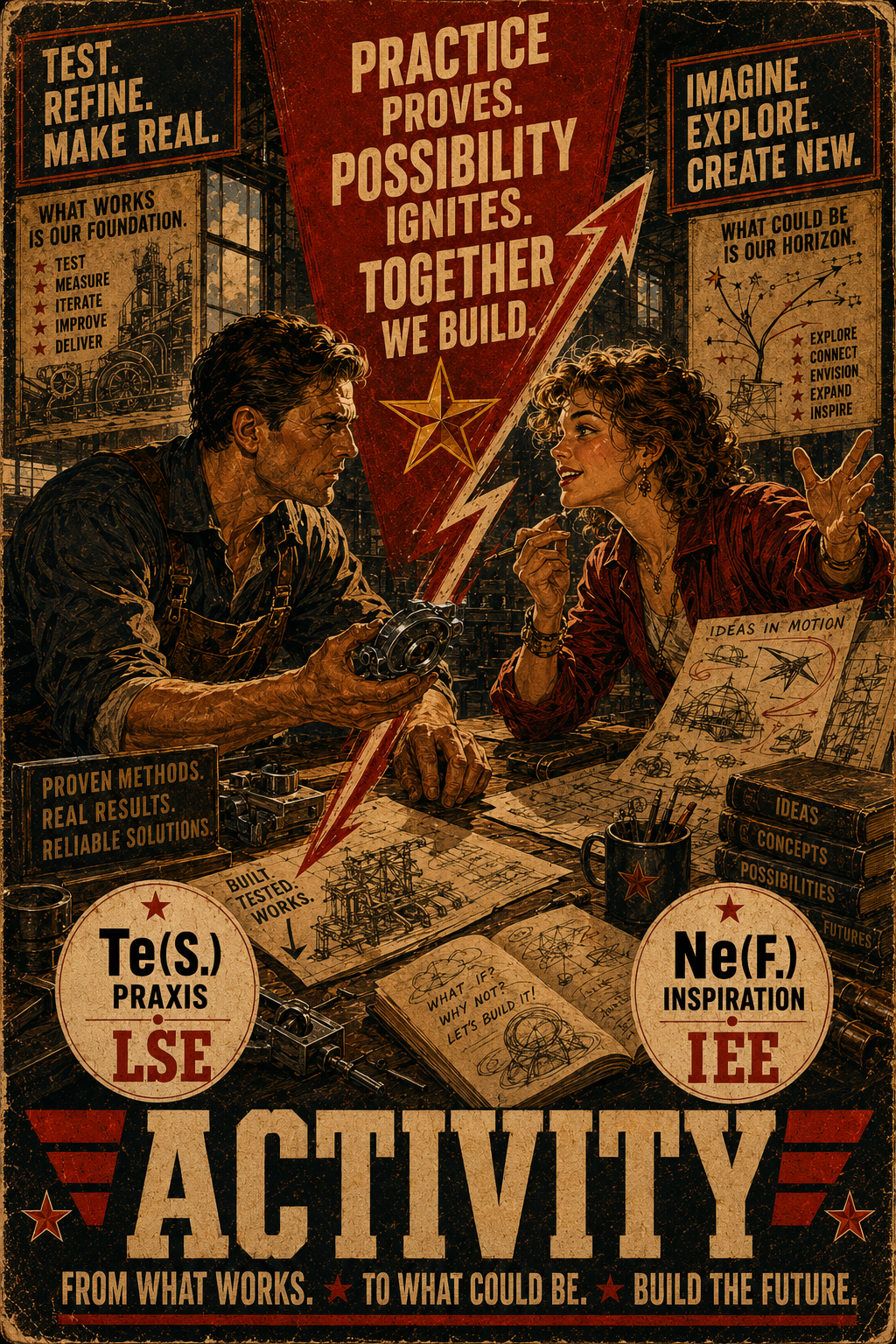
Activity relation poster

Activity Pair Menu

Complete Correspondence, Inverted Priority

This page presents the Model L Activity series: pairs where each Ego block corresponds completely to the other's Super-Id, while the Suggestive material arrives through the partner's Creative function.

Intellect element illustration
Ti(N.) Intellect · LII
Stimulation element illustration
Si(F.) Stimulation · SEI

Ti(N.) Intellect / Si(F.) Stimulation — LII and SEI

In Model A, Activity partners carry each other's full Ego block in their Super-Id — the block of what each type genuinely values and seeks from others. The correspondence is complete: every element, every sub-variant matches. But the priority is inverted relative to Dual. In Dual, A's leading function fills B's Suggestive — the position of what B most deeply seeks — as the partner's primary, most concentrated output. In Activity, A's leading fills B's Activating instead. What B most deeply seeks is what A produces as creative, not as leading. It arrives genuinely and naturally, but always shaped by the function it serves.

The result is a relationship that is energising, mutually beneficial, and never quite perfectly calibrated. Each type provides what the other genuinely needs. Neither provides it in quite the form the other would most naturally receive.

Model L makes the specific exchange visible.

LII leads with Ti(N.) Intellect and creates with Ne(T.) Ideation. The SEI's Super-Id seeks Ne(T.) as Suggestive — what the SEI most deeply wants — and Ti(N.) as Activating. LII's base activates SEI; LII's creative satisfies what SEI most seeks. The structured logical intelligence energises the SEI into responsive aliveness; the conceptual generation that emerges from it is what the SEI most wants to receive.

SEI leads with Si(F.) Stimulation and creates with Fe(S.) Affect. The LII's Super-Id seeks Fe(S.) as Suggestive — what the LII most deeply wants — and Si(F.) as Activating. SEI's base activates LII; SEI's creative satisfies what LII most seeks. The somatic warmth and bodily ease energises the LII out of self-contained abstraction; the collective atmospheric warmth that flows from it is what the LII most wants to receive.

The slight calibration gap: what LII most deeply seeks — Fe(S.) collective warmth — arrives as the SEI's creative output, in service of the SEI's Si(F.) orientation toward immediate bodily ease. The warmth is genuine but it is the byproduct of somatic attention rather than the primary offering. What SEI most deeply seeks — Ne(T.) conceptual generation — arrives as the LII's creative output, in service of the LII's Ti(N.) structural logic. The generativity is genuine but it is in service of arriving at a framework rather than opening possibility for its own sake.

Both receive what they genuinely want. Neither receives it as the other's first and primary gift.

Activity relation illustration for LII and SEI
Ideation element illustration
Ne(T.) Ideation · ILE
Affect element illustration
Fe(S.) Affect · ESE

Ne(T.) Ideation / Fe(S.) Affect — ILE and ESE

Same structural rule. ILE's Ego fills ESE's Super-Id with inverted priority; ESE's Ego fills ILE's Super-Id with inverted priority. Full element and sub-variant correspondence. Priority slightly off-centre throughout.

ILE leads with Ne(T.) Ideation and creates with Ti(N.) Intellect. The ESE's Super-Id seeks Ti(N.) as Suggestive — what ESE most deeply wants — and Ne(T.) as Activating. ILE's conceptual generation energises the ESE into atmospheric responsiveness; the structural logical clarity that emerges from the exploration is what the ESE most wants to receive.

ESE leads with Fe(S.) Affect and creates with Si(F.) Stimulation. The ILE's Super-Id seeks Si(F.) as Suggestive — what ILE most deeply wants — and Fe(S.) as Activating. ESE's collective atmospheric warmth energises the ILE out of detached concept-space; the somatic sensory ease and physical comfort that flows from it is what the ILE most wants to receive.

Both are outward-broadcasting and expansively energetic. Both are Dynamic — continuously generating output at pace. The Activity exchange here is the loudest of the eight pairings: two types whose primary modes both project strongly outward, each amplifying the other's energy in active mutual feed.

The calibration gap: the ILE most deeply wants Si(F.) somatic ease — but it arrives as the ESE's creative output, shaped by and in service of collective atmosphere generation. The ease is genuine but atmospheric in character. The ESE most deeply wants Ti(N.) structural clarity — but it arrives as ILE's creative output, shaped by conceptual exploration. The clarity is genuine but provisional, arrived at on the way to further conceptual opening.

Each provides the other's most wanted. Each provides it through their own primary orientation, flavoured accordingly.

Activity relation illustration comparing ILE × ESE
Habitus element illustration
Ti(S.) Habitus · LSI
Reverie element illustration
Ni(F.) Reverie · IEI

Ti(S.) Habitus / Ni(F.) Reverie — LSI and IEI

Same structural rule. LSI's Ego fills IEI's Super-Id with inverted priority; IEI's Ego fills LSI's Super-Id with inverted priority.

LSI leads with Ti(S.) Habitus and creates with Se(T.) Actuation. The IEI's Super-Id seeks Se(T.) as Suggestive — what IEI most deeply wants — and Ti(S.) as Activating. LSI's embodied procedural structure energises the IEI, giving the inner narrative felt weight and concrete grounding; the regulatory external force that flows from LSI's structural authority is what the IEI most wants — it gives the narrative vision physical reality and the capacity to act.

IEI leads with Ni(F.) Reverie and creates with Fe(N.) Sentiment. The LSI's Super-Id seeks Fe(N.) as Suggestive — what LSI most deeply wants — and Ni(F.) as Activating. IEI's inner narrative vision energises the LSI, giving the codified structural procedure felt temporal significance; the inner passion shaped into rhetorical address that flows from IEI's narrative immersion is what the LSI most wants — it gives the structural authority emotional meaning and direction.

This pairing carries a specific quality unlike the more outwardly active pairs. Both types are in significant respects inward and self-directed. The LSI's authority is embodied and contained; the IEI's aspiration is interior and narratively absorbed. The Activity exchange happens across that inwardness — the structure giving the vision grounding, the vision giving the structure temporal and emotional depth. Neither is naturally outward-projecting, which makes the mutual energising quality here more intimate and less immediately visible than in other pairs.

The calibration gap: the LSI most deeply wants Fe(N.) inner passion expressed rhetorically — but it arrives shaped by and in service of the IEI's narrative aspiration. The emotional incitement is genuine but flows toward narrative rather than structural ends. The IEI most deeply wants Se(T.) regulatory force — but it arrives shaped by and in service of the LSI's codified procedural structure. The force is genuine but governed by established form rather than freely directed.

Activity relation illustration comparing LSI × IEI
Actuation element illustration
Se(T.) Actuation · SLE
Sentiment element illustration
Fe(N.) Sentiment · EIE

Se(T.) Actuation / Fe(N.) Sentiment — SLE and EIE

Same structural rule. SLE's Ego fills EIE's Super-Id with inverted priority; EIE's Ego fills SLE's Super-Id with inverted priority.

SLE leads with Se(T.) Actuation and creates with Ti(S.) Habitus. The EIE's Super-Id seeks Ti(S.) as Suggestive — what EIE most deeply wants — and Se(T.) as Activating. SLE's measured regulatory force energises the EIE, giving the rhetorical passion physical grounding and concrete authority; the embodied structural procedure that flows from SLE's governance is what the EIE most wants — it gives the emotional incitement structural legitimacy and physical weight.

EIE leads with Fe(N.) Sentiment and creates with Ni(F.) Reverie. The SLE's Super-Id seeks Ni(F.) as Suggestive — what SLE most deeply wants — and Fe(N.) as Activating. EIE's inner passion expressed rhetorically energises the SLE, giving the regulatory force direction and felt significance; the narrative vision and temporal depth that flows from EIE's passionate address is what the SLE most wants — it gives the governance strategic vision and a meaningful arc.

Both types are forceful, outward-directed, and capable of commanding a physical environment and an audience simultaneously. The Activity exchange here combines physical authority and rhetorical passion in mutual amplification — the force making the passion credible, the passion making the force purposeful. This is one of the most visibly powerful pairings in the Activity set.

The calibration gap: the SLE most deeply wants Ni(F.) narrative vision — but it arrives shaped by and in service of the EIE's rhetorical incitement. The vision is genuine but aimed at emotional impact rather than pure strategic comprehension. The EIE most deeply wants Ti(S.) embodied structural procedure — but it arrives shaped by and in service of the SLE's regulatory governance. The structure is genuine but defined by what governance requires rather than what codified form prescribes.

Activity relation illustration comparing SLE × EIE
Reason element illustration
Te(N.) Reason · LIE
Impetus element illustration
Se(F.) Impetus · SEE

Te(N.) Reason / Se(F.) Impetus — LIE and SEE

Same structural rule. LIE's Ego fills SEE's Super-Id with inverted priority; SEE's Ego fills LIE's Super-Id with inverted priority.

LIE leads with Te(N.) Reason and creates with Ni(T.) Apprehension. The SEE's Super-Id seeks Ni(T.) as Suggestive — what SEE most deeply wants — and Te(N.) as Activating. LIE's applied strategic reasoning energises the SEE, giving the visceral force direction and productive purpose; the detached strategic pattern tracking that flows from LIE's applied reasoning is what the SEE most wants — it gives the somatic exertion temporal intelligence and the capacity to anticipate.

SEE leads with Se(F.) Impetus and creates with Fi(S.) Animus. The LIE's Super-Id seeks Fi(S.) as Suggestive — what LIE most deeply wants — and Se(F.) as Activating. SEE's visceral mobilising force energises the LIE, giving the strategic reasoning somatic urgency and physical commitment; the visceral particular conviction that flows from SEE's impetus is what the LIE most wants — it gives the applied strategy a felt directional grounding and a specific relational purpose.

The pairing combines detached strategic intelligence with visceral physical force at the point where analysis becomes action. The LIE reads the situation and assembles strategy; the SEE provides the physical commitment to execute it. The SEE generates force; the LIE provides the strategic direction that converts force into effective outcome.

The calibration gap: the LIE most deeply wants Fi(S.) visceral particular conviction — but it arrives shaped by and in service of the SEE's somatic exertion. The conviction is genuine but carried in the momentum of physical force rather than standing as a settled prior verdict. The SEE most deeply wants Ni(T.) detached strategic apprehension — but it arrives shaped by and in service of the LIE's applied reasoning toward outcomes. The temporal intelligence is genuine but oriented toward actionable strategy rather than pure pattern comprehension.

Activity relation illustration comparing LIE × SEE
Animus element illustration
Fi(S.) Animus · ESI
Apprehension element illustration
Ni(T.) Apprehension · ILI

Fi(S.) Animus / Ni(T.) Apprehension — ESI and ILI

Same structural rule. ESI's Ego fills ILI's Super-Id with inverted priority; ILI's Ego fills ESI's Super-Id with inverted priority.

ESI leads with Fi(S.) Animus and creates with Se(F.) Impetus. The ILI's Super-Id seeks Se(F.) as Suggestive — what ILI most deeply wants — and Fi(S.) as Activating. ESI's visceral particular conviction energises the ILI, giving the strategic pattern tracking felt relational grounding and a specific human reality to attend to; the mobilising visceral force that flows from ESI's particular bonds is what the ILI most wants — it gives the apprehension of patterns physical consequence and somatic reality.

ILI leads with Ni(T.) Apprehension and creates with Te(N.) Reason. The ESI's Super-Id seeks Te(N.) as Suggestive — what ESI most deeply wants — and Ni(T.) as Activating. ILI's detached strategic pattern tracking energises the ESI, giving the visceral particular conviction wider temporal context and strategic implication; the applied reasoned inference that flows from ILI's apprehension is what the ESI most wants — it gives the particular felt bonds a logical framework and practical strategic direction.

This pairing is one of the quietest in the Activity set. Both types are inward, contained, and non-broadcasting as their primary mode. Both attend to their objects with private intensity — the ESI to particular persons and bonds, the ILI to temporal patterns and strategic implication. The Activity exchange happens in a register that is felt and real without being outwardly demonstrative.

The calibration gap: the ESI most deeply wants Te(N.) applied reasoned strategy — but it arrives shaped by and in service of the ILI's strategic pattern apprehension. The reasoning is genuine but oriented toward comprehension rather than immediate practical application. The ILI most deeply wants Se(F.) visceral somatic force — but it arrives shaped by and in service of the ESI's particular relational bonds. The force is genuine but directed by particular conviction rather than freely mobilising.

Activity relation illustration comparing ESI × ILI
Praxis element illustration
Te(S.) Praxis · LSE
Inspiration element illustration
Ne(F.) Inspiration · IEE

Te(S.) Praxis / Ne(F.) Inspiration — LSE and IEE

Same structural rule. LSE's Ego fills IEE's Super-Id with inverted priority; IEE's Ego fills LSE's Super-Id with inverted priority.

LSE leads with Te(S.) Praxis and creates with Si(T.) Observation. The IEE's Super-Id seeks Si(T.) as Suggestive — what IEE most deeply wants — and Te(S.) as Activating. LSE's hands-on practical effectiveness energises the IEE, giving the felt inspiration concrete material grounding and the evidence that something can actually be built; the controlled selective sensory observation that flows from LSE's practical experimentation is what the IEE most wants — it gives the imaginative possibility precise physical reality and the discipline to follow through.

IEE leads with Ne(F.) Inspiration and creates with Fi(N.) Soul. The LSE's Super-Id seeks Fi(N.) as Suggestive — what LSE most deeply wants — and Ne(F.) as Activating. IEE's felt aliveness to possibility energises the LSE, giving the practical experimentation imaginative range and renewed direction; the abstract foundational conviction that flows from IEE's inspired exploration is what the LSE most wants — it gives the practical effectiveness principled grounding and a sense of what the work is ultimately for.

This pairing bridges the concrete and the imaginative in a way that is productive and mutually generative. The LSE provides the practical evidence that possibilities can be realised; the IEE provides the imaginative aliveness that gives practical work its direction and felt significance. Each supplies what the other's strength most requires to function fully.

The calibration gap: the LSE most deeply wants Fi(N.) abstract principled conviction — but it arrives shaped by and in service of the IEE's felt imaginative exploration. The conviction is genuine but carried in the momentum of inspired possibility rather than standing as a settled foundational verdict. The IEE most deeply wants Si(T.) controlled sensory precision — but it arrives shaped by and in service of the LSE's practical method-finding. The precision is genuine but oriented toward effective application rather than sensory understanding for its own sake.

Activity relation illustration comparing LSE × IEE
Observation element illustration
Si(T.) Observation · SLI
Soul element illustration
Fi(N.) Soul · EII

Si(T.) Observation / Fi(N.) Soul — SLI and EII

Same structural rule. SLI's Ego fills EII's Super-Id with inverted priority; EII's Ego fills SLI's Super-Id with inverted priority.

SLI leads with Si(T.) Observation and creates with Te(S.) Praxis. The EII's Super-Id seeks Te(S.) as Suggestive — what EII most deeply wants — and Si(T.) as Activating. SLI's controlled selective sensory attention energises the EII, giving the abstract principled conviction precise physical grounding and contact with what is actually present; the practical hands-on effectiveness that flows from SLI's careful observation is what the EII most wants — it gives the moral idealism concrete method and the capacity to produce real outcomes.

EII leads with Fi(N.) Soul and creates with Ne(F.) Inspiration. The SLI's Super-Id seeks Ne(F.) as Suggestive — what SLI most deeply wants — and Fi(N.) as Activating. EII's abstract foundational conviction energises the SLI, giving the controlled sensory attention moral weight and a sense of why precision matters; the felt aliveness to possibility that flows from EII's principled idealism is what the SLI most wants — it gives the careful sensory engagement imaginative range and personal felt significance.

This pairing is among the quietest and most inwardly focused of the Activity set. Both types attend to their objects with disciplined, private care — the SLI to the sensory qualities of immediate physical reality, the EII to abstract principled conviction. Neither broadcasts outward as their primary mode. The Activity exchange is felt in the quality of attention each brings to the other rather than in outward dramatic expression.

The calibration gap: the SLI most deeply wants Ne(F.) felt imaginative possibility — but it arrives shaped by and in service of the EII's abstract moral conviction. The inspiration is genuine but inflected with principled seriousness rather than spontaneous generative aliveness. The EII most deeply wants Te(S.) practical hands-on effectiveness — but it arrives shaped by and in service of the SLI's controlled sensory observation. The practical method is genuine but oriented toward sensory understanding rather than direct productive outcome.

Activity relation illustration comparing SLI × EII

Activity Summary

Wanted Output, Slightly Off-Centre

File namePairA EgoB EgoA Creative → B SuggestiveB Creative → A Suggestive
activity-lii-seiLII × SEITi(N.) / Ne(T.)Si(F.) / Fe(S.)Ne(T.) → SEI seeksFe(S.) → LII seeks
activity-ile-eseILE × ESENe(T.) / Ti(N.)Fe(S.) / Si(F.)Ti(N.) → ESE seeksSi(F.) → ILE seeks
activity-lsi-ieiLSI × IEITi(S.) / Se(T.)Ni(F.) / Fe(N.)Se(T.) → IEI seeksFe(N.) → LSI seeks
activity-sle-eieSLE × EIESe(T.) / Ti(S.)Fe(N.) / Ni(F.)Ti(S.) → EIE seeksNi(F.) → SLE seeks
activity-lie-seeLIE × SEETe(N.) / Ni(T.)Se(F.) / Fi(S.)Ni(T.) → SEE seeksFi(S.) → LIE seeks
activity-esi-iliESI × ILIFi(S.) / Se(F.)Ni(T.) / Te(N.)Se(F.) → ILI seeksTe(N.) → ESI seeks
activity-lse-ieeLSE × IEETe(S.) / Si(T.)Ne(F.) / Fi(N.)Si(T.) → IEE seeksFi(N.) → LSE seeks
activity-sli-eiiSLI × EIISi(T.) / Te(S.)Fi(N.) / Ne(F.)Te(S.) → EII seeksNe(F.) → SLI seeks

The structural pattern across all eight: every Activity pair is a same-quadra pairing. Every pair involves complete element and sub-variant correspondence between one type's Ego and the other's Super-Id. What each type most deeply seeks — its Suggestive function — is what its Activity partner produces as creative, in service of that partner's own leading function. The energising quality of Activity is genuine and sustained. The calibration is always slightly off-centre. What you most want arrives shaped by someone else's priority — genuinely produced, never quite produced for its own sake.