
Model L · Intertype Relations

Mirror Relations — Model L

Same Ego tools, reversed priority.Recognition with persistent disagreement about what should lead.

Model A To Model L

Where Mirror Reverses Priority

Model A describes Mirror partners as types that share the same two Ego functions in swapped positions. Each type leads with what the other uses creatively, and creates with what the other leads.

Model L sharpens the pattern. The relation is not incomprehension or bypassing: it is genuine recognition, paired with a persistent disagreement about which of two shared tools should be in charge.

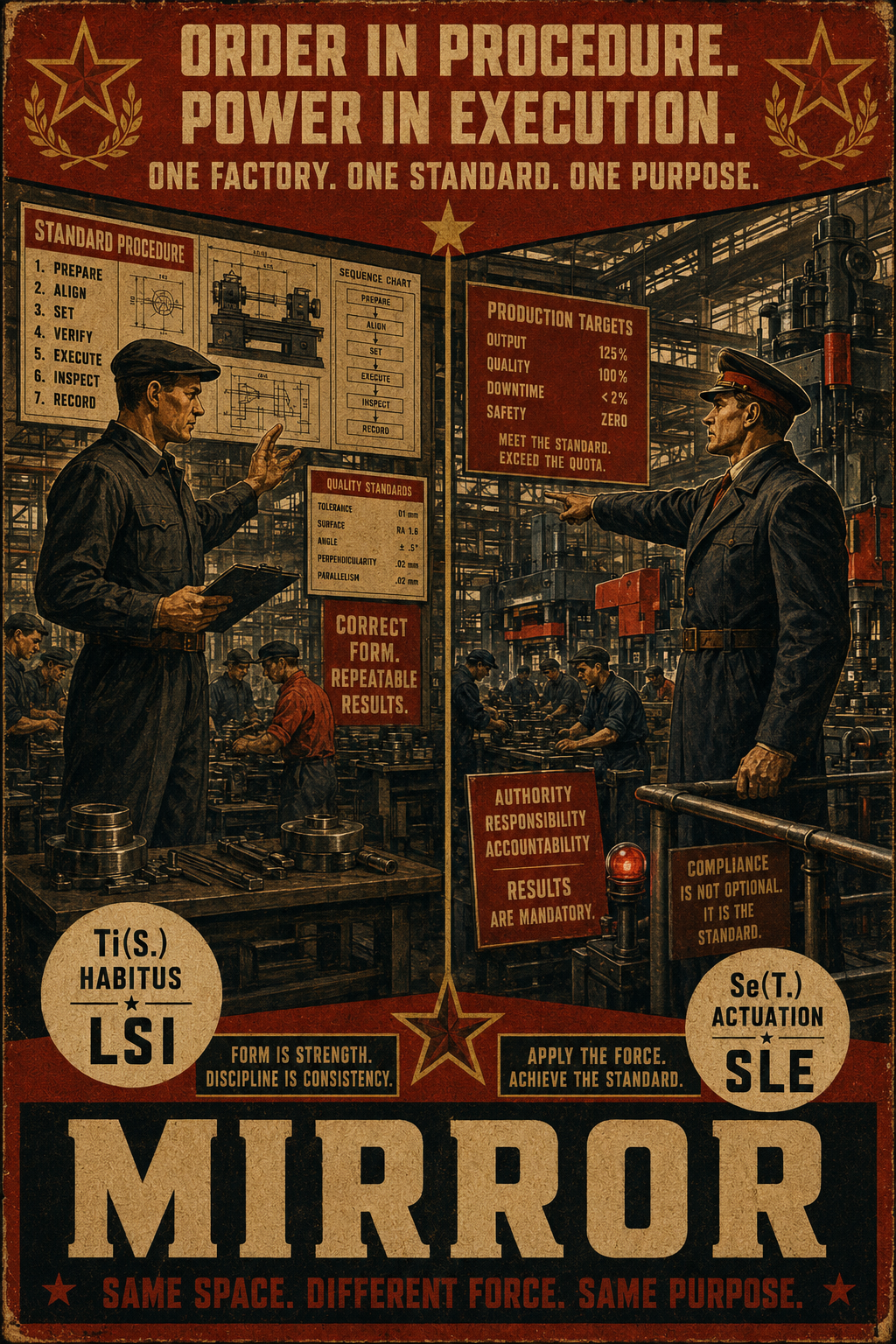
Mirror relation poster
Intellect element illustration
Ti(N.) Intellect · LII
Ideation element illustration
Ne(T.) Ideation · ILE

Ti(N.) Intellect / Ne(T.) Ideation — LII and ILE

In Model A, Mirror partners carry each other's Ego functions in swapped positions. LII leads with Ti(N.) and creates with Ne(T.). ILE leads with Ne(T.) and creates with Ti(N.). The same two functions, the same two sub-variants, reversed priority. Each type has immediate and complete access to what the other is doing — not the strained comprehension of Super-Ego, not the mutual bypass of Quasi-identity, but genuine recognition. The friction is not incomprehension. It is a persistent disagreement about which of the two shared tools should be in charge.

Model L makes the specific inversion visible.

LII leads with Ti(N.) Intellect and creates with Ne(T.) Ideation. The LII generates conceptual possibility in service of logical structure — branching exploration as a method for arriving at communicable, settled schema. The Ne(T.) opens material; the Ti(N.) resolves it. Generation is the instrument. Structure is the point.

ILE leads with Ne(T.) Ideation and creates with Ti(N.) Intellect. The ILE builds structural clarity in service of conceptual exploration — logical resolution as a method for making concept space navigable enough to explore further. The Ti(N.) organises material; the Ne(T.) continues moving through it. Structure is the instrument. Generation is the point.

Both types share the N./T. sub-variant — detached, analytically directed, comfortable with abstraction. The mutual recognition is immediate and genuine. Each understands exactly what the other is doing because each does it too, in a supporting role. The ILE has Ti(N.) as creative — it is not foreign, not strained, not uncomfortable. The LII has Ne(T.) as creative — equally natural, equally available. They are, in the most precise sense, doing the same things in the wrong order for each other.

The productive friction runs in one direction on both sides simultaneously. The LII finds the ILE's concept space prematurely open — connections keep proliferating when they should be resolving into settled structure. Every framework the LII tries to close, the ILE reopens with a further implication worth following. The ILE finds the LII's frameworks prematurely closed — the structure arrives before the full possibility space has been mapped. Every branch the ILE wants to pursue, the LII wants to consolidate into the schema already taking shape.

Neither is wrong within their own orientation. The LII needs Ne(T.) to remain generative long enough to produce good structure. The ILE needs Ti(N.) to remain structural enough to keep concept space navigable. Each is exactly what the other needs — and each keeps applying it at the wrong moment.
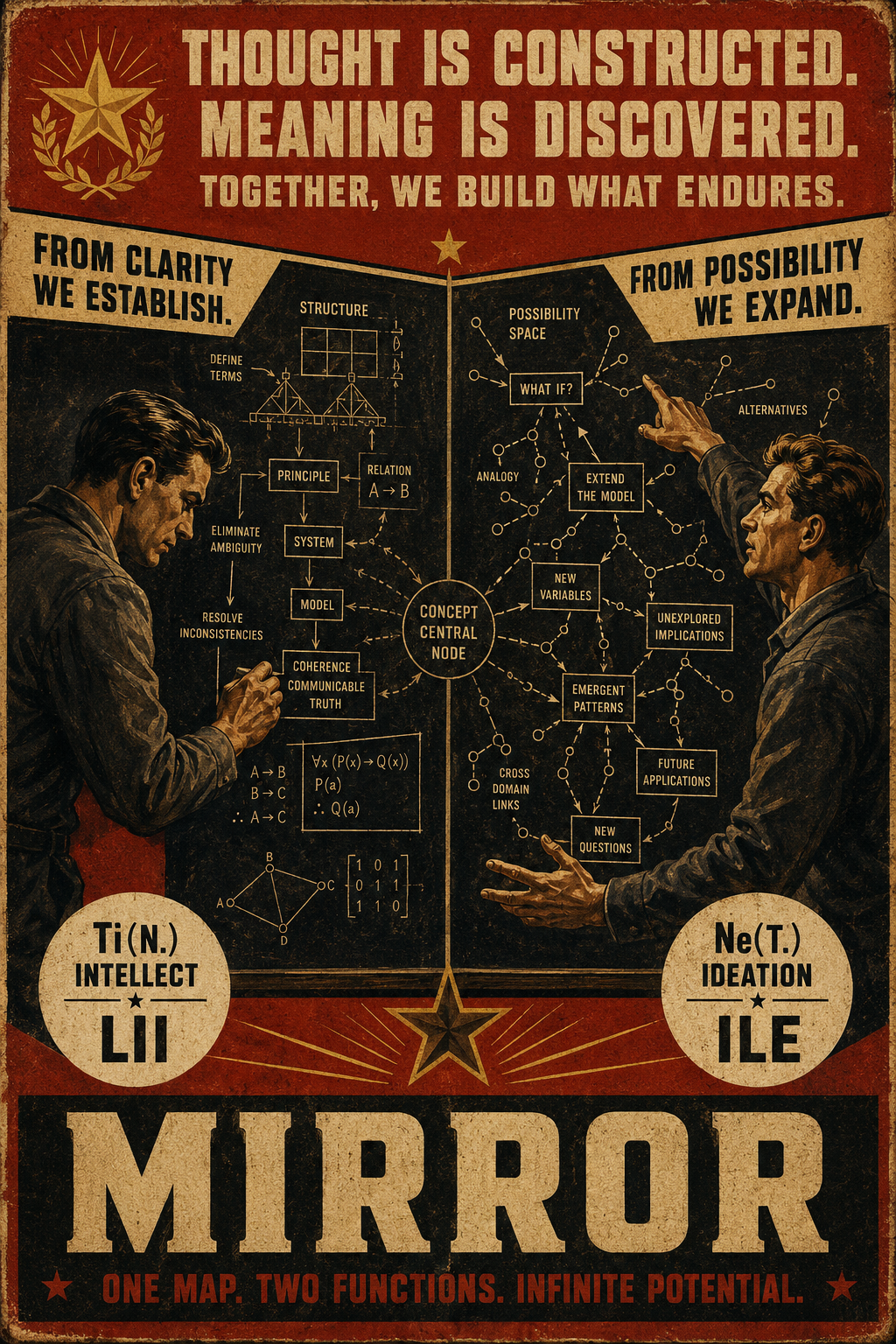

Mirror relation illustration comparing LII × ILE
Habitus element illustration
Ti(S.) Habitus · LSI
Actuation element illustration
Se(T.) Actuation · SLE

Ti(S.) Habitus / Se(T.) Actuation — LSI and SLE

Same structural rule. LSI leads with Ti(S.) and creates with Se(T.). SLE leads with Se(T.) and creates with Ti(S.). Same two functions, same S./T. sub-variant, reversed priority.

LSI leads with Ti(S.) Habitus and creates with Se(T.) Actuation. The LSI deploys regulatory force in service of codified structural procedure — physical authority as the instrument by which established form is enforced and maintained. The Se(T.) supplies the force; the Ti(S.) determines when and how it is applied. Governance is the instrument. Procedure is the point.

SLE leads with Se(T.) Actuation and creates with Ti(S.) Habitus. The SLE deploys codified structural procedure in service of regulatory physical governance — established form as the instrument by which the environment is brought into conformity with defined parameters. The Ti(S.) supplies the structure; the Se(T.) determines what that structure is in service of. Procedure is the instrument. Governance is the point.

The shared S./T. sub-variant means both types inhabit the same register of grounded, physically present, externally directed authority. Both are precise. Both are non-abstract. Both are quiet in the specific way that physical authority is quiet — not withdrawn but contained. The mutual recognition between them is immediate: each sees in the other someone who understands what it means to hold a physical environment to a standard.

The friction runs along a single axis: who is in charge of whom. For the LSI, force exists to enforce procedure. The structure is prior; the governance follows from it. An SLE who deploys force without sufficient procedural grounding appears to be governing arbitrarily — applying authority without the structural legitimacy that makes it valid. For the SLE, procedure exists to enable governance. The governance is prior; the structure serves it. An LSI who insists on procedural form when the situation demands immediate regulatory adjustment appears to be constraining effective authority with unnecessary rigidity.

Both are right within their own orientation. The LSI needs Se(T.) to enforce what procedure requires. The SLE needs Ti(S.) to give governance its structural coherence. Each carries exactly what the other needs as a creative function — deployed in service of a priority the other finds slightly inverted.

Mirror relation illustration comparing LSI × SLE
Sentiment element illustration
Fe(N.) Sentiment · EIE
Reverie element illustration
Ni(F.) Reverie · IEI

Fe(N.) Sentiment / Ni(F.) Reverie — EIE and IEI

Same structural rule. EIE leads with Fe(N.) and creates with Ni(F.). IEI leads with Ni(F.) and creates with Fe(N.). Same two functions, same N./F. sub-variant, reversed priority.

EIE leads with Fe(N.) Sentiment and creates with Ni(F.) Reverie. The EIE draws on inner narrative vision in service of rhetorical emotional incitement — felt temporal significance as the fuel that gives dramatic address its depth and charge. The Ni(F.) supplies the vision; the Fe(N.) shapes it into incitement aimed at an audience. Narrative is the instrument. Rhetoric is the point.

IEI leads with Ni(F.) Reverie and creates with Fe(N.) Sentiment. The IEI draws on rhetorical emotional expression in service of inner narrative aspiration — dramatic address as the outward form through which felt narrative significance finds expression. The Fe(N.) supplies the emotional charge; the Ni(F.) follows where it leads through imagined time. Rhetoric is the instrument. Narrative is the point.

The shared N./F. sub-variant means both types carry the same quality of inward personal charge — deep, felt, non-somatic, sourced from an interior register and expressed with genuine dramatic intensity. Both are capable of moving others. Both carry narrative vision and rhetorical power in equal measure. The mutual recognition between them can be profound: each sees in the other someone who understands what it means to hold significant felt meaning inside and find a form for it.

The friction is specific and persistent. The EIE wants the story shaped into something that moves people now — the narrative exists to fuel the address, and what matters is the emotional response it produces in the audience. When the IEI withdraws into inner narrative immersion instead of converting it into incitement, the EIE experiences this as squandering the dramatic charge: the story is there, the feeling is alive, the audience is waiting. The IEI wants the rhetoric to serve the unfolding of the story — the address exists to express what the narrative reveals, and what matters is the integrity of the imagined temporal arc. When the EIE shapes the narrative into rhetoric aimed at a specific response, the IEI experiences this as flattening it: the story has been instrumentalised before it has been fully inhabited.

Both carry Ni(F.) and Fe(N.) as genuine strengths. The disagreement is purely about which serves which.

Mirror relation illustration comparing EIE × IEI
Affect element illustration
Fe(S.) Affect · ESE
Stimulation element illustration
Si(F.) Stimulation · SEI

Fe(S.) Affect / Si(F.) Stimulation — ESE and SEI

Same structural rule. ESE leads with Fe(S.) and creates with Si(F.). SEI leads with Si(F.) and creates with Fe(S.). Same two functions, same S./F. sub-variant, reversed priority.

ESE leads with Fe(S.) Affect and creates with Si(F.) Stimulation. The ESE draws on sensory comfort and physical ease in service of collective atmospheric mood generation — somatic pleasure as the medium through which shared emotional texture is created and sustained. The Si(F.) supplies the sensory richness; the Fe(S.) broadcasts it outward into collective feeling. Sensory ease is the instrument. Atmosphere is the point.

SEI leads with Si(F.) Stimulation and creates with Fe(S.) Affect. The SEI draws on collective atmospheric warmth in service of immediate bodily comfort and sensory ease — shared emotional mood as the condition that makes immediate physical experience pleasurable. The Fe(S.) supplies the warmth; the Si(F.) inhabits and attends to what it creates in the body. Atmosphere is the instrument. Sensory ease is the point.

The shared S./F. sub-variant means both types are warm, somatically present, physically attentive. Both care about the felt quality of the immediate shared environment. Both attend to bodily comfort and collective feeling. The mutual recognition is easy and immediate: each finds in the other someone who understands the importance of the sensory and emotional quality of shared physical space.

The friction is gentle but persistent. The ESE attends to sensory comfort because it sustains collective atmosphere — a physically pleasant space makes shared feeling possible, and shared feeling is what matters. When the SEI retreats into private sensory absorption rather than contributing to the collective mood, the ESE experiences this as a withdrawal from what the shared space is for. The SEI attends to collective warmth because it enriches immediate bodily experience — a warm shared atmosphere makes the present moment pleasurable to inhabit, and present pleasure is what matters. When the ESE generates collective mood in ways that override rather than enhance individual sensory ease, the SEI experiences this as atmospheric pressure substituted for genuine physical comfort.

Both carry Fe(S.) and Si(F.) naturally and warmly. The disagreement is about which of them the other is in service of.

Mirror relation illustration comparing ESE × SEI
Reason element illustration
Te(N.) Reason · LIE
Apprehension element illustration
Ni(T.) Apprehension · ILI

Te(N.) Reason / Ni(T.) Apprehension — LIE and ILI

Same structural rule. LIE leads with Te(N.) and creates with Ni(T.). ILI leads with Ni(T.) and creates with Te(N.). Same two functions, same N./T. sub-variant, reversed priority.

LIE leads with Te(N.) Reason and creates with Ni(T.) Apprehension. The LIE draws on detached strategic pattern tracking in service of applied reasoning toward productive outcomes — temporal intelligence as a resource for assembling workable strategy. The Ni(T.) reads the pattern; the Te(N.) extracts from it what can be done. Apprehension is the instrument. Reason is the point.

ILI leads with Ni(T.) Apprehension and creates with Te(N.) Reason. The ILI draws on applied reasoning in service of detached strategic tracking of how things unfold — logical inference as a tool for sharpening the comprehension of temporal pattern. The Te(N.) organises what is known; the Ni(T.) follows where the pattern leads regardless of what anyone intends to do about it. Reason is the instrument. Apprehension is the point.

The shared N./T. sub-variant means both types are analytically precise, detached, non-somatic, comfortable with complexity and abstraction. Both are quiet. Both carry the same quality of intelligence that reads situations without being personally invested in them. The mutual recognition between LIE and ILI can be immediate and substantial — each senses in the other a mind that operates in a familiar register, that moves through evidence with the same kind of detached analytical precision.

The friction is clean and specific. The LIE wants the temporal pattern to yield actionable strategy. Pattern reading is in service of effective application — what matters is what the analysis enables. When the ILI continues tracking the pattern beyond the point where the LIE has extracted sufficient basis for action, it reads as rumination without productive application: the intelligence is present, the analysis is sound, but nothing is being done with it. The ILI wants the analytical reasoning to serve genuine comprehension of what is actually happening. Applied inference is in service of understanding — what matters is what the pattern actually means. When the LIE moves to strategy before the pattern has been fully apprehended, it reads as premature application: action assembled on incomplete understanding, strategy that may be locally effective but misses the deeper temporal shape.

Both are right within their own orientation. The LIE needs Ni(T.) to read the situation accurately before acting. The ILI needs Te(N.) to make the apprehension logically rigorous. Each carries exactly what the other needs — oriented in the wrong direction.

Mirror relation illustration comparing LIE × ILI
Animus element illustration
Fi(S.) Animus · ESI
Impetus element illustration
Se(F.) Impetus · SEE

Fi(S.) Animus / Se(F.) Impetus — ESI and SEE

Same structural rule. ESI leads with Fi(S.) and creates with Se(F.). SEE leads with Se(F.) and creates with Fi(S.). Same two functions, same S./F. sub-variant, reversed priority.

ESI leads with Fi(S.) Animus and creates with Se(F.) Impetus. The ESI deploys visceral mobilising force in service of protecting and enforcing particular relational bonds and aversions — somatic exertion as the instrument by which felt particular verdicts are enacted and defended. The Se(F.) supplies the force; the Fi(S.) determines what it is for. Force is the instrument. The bond is the point.

SEE leads with Se(F.) Impetus and creates with Fi(S.) Animus. The SEE deploys visceral particular felt conviction in service of directing somatic exertion toward concrete aims — settled felt verdicts as the instrument that gives physical force its specific target and personal charge. The Fi(S.) supplies the direction; the Se(F.) converts it into explosive action. The bond is the instrument. Force is the point.

The shared S./F. sub-variant means both types are viscerally immediate, physically committed, warmly present to particular persons and situations in ways that are felt in the body rather than processed abstractly. Both carry genuine physical force. Both carry genuine particular felt conviction. The mutual recognition between ESI and SEE can be strong and immediate: each senses in the other someone who operates from the gut, who commits fully, who does not separate feeling from physical consequence.

The friction runs along the axis of what the force is for. For the ESI, physical commitment exists to protect and enforce what is already held — the particular bonds are prior, and force serves them. Uncontrolled force that is not in service of a specific relational commitment reads as undirected aggression: exertion without the felt particular grounding that gives it meaning and justification. For the SEE, felt particular conviction exists to give direction and personal charge to physical exertion — the force is prior, and the particular felt sense tells it where to go. Force restrained by relational commitment rather than released through it reads as energy held back unnecessarily: the capacity is there, the charge is there, but the exertion isn't happening.

Both carry Fi(S.) and Se(F.) as genuine strengths. The disagreement is about which of them holds the other in its service.

Mirror relation illustration comparing ESI × SEE
Praxis element illustration
Te(S.) Praxis · LSE
Observation element illustration
Si(T.) Observation · SLI

Te(S.) Praxis / Si(T.) Observation — LSE and SLI

Same structural rule. LSE leads with Te(S.) and creates with Si(T.). SLI leads with Si(T.) and creates with Te(S.). Same two functions, same S./T. sub-variant, reversed priority.

LSE leads with Te(S.) Praxis and creates with Si(T.) Observation. The LSE draws on controlled sensory attention in service of practical experimentation — precise sensory perception as the instrument by which methods are tested and results evaluated. The Si(T.) reads what is actually there; the Te(S.) extracts from it what works. Observation is the instrument. Praxis is the point.

SLI leads with Si(T.) Observation and creates with Te(S.) Praxis. The SLI draws on practical method in service of controlled sensory attention — effective technique as the instrument by which the sensory qualities of material reality are made accessible to disciplined perception. The Te(S.) provides the method; the Si(T.) attends to what the method reveals. Praxis is the instrument. Observation is the point.

The shared S./T. sub-variant means both types are grounded, hands-on, physically precise, non-abstract, and externally directed in their mode of engagement with material reality. Both are quiet workers. Both attend to the physical world with disciplined attention that produces reliable results. The mutual recognition between LSE and SLI is easy and practical — each senses in the other someone who understands how to work carefully with what is actually in front of them.

The friction is specific and practical. The LSE wants sensory precision to yield effective method — observation is in service of finding what works, and what matters is the practical outcome. When the SLI continues refining sensory attention beyond the point where the LSE has identified a sufficiently effective method, it reads as precision without application: the sensory intelligence is present and impressive, but it is not being converted into practical improvement. The SLI wants practical method to sharpen sensory contact with material reality — technique is in service of understanding what is actually there, and what matters is the quality of the perception. When the LSE moves to application before the sensory picture has been fully attended to, it reads as premature method: technique assembled before the material has been fully understood, efficiency that bypasses the actual qualities of what is being worked with.

Both carry Te(S.) and Si(T.) as genuine hands-on strengths. The disagreement is about which of them the other exists to serve.

Mirror relation illustration comparing LSE × SLI
Soul element illustration
Fi(N.) Soul · EII
Inspiration element illustration
Ne(F.) Inspiration · IEE

Fi(N.) Soul / Ne(F.) Inspiration — EII and IEE

Same structural rule. EII leads with Fi(N.) and creates with Ne(F.). IEE leads with Ne(F.) and creates with Fi(N.). Same two functions, same N./F. sub-variant, reversed priority.

EII leads with Fi(N.) Soul and creates with Ne(F.) Inspiration. The EII draws on felt aliveness to possibility in service of abstract foundational moral conviction — imaginative exploration as the instrument by which principled ideals are tested, deepened, and given personal felt weight. The Ne(F.) opens up what could be; the Fi(N.) evaluates it against what is inherently right. Possibility is the instrument. Conviction is the point.

IEE leads with Ne(F.) Inspiration and creates with Fi(N.) Soul. The IEE draws on abstract principled conviction in service of felt aliveness to possibility — moral grounding as the instrument that gives imaginative exploration its personal charge and felt significance. The Fi(N.) provides the foundational sense of what matters; the Ne(F.) follows the possibilities it opens. Conviction is the instrument. Possibility is the point.

The shared N./F. sub-variant means both types are inwardly felt, personally charged, quiet in the specific way that deep inner significance is quiet — not withdrawn but self-contained. Both carry genuine moral seriousness. Both carry genuine imaginative aliveness. Both are non-somatic, non-abstract in the cold detached sense, attending to their interior world with personal felt intensity. The mutual recognition between EII and IEE can be immediate and warm: each senses in the other someone who takes inner felt significance seriously, who is moved by what is genuinely important rather than what is merely visible.

The friction is gentle but structurally persistent. The EII wants possibilities tested against principled conviction — exploration exists to deepen and refine what is inherently right, and what matters is the moral conclusion it arrives at. When the IEE continues opening new possibilities beyond the point where the EII has reached a principled felt verdict, it reads as endless opening without moral resolution: the imagination is vivid and genuine, but it keeps generating instead of arriving anywhere that can be held. The IEE wants principled conviction to energise further exploration — moral grounding exists to give personal charge and direction to imaginative possibility, and what matters is the aliveness of what it opens. When the EII closes into conviction before the full range of possibility has been followed, it reads as premature resolution: principles arrived at before the space of what could be has been sufficiently inhabited, moral conclusions that foreclose rather than illuminate.

Both carry Fi(N.) and Ne(F.) as genuine inner strengths. The disagreement is purely about which of them is the destination and which is the path.

Mirror relation illustration comparing EII × IEE

Mirror Summary

Same Tools, Reversed Priority

File namePairShared sub-variantBase → Creative
mirror-lii-ileLII × ILEN./T.Ti(N.) → Ne(T.) / Ne(T.) → Ti(N.)
mirror-lsi-sleLSI × SLES./T.Ti(S.) → Se(T.) / Se(T.) → Ti(S.)
mirror-eie-ieiEIE × IEIN./F.Fe(N.) → Ni(F.) / Ni(F.) → Fe(N.)
mirror-ese-seiESE × SEIS./F.Fe(S.) → Si(F.) / Si(F.) → Fe(S.)
mirror-lie-iliLIE × ILIN./T.Te(N.) → Ni(T.) / Ni(T.) → Te(N.)
mirror-esi-seeESI × SEES./F.Fi(S.) → Se(F.) / Se(F.) → Fi(S.)
mirror-lse-sliLSE × SLIS./T.Te(S.) → Si(T.) / Si(T.) → Te(S.)
mirror-eii-ieeEII × IEEN./F.Fi(N.) → Ne(F.) / Ne(F.) → Fi(N.)

Every Mirror pair shares a sub-variant across both Ego functions. Every pair crosses the Rational/Irrational domain axis — one type leads with a Rational element and creates with an Irrational, the other inverts that order. The mutual recognition is genuine and immediate in every case: each type has full access to what the other is doing because they do it too, in a supporting role. The friction is never incomprehension. It is a persistent, structurally irresolvable disagreement about which of two shared tools is in charge.