
Ti(N.) Intellect vs Ni(T.) Apprehension — LII and ILI
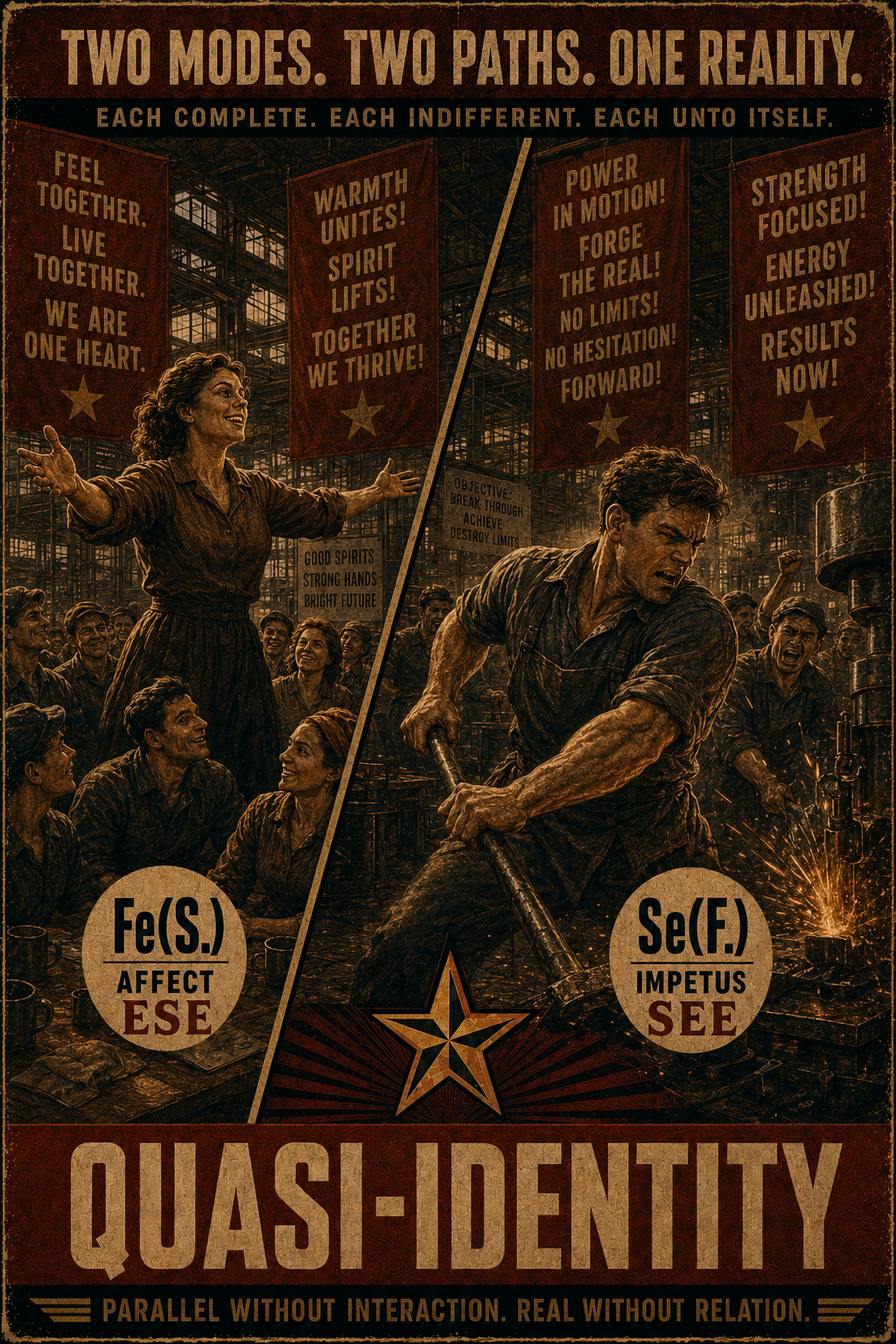
In Model A, Quasi-identity has a precise definition: each type's leading function sits at the other's Demonstrative position — the 8th. Not the Role, where Super-Ego strikes. Not the Vulnerable, where Conflict lands. The Demonstrative function is strong — it belongs to the Id block, meaning the type uses it naturally and freely — but it is not what they orient toward as primary. It operates in the background, deployed readily in support of others, without being led with or sought out.
LII's Ni is at position 8 — used naturally, present in background operation, but not what LII orients toward. ILI's Ti is at position 8 — equally natural, equally present, equally not oriented toward. Each type's greatest strength is what the other deploys freely without making it their primary object of attention.
Model L shows why the dynamic plays out the way it does.
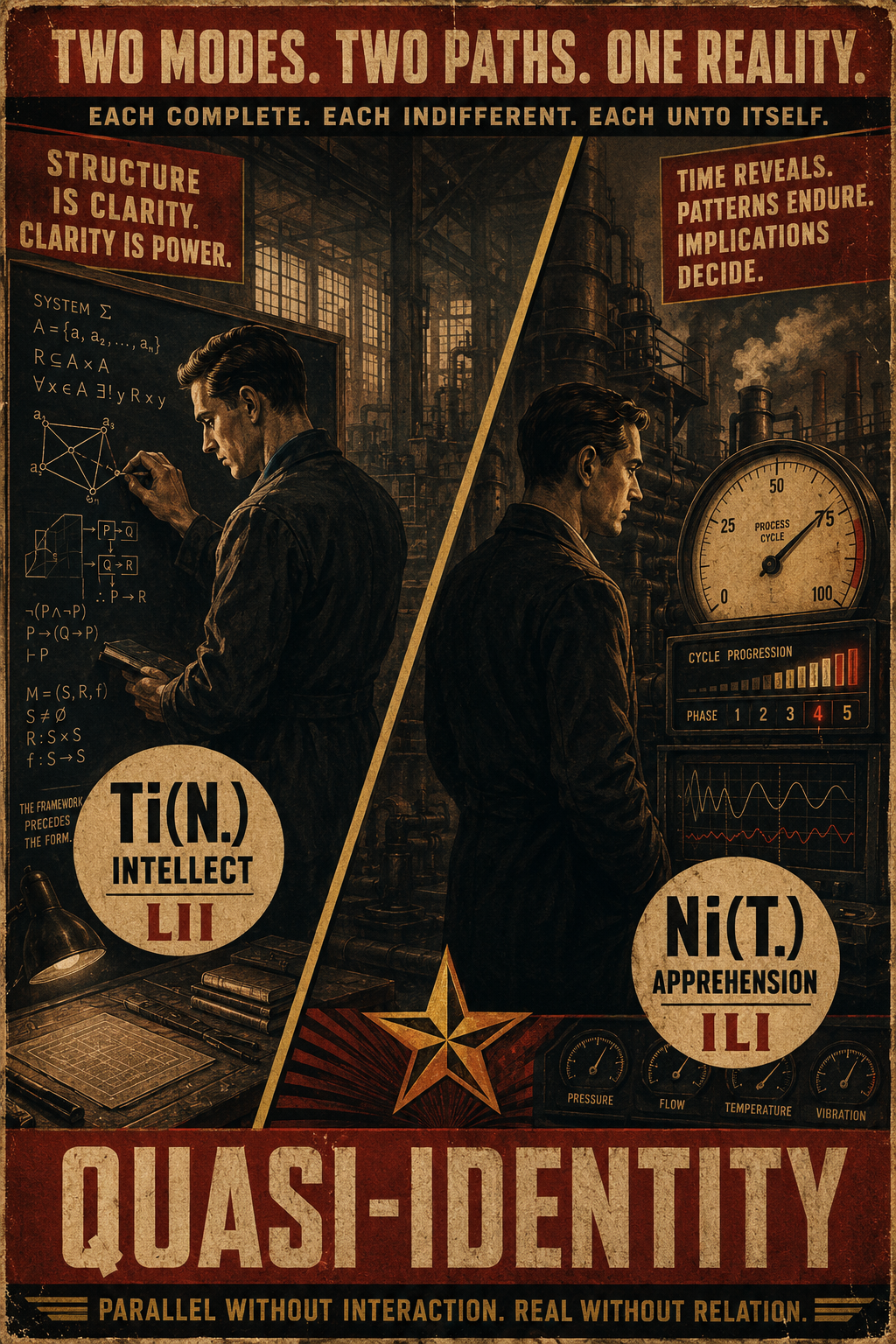
LII leads with Ti(N.) Intellect — detached abstract structural logic. The LII builds communicable frameworks: concepts articulated, relations mapped, contradictions resolved into coherent schema. The output is formal, static, conclusive — a structure that stands.
ILI leads with Ni(T.) Apprehension — detached strategic tracking of temporal patterns. The ILI reads how events are likely to unfold: trends followed, implications drawn, the strategic shape of what is becoming visible through accumulated pattern. The output is nonverbal, dynamic, conclusive — a trajectory that holds.
The shared sub-variant is N./T. — both detached. Both operate with analytical distance from their material. Both are inward, self-contained, non-broadcasting. Both are comfortable with abstraction. Both are quiet. On the surface, they can appear to be doing something similar. A kind of mutual recognition is possible — each senses in the other a familiar quality of absorbed, systematic, detached engagement.
But the domains do not connect. Ti(N.) builds static logical structure. Ni(T.) tracks dynamic temporal pattern. One arrives at a framework that is formally correct. The other arrives at a reading of where things are heading. These are not competing answers to the same question. They are answers to entirely different questions, pursued through modes that share a register but point in opposite directions.
The ILI uses Ti(N.) naturally — it runs in background operation, available and deployed freely — but does not orient toward it. Communicable logical architecture, explicit structural schema, the work of making a framework legible is not what the ILI is trying to do. The LII uses Ni(T.) naturally — it too runs in background operation — but does not orient toward it. Nonverbal temporal tracking, strategic pattern reading, the work of following implication through time is not what the LII is trying to do.
They can occupy the same space without friction. They may even admire something in each other from a distance — that quality of detached, absorbed precision which each recognises as cognate with their own mode. But sustained convergence is elusive. Each proceeds along their own axis. The LII keeps building structure. The ILI keeps reading pattern. Neither output is what the other is primarily oriented toward.