

Beta Quadra · Logical Sensory Integrator

LSI

The Inspector

Beta quadra · LSI

Logical Sensory Integrator

The Inspector

Club
ST Pragmatists
Temperament
IJ — Balanced-Stable
Dual
EIE — The Icon
Model A Base
Ti — Laws
Model L Base
Ti(S.) — Habitus

The LSI is the type most naturally oriented toward structure as a physical and institutional reality — rules, hierarchies, procedures and proper conduct experienced not as abstract principles but as things that must be embodied and maintained in practice. At their best they are the person who holds complex systems together through sheer disciplined consistency, who can be relied upon absolutely to do what they have committed to do in exactly the way it should be done, and who brings a physical force and decisiveness to the enforcement of order that others find both reassuring and sobering.

Their Beta quadra membership means they value passion, certainty, codes of honour and the willingness to hold a position without equivocation. The LSI is the Beta type most concerned with structural integrity — they bring the disciplined procedural dimension to a quadra otherwise characterised by vision and dramatic force. Their IJ temperament makes them stable, consistent and resistant to change — they hold their position with a fidelity that can be either a strength or an immovable obstacle depending on whether the structure they are maintaining is still the right one.

The LSI-EIE dual captures something essential about both types. The EIE provides the felt meaning — the passion, the historical weight, the sense of what it all stands for — that the LSI's structural enforcement would otherwise lack. The LSI provides the disciplined institutional reality — the structure, the procedure, the physical order — that the EIE's dramatic vision would otherwise have no ground to stand on. Each makes the other's contribution possible.

Torn-paper collage portrait: a man in a wool coat checking a pocket watch beside a railway signal box

Type profile

LSI In Depth

The eight Model A positions, each with its Model L element. Open any position to read it.

Ego

Conscious and valued: what this type leads with and creates from.

1BaseHabitusTi(S.)

The LSI's fundamental mode of engaging with reality is through the tangible defining forms of organised systems — embodied physical structures, codified behavioural habits, the proper procedures and hierarchical arrangements that give a system its recognisable form and integrity. Ti(S.) is not the abstract linguistic schema of Ti(N.) in the LII but structure as something lived and enforced — rules that must be embodied in conduct, hierarchies that must be maintained in practice, the right way to do things as a physical and institutional reality. The LSI does not merely understand structure; they inhabit it and hold it in place. Habitus is automatic and effortless — the LSI cannot help registering where the structure is holding and where it is breaking down.

2CreativeActuationSe(T.)

In service of Habitus, the LSI deploys the regulatory leveraging of force — the disciplined control and shaping of the physical environment to bring it into conformity with the structural requirements their Ti(S.) has established. Se(T.) is more visible in behaviour than Ti(S.) — more externally expressed, more physically present — and LSIs are often experienced as forceful, disciplined and capable of imposing order with a decisiveness that admits no argument. The Actuation serves the Habitus: the LSI knows how things should be structured and has the physical and volitional force to make them that way.

Super-ego

Conscious but unvalued: performed for others, or a sore point.

3RoleSoulFi(N.)

The LSI's performance function — the abstract inner landscape of personal values and moral convictions they are called upon to express in certain contexts but find unnatural to sustain. Fi(N.) sits uncomfortably against the LSI's concrete, procedural, externally-oriented register. They can perform inner ethical reflection when the situation demands it but the introspective, value-articulating mode is effortful and temporary. The structure is what matters; the inner moral landscape is a performance rather than a natural home.

4VulnerableInspirationNe(F.)

The LSI's point of greatest sensitivity. Ne(F.) is the personally vivid and felt sense of creative possibility — the inner charge of potentiality and spontaneous impulse toward the new and the unexplored. This is the furthest territory from the LSI's natural register. Being expected to embrace open-ended creative exploration, to remain comfortable with unstructured possibility, to engage enthusiastically with the new and untested lands as a deeply uncomfortable demand. Criticism of their imaginative range hits hard; excessive pressure toward creative flexibility and openness produces defensiveness and stress.

Super-id

Unconscious and valued: what this type seeks and responds to.

5SuggestiveSentimentFe(N.)

What the LSI most wants and responds to most positively in others. Fe(N.) — Sentiment — is deeply felt emotion expressed through dramatic rhetoric and symbolic gesture, inner passion inciting others to feel and act accordingly. The LSI cannot easily produce this themselves — their engagement with the world is structural and physical rather than dramatically emotional — but they experience it as profoundly compelling when it appears in others. Their dual EIE leads with exactly this element: the EIE's natural Sentiment is precisely what the LSI's Habitus yearns to be animated by. Where the LSI holds the structure in place, the EIE fills it with felt meaning and passionate conviction.

6MobilisingReverieNi(F.)

Energising and uplifting when present in others. Ni(F.) — Reverie — is the inner reflection on narrative significance and temporal meaning, the felt sense of what is destined, what is inevitable, what the flow of events portends. The LSI cannot easily generate this themselves but responds with energy and engagement when they encounter it — the sense of historical weight and narrative trajectory enlivening a type whose own temporal awareness tends toward the structural and strategic rather than the personally meaningful. Together with the Suggestive it defines the LSI's interpersonal chemistry.

Id

Unconscious and unvalued: capable, but kept in the background.

7IgnoringPraxisTe(S.)

Capable but uninteresting. Te(S.) — practical operational logic and hands-on efficiency — is something the LSI can deploy but finds less compelling than the deeper structural work of Ti(S.). Both are logical functions but they operate at different levels: Ti(S.) establishes and maintains proper form; Te(S.) makes things run efficiently. The LSI can make things run efficiently when the base has genuine need of it but does not seek this territory as its primary domain and returns from it without regret.

8DemonstrativeObservationSi(T.)

The LSI's strong background competence — precise sensory assessment and refined quality discrimination operating automatically without the type fully registering it. Si(T.) — Observation — runs quietly in the background giving the LSI an accurate physical attentiveness that supports their structural work without demanding recognition for itself. The LSI notices the real sensory condition of things in their environment with considerable accuracy; they simply do not prioritise this as an end in itself.

Dual relationship

LSI and EIE

LSI's dual is EIE — The Icon. LSI's Suggestive is Fe(N.) — Sentiment: symbolic emotion, conviction, rhetoric, and charged meaning. EIE leads with exactly this mode of expression.

EIE's Suggestive is Ti(S.) — Habitus: embodied structure, codified form, and the tangible order of systems. LSI leads with that mode effortlessly. Each type supplies what the other most needs without having to translate it into a foreign language.

The type in life

The Inspector

Four fictional sketches of the type in an ordinary day.

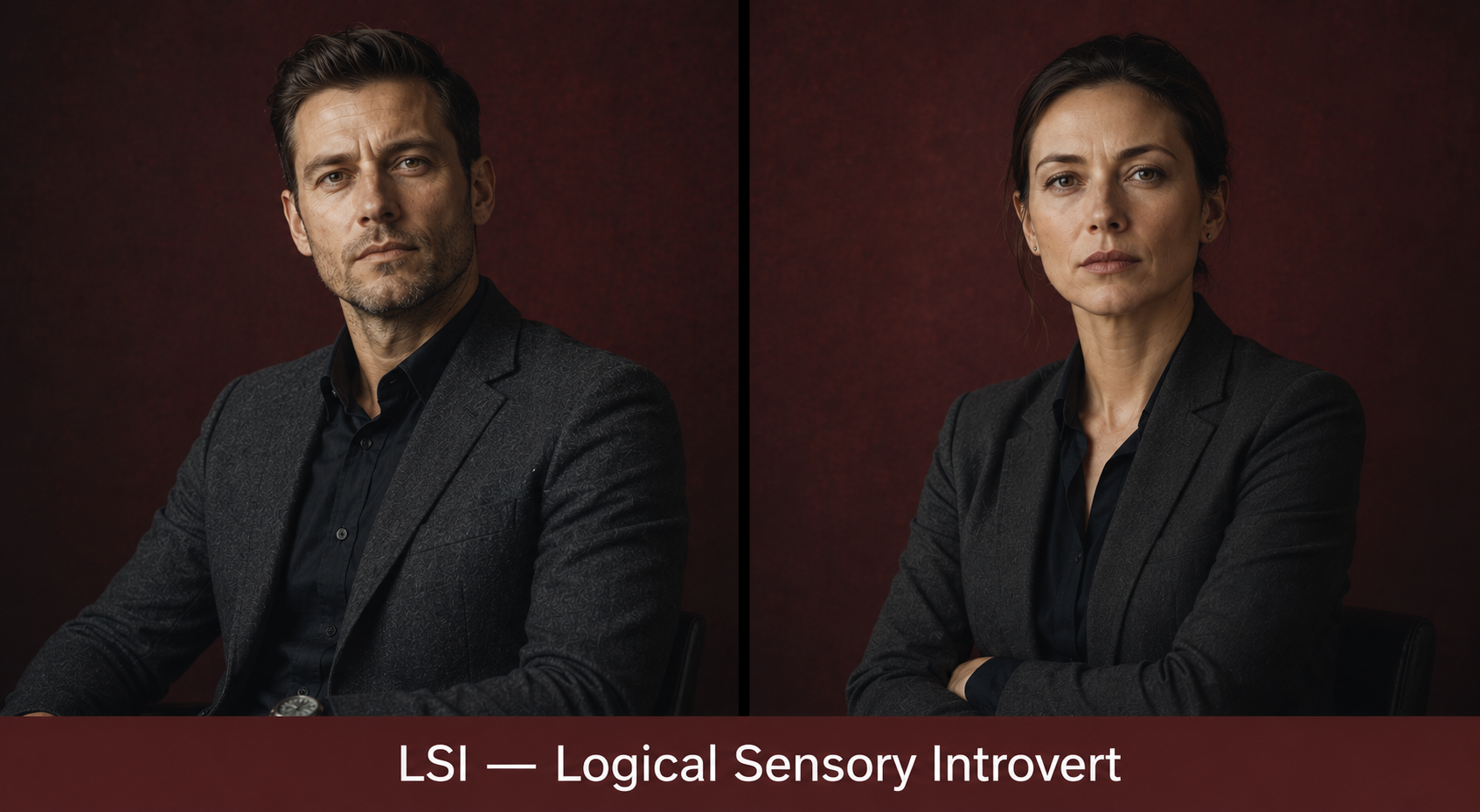
LSI original portrait set fictional type portrait

Male story

Viktor

Viktor does not improvise when procedure will serve. He has a way of moving through institutions — bureaucracies, organisations, physical environments — that suggests intimate knowledge of their actual structure, not their stated structure. He is patient in a way that has weight to it: he will wait until the correct moment and then act, without drama. He expects competence and is disappointed, regularly, by its absence. He will not say so directly. He will find the correct person to route the task through and the task will get done. He does this without acknowledgment. The acknowledgment is not the point. He carries structure like armour: rules, ranks, procedures, and duties are not decoration but the frame that keeps disorder from spreading. He can be stern, but his sternness usually points toward protection, discipline, and the relief of knowing where one stands.

Female story

Sonja

Sonja handles the practical architecture of the household with a quiet authority that only becomes visible when it breaks down. She knows where things are, which things matter, how the systems hold. She does not need recognition for this, but she needs it not to be undermined. She has strong views about how things should be done — not preferences, views. She will listen to an alternative method once. If it holds up to scrutiny she will adopt it without sentimentality. She does not hold on to things that don't work. What she holds on to is the standard. She notices when authority becomes sloppy or sentimental and tightens the line. Her loyalty is exacting: if something matters, it deserves form, consistency, and the courage to enforce what everyone agreed to when agreement was easy.
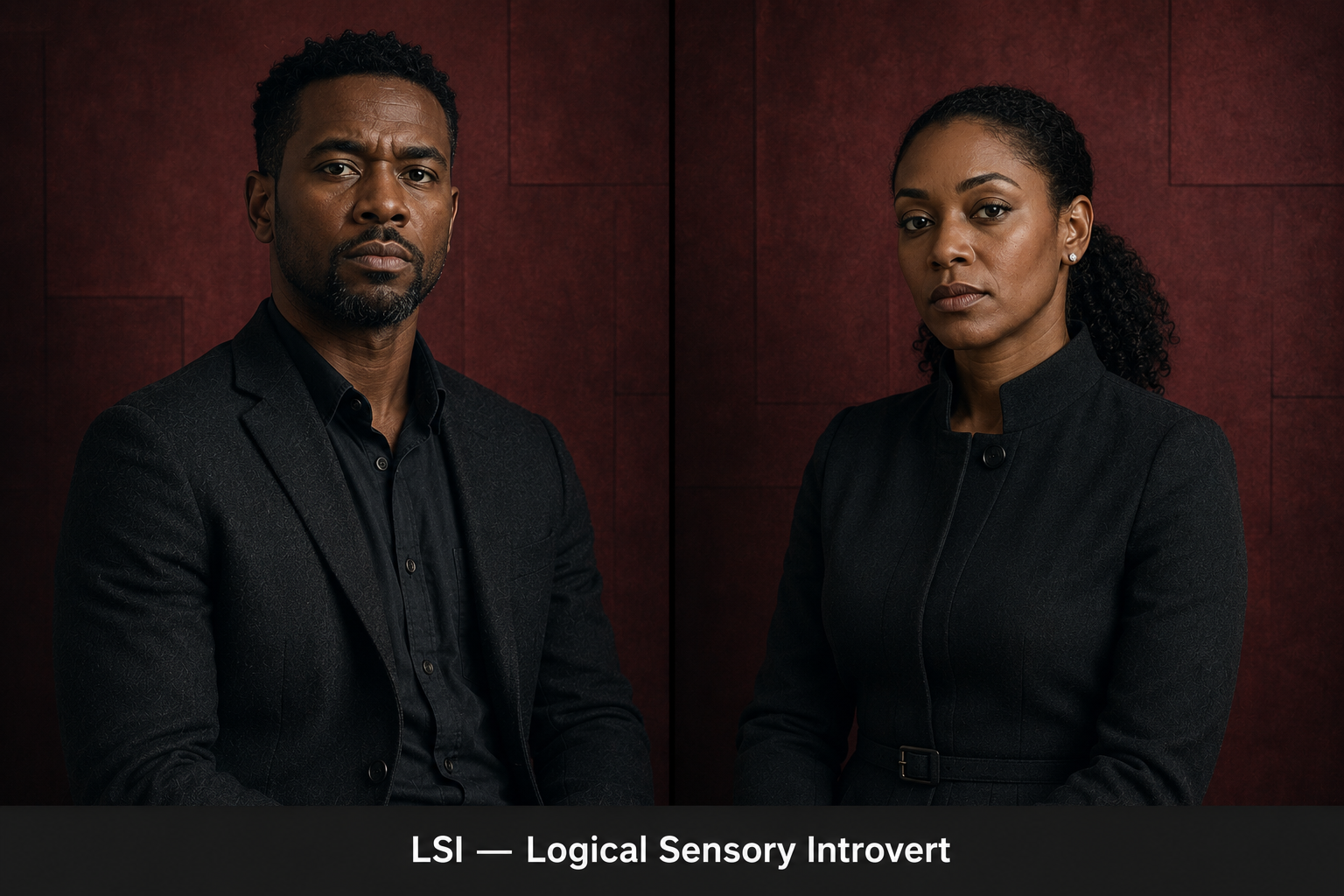
LSI diverse portrait set fictional type portrait

Male story

Emeka

Emeka is a senior officer in the Nigerian civil service and his department runs on time because his department has a system and the system has a reason. He designed the system. He can explain the reason for every element in it, and when an element no longer serves its purpose he revises it — not reluctantly, not sentimentally, but methodically, the way you replace a worn bearing in a machine that is otherwise sound. He dislikes improvisation in professional contexts with a structural distaste that others sometimes interpret as inflexibility. It is not inflexibility. He has simply already done the planning they are now improvising to avoid. He has a tactical sense for pressure, knowing when to hold position and when to move. In work and family alike, he dislikes vague responsibility; someone must own the standard, and if no one else will, he will.

Female story

Hyun-Ji

Hyun-Ji manages logistics for a shipping company in Busan with a precision that other people find either reassuring or quietly reproving, depending on how they feel about their own standards. She does not communicate the reproach; they supply it themselves. She holds the structural knowledge of a very large operation in her head and can be asked, at any point, where anything is — not because she has memorised it but because the system is logical and she knows the system. She does not describe herself as a people person. She would describe herself as reliable, which she considers considerably more useful. Her composure is built on internal command. She reads hierarchy, risk, and obligation quickly, then acts with a precision that can feel severe until the situation steadies and others realise she prevented drift from becoming damage.

Intertype relations

LSI In Relation

How LSI meets each of the sixteen types. Open a relation to read it; each links to the full relation page.

Dualitywith EIE — The Orator

The LSI figure is doing Ti(S.) — Habitus. The structure is in the body, enacted as trained physical procedure and codified behavioural discipline. Every movement of the demonstration is governed by deeply embedded habit rather than by sensory attention to any material or equipment. The procedural chart on the wall is not a reference being consulted — it is the codified form of what the body already knows and automatically performs. The workers behind and beside the LSI are conforming to a standard that is transmitted through physical demonstration rather than through articulated concept. The structure is correct because the body enacts it correctly. It has always been done this way because this is how it is done.

The EIE figure is doing Fe(N.) — Sentiment. Deeply felt inner passion is erupting outward through dramatic rhetoric and symbolic gesture, inciting the watching workers to feel the significance of what is being demonstrated. The conviction is genuine and internal — not performed atmosphere but a real inner fire expressed through the full force of rhetorical address. The EIE gives the LSI's embodied procedure its human meaning: this matters, this is what we are, this is worth doing with everything you have.

Read the full Duality section
Identitywith LSI — The Inspector

Two LSI types encounter in each other a procedural authority that mirrors completely. Every codified physical sequence enacted by one is immediately recognised by the other as correct — the established form is flawless in both directions, each confirming the other's procedural precision without friction or new information.

What doubles: Ti(S.) embodied procedural authority, codified physical structure, the trained enactment of correct form through the body. Se(T.) regulatory force — the physical governance that enforces procedure — also doubles. Two instances of the same physically precise procedural mode operating in parallel.

Read the full Identity section
Mirrorwith SLE — The Marshal

Same structural rule. LSI leads with Ti(S.) and creates with Se(T.). SLE leads with Se(T.) and creates with Ti(S.). Same two functions, same S./T. sub-variant, reversed priority.

LSI leads with Ti(S.) Habitus and creates with Se(T.) Actuation. The LSI deploys regulatory force in service of codified structural procedure — physical authority as the instrument by which established form is enforced and maintained. The Se(T.) supplies the force; the Ti(S.) determines when and how it is applied. Governance is the instrument. Procedure is the point.

Read the full Mirror section
Activitywith IEI — The Mystic

Same structural rule. LSI's Ego fills IEI's Super-Id with inverted priority; IEI's Ego fills LSI's Super-Id with inverted priority.

LSI leads with Ti(S.) Habitus and creates with Se(T.) Actuation. The IEI's Super-Id seeks Se(T.) as Suggestive — what IEI most deeply wants — and Ti(S.) as Activating. LSI's embodied procedural structure energises the IEI, giving the inner narrative felt weight and concrete grounding; the regulatory external force that flows from LSI's structural authority is what the IEI most wants — it gives the narrative vision physical reality and the capacity to act.

Read the full Activity section
Kindredwith LII — The Analyst

Both LII and LSI lead Ti. Both are oriented toward logical structure, principle, and consistency. Both resist information that does not cohere. The Kindred recognition between them is immediate — each identifies the other as someone who cares about how things are properly organised and governed. What neither can fully account for, without Model L, is why something persistently differs in how they are doing what looks like the same thing.

The LII figure at the chalkboard is doing Ti(N.) — Intellect. The structure exists as articulated concept. Logical principles are taken and rendered into communicable form — stated, organised, transmissible, open to debate and refinement through discourse. The chalkboard is full of the formal architecture of how the system works. The books beside it are the accumulated conceptual framework the LII draws from. This is Ti operating in the linguistic and conceptual register — structure as something that can be said, written down, argued with, and passed between minds.

Read the full Kindred section
Semi-Dualitywith ESE — The Host

Same structural rule. Each type's leading function provides the right element, wrong sub-variant for the other's Suggestive.

ESE leads with Fe(S.) Affect — somatic atmospheric emotion, collective mood broadcast through physical presence. The LSI's Suggestive is Fe(N.) — inner passion expressed rhetorically, aimed at inciting feeling through dramatic symbolic address. ESE provides Fe(S.) instead: ambient warmth suffusing shared space through body and aesthetic signal. The element is right — the LSI genuinely values and seeks Fe — but the LSI most deeply wants the directed inner rhetorical passion that gives structural authority emotional fire and felt conviction, and what arrives is diffuse atmospheric warmth. Genuine and comfortable. Slightly less directed and less inwardly charged than most deeply sought.

Read the full Semi-Duality section
Businesswith ESI — The Guardian

The LSI and ESI can work alongside each other. Both are concrete, both are physically grounded, both are settled in their verdicts without needing to articulate the reasoning behind them at length. Neither operates from abstract principle held at a conceptual remove — both are embedded in the physical world, both know where they stand from the body rather than from the mind. The shared S. sub-variant means both are operating in the concrete embodied register, and that shared quality creates a genuine surface of mutual recognition. Both appear solid and reliable in a way that abstract types are not. Both appear to know exactly what is required without excessive deliberation. This is what makes them Business/Lookalike in Model L — they can function alongside each other in the same concrete environment, recognise each other as grounded and settled, and work in the same operational space without the immediate register alienation the full Conflict versions produce.

The LSI figure is doing Ti(S.) — Habitus. The logical structure is enacted through the body as codified physical procedure and disciplined behavioural habit. The foreman's movements are governed by deeply embedded trained discipline rather than by sensory attention to the material or by abstract conceptual reasoning. The procedure is correct because it is the procedure — the structure applies to this situation as it applies to every situation, regardless of who is involved or what particular relationships exist between the people present. The verdict arrives from the body as physical disciplined authority. The impersonality is not abstract — it is enacted and concrete, the procedure governing the situation because correct procedure always governs the situation.

Read the full Business section
Illusionarywith LIE — The Entrepreneur

Same structural rule.

LSI leads with Ti(S.) Habitus — embodied structural logic, codified procedure enacted through the body with physical authority. In LIE's Model L stack, Ti(S.) sits at the A3 Ignoring position. LIE finds it uninteresting and unrewarding to engage directly.

Read the full Illusionary section
Quasi-Identitywith SLI — The Craftsman

Same structural rule. LSI's Si sits at position 8 — strong, naturally deployed, not what LSI orients toward as primary. SLI's Ti sits at position 8 — equally strong, equally natural, equally not oriented toward.

Of all eight Quasi-identical pairings, this one produces the most surface similarity. Both are physically present. Both are precise. Both are quiet and practically engaged with material reality. Both share the S./T. sub-variant — embodied, externally directed, detached in their mode of engagement. From any distance they can appear to be doing the same thing.

Read the full Quasi-Identity section
Super-Egowith EII — The Humanist

The same structural rule applies: each type's leading function sits at the other's Role position. LSI's Ti is EII's 3rd. EII's Fi is LSI's 3rd. Full strength on both sides, landing on the position the other strains toward but never occupies with ease.

Model L shows a specific inversion relative to the LII/ESI pairing — and it matters.

Read the full Super-Ego section
Extinguishmentwith LSE — The Director

Same structural rule. LSI's Ego block Ti(S.)/Se(T.) sits exactly in LSE's Contributive capacity. LSE's Ego block Te(S.)/Si(T.) sits exactly in LSI's Contributive capacity.

Read the full Extinguishment section
Conflictwith IEE — The Inspirer

Same structural rule. LSI's base Ti(S.) sits exactly at IEE's D2 Vulnerable. IEE's base Ne(F.) sits exactly at LSI's D2 Vulnerable.

LSI leads with Ti(S.) Habitus — embodied structural logic, codified procedure enacted through the body with physical authority. In IEE's Model L stack, Ti(S.) sits at the Vulnerable position. IEE is genuinely inept with embodied procedural structure, treats it with careless indifference. When LSI's codified physical authority fills the shared space — the correct sequence demonstrated, the established form enacted with trained precision — IEE has no functional register to receive it. The procedural structure does not translate into anything the IEE's imaginative mode can inhabit.

Read the full Conflict section
Supervision: Supervisorwith SEE — The Politician

LSI leads with Ti(S.) Habitus and creates with Se(T.) Actuation. The Se(T.) creative flows naturally as the regulatory force that enforces and maintains established procedure — controlled circumscribed governance in service of codified structural form. The LSI is not trying to contain SEE's physical energy. The regulatory force serves the procedural orientation.

Read Supervision in the Model A library
Supervision: Superviseewith ILE — The Inventor

LSI leads with Ti(S.) Habitus — 4d, 4p, embodied procedural authority at maximum strength. Against ILE's Ti(N.) creative this lands on a 3d position. The LSI's procedural authority genuinely adjusts ILE's structural framework. But this is the lesser pressure.

Read Supervision in the Model A library
Benefit: Benefactorwith ILI — The Critic

LSI leads with Ti(S.) Habitus — embodied procedural authority as primary mode. The Se(T.) Actuation creative flows naturally as the regulatory force that enforces and maintains that procedure: controlled circumscribed physical authority in service of codified structural form. The LSI is not trying to mobilise the ILI. The regulatory force simply maintains the procedure.

Read Benefit — Model A
Benefit: Beneficiarywith SEI — The Mediator

SEI leads with Si(F.) Stimulation — somatic bodily ease as primary mode. The Fe(S.) Affect creative flows naturally as the collective atmospheric warmth that sustains that ease: somatic mood broadcast into shared space in service of immediate sensory comfort. The SEI is not trying to inspire the LSI with rhetorical conviction. The atmospheric warmth simply sustains the sensory environment.

Read Benefit — Model A

A note on this type

What Model L Adds

Model A identifies LSI as Ti-leading with Se Creative. Model-L specifies that this is Ti(S.) — Habitus, the embodied and codified mode of structure, supported by Se(T.) — Actuation.

This distinction matters when separating LSI from LII. Both lead with Ti in Model A terms, but LSI's Ti(S.) is concrete, procedural, and institutionally embodied. LII's Ti(N.) is detached, linguistic, and conceptually analytic.

For LSI, Model-L shows why order is not only theoretical. It is enacted through rules, standards, spaces, systems, and the disciplined use of force.

Attribution: Model-L is Kimani White's original framework. This interpretation is the author's own.

B Radial Group

Supported Same-Club Positions

B positions share the A capacity's rational or irrational club orientation. They are radial, foreground, and resistant: available as conscious support, but not as effortless as the central A cross.

B1 — CorrespondentTi(N.) — Intellect

Derivation: radial + foreground + resistant · 3D / 2P

Conscious support that can correspond with the A region. It is capable enough to be useful, but it asks for deliberate handling rather than automatic expression.

B2 — CollaborativeNe(T.) — Ideation

Derivation: radial + foreground + resistant · 2D / 3P

A visible support position that collaborates with the type's central orientation. It receives attention and can help the profile work outwardly, but it is less dimensionally equipped than the A positions.

B3 — CompensatoryTe(N.) — Reason

Derivation: radial + foreground + resistant · 2D / 3P

A compensating support position. It helps cover less central areas of the cross while still requiring conscious effort and structural management.

B4 — InstrumentalNi(T.) — Apprehension

Derivation: radial + foreground + resistant · 3D / 2P

A workable instrument. It can be applied when needed as practical support, without becoming the type's main orientation.

C Radial Group

Contrasting Opposite-Club Positions

C positions take the opposite club orientation from A. They are radial, background, and facile: indirect resources that complement the type's main cross from the contrasting axis.

C1 — SubsidiaryFi(S.) — Animus

Derivation: radial + background + facile · 3D / 2P

Quiet background support from the contrasting club orientation. It works as a subsidiary resource rather than a leading concern.

C2 — NegligentSe(F.) — Impetus

Derivation: radial + background + facile · 2D / 3P

Indirect background material that may be psychologically noticeable but is easy to neglect. It colours the profile without becoming a central task.

C3 — PromptingFe(S.) — Affect

Derivation: radial + background + facile · 2D / 3P

A prompting support position. It nudges the type toward material that complements the A capacity from the opposing axis.

C4 — GalvanizingSi(F.) — Stimulation

Derivation: radial + background + facile · 3D / 2P

A galvanizing support position. It shapes output from the contrasting axis, adding momentum without becoming a direct Model A anchor.

Classification

Dichotomies and Small Groups

Fifteen Reinin dichotomies

  1. Integrator
  2. Sensory
  3. Logical
  4. Rational
  5. Reductionist
  6. Rejecter
  7. Clarifier
  8. Transforming
  9. Exacting
  10. Obstinate
  11. Space-Locked
  12. Sight-Locked
  13. Affirmer
  14. Thetic
  15. Clockwise

Seven small groups

Quadra
Beta
Club
Realist
Temperament
Normative
Tournament
Truth
Axis
Activist
Standoff
Proposer
Course
Cardinal