

Alpha Quadra · Ethical Sensory Energiser

ESE

The Host

Alpha quadra · ESE

Ethical Sensory Energiser

The Host

Club
SF Socials
Temperament
EJ — Linear-Assertive
Dual
LII — The Analyst
Model A Base
Fe — Emotions
Model L Base
Fe(S.) — Affect

The ESE is the type most naturally oriented toward the creation of shared emotional warmth as a living physical reality — the person whose presence makes collective experience feel genuinely good, whose atmospheric generosity is automatic rather than calculated, and whose care for the felt quality of shared life is both the most visible and the most fundamental thing about them. At their best they are the person who makes every gathering more alive, who notices when someone is uncomfortable and addresses it without fuss, and whose warmth is experienced as genuine precisely because it is not a performance.

Their Alpha quadra membership means they value curiosity, inclusion, fun and the pleasure of genuine shared discovery. The ESE's warmth is not merely social ease — it is in service of the Alpha values of inclusion, openness and the genuine enjoyment of being together. Their EJ temperament makes them continuously purposeful and outward-directed — the ESE does not wait for the atmosphere to improve but moves immediately to improve it, always finding something to contribute in every social situation.

The ESE-LII dual captures something essential about both types. The LII provides the intellectual architecture — the conceptual precision, the systematic framework, the depth of understanding — that the ESE's warm inclusive world can be genuinely enriched by rather than merely comfortable within. The ESE provides the warmth, the ease, the felt conditions of shared life — the atmosphere in which the LII's detached conceptual work can be shared and received rather than remaining isolated in the abstract. Each makes the other's contribution possible.

Torn-paper collage portrait: a woman laughing and raising a glass at a long lantern-lit dinner table

Type profile

ESE In Depth

The eight Model A positions, each with its Model L element. Open any position to read it.

Ego

Conscious and valued: what this type leads with and creates from.

1BaseAffectFe(S.)

The ESE's fundamental mode of engaging with reality is through the physiological conveyance of somatic feeling — the physical expression of mood that mediates sensory experience between subjects through aesthetic signals, creating shared atmospheric warmth and collective ease. Fe(S.) is not the dramatic rhetorical passion of Fe(N.) in the EIE but emotion as a living physical atmosphere — the ESE generates the conditions of shared feeling as naturally and automatically as others generate thought. The ESE does not perform warmth; they produce it as a metabolic fact, and others feel it the moment they enter the ESE's field. Affect is automatic and effortless — the ESE cannot help creating the emotional atmosphere of every space they inhabit.

2CreativeStimulationSi(F.)

In service of Affect, the ESE deploys their subjective experience of physical vitality and sensory ease — the felt sense of what is comfortable, pleasurable and genuinely good in the immediate present. Si(F.) is more quietly present than externally obvious but it informs every atmospheric decision the ESE makes — the temperature, the texture, the quality of light, the sensory conditions that make collective ease genuinely possible rather than merely performed. The Stimulation serves the Affect: the ESE creates the physical conditions that make shared emotional warmth real rather than theatrical.

Super-ego

Conscious but unvalued: performed for others, or a sore point.

3RoleReasonTe(N.)

The ESE's performance function — the abstract logical reasoning and theoretical analysis they are called upon to produce in certain contexts but find unnatural to sustain. Te(N.) sits uncomfortably against the ESE's warm, atmospherically-oriented, present-focused register. They can engage with abstract causal reasoning and systematic fact-analysis when the situation demands it but the detached theoretical mode is effortful and temporary. The shared emotional atmosphere is what matters; the abstract analytical performance is something they produce when necessary and set down when possible.

4VulnerableApprehensionNi(T.)

The ESE's point of greatest sensitivity. Ni(T.) is the detached strategic awareness of temporal trends and long-term trajectories — the cold clear reading of where things are heading regardless of what anyone wants or feels about it. This is the furthest territory from the ESE's naturally warm, present-focused, atmospherically-engaged register. Being expected to read the long-term structural implications of current events, to reason coldly about future trajectories, to detach from the immediate felt present in order to assess the strategic configuration of what is coming lands as a deeply uncomfortable demand. Criticism of their strategic foresight hits hard; excessive pressure toward cold temporal detachment produces stress and defensiveness.

Super-id

Unconscious and valued: what this type seeks and responds to.

5SuggestiveIntellectTi(N.)

What the ESE most wants and responds to most positively in others. Ti(N.) — Intellect — is the linguistic formatting and interpretative schema of the mind — the articulation of concepts into coherent, internally consistent frameworks that make the world genuinely intelligible. The ESE cannot easily produce this themselves — their engagement with the world is atmospheric and emotionally present rather than abstractly systematic — but they experience it as deeply compelling and nourishing when it appears in others. Their dual LII leads with exactly this element: the LII's natural Intellect is precisely what the ESE's Affect yearns to be given structure by. Where the ESE creates the warmth in which ideas can be shared, the LII provides the conceptual architecture that gives those ideas their precision and depth.

6MobilisingIdeationNe(T.)

Energising and uplifting when present in others. Ne(T.) — Ideation — is the architecturally directed generation of conceptual possibilities, the active manipulation of ideas evaluated for their structural potential. The ESE cannot easily generate this themselves but responds with animation and enthusiasm when they encounter it — the inventive conceptual energy of others enlivening a type whose own attention tends toward the felt present rather than the abstract possible. Together with the Suggestive it defines the ESE's interpersonal chemistry.

Id

Unconscious and unvalued: capable, but kept in the background.

7IgnoringAnimusFi(S.)

Capable but uninteresting. Fi(S.) — the stable visceral attitudes of personal relational affinity and aversion — is something the ESE can access but finds less compelling than the collective atmospheric warmth of Fe(S.). Both are ethical functions but they operate at different scales: Fe(S.) generates shared emotional conditions for everyone present; Fi(S.) maintains particular bonds with specific individuals. The ESE can attend to particular relational bonds when the base has genuine need of it but finds the collective register more natural than the particular.

8DemonstrativeImpetusSe(F.)

The ESE's strong background competence — the generation of personal vital force and physical presence running automatically without the type fully registering it. Se(F.) — Impetus — operates quietly in the background giving the ESE a natural physical vitality and personal energy that others experience as part of the atmospheric warmth the ESE generates. The ESE is often more physically energising than they realise simply because the background Impetus is always running.

Dual relationship

ESE and LII

ESE's dual is LII — The Analyst. ESE's Suggestive is Ti(N.) — Intellect: detached structure, clear definitions, and coherent articulation of concepts. LII leads with exactly this mode of structure.

LII's Suggestive is Fe(S.) — Affect: physiological mood, aesthetic atmosphere, and shared sensory feeling tone. ESE leads with that mode effortlessly. Neither has to strain to offer what the other most needs.

The type in life

The Host

Four fictional sketches of the type in an ordinary day.

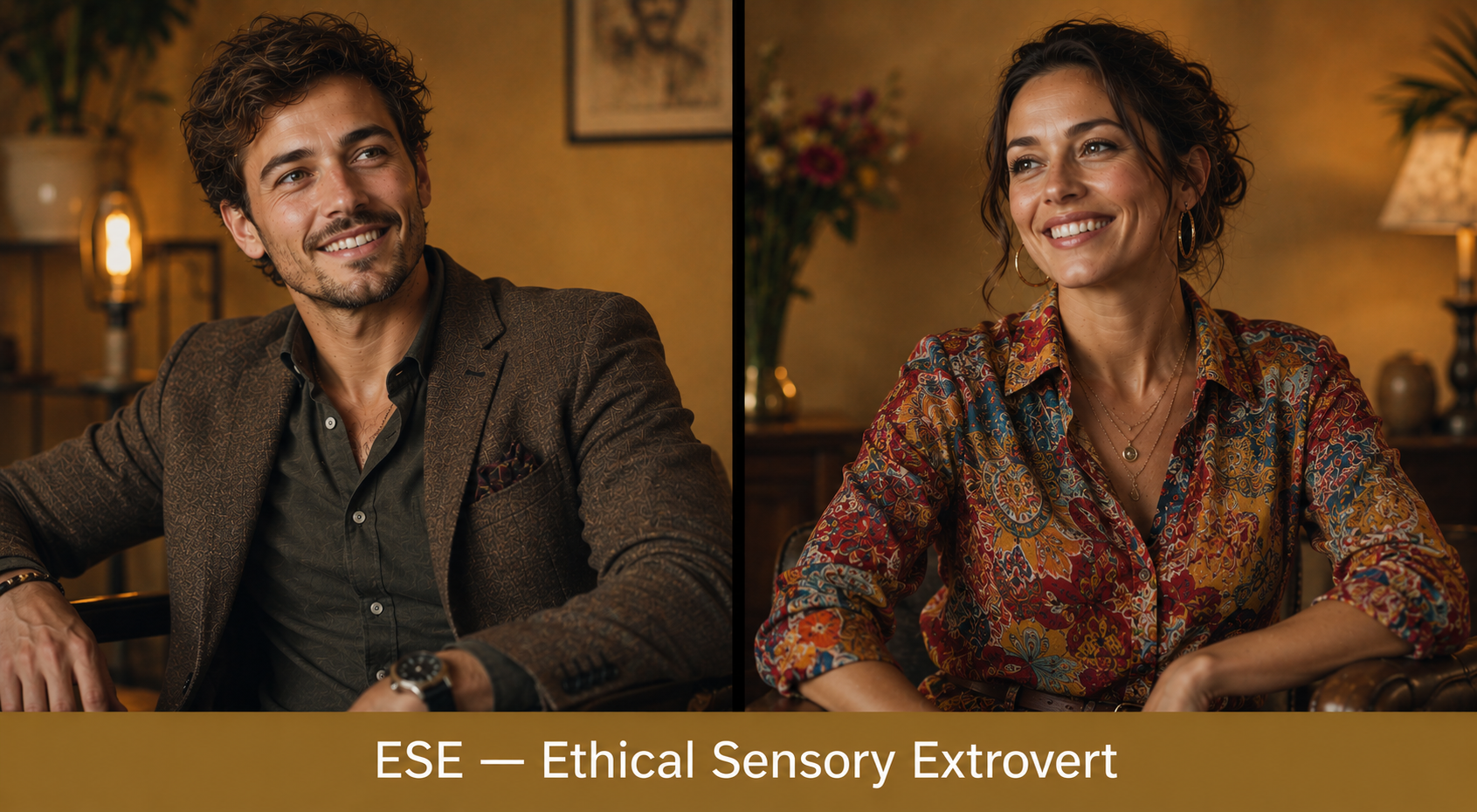
ESE original portrait set fictional type portrait

Male story

Rafael

Rafael enters a room and the room responds. This is not performance — he is not performing — it is simply that he reads the atmosphere before he reads anything else, and adjusts. Someone in the corner needs drawing out; he does it without making it obvious. Someone at the table is anxious; he reduces the pressure by shifting the mood two degrees warmer. By mid-afternoon he has moved through four different social registers without apparent effort and is genuinely energised rather than depleted. He buys a round without being asked. He always buys a round. He notices the social room as if it were a hearth: whose glass is empty, whose joke did not land, whose mood needs lifting before the meal can really begin. His energy is practical hospitality, emotional timing made visible through food, music, lighting, and welcome.

Female story

Claudia

Claudia organises the birthday celebration because she is the only one who will remember that the venue matters, the music matters, that the details land in people's bodies before they land in their minds. She doesn't think of herself as controlling. She is not controlling. She is accurate about what makes an occasion feel right rather than merely adequate. At the party she is at the centre of it, not because she pushed to the centre but because the centre is warm and she made it warm. She photographs nothing. She is too busy being there. She makes celebration feel organised without making it feel managed. Behind the laughter is a precise awareness of social appetite: when to warm the atmosphere, when to smooth tension, when to give someone a role so they can join the group without embarrassment.
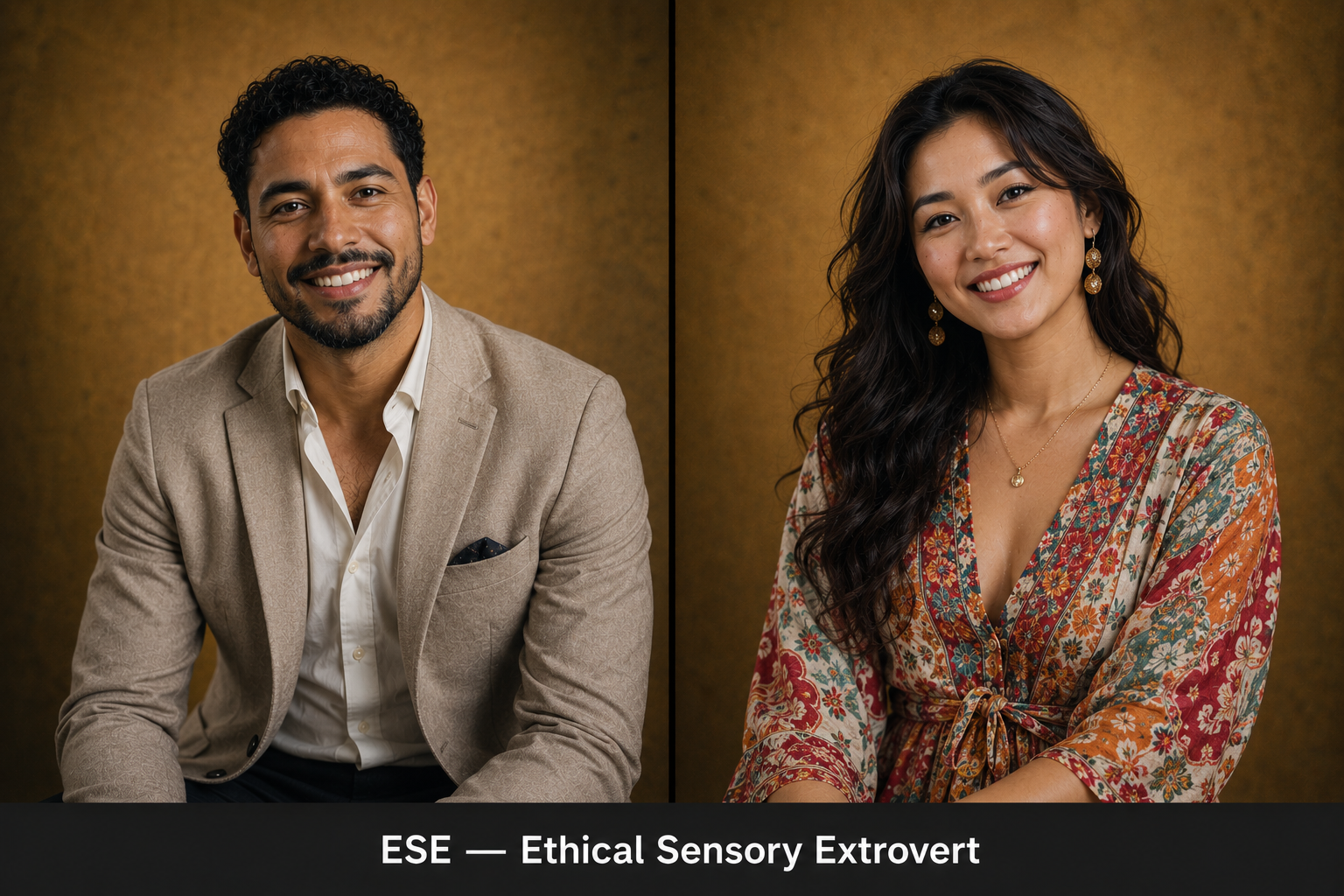
ESE diverse portrait set fictional type portrait

Male story

Chidi

Chidi teaches secondary school in Enugu and his classroom is not the noisiest but it is, reliably, the most alive. He reads the room the way other teachers read the lesson plan — he knows before the bell who is off today, who needs drawing out, who needs the brief private word before class rather than the public correction during it. He adjusts the energy by changing his own. This is not a technique he learned; it is something he does as naturally as breathing and slightly more consciously. After school he stays late. Two students needed it. That settled it. He brings people together through movement and routine, turning ordinary gatherings into something that feels abundant and shared. If someone is left out, he feels it almost physically, and he will rearrange the whole rhythm of the event until the person can step back in.

Female story

Valentina

Valentina coordinates events in Bogot— and her gift is that she knows the difference between an event that is technically successful and one that people actually felt something in, and she refuses to accept the first without the second. She manages vendors, timelines, budgets, and atmospheres — the last item being what no one puts on the invoice but everyone notices when it is missing. The night of the event she is everywhere at once without appearing to hurry. She is the last to leave. She walks out satisfied or she walks out with a list. Usually both. Her warmth is not vague; it has choreography. She remembers birthdays, favourite dishes, old worries, and the exact tone that makes someone relax, using these details to keep a community emotionally fed and unmistakably alive.

Intertype relations

ESE In Relation

How ESE meets each of the sixteen types. Open a relation to read it; each links to the full relation page.

Dualitywith LII — The Analyst

The LII figure at the board is doing what Ti(N.) does — building communicable logical structure, articulating principle into coherent form. The framework on the board is precise and correct. But it needs a room that can receive it. The ESE figure is providing exactly that — not through rhetoric or dramatic gesture, but through the physical atmospheric ease of Fe(S.) Affect. The warmth is somatic and ambient, carried in physical presence rather than in expressed inner conviction. Together the structure finds the atmosphere it needs to actually land, and the atmosphere has the principled content it needs to be more than mere pleasant feeling. Neither is trying to provide what the other needs. Each is simply being themselves.

Read the full Duality section
Identitywith ESE — The Host

Two ESE types encounter in each other an atmospheric warmth that amplifies. Every quality of collective somatic mood produced by one is immediately inhabited and amplified by the other — the shared atmosphere intensifies in both directions, each recognising and generating the same quality of collective emotional warmth.

What doubles: Fe(S.) collective atmospheric generation, somatic mood broadcast, the physical conveyance of felt warmth into shared space. Si(F.) somatic ease — the bodily comfort that sustains atmospheric generation — also doubles. Two instances of the same warm atmospheric mode filling shared space.

Read the full Identity section
Mirrorwith SEI — The Mediator

Same structural rule. ESE leads with Fe(S.) and creates with Si(F.). SEI leads with Si(F.) and creates with Fe(S.). Same two functions, same S./F. sub-variant, reversed priority.

ESE leads with Fe(S.) Affect and creates with Si(F.) Stimulation. The ESE draws on sensory comfort and physical ease in service of collective atmospheric mood generation — somatic pleasure as the medium through which shared emotional texture is created and sustained. The Si(F.) supplies the sensory richness; the Fe(S.) broadcasts it outward into collective feeling. Sensory ease is the instrument. Atmosphere is the point.

Read the full Mirror section
Activitywith ILE — The Inventor

Same structural rule. ILE's Ego fills ESE's Super-Id with inverted priority; ESE's Ego fills ILE's Super-Id with inverted priority. Full element and sub-variant correspondence. Priority slightly off-centre throughout.

ILE leads with Ne(T.) Ideation and creates with Ti(N.) Intellect. The ESE's Super-Id seeks Ti(N.) as Suggestive — what ESE most deeply wants — and Ne(T.) as Activating. ILE's conceptual generation energises the ESE into atmospheric responsiveness; the structural logical clarity that emerges from the exploration is what the ESE most wants to receive.

Read the full Activity section
Kindredwith EIE — The Orator

The EIE and ESE are both doing Fe. Both are expressively attuned, both affect the emotional temperature of every room they enter, both are unmistakably feeling types who create atmosphere rather than simply responding to it. The Kindred recognition between them is immediate and strong — each knows what the other is doing in the feeling domain and recognises it as kin. The EIE's Fe operates through inner passion expressed rhetorically: deeply felt emotional conviction that erupts outward through dramatic gesture and symbolic language, inciting others to feel and act through the force of expressed inner fire. The ESE's Fe operates through somatic atmospheric presence: physiological mood conveyed through physical expressiveness, the vibe built body-to-body through aesthetic signals rather than through the rhetorical force of inner conviction. The EIE may find the ESE's approach insufficiently deep — too much warm vibe and not enough felt conviction. The ESE may find the EIE too intense, too dramatically rhetorical, not sufficiently warm and present in the moment. Together they can create extremely powerful atmospheres — EIE's passionate conviction amplified by ESE's physical warmth. The persistent difference is that one feels deeply and expresses dramatically, while the other expresses physically and atmospherically. Model A sees both as Fe-leading. Model L explains why EIE and ESE feel recognisably different to everyone they meet.

Read the full Kindred section
Semi-Dualitywith LSI — The Inspector

Same structural rule. Each type's leading function provides the right element, wrong sub-variant for the other's Suggestive.

ESE leads with Fe(S.) Affect — somatic atmospheric emotion, collective mood broadcast through physical presence. The LSI's Suggestive is Fe(N.) — inner passion expressed rhetorically, aimed at inciting feeling through dramatic symbolic address. ESE provides Fe(S.) instead: ambient warmth suffusing shared space through body and aesthetic signal. The element is right — the LSI genuinely values and seeks Fe — but the LSI most deeply wants the directed inner rhetorical passion that gives structural authority emotional fire and felt conviction, and what arrives is diffuse atmospheric warmth. Genuine and comfortable. Slightly less directed and less inwardly charged than most deeply sought.

Read the full Semi-Duality section
Businesswith LSE — The Director

The ESE and LSE can work alongside each other easily enough. Both are physically present and concretely engaged with the world around them. Both are practical rather than abstract, grounded rather than theoretical. The shared S. sub-variant means both are operating in the concrete involved register — the surface resemblance is real and can make them appear very compatible. The Business/Lookalike quality comes precisely from this. From the outside they look like they should work well together. The conflict is present but muted and hard to identify precisely.

The ESE figure is doing Fe(S.) — Affect. The emotional content is carried through somatic physical presence — warmth transmitted body to body, the atmospheric ease of the space built through physical expressiveness rather than rhetorical force. The ESE is attending to how the environment feels to be in, creating the ambient mood that makes shared physical space genuinely pleasant. This is real work producing a real output — the felt quality of the shared space.

Read the full Business section
Illusionarywith EII — The Humanist

Same structural rule. Each type's base sits at the other's A3 Ignoring position. Each type's Role and 3D Contributive generate false signals of compatibility that draw each toward the other.

EII leads with Fi(N.) Soul — abstract foundational moral conviction. In ESE's Model L stack, Fi(N.) sits at the A3 Ignoring position: competent, available, found unrewarding to engage directly. What EII most naturally produces is what ESE routinely bypasses.

Read the full Illusionary section
Quasi-Identitywith SEE — The Politician

Same structural rule. ESE's Se sits at position 8 — naturally used, present in background operation, not what ESE orients toward as primary. SEE's Fe sits at position 8 — equally natural, equally present, equally not oriented toward.

Both types are physically present and somatically energised. Both are S./F. — visceral, involved, non-abstract, warm in immediate physical space. Both are outward-broadcasting, generating somatic charge into the shared environment at pace. The surface resemblance is the most physically vivid of the eight Quasi-identical pairings — two types whose presence in a room carries the same quality of warm, bodily, immediately felt aliveness.

Read the full Quasi-Identity section
Super-Egowith LIE — The Entrepreneur

Same structural rule. LIE's Te sits at ESE's Role position. ESE's Fe sits at LIE's Role position. Full strength, landing where the other strains most.

LIE leads with Te(N.) Reason — detached applied logic. The LIE works through available information toward productive end goals: what does the data support, what is the workable strategy, what inference leads to an effective outcome. The engagement is analytical and forward-directed. Output is communicable, targeted, aimed at what works.

Read the full Super-Ego section
Extinguishmentwith ESI — The Guardian

Same structural rule. ESI's Ego block Fi(S.)/Se(F.) sits exactly in ESE's Contributive capacity. ESE's Ego block Fe(S.)/Si(F.) sits exactly in ESI's Contributive capacity.

Read the full Extinguishment section
Conflictwith ILI — The Critic

Same structural rule. ILI's base Ni(T.) sits exactly at ESE's D2 Vulnerable. ESE's base Fe(S.) sits exactly at ILI's D2 Vulnerable.

ILI leads with Ni(T.) Apprehension — detached strategic tracking of temporal patterns, nonverbal comprehension of how things are likely to unfold. In ESE's Model L stack, Ni(T.) sits at the Vulnerable position. ESE is genuinely inept with detached temporal pattern tracking, treats it with careless indifference. When ILI's quiet strategic intelligence fills the shared space — patterns read, implications followed, the temporal shape of what is becoming mapped without announcement — ESE has no functional register to receive it. The strategic apprehension does not translate into anything the ESE's atmospheric mode can broadcast or sustain.

Read the full Conflict section
Supervision: Supervisorwith SLI — The Craftsman

ESE leads with Fe(S.) Affect and creates with Si(F.) Stimulation. The Si(F.) creative flows naturally as the somatic sensory comfort that sustains the collective atmosphere ESE generates — subjective bodily ease in service of collective mood. The ESE is not trying to dissolve SLI's precise sensory attention into somatic comfort. The bodily ease simply sustains the atmospheric warmth.

Read Supervision in the Model A library
Supervision: Superviseewith IEI — The Mystic

ESE leads with Fe(S.) Affect — 4d, 4p, collective atmospheric warmth at maximum strength. Against IEI's Fe(N.) creative this lands on a 3d position. The ESE's somatic collective mood genuinely adjusts IEI's directed emotional expression. But this is the lesser pressure.

Read Supervision in the Model A library
Benefit: Benefactorwith IEE — The Inspirer

ESE leads with Fe(S.) Affect — collective atmospheric warmth as primary mode. The Si(F.) Stimulation creative flows naturally as the somatic sensory comfort that sustains that atmosphere: subjective bodily ease in service of collective mood generation. The ESE is not trying to provide precise sensory grounding for the IEE. The somatic comfort simply sustains the atmospheric warmth.

Read Benefit — Model A
Benefit: Beneficiarywith SLE — The Marshal

SLE leads with Se(T.) Actuation — regulatory external governance as primary mode. The Ti(S.) Habitus creative flows naturally as the embodied structural precision that gives that governance its organised form: codified procedure, physical form, structural habit in service of regulatory authority. The SLE is not trying to provide logical clarity for the ESE. The structural precision simply organises the governance.

Read Benefit — Model A

A note on this type

What Model L Adds

Model A identifies ESE as Fe-leading with Si Creative. Model-L specifies that this is Fe(S.) — Affect, the involved and physically conveyed mode of emotion, supported by Si(F.) — Stimulation.

This distinction matters when separating ESE from EIE. Both lead with Fe in Model A terms, but ESE's Fe(S.) creates immediate warmth, atmosphere, and sensory-emotional comfort. EIE's Fe(N.) is symbolic, dramatic, and rhetorically charged.

For ESE, Model-L shows why social warmth is not merely expressive. It is embodied: mood, beauty, comfort, and physical presence are the material through which the type works.

Attribution: Model-L is Kimani White's original framework. This interpretation is the author's own.

B Radial Group

Supported Same-Club Positions

B positions share the A capacity's rational or irrational club orientation. They are radial, foreground, and resistant: available as conscious support, but not as effortless as the central A cross.

B1 — CorrespondentFe(N.) — Sentiment

Derivation: radial + foreground + resistant · 3D / 2P

Conscious support that can correspond with the A region. It is capable enough to be useful, but it asks for deliberate handling rather than automatic expression.

B2 — CollaborativeNi(F.) — Reverie

Derivation: radial + foreground + resistant · 2D / 3P

A visible support position that collaborates with the type's central orientation. It receives attention and can help the profile work outwardly, but it is less dimensionally equipped than the A positions.

B3 — CompensatoryFi(N.) — Soul

Derivation: radial + foreground + resistant · 2D / 3P

A compensating support position. It helps cover less central areas of the cross while still requiring conscious effort and structural management.

B4 — InstrumentalNe(F.) — Inspiration

Derivation: radial + foreground + resistant · 3D / 2P

A workable instrument. It can be applied when needed as practical support, without becoming the type's main orientation.

C Radial Group

Contrasting Opposite-Club Positions

C positions take the opposite club orientation from A. They are radial, background, and facile: indirect resources that complement the type's main cross from the contrasting axis.

C1 — SubsidiaryTe(S.) — Praxis

Derivation: radial + background + facile · 3D / 2P

Quiet background support from the contrasting club orientation. It works as a subsidiary resource rather than a leading concern.

C2 — NegligentSi(T.) — Observation

Derivation: radial + background + facile · 2D / 3P

Indirect background material that may be psychologically noticeable but is easy to neglect. It colours the profile without becoming a central task.

C3 — PromptingTi(S.) — Habitus

Derivation: radial + background + facile · 2D / 3P

A prompting support position. It nudges the type toward material that complements the A capacity from the opposing axis.

C4 — GalvanizingSe(T.) — Actuation

Derivation: radial + background + facile · 3D / 2P

A galvanizing support position. It shapes output from the contrasting axis, adding momentum without becoming a direct Model A anchor.

Classification

Dichotomies and Small Groups

Fifteen Reinin dichotomies

  1. Energiser
  2. Sensory
  3. Ethical
  4. Rational
  5. Holist
  6. Accepter
  7. Clarifier
  8. Identifying
  9. Exacting
  10. Contrarian
  11. Space-Locked
  12. Sight-Locked
  13. Affirmer
  14. Thetic
  15. Anticlockwise

Seven small groups

Quadra
Alpha
Club
Socialite
Temperament
Obliging
Tournament
Decency
Axis
Diplomat
Standoff
Cycler
Course
Crusader