A fuller reading from the source profile, following the eight Model A positions and their Model L sub-variants.
Position 1 — Base — Si(F.) Stimulation
The SEI's fundamental mode of engaging with reality is through their subjective experience of incoming bodily stimuli and physical vitality — the felt quality of comfort, pleasure, ease and sensory wellbeing. Si(F.) is not the detached assessment of physical conditions that characterises Si(T.) in the SLI but the lived, personal experience of how things feel from inside. The SEI is exquisitely attuned to the atmosphere of their immediate physical environment — whether it feels right, whether it is comfortable, whether the conditions support ease and pleasure for themselves and those around them. Stimulation is automatic and effortless — the SEI cannot help registering the felt quality of the present moment.
Position 2 — Creative — Fe(S.) Affect
In service of Stimulation, the SEI deploys atmospheric emotional expression — the physical conveyance of somatic feeling that mediates sensory experience between subjects, creating shared atmospheric warmth and collective ease. Fe(S.) is more visible in behaviour than Si(F.) — more externally expressed, more conversational — and SEIs are often experienced as warm, approachable and emotionally present. The Affect is not performed but genuinely felt and genuinely shared: the SEI creates the atmosphere they themselves want to be in, and others benefit from being in it with them.
Position 4 — Vulnerable — Te(N.) Reason
The SEI's point of greatest sensitivity. Te(N.) is abstract logical reasoning — the articulation of fact propositions, the tracing of causal structure through complex systems, the production of accurate theoretical explanations. This is the furthest territory from the SEI's natural register. Criticism of their reasoning lands hard; excessive demands for abstract logical justification produce stress and defensiveness. The SEI is not without logic but is not built for this kind of impersonal theoretical analysis, and they know it.
Position 3 — Role — Ni(T.) Apprehension
The SEI's performance function — the strategic temporal awareness they are called upon to deploy in certain contexts but find tiring to sustain. Ni(T.) is the detached insight into trends, trajectories and long-term implications — the reading of how things are likely to play out over time. The SEI can access this but it sits uncomfortably against their naturally present-focused register. They can think strategically when required but will not maintain it a moment longer than the situation demands.
Position 6 — Mobilising — Ti(N.) Intellect
Energising and uplifting when present in others. Ti(N.) — Intellect — is the detached linguistic schema of the mind, the framing and articulation of concepts into coherent communicable ideas. The SEI cannot easily generate this themselves but responds warmly and animatedly when they encounter it — it enlivens them, gives their felt experience a conceptual architecture it would not otherwise have. Together with the Suggestive it defines the SEI's interpersonal chemistry.
Position 5 — Suggestive — Ne(T.) Ideation
What the SEI most wants and responds to most positively in others. Ne(T.) — Ideation — is the architecturally directed generation of conceptual structure, the active manipulation of abstract possibilities evaluated for their logical potential. The SEI cannot easily produce this themselves — their attention is anchored in the felt present rather than the conceptual possible — but they experience it as a gift when it appears in others. Their dual ILE leads with exactly this element: the ILE's natural Ideation is precisely what the SEI's Stimulation yearns to be complemented by. Where the SEI makes the present feel good, the ILE opens up what it could become.
Position 7 — Ignoring — Se(F.) Impetus
Capable but uninteresting. Se(F.) — the generation of viscerally felt mobilising impulses and personal vital force — is something the SEI can access but finds unrewarding to dwell in. The assertive physical drive of Se(F.) is suppressed by the Si(F.) base, which takes a softer, more receptive approach to the physical world. The SEI can assert themselves when the base has genuine need of it but does not seek this territory and returns from it quickly.
Position 8 — Demonstrative — Fi(S.) Animus
The SEI's strong background competence — stable felt personal ethics and visceral relational bonds running quietly without the type fully registering them. Fi(S.) — the totality of stable attitudes of affinity and aversion toward particular individuals — operates automatically in the background, giving the SEI a quiet personal loyalty and relational consistency that others may notice before the SEI does themselves. Used to relax; returned to when confidence is low.
Overall Character
The SEI is the type most naturally oriented toward the felt quality of immediate physical and emotional experience — comfort, warmth, ease, pleasure, and the shared atmospheric conditions that make people feel genuinely at home. They are the supreme creators of pleasant environments, not through deliberate management but through simple attunement: the SEI makes things feel right because that is how they themselves need things to feel, and others benefit from being in the atmosphere they naturally generate.
Their Alpha quadra membership means they value curiosity, inclusion, fun and aesthetic beauty — the SEI's comfort-creation has an aesthetic dimension, a care for how things look and feel as a unified whole. Their IP temperament makes them receptive and adaptive — they absorb and respond rather than impose, their engagement with the world a continuous process of attunement rather than direction.
The SEI-ILE dual captures something essential about both types. The SEI provides the felt present — the warmth, the comfort, the atmospheric ease — that the ILE's abstract conceptual world would otherwise lack entirely. The ILE provides the conceptual possibility space — the ideas, the structures, the imaginative architecture — that the SEI's present-focused Stimulation yearns to inhabit. Each makes the other's world complete.
Beta Quadra
Valued elements: Ti, Se, Ni, Fe
Dual Relationship
SEI and ILE
Ne(T.) - Ideation
Suggestive element
Si(F.) - Stimulation
Suggestive element
SEI's dual is ILE — The Inventor. SEI's Suggestive is Ne(T.) — Ideation: active conceptual generation, brainstorming, and the opening of semantic possibilities. ILE leads with exactly this mode of imagination.
ILE's Suggestive is Si(F.) — Stimulation: subjective bodily comfort, vitality, and felt physical ease. SEI leads with that mode effortlessly. The exchange is gentle but structurally exact: one opens possibilities, the other makes the world livable enough to explore them.
Intertype Relations
SEI In Relation
Each card uses the Model L relation image as a concrete scene: how SEI appears when its structure is doubled, completed, strained, supervised, benefited, or set beside another type.
Duality · with ILE — The Inventor
SEI and ILE
The ILE figure is doing Ne(T.) — Ideation. The imagination operates as deliberate architectural craft — concepts generated and connected from the outside, ideas built into structural form, the conceptual board filling with the organised architecture of possibilities being systematically explored. This is not inspiration felt from within. It is construction directed from without. The ILE is not experiencing the ideas as personally vivid and meaningful — they are manipulating them as objects, building and connecting them with the focused precision of someone whose imagination is a tool for making conceptual structure.
That kind of sustained conceptual construction has a specific environmental requirement. It needs the physical surroundings to recede — to become warm, comfortable, unobtrusively good — so that nothing pulls attention away from the work. The ILE is not attending to the physical environment and cannot sustain that inattention if the environment is draining or uncomfortable. What is needed is a somatic ease that simply holds, quietly and continuously, without requiring any of the ILE's attention to maintain it.
Two SEI types encounter in each other a somatic warmth that simply resonates. Every quality of immediate bodily ease produced by one is immediately inhabited by the other — the sensory comfort deepens in both directions without friction, each recognising in the other the same quality of absorbed somatic presence.
What doubles: Si(F.) somatic ease, subjective bodily warmth, immediate sensory pleasure. Fe(S.) atmospheric warmth — the collective mood generation that serves bodily ease — also doubles. Two instances of the same warmly somatic mode occupying shared space.
Same structural rule. ESE leads with Fe(S.) and creates with Si(F.). SEI leads with Si(F.) and creates with Fe(S.). Same two functions, same S./F. sub-variant, reversed priority.
ESE leads with Fe(S.) Affect and creates with Si(F.) Stimulation. The ESE draws on sensory comfort and physical ease in service of collective atmospheric mood generation — somatic pleasure as the medium through which shared emotional texture is created and sustained. The Si(F.) supplies the sensory richness; the Fe(S.) broadcasts it outward into collective feeling. Sensory ease is the instrument. Atmosphere is the point.
In Model A, Activity partners carry each other's full Ego block in their Super-Id — the block of what each type genuinely values and seeks from others. The correspondence is complete: every element, every sub-variant matches. But the priority is inverted relative to Dual. In Dual, A's leading function fills B's Suggestive — the position of what B most deeply seeks — as the partner's primary, most concentrated output. In Activity, A's leading fills B's Activating instead. What B most deeply seeks is what A produces as creative, not as leading. It arrives genuinely and naturally, but always shaped by the function it serves.
The result is a relationship that is energising, mutually beneficial, and never quite perfectly calibrated. Each type provides what the other genuinely needs. Neither provides it in quite the form the other would most naturally receive.
The SLI and SEI are both doing Si. Both are grounded, quality-oriented, and attentive to the physical present with a care and precision that marks them out from other types. The Kindred recognition between them is one of the most immediately legible in the system — both inhabiting the sensation domain with genuine seriousness, both valuing the concrete here and now in a way that other types rarely match.
The SLI's Si(T.) operates through controlled selective observation — a rational and detached deployment of an irrational element. Sensory faculties are directed deliberately, filtered for functional relevance, attending to specific external details of what the environment is actually showing. The body is slightly withdrawn from direct contact in order to observe more precisely. The physical present is known through careful directed external attention.
Same structural rule. Each type's leading function provides the right element, wrong sub-variant for the other's Suggestive.
SEI leads with Si(F.) Stimulation — subjective immersion in immediate bodily experience, somatic ease and sensory comfort experienced from within. The IEE's Suggestive is Si(T.) — controlled selective external sensory attention, precise disciplined focus on functional physical detail. SEI provides Si(F.) instead: the felt charge of somatic ease, the warmth of immediate bodily comfort, sensory experience inhabited from inside. The element is right — the IEE genuinely values and seeks Si — but the IEE most deeply wants the precise sensory grounding that gives felt inspiration definite physical form, and what arrives is sensory experience that is warm and subjectively rich but without the disciplined precision most deeply sought. Genuine and comforting. Slightly too diffuse to provide the definite sensory anchor most wanted.
The SEI and IEI can work alongside each other. Both are warm. Both are inwardly absorbed. Both are operating from genuine felt inner experience rather than from cool external analytical attention. Neither produces a detached objective account of anything — both are immersed in something felt from the inside, both attending to an inner world with genuine care and sensitivity. The shared F. sub-variant means both are in the involved register and that shared quality creates a genuine surface of mutual warmth and recognition. Both appear deeply present in their respective felt worlds. Both appear genuinely sensitive to qualities of experience that more detached types overlook entirely. This is what makes them Business/Lookalike in Model L — they can occupy the same warm interior space, recognise each other as genuinely felt and inwardly present types, and engage with each other's experience even while finding it consistently oriented in the wrong direction.
The SEI figure is doing Si(F.) — Stimulation. The somatic experience of the physical present is being attended to from the inside — the felt quality of bodily contact with the physical world, the vitality of immediate sensory engagement, the warmth and texture of what is actually here being inhabited through the body's own subjective felt experience. The SEI is not observing the physical environment with controlled selective precision from the outside. They are feeling it from within — absorbed in the somatic quality of what the body is undergoing right now. The physical present is the entire world of interest. What is not immediately felt in the body is simply not where the SEI's attention lives. The absorption is warm, inward and complete in the physical now.
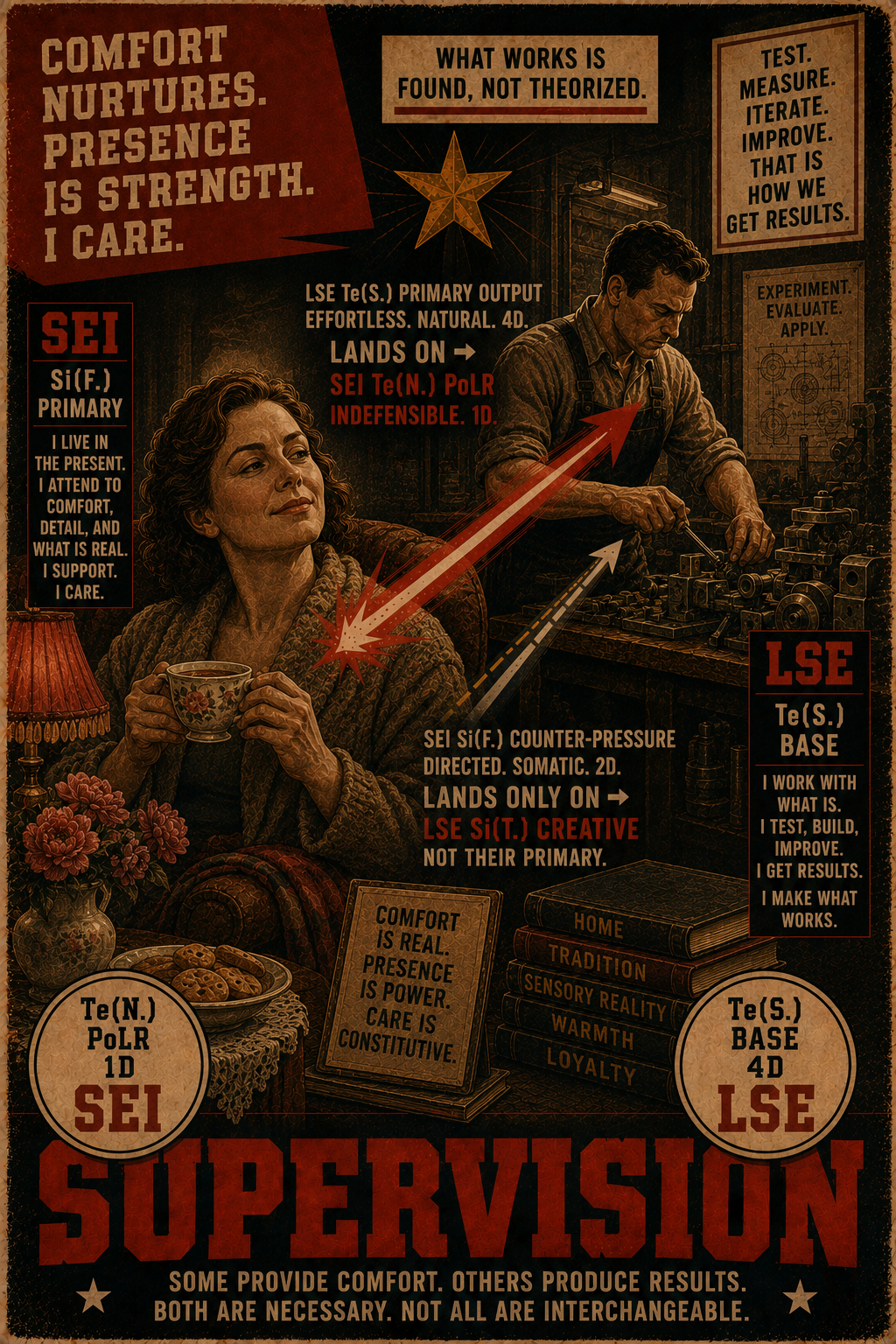
SLE leads with Se(T.) Actuation — regulatory external force, measured governance of the physical environment. In SEI's Model L stack, Se(T.) sits at the A3 Ignoring position. SEI finds it uninteresting and unrewarding to engage directly.
Same structural rule. ESI's Si sits at position 8 — naturally used, present in background operation, not what ESI orients toward as primary. SEI's Fi sits at position 8 — equally natural, equally present, equally not oriented toward.
The shared S./F. sub-variant produces immediate surface warmth. Both types are physically present. Both carry visceral felt charge. Both are somatically immediate — not withdrawn into abstraction like EII/IEI, not absorbed in procedural precision like LSI/SLI, but warmly, bodily present in the immediate physical and relational environment. An observer could easily mistake one for the other at distance.
Same structural rule. ILI's Ni sits at SEI's Role position. SEI's Si sits at ILI's Role position. Full strength on both sides, landing where the other strains most.
ILI leads with Ni(T.) Apprehension — detached strategic tracking of temporal patterns. The ILI attends nonverbally to how events are likely to unfold over time: trends read, implications tracked, the strategic shape of what is becoming visible through accumulated pattern. The engagement is inward and still. Physical presence is incidental. The ILI inhabits time more than space.
Same structural rule. LIE's base Te(N.) sits exactly at SEI's D2 Vulnerable. SEI's base Si(F.) sits exactly at LIE's D2 Vulnerable.
LIE leads with Te(N.) Reason — detached applied logic, informal reasoning toward productive outcomes using available data to formulate workable strategy. In SEI's Model L stack, Te(N.) sits at the Vulnerable position. SEI is genuinely inept with detached applied strategic reasoning, treats it with careless indifference. When LIE's analytical intelligence fills the shared space — evidence processed toward workable conclusions, strategy assembled from available data — SEI has no functional register to receive it. The applied reasoning does not translate into anything the SEI's somatic mode can inhabit or generate.
SEI leads with Si(F.) Stimulation and creates with Fe(S.) Affect. The Fe(S.) creative flows naturally as the collective atmospheric warmth that sustains the immediate somatic ease SEI seeks — ambient collective mood in service of bodily sensory comfort. The SEI is not trying to diffuse EIE's rhetorical passion into general warmth. The atmospheric generation simply sustains the sensory environment.
SEI leads with Si(F.) Stimulation — 4d, 4p, somatic bodily ease at maximum strength. Against LSE's Si(T.) creative this lands on a 3d position. The SEI's somatic warmth genuinely adjusts LSE's sensory precision. But this is the lesser pressure.
SEI leads with Si(F.) Stimulation — somatic bodily ease as primary mode. The Fe(S.) Affect creative flows naturally as the collective atmospheric warmth that sustains that ease: somatic mood broadcast into shared space in service of immediate sensory comfort. The SEI is not trying to inspire the LSI with rhetorical conviction. The atmospheric warmth simply sustains the sensory environment.
EII leads with Fi(N.) Soul — abstract principled conviction as primary mode. The Ne(F.) Inspiration creative flows naturally as the felt imaginative exploration that serves and deepens that conviction: personally-charged creative possibilities opened in service of moral idealism. The EII is not trying to provide architectural structure for the SEI. The imaginative exploration simply serves the principled conviction.
Model A identifies SEI as Si-leading with Fe Creative. Model-L specifies that this is Si(F.) — Stimulation, the involved mode of sensation concerned with bodily vitality, comfort, and felt physical experience, supported by Fe(S.) — Affect.
This distinguishes SEI from SLI. Both lead with Si in Model A terms, but SEI's Si(F.) is subjective and enlivening, tied to comfort, mood, and the felt charge of experience. SLI's Si(T.) is observational and functional, attending to external sensory detail and material accuracy.
For SEI, Model-L clarifies why warmth and comfort are not decorative additions. They are the central mode of perception and the medium through which the type shapes its surroundings.
Attribution: Model-L is Kimani White's original framework. This interpretation is the author's own.
B Radial Group
Supported Same-Club Positions
B positions share the A capacity's rational or irrational club orientation. They are radial, foreground, and resistant: available as conscious support, but not as effortless as the central A cross.
B1 — Correspondent
Ni(F.) — Reverie
Derivation: radial + foreground + resistant · 3D / 2P
Conscious support that can correspond with the A region. It is capable enough to be useful, but it asks for deliberate handling rather than automatic expression.
A visible support position that collaborates with the type's central orientation. It receives attention and can help the profile work outwardly, but it is less dimensionally equipped than the A positions.
A compensating support position. It helps cover less central areas of the cross while still requiring conscious effort and structural management.
B4 — Instrumental
Fi(N.) — Soul
Derivation: radial + foreground + resistant · 3D / 2P
A workable instrument. It can be applied when needed as practical support, without becoming the type's main orientation.
C Radial Group
Contrasting Opposite-Club Positions
C positions take the opposite club orientation from A. They are radial, background, and facile: indirect resources that complement the type's main cross from the contrasting axis.
C1 — Subsidiary
Si(T.) — Observation
Derivation: radial + background + facile · 3D / 2P
Quiet background support from the contrasting club orientation. It works as a subsidiary resource rather than a leading concern.
C2 — Negligent
Te(S.) — Praxis
Derivation: radial + background + facile · 2D / 3P
Indirect background material that may be psychologically noticeable but is easy to neglect. It colours the profile without becoming a central task.
C3 — Prompting
Se(T.) — Actuation
Derivation: radial + background + facile · 2D / 3P
A prompting support position. It nudges the type toward material that complements the A capacity from the opposing axis.
C4 — Galvanizing
Ti(S.) — Habitus
Derivation: radial + background + facile · 3D / 2P
A galvanizing support position. It shapes output from the contrasting axis, adding momentum without becoming a direct Model A anchor.
The Type In Life
The Nurturer
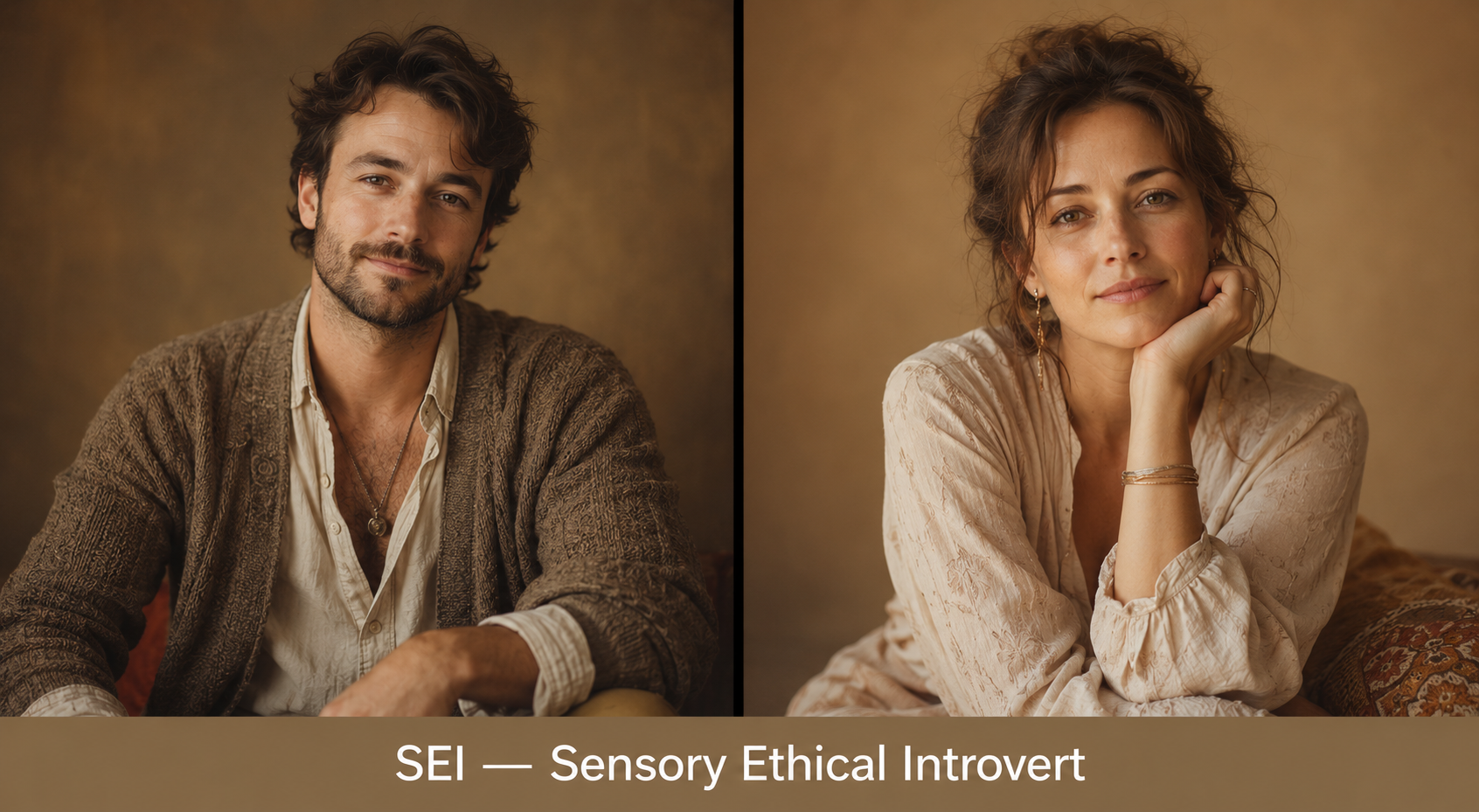
Male story
Tomás
Tomás knows exactly how long his coffee needs to steep and the difference it makes to get it right. His flat is arranged for comfort in a way that looks effortless but is not; he notices when something is off — a light too harsh, a chair at the wrong angle — and fixes it without announcing what he is doing. He moves through the day at a pace that other people find either calming or baffling. He talks easily, warmly, about small things. He is not avoiding large things. He is making the environment good before the large things arrive.
Female story
Mia
Mia brings food to things. Meetings, difficult conversations, afternoons when the energy in a room goes flat — she appears with something that smells right, and the temperature of the space changes. She doesn't orchestrate this; she just notices what is needed and supplies it. She is a generous host in the way that means something: she pays attention. By evening she is tired in a way she does not always name, having absorbed the physical texture of other people's days. She makes a bath, puts something gentle on, and lets the day drain away. She senses comfort as a living arrangement between bodies, moods, textures, and timing. Her care is not abstract sympathy; it arrives as tea at the right temperature, a changed plan, a softened edge, a room made easier to breathe in.
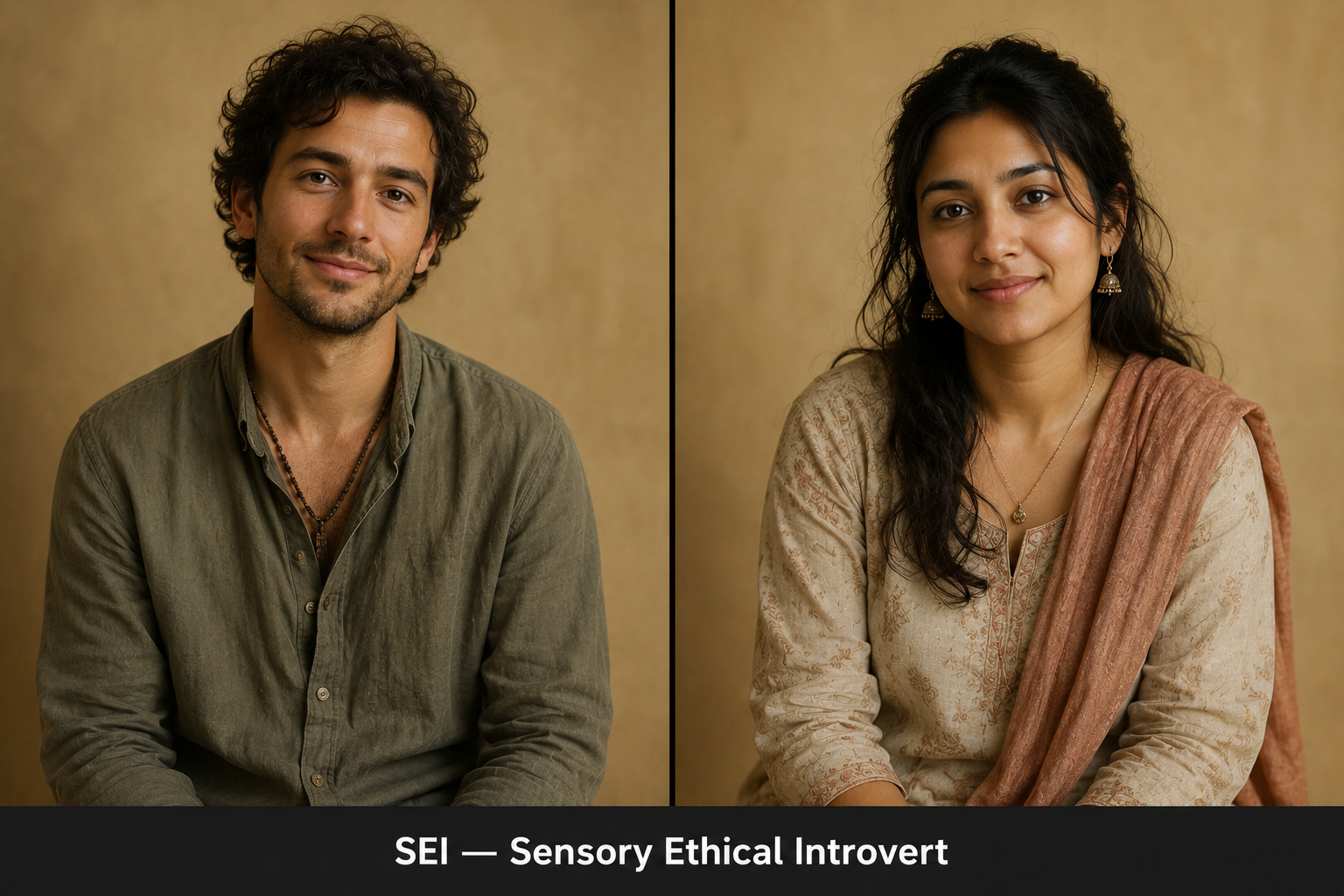
Male story
Tariq
Tariq runs a small café in Marrakech that does not need to be reviewed to be full. He knows what the light does at 4pm through the south window and has positioned two tables accordingly. He knows when a customer needs to be left alone and when they need to be offered something, and the offering is always the right thing at the right moment: a particular tea, the pastry that is still warm, the seat that faces the courtyard. He moves quietly, efficiently, without performance. The place feels good. He built it to feel good and it does. He does not force peace; he cultivates it. In a crowded kitchen or a difficult conversation, he notices the small sensory and emotional frictions that make people tighten, then removes them almost invisibly until everyone thinks they calmed down by themselves.
Female story
Sunita
Sunita's house in Pune runs on a rhythm that visitors take two or three visits to notice: mealtimes that honour appetite rather than clocks, music that changes with the hour, a garden tended not for display but because the smell of jasmine in the evening is worth the effort. She is attentive to physical states in herself and others — she notices the tension in someone's shoulders before they mention a headache. She does not describe herself as perceptive. She is paying attention, she will say, if pressed. Most people, she has found, are not. Her warmth is practical, observant, and quietly artful. She knows which music will loosen a room, which colour makes a corner welcoming, and which person needs to be protected from too much attention until they can relax.