
Alpha Quadra · Logical Intuitive Integrator

LII

The Analyst

Alpha quadra · LII

Logical Intuitive Integrator

The Analyst

Club
NT Researchers
Temperament
IJ — Balanced-Stable
Dual
ESE — The Host
Model A Base
Ti — Laws
Model L Base
Ti(N.) — Intellect

The LII is the type most naturally oriented toward the construction and refinement of conceptual frameworks — the building of the logical architecture through which reality becomes intelligible. At their best they are the person who can take a complex and apparently disordered domain and articulate the principles that make it coherent, who can identify the precise point at which an argument fails and explain exactly why, and whose conceptual precision is matched by a genuine curiosity about whether their frameworks are actually correct.

Their Alpha quadra membership means they value curiosity, clarity, the free exchange of ideas and the pleasure of genuine intellectual discovery. The LII's framework-building is not cold or territorial — it is genuinely exploratory, oriented toward understanding rather than domination, and open to revision when the evidence requires it. Their IJ temperament makes them stable and consistent in their approach — the frameworks they have built are not lightly abandoned, but they are not defended beyond the point where the evidence turns against them.

The LII-ESE dual captures something essential about both types. The ESE provides the warmth, the atmospheric ease, the felt human presence — the conditions in which the LII's detached conceptual work can be shared and received rather than remaining isolated in the abstract. The LII provides the intellectual architecture — the frameworks, the clarity, the conceptual precision — that the ESE's warmly inclusive world can be understood through. Each makes the other's contribution possible and each finds in the other the complement their own mode of engaging with the world cannot generate.

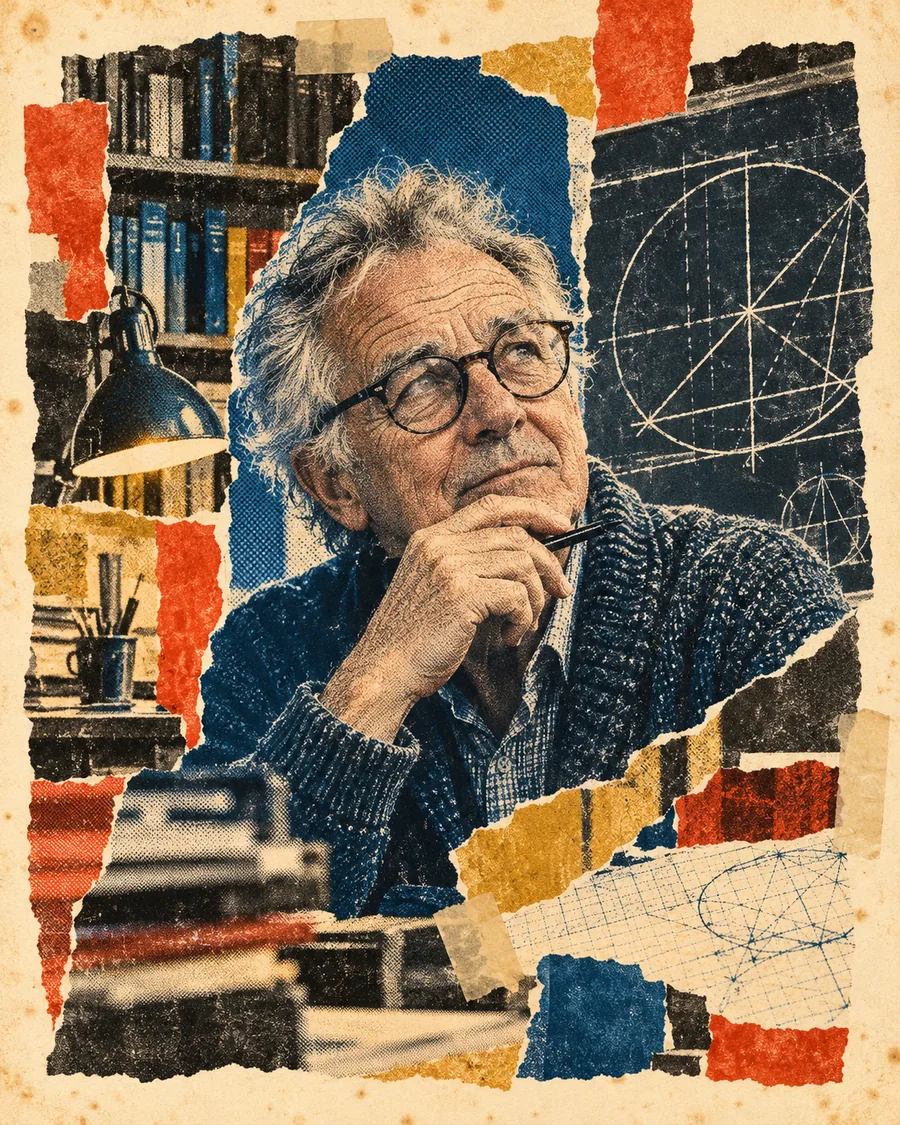
Torn-paper collage portrait: an older man in round glasses thinking through geometric diagrams among library shelves

Type profile

LII In Depth

The eight Model A positions, each with its Model L element. Open any position to read it.

Ego

Conscious and valued: what this type leads with and creates from.

1BaseIntellectTi(N.)

The LII's fundamental mode of engaging with reality is through the linguistic formatting and interpretative schema of the mind — framing and articulating concepts into coherent, communicable, internally consistent structures. Ti(N.) is not the embodied codified structural logic of Ti(S.) in the LSI but logic as pure conceptual architecture — the building and inhabiting of frameworks that make sense of the world at the highest level of abstraction. The LII does not merely apply logic to problems; they construct and refine the conceptual schemas through which problems become intelligible in the first place. Intellect is automatic and effortless — the LII cannot help organising experience into coherent frameworks and cannot help noticing where a framework is inconsistent, incomplete or built on a false premise.

2CreativeIdeationNe(T.)

In service of Intellect, the LII deploys the architecturally directed generation and creative manipulation of concepts — brainstorming, exploring semantic possibilities, testing ideas against logical frameworks, generating the conceptual material from which the Ti(N.) schema is built and refined. Ne(T.) is more visible in behaviour than Ti(N.) — more externally expressed, more conversational — and LIIs are often experienced as conceptually inventive, theoretically penetrating and capable of generating unexpected connections between ideas with casual facility. The Ideation serves the Intellect: the LII explores possibility space in order to understand what it actually contains, not for the pleasure of exploration itself.

Super-ego

Conscious but unvalued: performed for others, or a sore point.

3RoleAnimusFi(S.)

The LII's performance function — the visceral felt attitudes of relational affinity and aversion they are called upon to express in certain social contexts but find unnatural to sustain. Fi(S.) sits uncomfortably against the LII's detached, framework-building register. They can perform relational warmth and personal loyalty when the situation demands it but the viscerally embodied relational mode is effortful and temporary. The framework is what matters; the personal relational performance is something they produce when necessary and set down when possible.

4VulnerableImpetusSe(F.)

The LII's point of greatest sensitivity. Se(F.) is the generation of viscerally felt mobilising impulses — personal vital force, the conversion of desire into vigorous physical action, charismatic bodily presence. This is the furthest territory from the LII's natural register. Being expected to assert themselves physically, to project personal force, to compete through presence and drive lands as a deeply uncomfortable demand. Criticism of their assertiveness or physical confidence hits hard; excessive pressure toward the kind of direct visceral impact that Se(F.) types produce naturally generates genuine stress and defensiveness.

Super-id

Unconscious and valued: what this type seeks and responds to.

5SuggestiveAffectFe(S.)

What the LII most wants and responds to most positively in others. Fe(S.) — Affect — is the physiological conveyance of somatic feeling that creates shared atmospheric warmth and collective sensory ease — the generation of good feeling as a living atmospheric presence. The LII cannot easily produce this themselves — their engagement with the world is conceptual and detached rather than atmospherically warm — but they experience it as deeply nourishing when it appears in others. Their dual ESE leads with exactly this element: the ESE's natural Affect is precisely what the LII's Intellect yearns to be warmed by. Where the LII builds the architecture of understanding, the ESE fills the space it creates with felt human warmth.

6MobilisingStimulationSi(F.)

Energising and uplifting when present in others. Si(F.) — Stimulation — is the subjective experience of physical vitality and sensory ease, the cultivation of comfort and felt wellbeing. The LII cannot easily generate this themselves but responds with energy and animation when they encounter it — the warm sensory attentiveness of others creating conditions in which the LII's conceptual work can proceed without the abrasion of an uncomfortable physical environment. Together with the Suggestive it defines the LII's interpersonal chemistry.

Id

Unconscious and unvalued: capable, but kept in the background.

7IgnoringReasonTe(N.)

Capable but uninteresting. Te(N.) — abstract logical reasoning applied to facts and causal structures — is something the LII can produce fluently but finds less compelling than the deeper architectural work of Ti(N.). Both are detached logical functions but they operate at different levels: Ti(N.) builds the schema; Te(N.) applies logic to factual propositions within it. The LII can reason about facts with considerable precision when the base has genuine need of it but does not seek this territory as its primary domain — the schema is more interesting than the facts it organises.

8DemonstrativeApprehensionNi(T.)

The LII's strong background competence — the detached strategic awareness of temporal trends and long-term trajectories operating quietly without the type fully registering it. Ni(T.) — Apprehension — runs in the background giving the LII a natural sense of where things are going and what the current configuration will produce that supports their framework-building without demanding recognition for itself. The LII often has a quiet prescience about how systems will develop that they experience simply as logical inference rather than as a distinct and powerful function.

Dual relationship

LII and ESE

LII's dual is ESE — The Host. The dual relationship is the most complementary in socionics: each type's Suggestive is precisely served by the other's Base.

LII's Suggestive is Fe(S.) — Affect: atmospheric warmth, felt ease, the physical conveyance of emotional comfort. This is exactly what ESE leads with as their Base. ESE's Suggestive is Ti(N.) — Intellect: logical structure, conceptual clarity, the architecture of ideas. This is exactly what LII leads with.

Neither has to strain to give what the other most needs. The exchange is effortless precisely because it runs along the grain of both types' deepest capacities.

The type in life

The Analyst

Four fictional sketches of the type in an ordinary day.

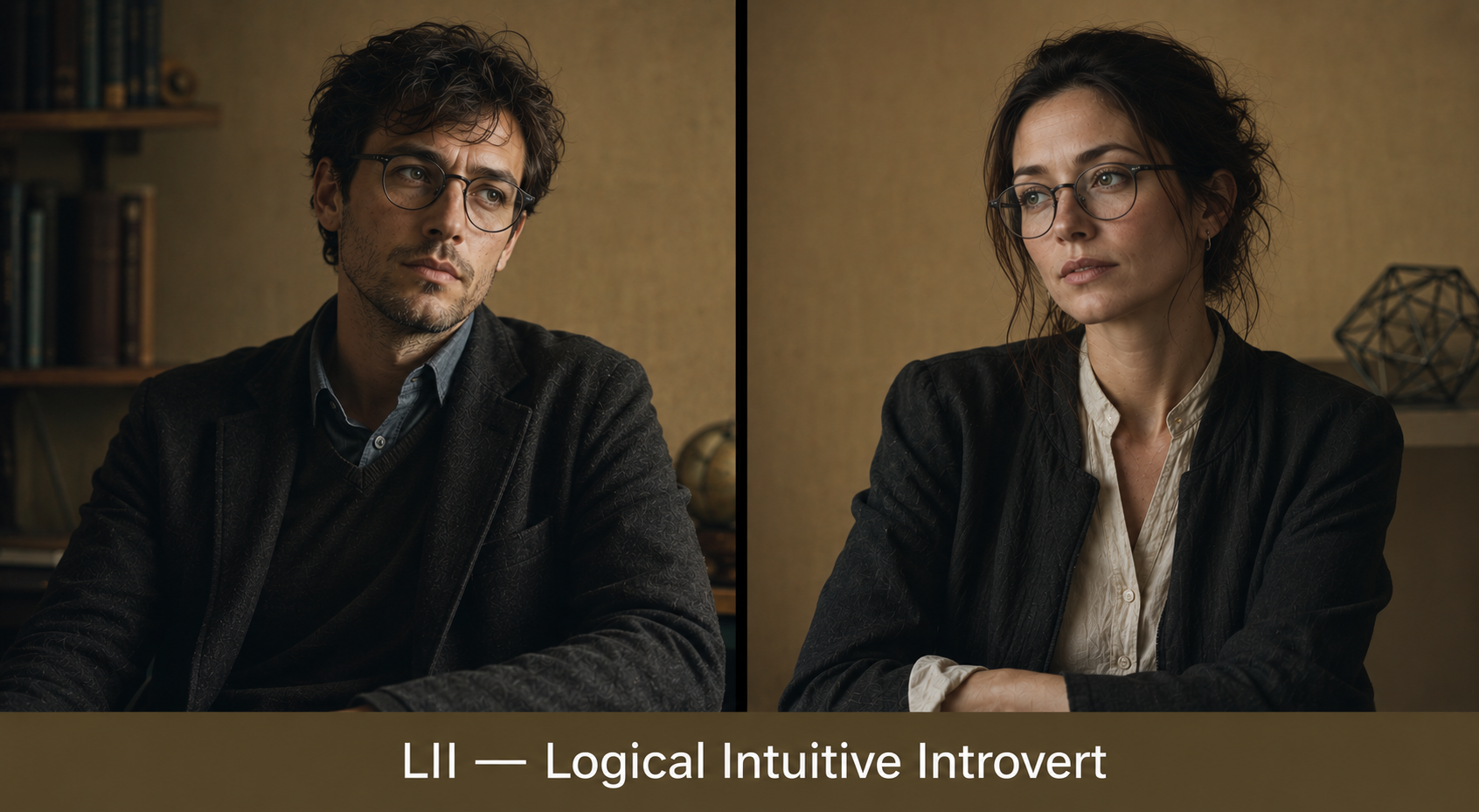
LII original portrait set fictional type portrait

Male story

Marcus

Marcus wakes before his alarm and lies still for a few minutes, working through the flaw he noticed in his own argument the night before. By the time he reaches the kitchen his position has shifted — not dramatically, but with precision. He makes coffee in silence, not because the silence is comfortable but because sound interrupts the thread. By mid-morning he has filled two pages of notes that no one will ever read; they are not *for* anyone. They are the scaffolding behind what he will eventually say clearly. Colleagues describe him as reserved. He is not reserved. He is busy. He trusts definitions the way a builder trusts foundations. In conversation he listens for the point where meanings slip, then quietly braces the structure, not to win the exchange but because unclear categories make honest thought impossible.

Female story

Lena

Lena has a habit of pausing mid-sentence to correct herself. Not out of uncertainty — she knows what she means — but because the first formulation was almost right and almost right is not right. She spends the afternoon reorganising a framework she built six months ago, not because it was wrong but because she now sees a cleaner structure underneath it. The reorganisation takes three hours. No one asked her to do it. She makes tea, returns to the desk, and reads what she has produced. Reads it again. Removes one sentence. Now it is correct. She is patient with complexity and impatient with muddle. Her notebooks are full of distinctions, nested systems, and careful revisions, each one an attempt to make the world more intelligible without flattening it into something merely convenient.
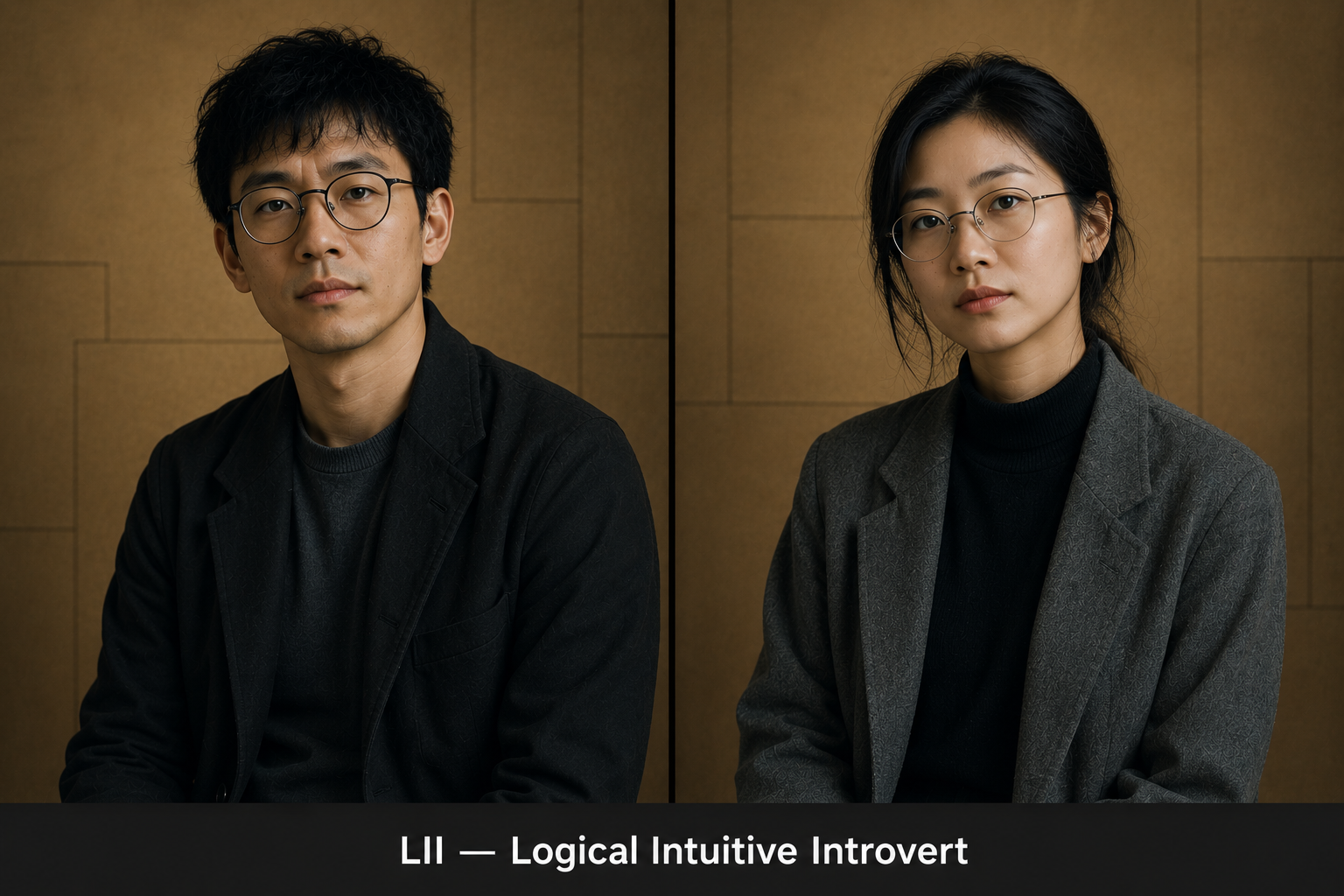
LII diverse portrait set fictional type portrait

Male story

Arjun

Arjun teaches mathematics at a university in Chennai and has a reputation for asking questions that silence the room — not rhetorical questions, genuine ones he has been sitting with for weeks. He writes derivations on the board and then steps back and looks at them with the expression of a man checking a lock. Twice during the lecture he crosses something out and rewrites it, not because it was wrong but because the notation implied something he did not mean. His students find him difficult and essential in roughly equal measure. He finds this neither flattering nor troubling. He finds it accurate. He can spend an afternoon repairing one crooked premise in an argument and consider the day well used. His reserve hides a fierce loyalty to coherence: if the structure is sound, he relaxes; if it is not, he cannot leave it alone.

Female story

Yemi

Yemi is a constitutional lawyer in Lagos and her briefs are models of compression: every word doing work, nothing decorative, the argument arriving at its conclusion by the most direct route available. She rewrites the introduction three times before she is satisfied — not because the argument changed but because the framing of the first two versions admitted a counterargument she would rather close off in advance. She does not enjoy courtroom theatrics. She is not performing. She is constructing, and the construction needs to hold. Colleagues who mistake her quietness for uncertainty tend not to make the same mistake twice. She makes order quietly, through exact questions and principled exclusions. People sometimes mistake her calm for detachment, but she is often deeply invested in whether a shared idea can stand upright without hidden contradiction.

Intertype relations

LII In Relation

How LII meets each of the sixteen types. Open a relation to read it; each links to the full relation page.

Dualitywith ESE — The Host

The LII figure at the board is doing what Ti(N.) does — building communicable logical structure, articulating principle into coherent form. The framework on the board is precise and correct. But it needs a room that can receive it. The ESE figure is providing exactly that — not through rhetoric or dramatic gesture, but through the physical atmospheric ease of Fe(S.) Affect. The warmth is somatic and ambient, carried in physical presence rather than in expressed inner conviction. Together the structure finds the atmosphere it needs to actually land, and the atmosphere has the principled content it needs to be more than mere pleasant feeling. Neither is trying to provide what the other needs. Each is simply being themselves.

Read the full Duality section
Identitywith LII — The Analyst

Two LII types encounter in each other the most complete recognition available in the socion. Every structural schema produced by one is immediately comprehensible to the other — not merely understood but redundant. The abstract logical architecture each builds, the conceptual frameworks each articulates, the structural resolutions each arrives at: all of this flows in both directions with zero friction and zero new information.

What doubles: Ti(N.) precision, abstract communicable structural logic, the capacity to build and evaluate formal conceptual schema. Ne(T.) generativity — the conceptual exploration that serves structural resolution — also doubles. Two instances of the same analytical mode operating in full resonance.

Read the full Identity section
Mirrorwith ILE — The Inventor

In Model A, Mirror partners carry each other's Ego functions in swapped positions. LII leads with Ti(N.) and creates with Ne(T.). ILE leads with Ne(T.) and creates with Ti(N.). The same two functions, the same two sub-variants, reversed priority. Each type has immediate and complete access to what the other is doing — not the strained comprehension of Super-Ego, not the mutual bypass of Quasi-identity, but genuine recognition. The friction is not incomprehension. It is a persistent disagreement about which of the two shared tools should be in charge.

Model L makes the specific inversion visible.

Read the full Mirror section
Activitywith SEI — The Mediator

In Model A, Activity partners carry each other's full Ego block in their Super-Id — the block of what each type genuinely values and seeks from others. The correspondence is complete: every element, every sub-variant matches. But the priority is inverted relative to Dual. In Dual, A's leading function fills B's Suggestive — the position of what B most deeply seeks — as the partner's primary, most concentrated output. In Activity, A's leading fills B's Activating instead. What B most deeply seeks is what A produces as creative, not as leading. It arrives genuinely and naturally, but always shaped by the function it serves.

The result is a relationship that is energising, mutually beneficial, and never quite perfectly calibrated. Each type provides what the other genuinely needs. Neither provides it in quite the form the other would most naturally receive.

Read the full Activity section
Kindredwith LSI — The Inspector

Both LII and LSI lead Ti. Both are oriented toward logical structure, principle, and consistency. Both resist information that does not cohere. The Kindred recognition between them is immediate — each identifies the other as someone who cares about how things are properly organised and governed. What neither can fully account for, without Model L, is why something persistently differs in how they are doing what looks like the same thing.

The LII figure at the chalkboard is doing Ti(N.) — Intellect. The structure exists as articulated concept. Logical principles are taken and rendered into communicable form — stated, organised, transmissible, open to debate and refinement through discourse. The chalkboard is full of the formal architecture of how the system works. The books beside it are the accumulated conceptual framework the LII draws from. This is Ti operating in the linguistic and conceptual register — structure as something that can be said, written down, argued with, and passed between minds.

Read the full Kindred section
Semi-Dualitywith EIE — The Orator

In Model A, Semi-duality has a precise structural definition: each type's leading function provides the correct element for the other's Suggestive position — what each type most deeply seeks — but in the wrong sub-variant. The domain is right. The register is slightly off. You receive something genuinely related to what you most want from someone whose natural output is almost but not quite the form you most deeply need.

This distinguishes Semi-duality from every other relation type covered so far. Dual provides the right element in the right sub-variant as the partner's primary output. Activity provides the right element in the right sub-variant as the partner's secondary output. Semi-duality provides the right element in the wrong sub-variant as the partner's primary output. The domain arrives with full strength and genuine intention. The register arrives slightly displaced.

Read the full Semi-Duality section
Businesswith EII — The Humanist

The LII and EII can work together. Both are principled. Both are abstract. Both are comfortable operating through careful reasoned engagement with ideas rather than through physical procedure or concrete embodied practice. Both resist having their inner frameworks overridden by external pressure or situational convenience. Both arrive at settled concluded verdicts through their respective processes of careful principled reasoning. From the outside they can appear very similar — two quietly thoughtful types who care deeply about getting things right and who operate from a stable inner sense of what is correct. This surface resemblance is genuine. It is what makes them Business/Lookalike in Model L and what allows them to engage with each other productively in a way the full Conflict versions cannot manage as readily.

The LII figure is doing Ti(N.) — Intellect. The logical structure is being articulated as communicable abstract principle — the framework applied to the situation, the relevant categories identified, the verdict arrived at through impersonal structural logic that applies equally to everyone regardless of who they are or what their relationship to the situation is. The conclusion is settled and the LII is comfortable stating it clearly. The criterion for the verdict is structural coherence — something either follows the logical framework or it does not. The personal identity of the people involved is not a variable in the assessment. The impersonality is not coldness. It is what makes the principle a principle rather than a preference.

Read the full Business section
Illusionarywith LSE — The Director

In Model A, the Illusionary relationship is sometimes called Mirage — a name that captures the phenomenology precisely. Each type is genuinely drawn toward the other. The draw is not mistaken in the sense of being baseless. It is mistaken in the sense of being based on the wrong signals.

Model L shows exactly what those signals are and why they mislead.

Read the full Illusionary section
Quasi-Identitywith ILI — The Critic

In Model A, Quasi-identity has a precise definition: each type's leading function sits at the other's Demonstrative position — the 8th. Not the Role, where Super-Ego strikes. Not the Vulnerable, where Conflict lands. The Demonstrative function is strong — it belongs to the Id block, meaning the type uses it naturally and freely — but it is not what they orient toward as primary. It operates in the background, deployed readily in support of others, without being led with or sought out.

LII's Ni is at position 8 — used naturally, present in background operation, but not what LII orients toward. ILI's Ti is at position 8 — equally natural, equally present, equally not oriented toward. Each type's greatest strength is what the other deploys freely without making it their primary object of attention.

Read the full Quasi-Identity section
Super-Egowith ESI — The Guardian

In Model A, the Super-Ego relationship has a precise structural definition: each type's leading function sits at the other's Role position — the 3rd. Not the Vulnerable, where Conflict strikes. One level above it. The Role is the position a type strains toward, performs under pressure, but never inhabits with ease. In Super-Ego, both types are operating from full strength, and both are landing on exactly that position in the other person.

Model L shows why.

Read the full Super-Ego section
Extinguishmentwith LIE — The Entrepreneur

In Model L, the Extinguishment relationship has a precise structural definition: each type's full Ego block — base (A1) and creative (A2) — sits exactly in the other's Contributive capacity, occupying the C1 Subsidiary and C4 Galvanizing positions. The Contributive capacity is Background/Facile: these functions are 3d capable, easy to focus on for extended periods, but of menial value and overwhelmingly co-opted in service of the type's own base operation.

Read the full Extinguishment section
Conflictwith SEE — The Politician

In Model L, the Conflict relationship has a precise structural definition: each type's base function sits exactly at the other's D2 Vulnerable position — the PoLR, Point of Least Resistance. Not the Role (2d, aspirational, strained), not the Ignoring (3d, competent but unrewarding), but the absolute weakest position in the functional stack: 1d, 1p, treated with careless indifference, the position where a type is genuinely inept and finds direct engagement both draining and largely irrelevant to their natural operation.

The match is exact. Same element, same sub-variant. Each type's most natural, most effortless primary output strikes the other's blind spot with full force — not out of intent, not through incompatibility of domain alone, but because what flows most naturally from each is precisely what the other has the least capacity to process.

Read the full Conflict section
Supervision: Supervisorwith IEE — The Inspirer

LII leads with Ti(N.) Intellect and creates with Ne(T.) Ideation. The Ne(T.) creative flows naturally as the conceptual generation that serves structural resolution — architectural concept space opened in service of arriving at communicable logical framework. The LII is not trying to inspire. The conceptual generation serves the structural orientation, not felt personal significance.

Read Supervision in the Model A library
Supervision: Superviseewith SLE — The Marshal

LII leads with Ti(N.) Intellect — 4d, 4p, the most powerful possible expression of abstract structural logic. Against the SLE's Ti(S.) creative, this counter-pressure lands on a 3d position. The LII is capable of producing substantial structural correction, and the SLE's creative procedure is genuinely adjusted by it. But this is the lesser pressure.

Read Supervision in the Model A library
Benefit: Benefactorwith SLI — The Craftsman

LII leads with Ti(N.) Intellect — abstract structural logic as primary mode. The Ne(T.) Ideation creative flows naturally as the conceptual generation that serves that structure: branching possibility space opened in service of arriving at communicable logical framework. The LII is not trying to inspire the SLI. The conceptual generation simply serves the structural resolution.

Read Benefit — Model A
Benefit: Beneficiarywith IEI — The Mystic

IEI leads with Ni(F.) Reverie — inner narrative aspiration as primary mode. The Fe(N.) Sentiment creative flows naturally as the inner emotional expression that gives that narrative its outward form: rhetorical feeling, directed inner passion, conviction shaped into address. The IEI is not trying to warm the LII. The emotional expression simply voices the narrative.

Read Benefit — Model A

A note on this type

What Model L Adds

Model A identifies LII as a Ti-leading type with Ne Creative. This accurately captures the type's core orientation but leaves ambiguous which mode of Ti and which mode of Ne is operative.

Model-L specifies: LII's Ti is Ti(N.) — Intellect, the detached linguistic schema of the mind, used to frame and articulate concepts into coherent communicable ideas. It is not Ti(S.) — Habitus, the embodied physical structures and codified behavioural habits that characterise LSI.

This distinction matters when distinguishing LII from LSI: both lead with Ti, but LSI's Ti(S.) produces procedural discipline and institutional form, while LII's Ti(N.) produces conceptual architecture and theoretical precision. Similar surface behaviour, fundamentally different orientation.

Similarly, LII's Ne is Ne(T.) — Ideation, the architecturally directed generation of conceptual structure. It is not Ne(F.) — Inspiration, the personally vivid, involved exploration of possibilities that characterises IEE. Both types generate ideas prolifically; the mode is different.

Attribution: Model-L is Kimani White's original framework. This interpretation is the author's own.

B Radial Group

Supported Same-Club Positions

B positions share the A capacity's rational or irrational club orientation. They are radial, foreground, and resistant: available as conscious support, but not as effortless as the central A cross.

B1 — CorrespondentTi(S.) — Habitus

Derivation: radial + foreground + resistant · 3D / 2P

Conscious support that can correspond with the A region. It is capable enough to be useful, but it asks for deliberate handling rather than automatic expression.

B2 — CollaborativeSe(T.) — Actuation

Derivation: radial + foreground + resistant · 2D / 3P

A visible support position that collaborates with the type's central orientation. It receives attention and can help the profile work outwardly, but it is less dimensionally equipped than the A positions.

B3 — CompensatoryTe(S.) — Praxis

Derivation: radial + foreground + resistant · 2D / 3P

A compensating support position. It helps cover less central areas of the cross while still requiring conscious effort and structural management.

B4 — InstrumentalSi(T.) — Observation

Derivation: radial + foreground + resistant · 3D / 2P

A workable instrument. It can be applied when needed as practical support, without becoming the type's main orientation.

C Radial Group

Contrasting Opposite-Club Positions

C positions take the opposite club orientation from A. They are radial, background, and facile: indirect resources that complement the type's main cross from the contrasting axis.

C1 — SubsidiaryFi(N.) — Soul

Derivation: radial + background + facile · 3D / 2P

Quiet background support from the contrasting club orientation. It works as a subsidiary resource rather than a leading concern.

C2 — NegligentNe(F.) — Inspiration

Derivation: radial + background + facile · 2D / 3P

Indirect background material that may be psychologically noticeable but is easy to neglect. It colours the profile without becoming a central task.

C3 — PromptingFe(N.) — Sentiment

Derivation: radial + background + facile · 2D / 3P

A prompting support position. It nudges the type toward material that complements the A capacity from the opposing axis.

C4 — GalvanizingNi(F.) — Reverie

Derivation: radial + background + facile · 3D / 2P

A galvanizing support position. It shapes output from the contrasting axis, adding momentum without becoming a direct Model A anchor.

Classification

Dichotomies and Small Groups

Fifteen Reinin dichotomies

  1. Integrator
  2. Intuitive
  3. Logical
  4. Rational
  5. Reductionist
  6. Accepter
  7. Clarifier
  8. Identifying
  9. Determined
  10. Obstinate
  11. Time-Locked
  12. Speech-Locked
  13. Denier
  14. Antithetic
  15. Anticlockwise

Seven small groups

Quadra
Alpha
Club
Intellectual
Temperament
Normative
Tournament
Accomplishment
Axis
Diplomat
Standoff
Disruptor
Course
Healer