TetraTypes is an independent resource. It is not affiliated with the World Socionics Society or with Kimani White.

Gamma Quadra · Ethical Sensory Introvert

ESI

The Guardian

Type code: ESI

Ethical Sensory Introvert

The Guardian

γ Gamma Club: SF Socials Dual: LIE — The Entrepreneur Model A Base: Fi — Relations Model L Base: Fi(S.) — Animus

Model A · WSS

Function Stack

Position 1 — LeadingFi — Relations
Position 2 — CreativeSe — Force
Position 3 — RoleTi — Laws
Position 4 — VulnerableNe — Ideas
Position 5 — SuggestiveTe — Pragmatism
Position 6 — MobilisingNi — Telos
Position 7 — IgnoringFe — Emotions
Position 8 — DemonstrativeSi — Senses

Ego Block Summary

ESI leads with Fi — Relations: stable affinity, loyalty, aversion, and the visceral knowledge of who belongs close. Se — Force serves as the Creative function, protecting those bonds through direct action, boundaries, and pressure when needed.

Valued Elements

Valued elements: Fi ? Se ? Te ? Ni

These are the Gamma elements ESI finds most trustworthy: personal relation, decisive force, practical reasoning, and strategic timing.

Vulnerable Note

Ne — Ideas sits at position 4, the Vulnerable. Open-ended possibility, speculative reframing, or diffuse novelty can feel unreliable here, especially when it blurs clear loyalties and commitments.

Suggestive Note

Te — Pragmatism sits at position 5, the Suggestive. ESI welcomes practical competence, workable plans, and clear evidence that something can be done well. This is what the LIE dual provides naturally.

Model L · Kimani White

The Sixteenfold Cross

Model-L specifies each of ESI's sixteen element positions to the sub-variant level. The four capacity groups — A, B, C, D — organise these positions by the type's psychological relationship with each.

A CAPACITY — Preeminent

ESI's most natural region: concrete affinity, visceral drive, expressive atmosphere, and bodily vitality held around chosen commitments.

A1 — Fi(S.) — "Animus" — Base

ESI Base: Fi(S.) Animus. Stable visceral attitudes of affinity or aversion toward people and concrete objects. This is the central point of the type's confidence.

A2 — Se(F.) — "Impetus" — Creative

ESI Creative: Se(F.) Impetus. Visceral mobilizing impulse, turning stored energy toward concrete aims and exertion. This is the tool the type uses to express and support the Base.

A3 — Fe(S.) — "Affect" — Ignoring

ESI Ignoring: Fe(S.) Affect. Physiological mood, expressive atmosphere, aesthetic signals, and shared sensory feeling tone. Capable but not treated as the main point.

A4 — Si(F.) — "Stimulation" — Demonstrative

ESI Demonstrative: Si(F.) Stimulation. Subjective bodily stimulus, vitality, comfort, and the felt charge of physical experience. Strong and often automatic in the background.

B CAPACITY — Supported

Supported positions that add inner values, personal inspiration, symbolic emotion, and reflective timing to ESI's relational core.

B1 — Fi(N.) — "Soul" — Correspondent

ESI Correspondent: Fi(N.) Soul. Inner values, ideals, convictions, and abstract notions of what is inherently worthwhile. Available as a conscious support, but less central than the A positions.

B2 — Ne(F.) — "Inspiration" — Collaborative

ESI Collaborative: Ne(F.) Inspiration. Inner potentiality, spontaneous creative impulse, and imagined paths for growth or novelty. Works as a deliberate auxiliary route.

B3 — Fe(N.) — "Sentiment" — Compensatory

ESI Compensatory: Fe(N.) Sentiment. Inner opinions and passions conveyed through dramatic rhetoric, symbolism, and emotional meaning. Helps cover practical or structural gaps when needed.

B4 — Ni(F.) — "Reverie" — Instrumental

ESI Instrumental: Ni(F.) Reverie. Inner scenarios, narrative significance, symbolic subtext, and reflective imagination around events. Useful and deployable, especially in service of stronger aims.

C CAPACITY — Contrasting

Contrasting positions that bring embodied structure, regulated force, practical method, and sensory observation into the profile.

C1 — Ti(S.) — "Habitus" — Subsidiary

ESI Subsidiary: Ti(S.) Habitus. Embodied forms, codified habits, and the tangible structure of subjects, groups, or systems. A secondary shading of the profile rather than the lead voice.

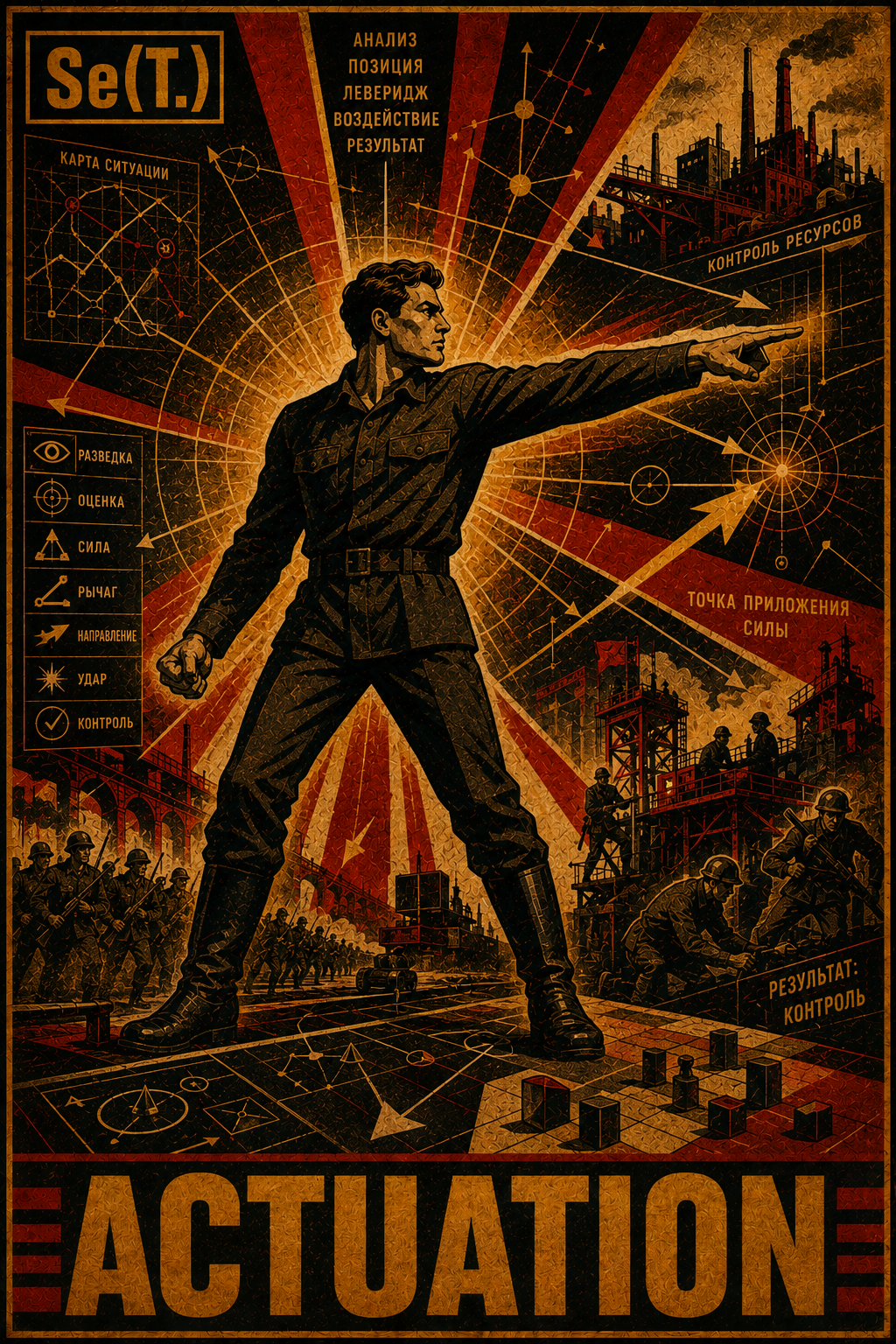
C2 — Se(T.) — "Actuation" — Negligent

ESI Negligent: Se(T.) Actuation. Regulatory force applied to shape the physical environment within concrete parameters. Present but not normally prioritised.

C3 — Te(S.) — "Praxis" — Prompting

ESI Prompting: Te(S.) Praxis. Hands-on methods, practical experimentation, resources, and material workflow improvement. Can be activated by context or by other people.

C4 — Si(T.) — "Observation" — Galvanizing

ESI Galvanizing: Si(T.) Observation. Selective intake of external sensory data, attending to functional details in the physical field. A background primer that can energise the type indirectly.

D CAPACITY — Vulnerable

The lower-capacity region: conceptual structure, detached possibility, impersonal reasoning, and strategic time as the field of need and support.

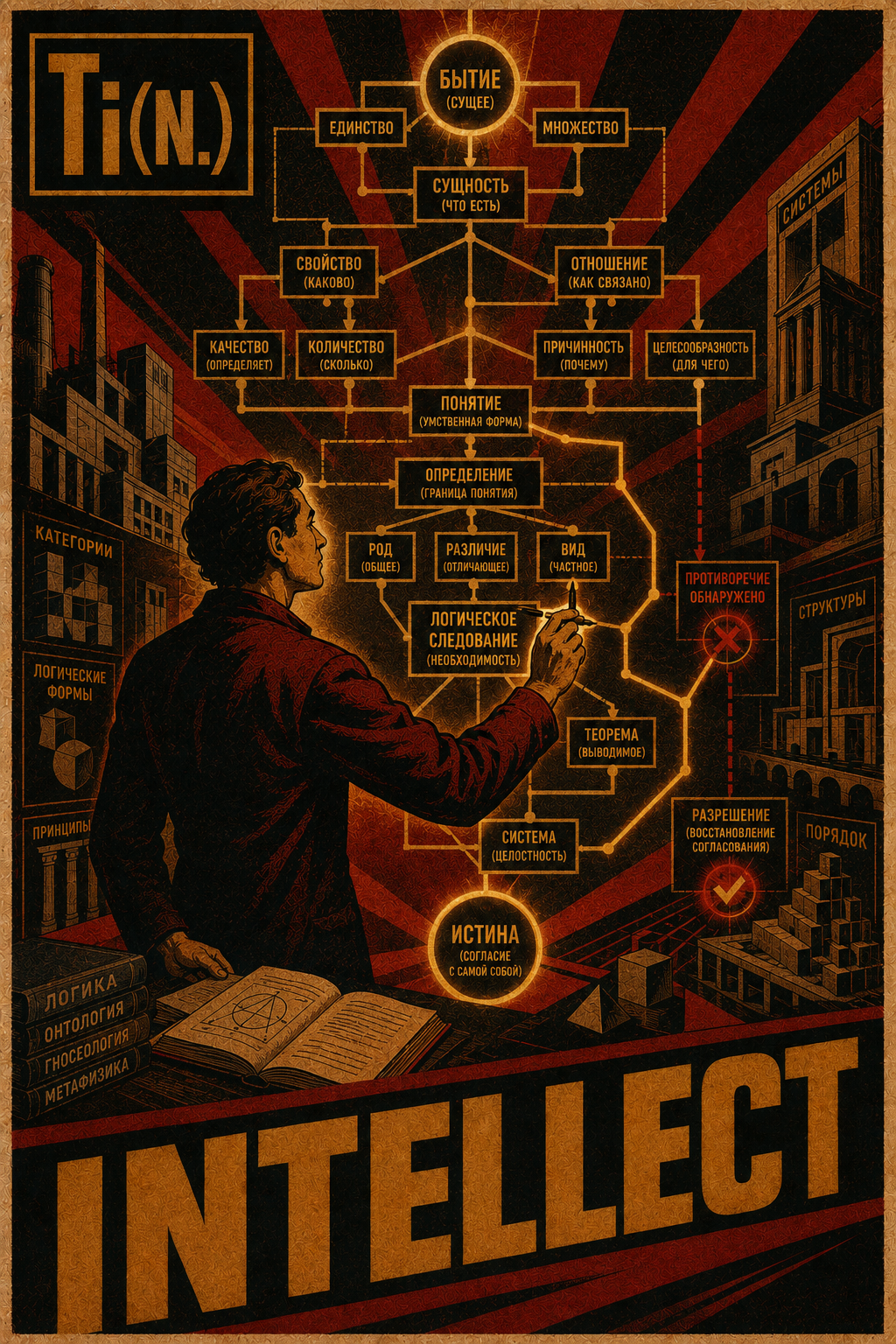
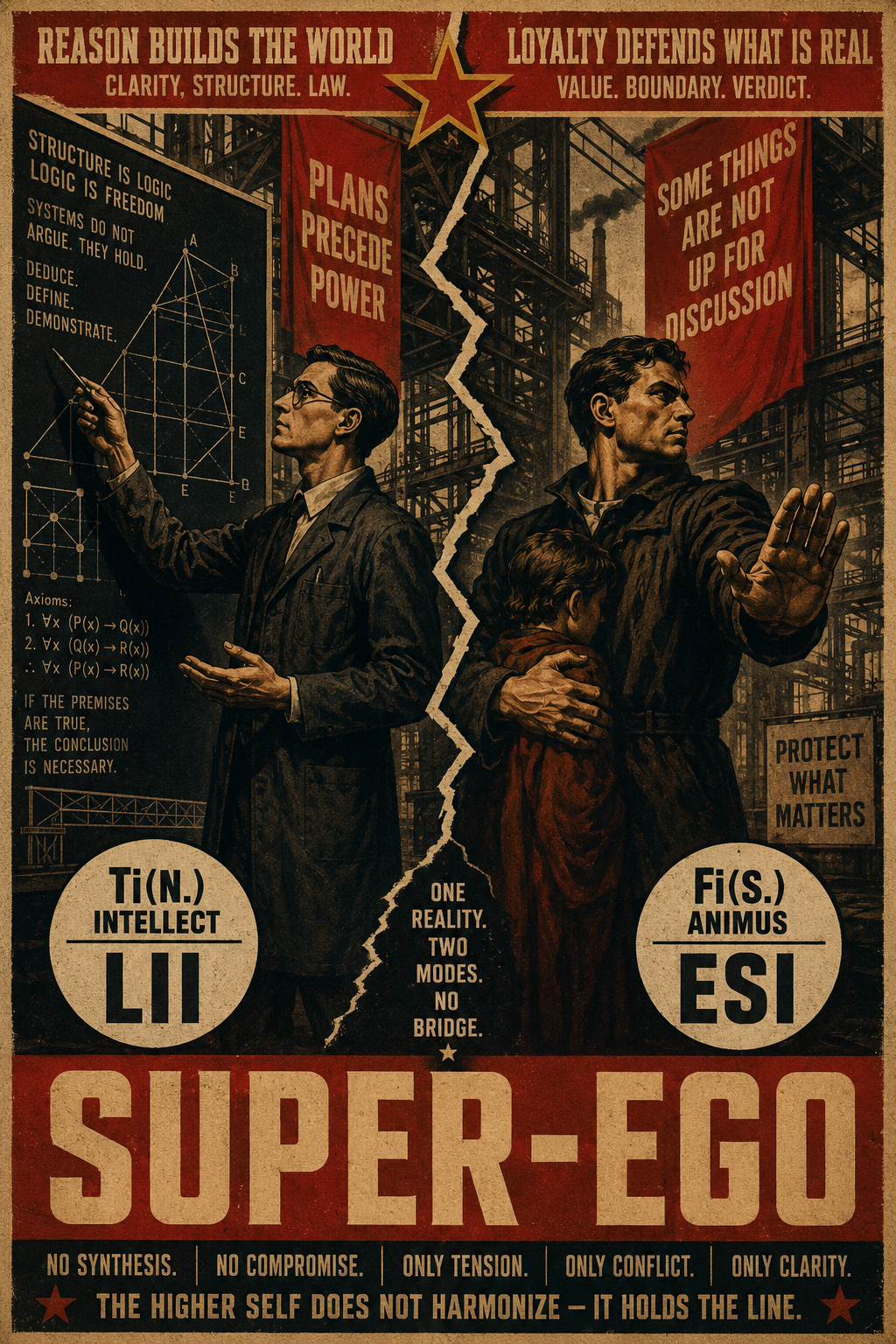
D1 — Ti(N.) — "Intellect" — Role

ESI Role: Ti(N.) Intellect. Linguistic framing, interpretive schema, and coherent articulation of concepts. Performed consciously when the situation asks for it.

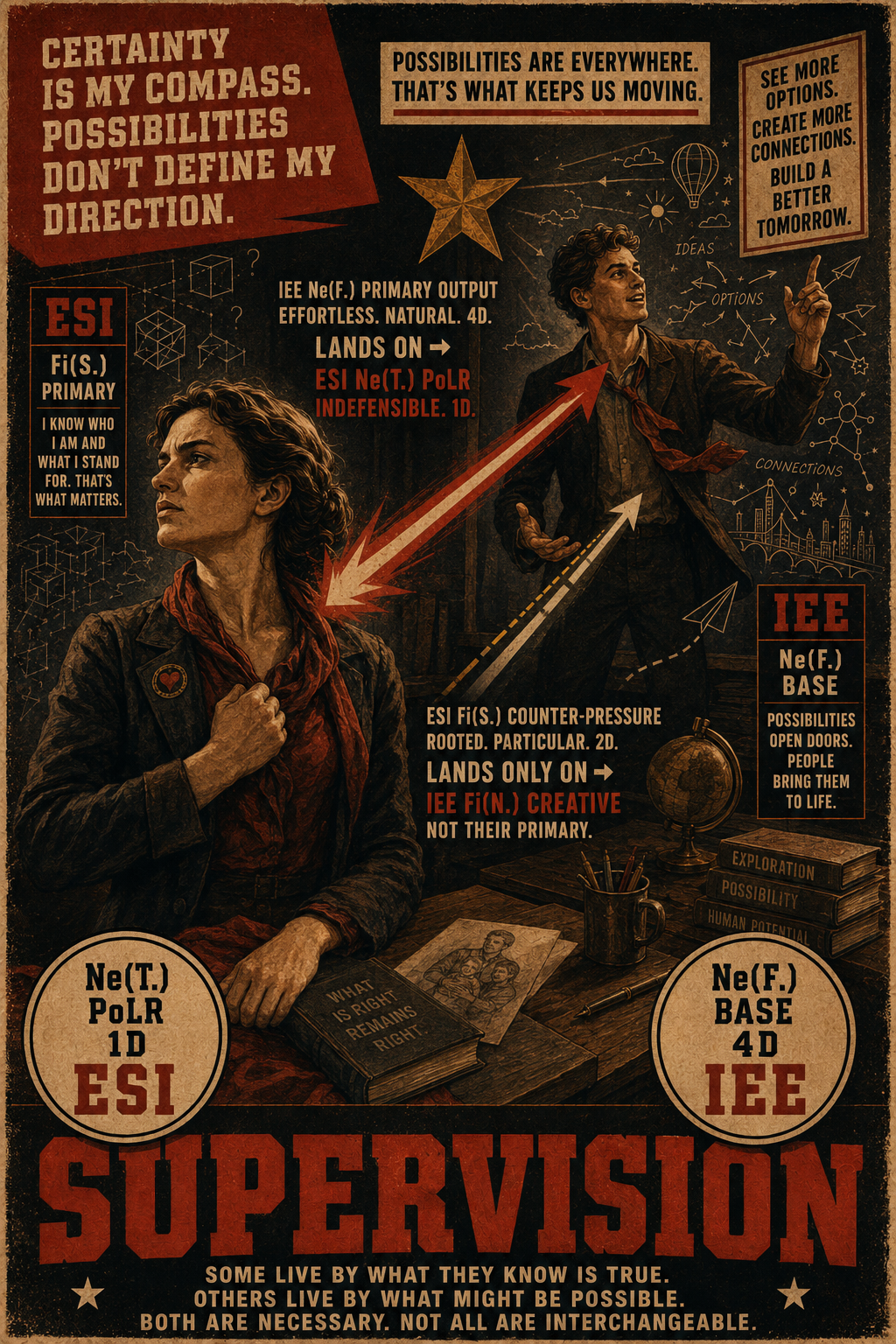
D2 — Ne(T.) — "Ideation" — Vulnerable

ESI Vulnerable: Ne(T.) Ideation. Active conceptual generation, brainstorming, and manipulation of semantic possibilities. A sensitive point where pressure can land hard.

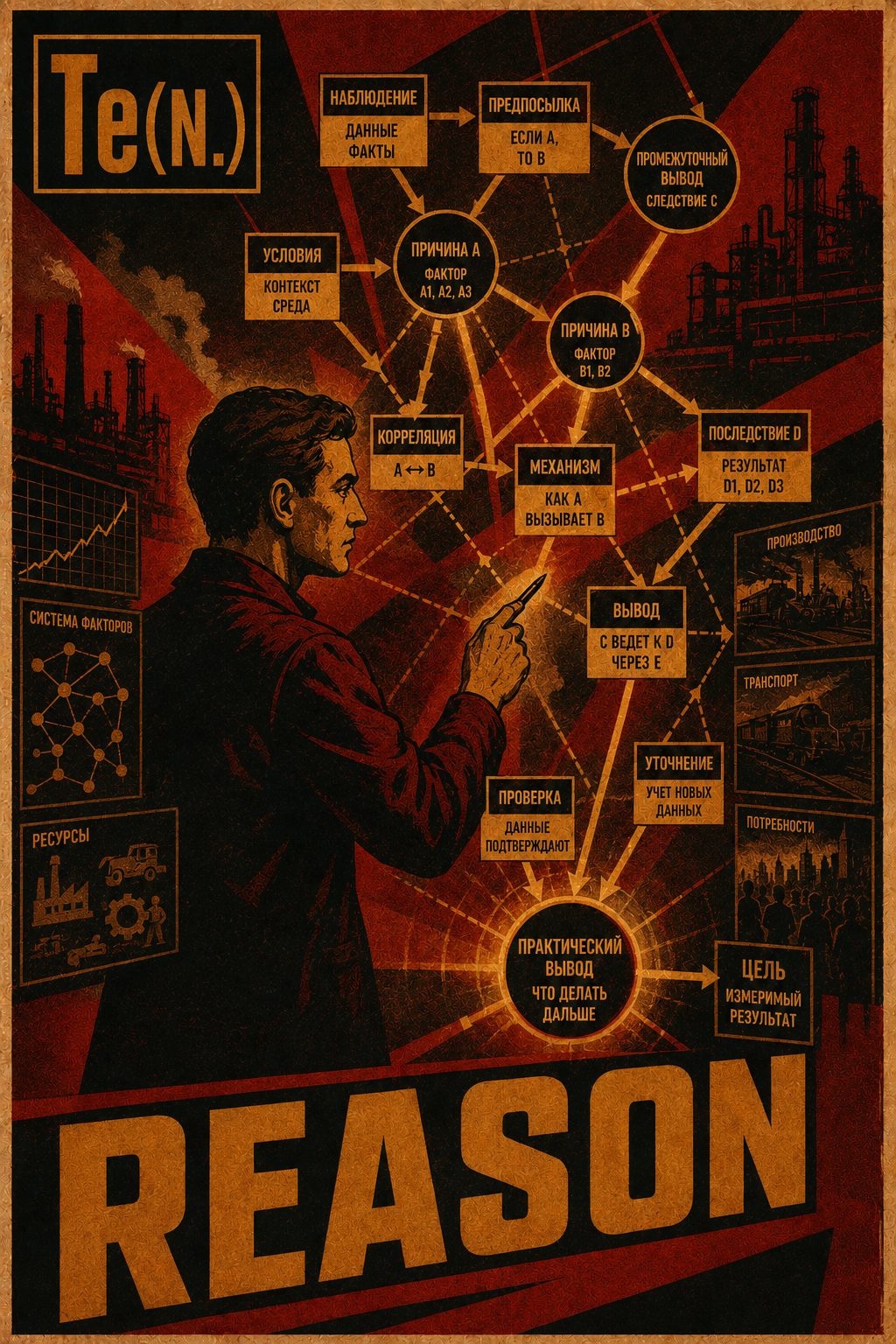
D3 — Te(N.) — "Reason" — Suggestive

ESI Suggestive: Te(N.) Reason. Fact propositions, informal logic, productive aims, and workable strategic formulations. A receptive point: what the type most welcomes from others.

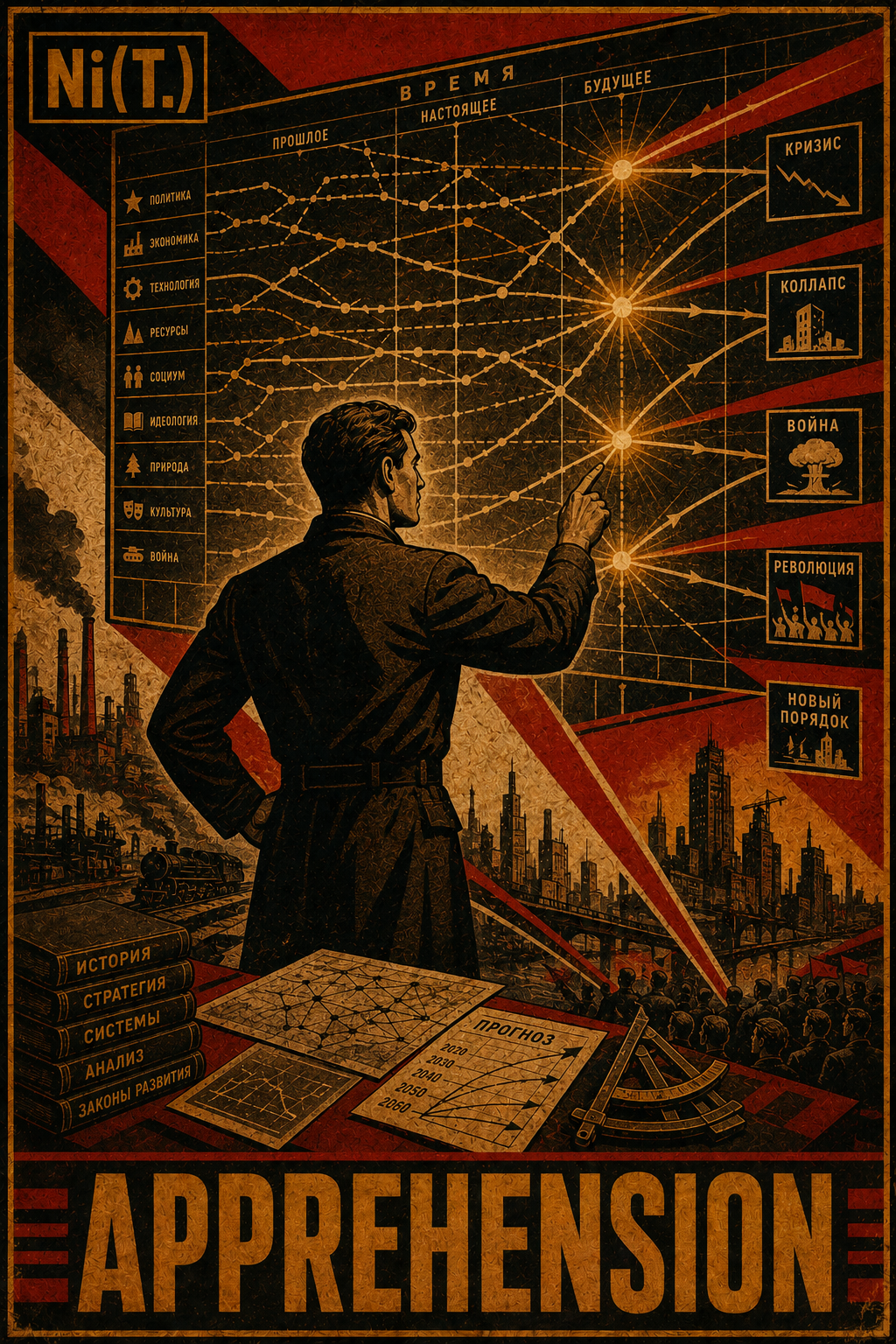
D4 — Ni(T.) — "Apprehension" — Mobilizing

ESI Mobilizing: Ni(T.) Apprehension. Strategic and temporal understanding of how events are likely to unfold over time. A low-capacity but energising point that responds to encouragement.

The Type In Life

The Guardian

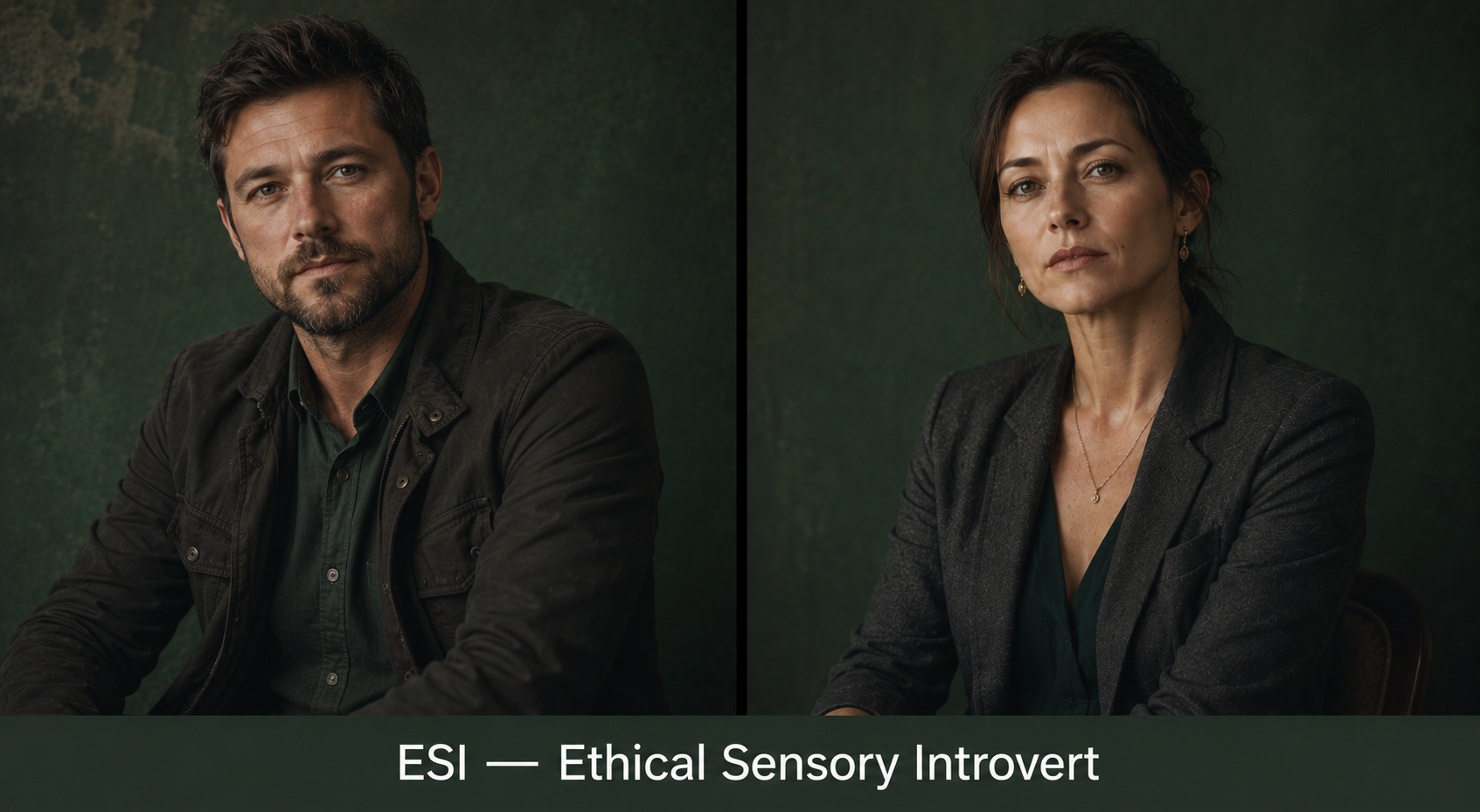
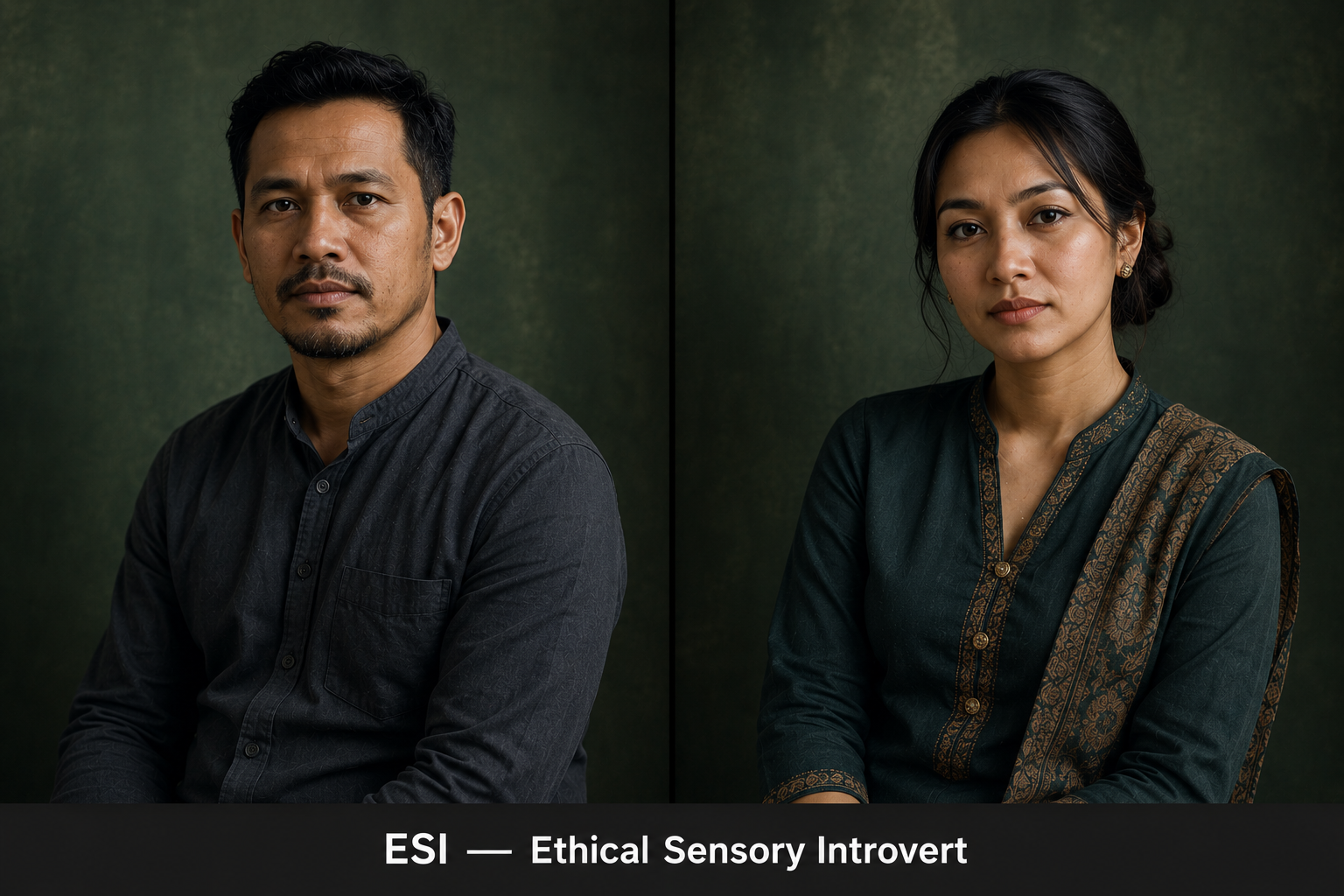
Lorenzo

Lorenzo is particular about who he allows close. This is not coldness — strangers find him warm, attentive, socially competent — but the distance between pleasant and trusted is long and he does not shorten it on request. He keeps commitments the way other people keep receipts: precisely, permanently. He helped someone move in 2019. He remembers. He knows, viscerally, who he can count on, and acts accordingly. When someone violates the trust he placed in them, the revision is absolute. He does not carry it as a wound. He carries it as information.

Amara

Amara has a settled sense of who she is that other people sometimes mistake for stubbornness. It is not stubbornness. She has simply already resolved the questions that others are still arguing about, at the level of feeling rather than principle. She has strong, specific aversions and does not apologise for them. The relationships she maintains are maintained actively; she calls, remembers, arrives. She does not arrive where she is not wanted. She can tell the difference.

Dual Relationship

ESI and LIE

ESI's dual is LIE — The Entrepreneur. ESI's Suggestive is Te(N.) — Reason: facts, workable logic, strategic aims, and productive formulation. LIE leads with exactly this mode of application.

LIE's Suggestive is Fi(S.) — Animus: stable visceral affinity, aversion, loyalty, and personal commitment. ESI leads with that mode effortlessly. Each gives the other a kind of certainty the other cannot manufacture alone.

A Note on This Type

What Model L Adds

Model A identifies ESI as Fi-leading with Se Creative. Model-L specifies that this is Fi(S.) — Animus, the concrete and visceral mode of relation, supported by Se(F.) — Impetus.

This distinction matters when separating ESI from EII. Both lead with Fi in Model A terms, but ESI's Fi(S.) is embodied, immediate, and bound to concrete loyalty or aversion. EII's Fi(N.) is ideal, internal, and value-oriented.

For ESI, Model-L shows why protection and judgement sit together: relation is not abstract sentiment, but a felt commitment that naturally draws boundaries.


Attribution: Model-L is Kimani White's original framework. This interpretation is the author's own.