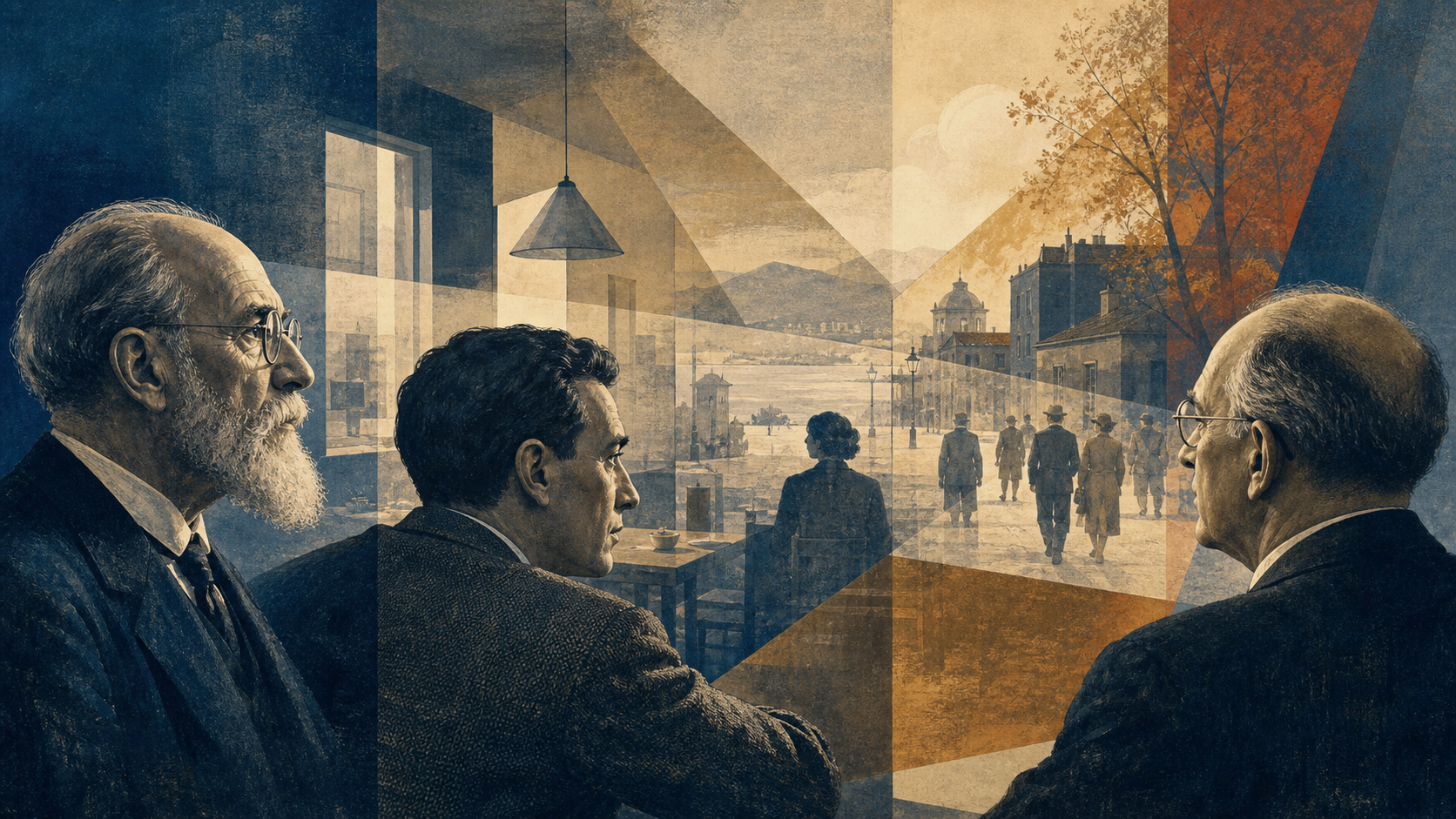
The Philosophy Behind TetraTypes
The Geometry of Four
Quattuor radices omnium — “The four roots of all things”Empedocles, On Nature, Fragment 6
Why TetraTypes treats type as a fourfold structure of information metabolism: useful, symbolic, corrigible, and never a final verdict on a person.
The Geometry of Four
Why TetraTypes
The Pythagoreans did not invent the number four. They recognised it.
To the school of Philolaus and his predecessors, mathematics was not an abstraction imposed on reality from outside — it was the skeleton of reality itself, legible to anyone willing to read it. And what they found, when they looked carefully, was that four is precisely where dimensionality begins.
One point is a position. Two points draw a line. Three points define a flat surface. Four points — no fewer, no more — construct the first solid: the tetrahedron, the minimum geometry of physical space. Before four, you have pure abstraction. At four, something becomes real enough to stand.
They encoded this in the Tetraktys: ten points arranged in four rows, the first four integers stacked in a triangle — 1, 2, 3, 4 at the base, summing to 10 and completing the decimal system itself. Its significance was cosmic, not decorative. The ratio 1:2 gives the octave; 2:3 the perfect fifth; 3:4 the perfect fourth. The same progression that builds three-dimensional space generates the fundamental consonances of music. Structure and harmony share a single root.
The Pythagoreans swore their most binding oaths by the Tetraktys because it was, in their understanding, the mathematical signature of order itself — what later Western thinkers would synthesise as ordo ex quattuor, order out of four. This is not numerology in the dismissive sense. It is a recognition, arrived at geometrically, that four is the threshold at which potential acquires dimension. Four is where form arrives.
Philolaus of Croton, Fragments (Diels-Kranz 44 B 6)
Image text: ЧЕТЫРЕ СТИХИИ — Four Elements.

Four Natures, Held In Proportion
From Roots to Temperaments
Empedocles took the geometric intuition and pressed it into cosmology.
His rhizomata — the four roots of all things — were not proposed as a tidy classification scheme. They were an argument about irreducibility. Fire, water, earth, air: four natures, each incommensurable with the others, each necessary, none sufficient. Reality is what you get when all four act together in shifting proportion. Remove any one and the account collapses. The four are not categories imposed on a continuous world. They are the actual joints at which the world is cut.
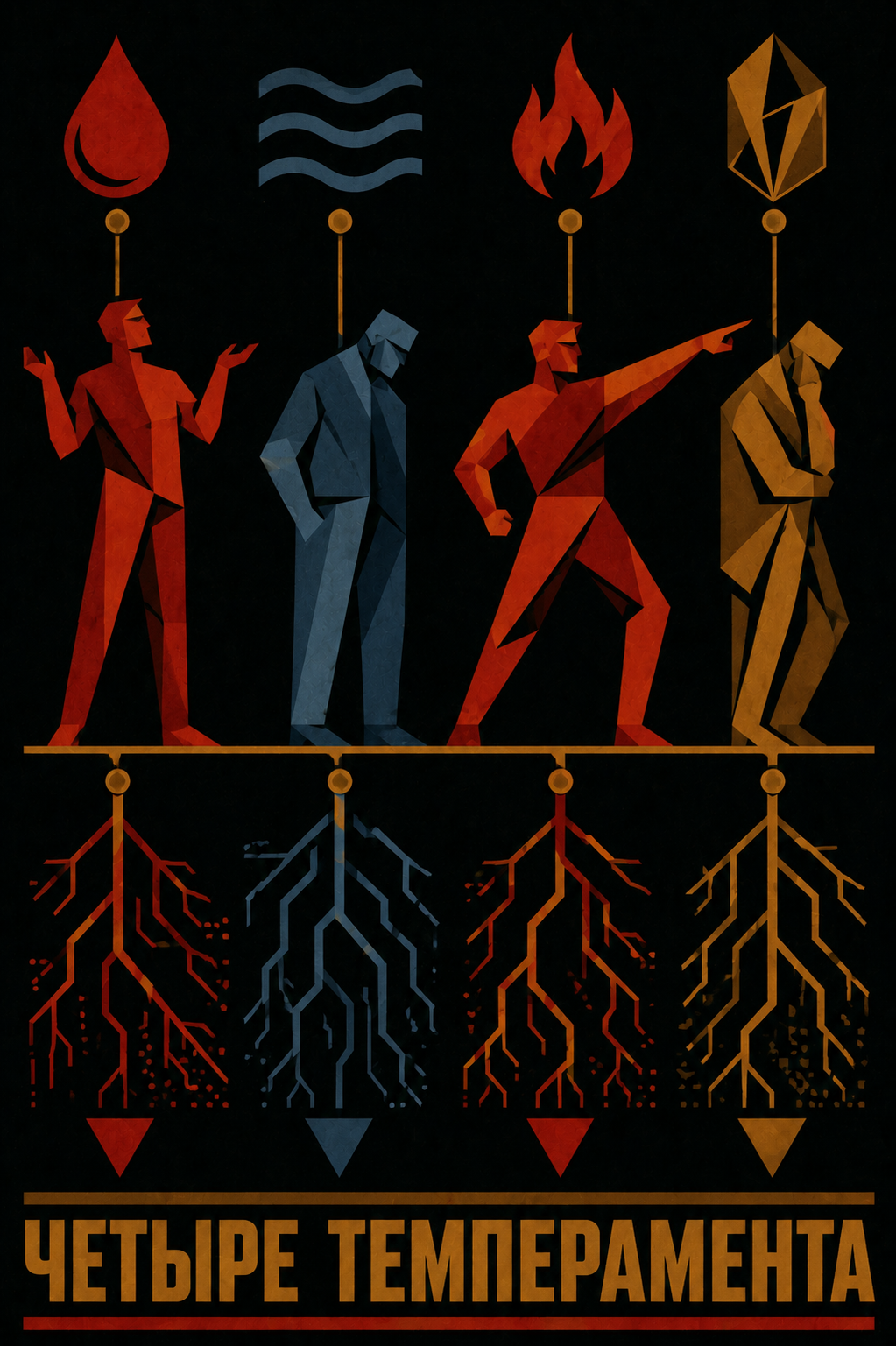
That structural logic migrated directly into medicine. The Hippocratic writers mapped the four roots onto the body's four humours — blood, phlegm, yellow bile, black bile — and from there onto the four temperaments: sanguine, phlegmatic, choleric, melancholic. Galen systematised what Hippocrates had sketched, and the result held European medicine and psychology in its grip for nearly two millennia. Not because it was empirically confirmed in the modern sense. Because it kept proving useful. The fourfold map cut human nature at something close to its actual joints, and practitioners returned to it because it worked well enough to be worth returning to.
What is striking, in retrospect, is the continuity of the gesture. From Pythagorean geometry to Empedoclean cosmology to Hippocratic medicine: each step is a translation of the same core claim into a new register. Four irreducible natures, held in dynamic relation, producing the full range of what is. The framework shifts. The architecture underneath it does not.
Empedocles, On Nature, Fragment 6 (Diels-Kranz 31 B 6)
Hippocrates, On the Nature of Man (c. 400 BCE)
Galen of Pergamum, De Temperamentis (c. 190 CE)
Image text: ЧЕТЫРЕ ТЕМПЕРАМЕНТА — Four Temperaments.
The Psyche Insists On Four
The Quaternary Mind
This lineage did not end with the scientific revolution. It went inward.
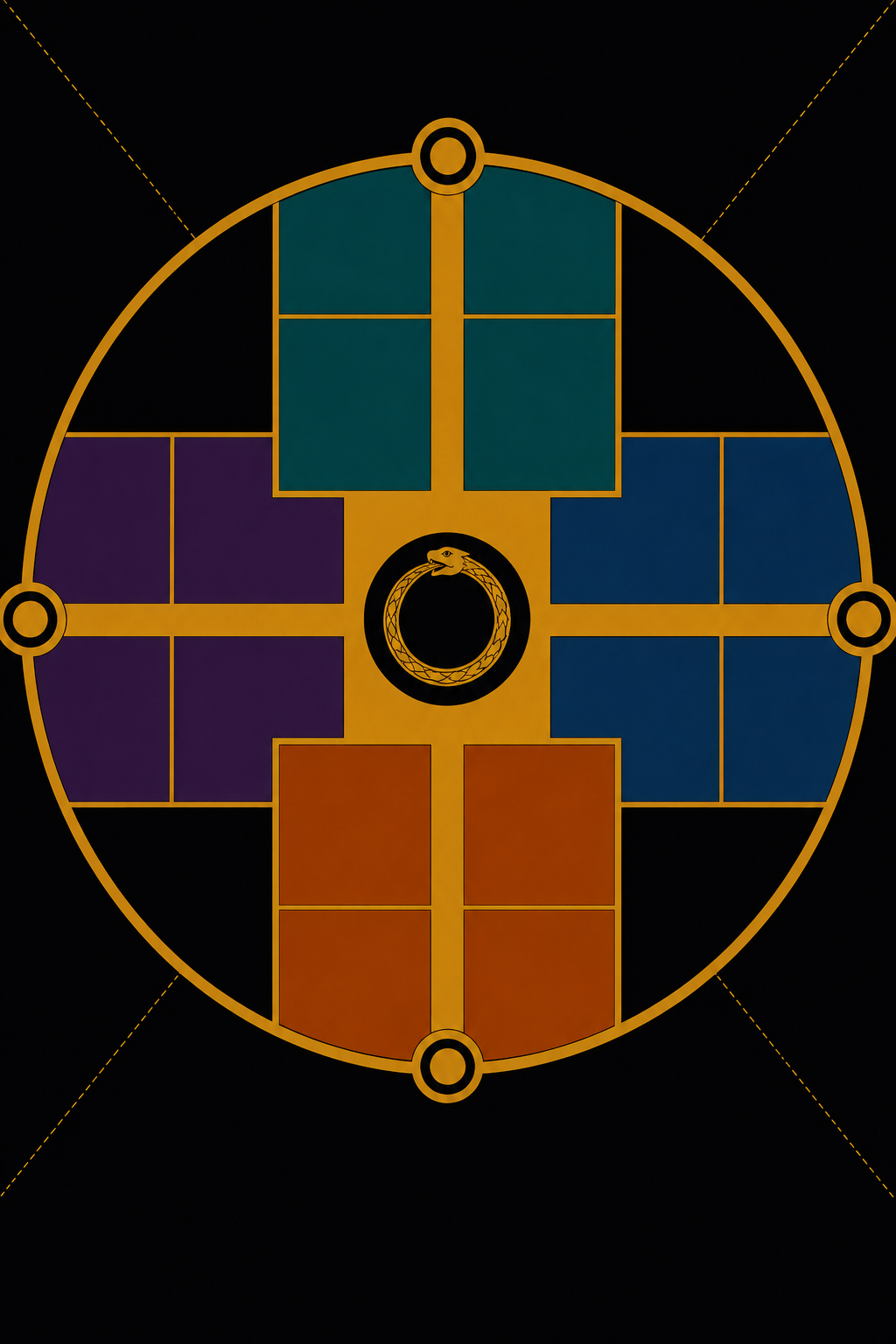
Carl Jung knew the history in meticulous detail. When he arrived at his own psychological quaternary — thinking, feeling, sensation, intuition — he was not proposing a new classification system. He was recognising the fourfold structure again, this time operating within the architecture of the human psyche. The quaternity, he argued, is "an organizing schema par excellence, something like the crossed threads in a telescope" — an instinctive coordinate system the mind reaches for whenever it attempts a complete account of anything. The four quarters of the compass. The four seasons. The four temperaments. Always four, and always for the same reason: "The ideal of completeness is the circle or sphere, but its natural minimal division is a quaternity."
After decades of clinical practice and what he estimated as tens of thousands of dreams, he kept returning to the same observation: the psyche insists on four. In the mandala — that ancient image of wholeness — the fourfold structure emerged unbidden from his patients' unconscious. Not borrowed from any cultural source. Not consciously chosen. Produced on its own authority, as if the mind were reporting a fact about its own structure rather than expressing a preference. Jung concluded that the quaternary was not a convention. It was a psychological a priori — the minimum architecture of conscious orientation.
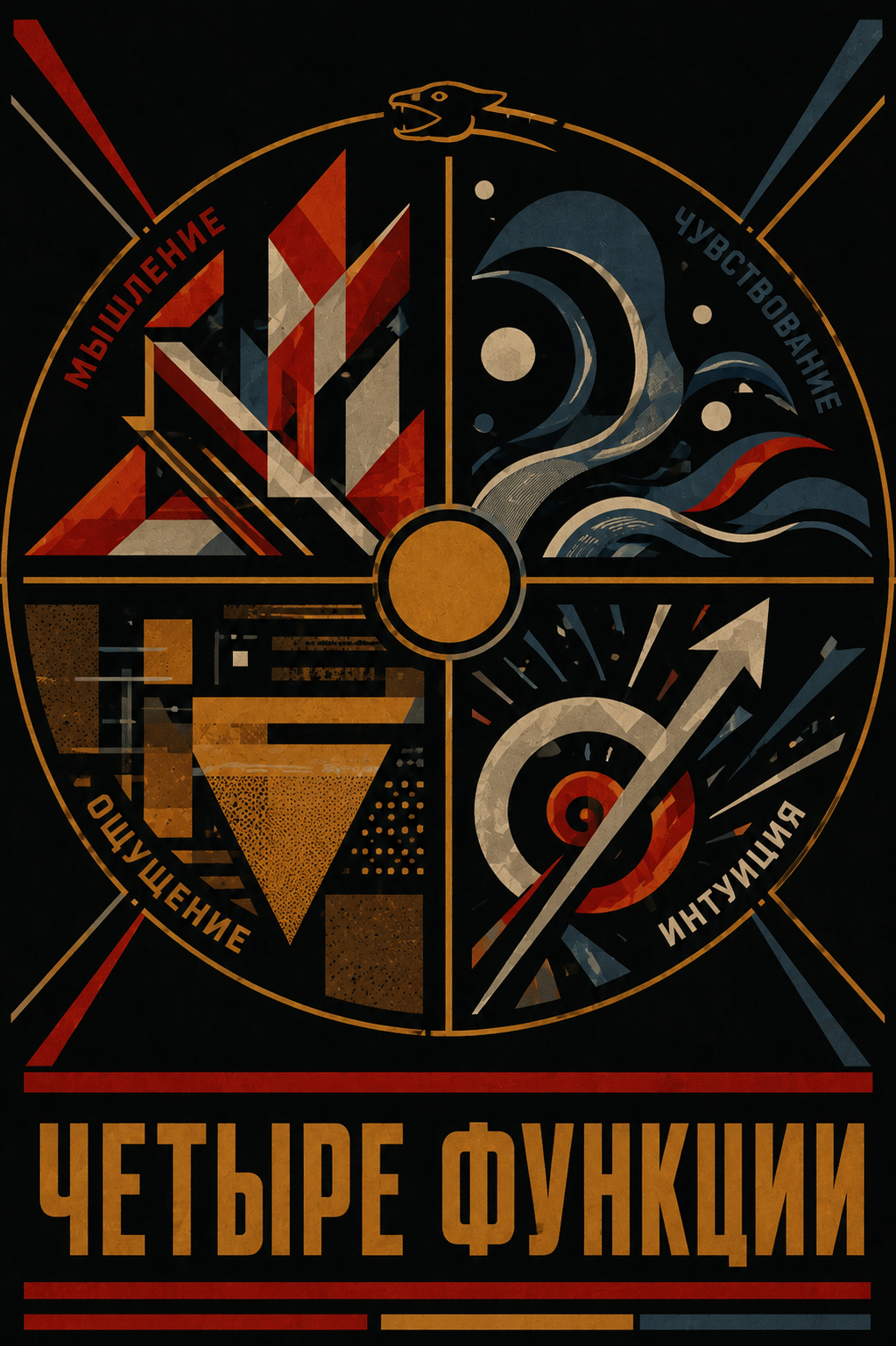
Sensation establishes what is actually given. Thinking enables us to recognise its meaning. Feeling tells us its value. Intuition points to the possibilities of the whence and whither lying within the immediate facts. Four functions, irreducible, each completing what the others cannot provide.
The Pythagoreans found four at the foundation of space. Empedocles found it at the foundation of matter. The physicians found it at the foundation of human constitution. Jung found it at the foundation of the mind itself. The framework kept shifting. The architecture kept returning.
Jung, C.G., Aion, Collected Works Vol. 9ii, §381
Jung, C.G., Psychology and Religion, Collected Works Vol. 11, §246
Image text: ЧЕТЫРЕ ФУНКЦИИ — Four Functions; МЫШЛЕНИЕ — Thinking; ЧУВСТВОВАНИЕ — Feeling; ОЩУЩЕНИЕ — Sensation; ИНТУИЦИЯ — Intuition.
Sixteen Types, Four Quadras, One Whole
The Socion Is A Mandala
When Aušra Augustinavičiūtė took this inheritance and built socionics from it, the four didn't disappear — it ramified.
Four quadras crystallised, each with its own values and its own sense of what is real and worth attending to. Four clubs. Four temperaments. The sixteen types arranged in a four-by-four grid, not because sixteen is a convenient number, but because four times four is what you get when you let the logic run to its natural conclusion. The socion is a mandala. Augustinavičiūtė may not have described it that way, but the architecture is unmistakable.
And in the alchemical tradition Jung found the same movement described as a riddle: the axiom of Maria Prophetissa — out of the one comes two, out of two comes three, and from the third comes the one as the fourth. He read this not as a description of chemistry but of the psyche's own movement toward wholeness through differentiation. Augustinavičiūtė's socion performs the same movement at the level of a social system: sixteen types, four quadras, one whole.
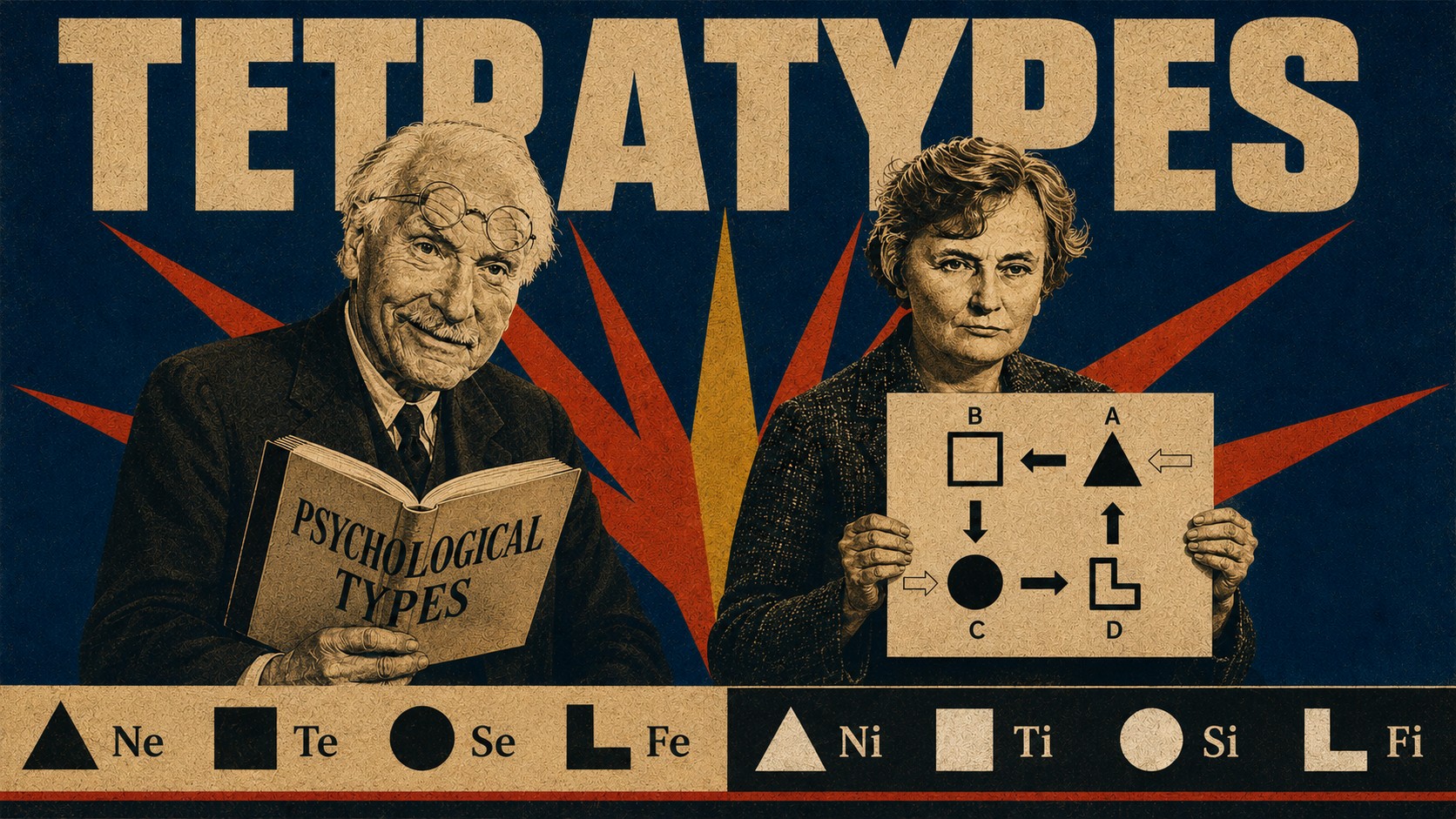
TetraTypes takes its name from that four. Tetra, from the Greek — four patterns, four natures, the quaternary skeleton that holds the whole system upright. A name that points at the structure underneath, at what socionics fundamentally is before it becomes sixteen labels and a grid of intertype relations.
The four quadras are the heartbeat of it. Alpha finds wonder in ideas and warmth in people. Beta burns with intensity and prophetic vision. Gamma moves through the world with force and clear-eyed purpose. Delta believes in the slow, patient work of becoming — in people, in craft, in the quiet accumulation of what is real and worth doing. Sixteen types. Four natures. One socion.
Welcome to TetraTypes.
Jung, C.G., Psychological Types, Collected Works Vol. 6, §983
Augustinavičiūtė, A., The Theory of Intertype Relations (1982)
Held As Conjecture
A Note on Method
Karl Popper’s sharpest philosophical attacks were aimed squarely at psychoanalysis. Freud’s theory of the unconscious, Adler’s theory of inferiority feelings — both, he argued, had the same structural flaw: they could explain anything. Whatever a patient did, the theory could accommodate it. That immunity to contradiction was not, for Popper, a sign of strength. It was the signature of pseudoscience.
Popper’s objection was not that Freud and Adler were necessarily wrong about everything. It was that their theories had become too safe. They were not exposed to serious risk. Every case could be absorbed. Every anomaly could be redescribed. Every apparent failure could be turned, with sufficient interpretive skill, into confirmation.
Popper once challenged Adler with a case he felt the theory of inferiority feelings could not straightforwardly explain. Adler was unmoved. His confidence, he said, came from his thousandfold experience. Popper’s reply was dry: and with this new case, I suppose, your experience has become thousand-and-one-fold. The remark was more than a joke. It exposed the problem. Every new case became confirming evidence. No conceivable observation could count against the theory.
Socionics is vulnerable to the same charge. A sufficiently fluent typist can often explain almost any behaviour retrospectively through almost any type. Subtype, development, masking, stress, social role, dual-seeking, PoLR avoidance, quadra values, benefit pressure, supervision effects — the framework is rich enough to explain a great deal, but that richness can become a danger. A theory that illuminates can also become a theory that excuses itself from correction.
That should be acknowledged rather than deflected.
Image text: МЕТОД И СОМНЕНИЕ — Method and Doubt.
Frameworks And Persons
Symbolic Compression
But Popper’s philosophy also complicates the picture. He did not believe that observation begins from nowhere. All observation is theory-laden. We never encounter human beings as raw data. We meet them through concepts, expectations, language, memories, comparisons, emotional reactions, and prior conjectures. There is no escape from interpretation, even in principle.
The question, therefore, is not whether we use interpretive frameworks. We always do. The question is whether those frameworks remain open to criticism.
In The Myth of the Framework, Popper argued that frameworks are not necessarily prisons. They are often the starting points of rational inquiry. Knowledge begins as myth, metaphor, conjecture, imaginative ordering. Only later is it subjected to criticism, comparison, correction, and refinement. David Deutsch makes a related point in the language of explanation: good explanations are not mechanically derived from observation. They are creative conjectures that precede observation. Experience then tests, constrains, and sometimes destroys them.
Socionics may best be understood in that spirit: not as an established science, but as a developed conjectural framework for interpreting human difference.
It is a symbolic compression of the social world.
Human cognition depends on such compression. We cannot meet every person as an infinite, unstructured complexity. We form models. We notice patterns. We speak of people as practical, dramatic, reserved, analytical, warm, volatile, dutiful, imaginative, grounded, visionary. Literature, theatre, religion, myth, politics, and ordinary social life all rely on recognisable human forms. An actor could not inhabit a character without some implicit typology of motives, attention, fear, desire, temperament, and value. In that broad sense, typological thinking is not abnormal. It is one of the ways human beings make the social world navigable.
The danger is not compression itself. The danger is bad compression: compression that hardens into prejudice.
Image text: СИМВОЛИЧЕСКОЕ СЖАТИЕ — Symbolic Compression.
Tools, Not Sentences
Hypothesis, Not A Verdict
Socionics can become a systematic prejudice about others. A person is no longer encountered freshly but filtered through a prior verdict: ESE, LII, ILI, ESI, supervisor, beneficiary, dual, conflictor. The living person is reduced to an instance of a structure. Contradictory evidence is reinterpreted. Surprise is diminished. The map begins to replace the territory.
But the same framework, held more lightly, can do something better. It can help articulate real differences in attention, communication, value, and interpersonal expectation. It can remind us that people do not merely disagree about facts; they inhabit different emphases of reality. Some are more attuned to the emotional field, some to procedural order, some to abstract structure, some to practical consequence, some to bodily immediacy, some to inner narrative possibility.
Used well, typology may aid social understanding. Used badly, it becomes a verdict.
That distinction matters.
A typing should be a hypothesis, not a sentence. It should remain answerable to the person in front of you. It should help you notice more, not less. It should increase charity, not reduce individuality. It should generate expectations that can be revised, not dogmas that can only be defended.
This is especially important because Socionics often occupies a space that is not purely scientific. Like Jungian psychology, myth, literature, and personality description more generally, it partly belongs to the human domain of symbolic orientation. It asks not only “what measurable traits does this person have?” but “what kind of person is this?”, “what do they attend to?”, “what do they need from others?”, “why do certain relations feel easy, strained, nourishing, or impossible?”
Those are not meaningless questions. They are central to human life. But they are not always scientific questions in the narrow empirical sense.
Image text: ГИПОТЕЗА, НЕ ПРИГОВОР — Hypothesis, Not a Verdict.

Beyond The Map
The Person Exceeds The Type
Science, poetry, myth, religion, theatre, and typology are not all doing the same work. Nobody serious reads Shakespeare as failed neuroscience. Nobody needs Hamlet to be a psychometric instrument in order for it to disclose something recognisable about human beings. The domains are distinct, though not always cleanly separable. Trouble begins when a symbolic framework starts making strong objective claims while refusing the burdens of objective testing.
So the proper question may not be simply:
Is Socionics science?
A better question may be:
Does Socionics offer a useful, reality-sensitive compression of human difference?
That is a more honest standard. It does not excuse Socionics from criticism. On the contrary, it makes criticism essential. A useful map must be corrigible. It must be possible to say: this typing was wrong; this distinction is overdrawn; this intertype prediction failed; this explanation is too convenient; this interpretation tells us more about the typist than the person being typed.
Held dogmatically, Socionics repeats Adler’s mistake.
Held as conjecture, it may remain useful.
It can be a map of meaning without pretending to be a completed science. It can orient without imprisoning. It can illuminate without delivering final verdicts. It can help us navigate the social world, provided we remember that every person exceeds the type assigned to them.
Image text: ЧЕЛОВЕК ПРЕВОСХОДИТ ТИП — The Person Exceeds the Type.
Tools, Not Verdicts
What Is Established and What Is Not
Model A has been developed and refined over several decades within the Socionics community. Its core structure — the eight information elements, the eight positions, the four blocks, the quadra system, and the basic logic of intertype relations — is well-established and widely recognised within the WSS tradition.
Model L is a more recent framework, developed by Kimani White and Aleesha Lowry within the WSS diagnostic community. Its central contribution is the sub-variant distinction: a finer-grained account of how types may differ internally while retaining the same underlying Model A structure. Its capacity group architecture extends Model A’s block logic in a coherent and practically suggestive direction.
Neither framework is empirical in the same sense as trait-based models such as the Big Five, which measure behavioural distributions across large populations and submit those measurements to statistical testing. Socionics is doing something different. It is a conjectural and symbolic framework for understanding how persons organise attention, value, communication, and interpersonal expectation.
Claims of that kind cannot be established merely by resonance. Nor can they be protected from criticism by saying that they are “not science.” If Socionics makes claims about real human beings, then those claims must remain accountable to experience. They should be assessed by whether they illuminate without overreaching: whether their distinctions correspond to stable patterns in lived reality, whether they improve understanding, whether they aid prediction, whether they remain coherent under pressure, and whether they can be revised when they fail.
On those terms, Model A has been extensively worked through in practitioner communities. Decades of application have refined its descriptions, sharpened its vocabulary, and stress-tested its account of interpersonal relations. That does not make it a settled science, but it does make it a serious body of accumulated interpretive practice.
Image text: УСТАНОВЛЕНО И НЕ УСТАНОВЛЕНО — Established and Not Established.

Analytical Tools
Tool, Not A Prison
Model L is younger and more granular. Its promise lies in its ability to explain differences that can remain obscure within Model A alone. Its risk lies in the same place: the finer the distinction, the easier it becomes to find what one is looking for. Greater resolution requires greater discipline. More interpretive power requires more humility.
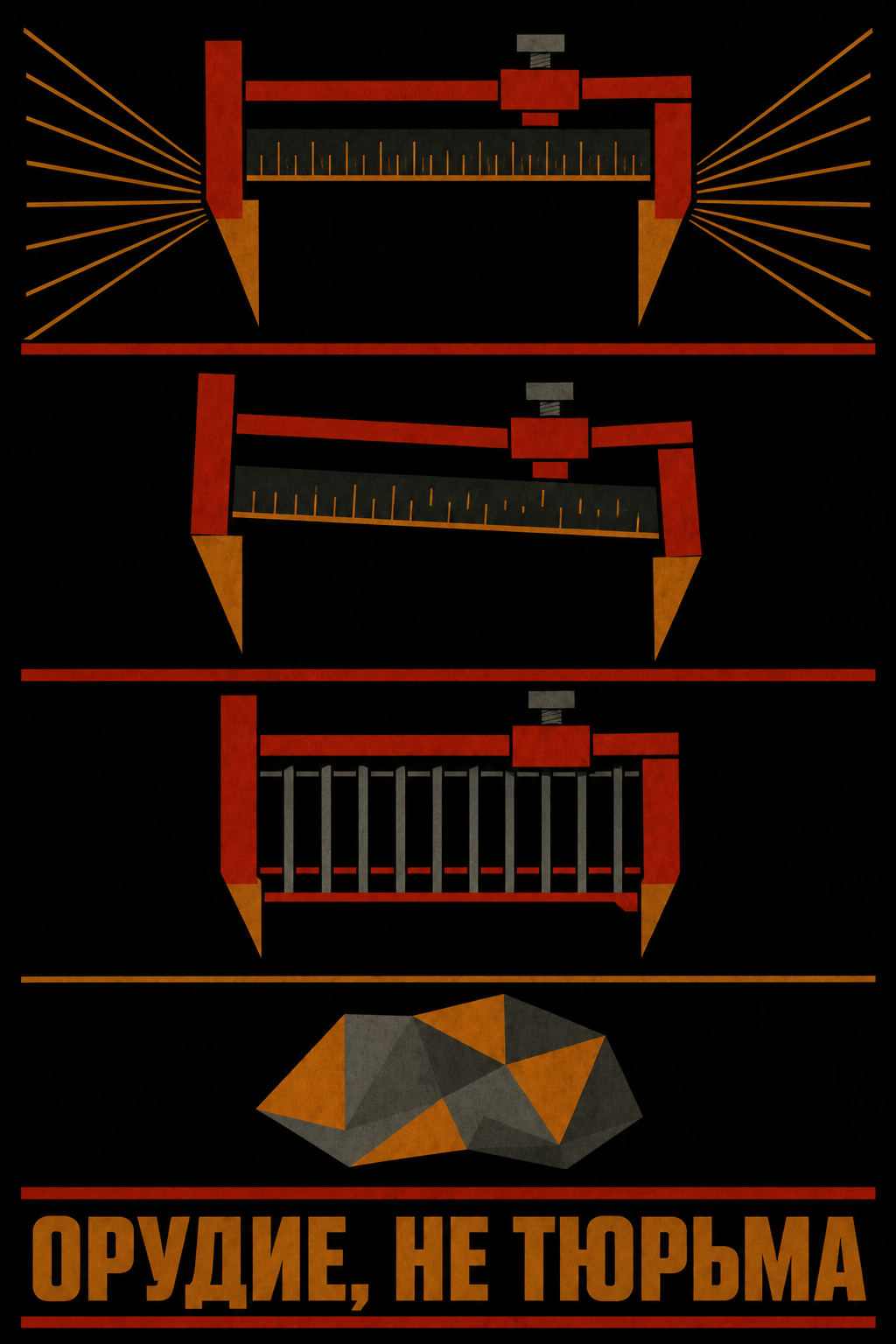
Both frameworks are therefore presented here as analytical tools, not definitive verdicts on persons.
A good tool clarifies. A bad tool distorts. A dogmatic tool imprisons.
The aim is not to reduce people to types, but to use type as one provisional map among others: useful where it helps, revisable where it fails, and always secondary to the complexity of the person in front of us.
Image text: ОРУДИЕ, НЕ ТЮРЬМА — Tool, Not a Prison.
Phenomenology
A Shared World, Differently Disclosed
The philosophy here has stressed the need to hold typology as a conjecture rather than a verdict. Phenomenology adds a complementary question: before we sort people into types, how does a situation become meaningful to a person in the first place?
A new essay reads Socionics through Husserl's intentionality, Merleau-Ponty's embodied perception, and Alfred Schutz's social world. It treats the information elements, dichotomies, and tetrachotomies as an attempted grammar of differentiated lived orientation, while keeping the empirical claims of the theory open to criticism.
Read Socionics and Phenomenology