
Stack Position
A function position tells you its role in the psyche: Leading, Creative, Role, Vulnerable, Suggestive, Mobilising, Ignoring, or Demonstrative. This is the first map of strength, need, and orientation.
Model L Video Hub
From stack positions to generated coordinates.
This page gathers the shorter conceptual foundations sequence for Model L. The focus is not the numbered catalogue of tetrachotomies, but the underlying shift in how the structure is read: a function is not only a place in a stack; it is a coordinate generated by intersecting conditions.
Orientation
The first conceptual move is simple but consequential: Model L is not just Model A with eight extra labels attached. It takes the familiar functions and asks how each one is generated by deeper structural coordinates.
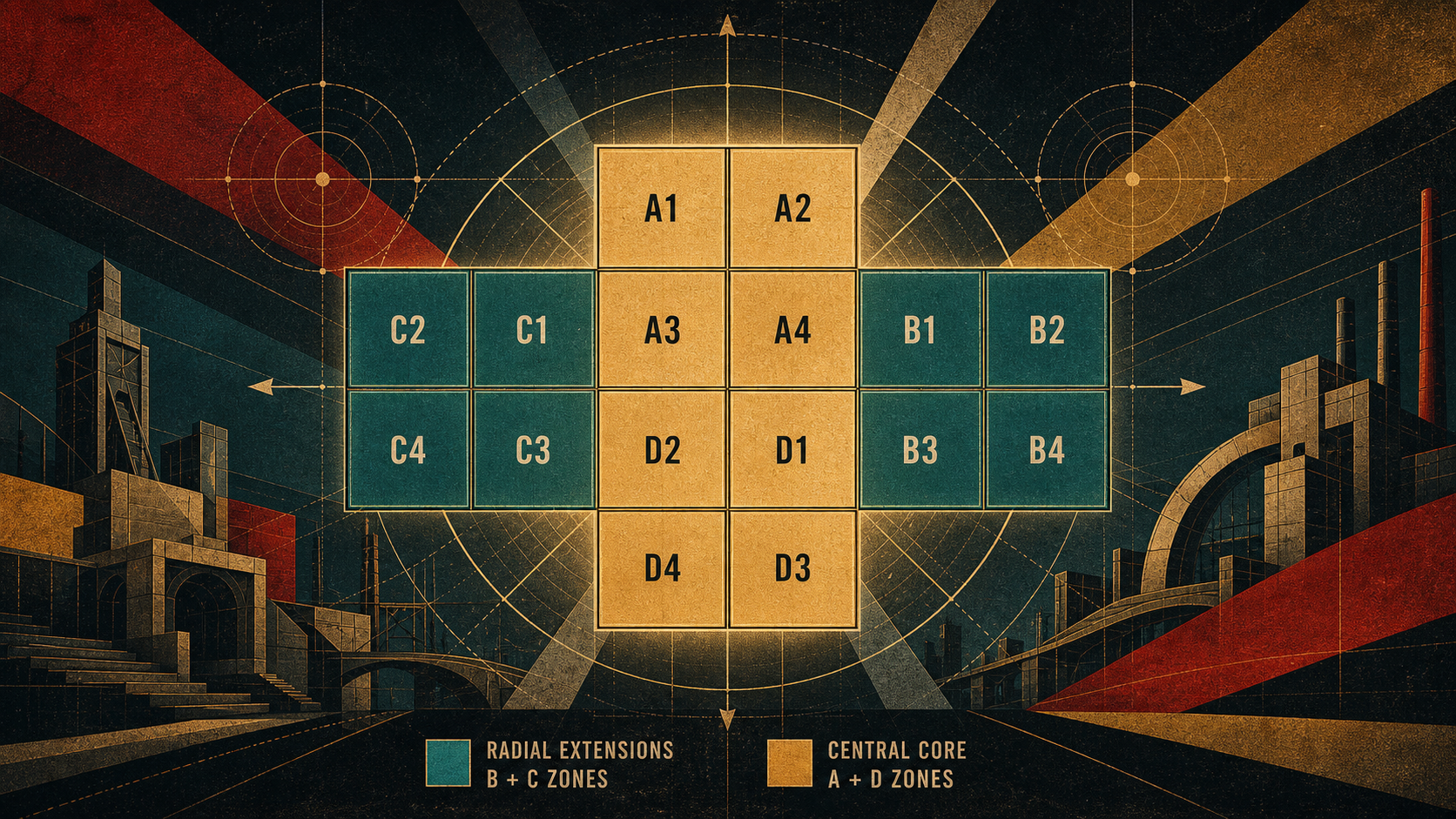
In Model A, the question often begins with position: Leading, Creative, Role, Vulnerable, Suggestive, Mobilising, Ignoring, or Demonstrative. In Model L, position still matters, but it is read through intersecting coordinates: central or radial placement, capacity, vergence, current, perspective, array, interest, and purview.
That is why behaviour alone cannot type anyone reliably. Behaviour is downstream. The same visible action can come from different coordinates, and the same coordinate can express itself through different visible actions depending on context, development, and pressure.
Core Distinction
Model A and Model L are not rivals. Model A tells you where a function sits in the stack; Model L asks what generated coordinate that function occupies inside the larger structural field.
A function position tells you its role in the psyche: Leading, Creative, Role, Vulnerable, Suggestive, Mobilising, Ignoring, or Demonstrative. This is the first map of strength, need, and orientation.
A coordinate tells you how that function is produced by intersecting conditions: element, sub-variant, capacity, radial placement, and the wider tetrachotomy structure.
Visible behaviour is evidence, but not proof. The same action can arise from different coordinates, and the same coordinate can produce different actions under different pressures.
The typing question becomes less "what did they do?" and more "what kind of information metabolism would make this pattern coherent across situations?"
A strong function can be central, ignored, resisted, or used without being cherished. Coordinate-reading keeps strength, value, comfort, and identity from collapsing into one claim.
The sixteen-position cross should be learned as a generated field, not as a flat list of extra terms. The labels matter because they preserve the structure that produced them.
Quadra Currents
One of the quickest ways into Model L is to stop treating quadras as personality clubs and start reading them as currents: four ways information is metabolised into meaning, action, purpose, and value.
Alpha turns lived stimulation into articulated possibility. It moves from shared sensory-affective contact toward ideas, patterns, hypotheses, and playful conceptual space.
In TetraTypes language, Alpha is the world where experience wants to become meaning.
Beta turns inner narrative pressure into formative action. It gathers aspiration, image, loyalty, and dramatic tension into codes, standards, and decisive movement.
This is the world where vision wants to become significance in public life.
Gamma turns strategic insight into effective personal force. It reads aims, leverage, risk, possession, and consequence, then grounds them in choices that actually move reality.
This is the world where perception wants to become purpose.
Delta turns practical experience into cultivated inner potential. It takes usefulness, craft, care, continuity, and close-range trust and grows them into sustainable values.
This is the world where practice wants to become value.
Need And Skill
Model L separates three things that are easy to blur together: how much facility a position has, how much priority it carries, and how much support it naturally invites.
Dimensionality names facility. A 4D position is fluent and expansive; a 1D position is narrow, tiring, or hard to generate independently.
Priority names psychological weight. A position can matter deeply even when the person cannot supply it easily, and a strong position can still feel secondary.
Demand appears when priority outruns aptitude. This is why the Suggestive and Mobilizing positions can feel receptive, magnetic, and growth-charged.
Video Sequence
This playlist sits beside the technical Model L guide sequence. It is for the ideas underneath the structure: how to think before trying to memorise the chart.
Related Reading
These pieces give the conceptual foundations more ground: why behaviour is downstream, why strength and value come apart, and how Model L organises its higher-resolution space.
Why behaviour alone cannot type anyone, and why typing has to move upstream toward metabolism, position, and structural pressure.
Read the essayA companion distinction for Model L: power, comfort, preference, and centrality are not all the same thing.
Read the essayThe broader map of Model L's seven four-part fields and how they extend the function dichotomies inherited from Model A.
Read the essayA practical bridge into the code language behind Model L, useful once the coordinate idea starts to click.
Read the essayThe full high-resolution guide: monadic elements, capacities, positions, radial structure, and the source frame.
Open Model LA slower route through prerequisites, derivation, typing use, and reference tools.
Open the learning pathFuture Shorts
As the playlist grows, new shorts can be added here without disturbing the numbered technical guide sequence.
Shorts that explain why visible behaviour has to be interpreted through position, value, capacity, and pressure rather than treated as direct evidence by itself.
Shorts that separate information metabolism from personality adjectives, keeping Model L structural rather than merely descriptive.
Shorts that show why Model L's sixteen positions are generated by interlocking conditions, not memorised as an isolated catalogue.