Not a founding myth, but a reconstruction from texts, manuscripts, translations, and schools.
Socionics begins with Jung and Kepinski, but it becomes Socionics in Aushra Augustinaviciute's attempt to model information metabolism, intertype relations, quadras, and the socion as a social whole.
Socionics did not appear as a finished system in one public book. It took shape through articles, manuscripts, correspondence, seminars, small-circulation journals, later editions, and translations. That is why its history needs care.
The safest account begins with three bodies of work. Carl Jung supplied the principal typological precursor: introversion and extraversion, and the four functions of thinking, feeling, sensation, and intuition. Antoni Kepinski supplied the wider psychiatric and philosophical phrase "information metabolism". Aushra Augustinaviciute transformed those inheritances into a distinctive programme: sixteen types of information metabolism, information elements, a functional model later known as Model A, systematic intertype relations, quadras, and the socion.
The result is not simply Jung with new labels. Jung did not publish an eight-position Model A, a table of sixteen intertype relations, or a social theory of quadras. Kepinski did not formulate the eight Socionics elements. The historical interest lies in the reconstruction: how these ideas were reworked into a relational information model.
Before Socionics
Jung, Kepinski, And The Problem Of Exchange
Jung published Psychological Types in German in 1921. His distinction between introverted and extraverted attitudes, and between thinking, feeling, sensation, and intuition, remains the typological starting point. He described orientation, differentiation, and compensating tendencies in the psyche. He did not provide the formal Socionics architecture.
Kepinski's phrase "information metabolism" gave a different kind of precursor. In his psychiatric work, information metabolism named the organism's meaningful exchange with its environment. It was not only a computational metaphor. Jan Ceklarz's later review stresses that Kepinski's concept belongs to a wider ethical and phenomenological account of lived orientation.
Augustinaviciute's move was to bring these lines together: type as a structure of information reception, transformation, and communication. This made typology relational. One type could be studied not only as a portrait, but as an informational arrangement meeting another informational arrangement.
The earliest securely identified printed landmark is Augustinaviciute's Lithuanian article "Informacinio metabolizmo modelis", published in Mokslas ir technika, no. 4, in 1980. The Russian text commonly read today is later: Augustinaviciute translated the article herself in early 1988 with omissions, and it was published in 1995. An English translation of that Russian version is therefore not the same thing as the original Lithuanian article.
The larger system appears around a cluster of early 1980s manuscripts. A later academic bibliography records Theory of Intertype Relations as a 116-page manuscript in 1982, and The Dual Nature of Man as a 77-page manuscript in 1983, both associated with the Library of the Lithuanian Academy of Sciences. Those dates are manuscript evidence, not ordinary commercial publication dates.
This matters because later Socionics often smooths the record into a simple founding story. It is safer to say that Socionics formed during the 1970s, reached print in 1980, and had its core relational architecture documented in the early 1980s.
The Lithuanian Universal Encyclopaedia gives 1970 as the year of creation, but it does not identify a single surviving event that demonstrates completion in that year. Aushra can be described securely as a Lithuanian economist and theorist. More elaborate claims about degrees, university offices, psychological credentials, lectures, or the precise membership of an early Vilnius group require institutional records or dated contemporary evidence.
The manuscript history also shows why circulation matters. Copies, correspondence, seminars, small-circulation journals, authorial translation, and later collected editions all helped make the system public. A manuscript date, a translation date, and a print date may describe three different moments in the life of one text.
The eight-position structure and the later label "Model A" are related but separate historical questions.
Socionics transforms Jung's four functions by combining each with an attitude, yielding the eight information categories conventionally written as Ne, Ni, Te, Ti, Fe, Fi, Se, and Si. The decisive further move is positional: the same element has a different role when it occupies a leading, creative, role, vulnerable, suggestive, mobilising, ignoring, or demonstrative position.
English often calls both an information element and a numbered place in the model a "function". That ambiguity obscures the history. This page uses element for the eight forms of information and position for the places they occupy. It then becomes possible to ask when each component of the familiar model first appeared.
In its later standard form, Model A arranges eight positions into Ego, Super-Ego, Super-Id, and Id blocks and into mental and vital rings. Yet the existence of an information-metabolism model in the 1980 article does not prove that every modern position name, symbol, dimension, sign, or school explanation was already fixed there. Historical diagrams should be dated layer by layer rather than reconstructed backwards from current teaching.
Later sources consistently understand the letter A as honouring Aushra. The first use, coiner, and date of the name have not yet been established from a primary source located by this project. The safest formulation is therefore "the architecture later known as Model A".
Dimensionality, plus and minus signs, contact and inert terminology, subtype systems, and school-specific function names have their own authors and histories. They may be valuable elaborations without belonging to the original publication. TetraTypes teaches a current Model A convention influenced by the World Socionics Society and credits Model L separately as a contemporary extension.
Socionics becomes most distinctive when it stops treating type as an isolated description. In Augustinaviciute's system, a type is a position inside a complete field of relations. Duality, activation, conflict, supervision, benefit, and other relations are not add-ons to the type descriptions. They are part of the model's central ambition.
By December 1982, Augustinaviciute was writing explicitly about the socion, four quadras, dual dyads, activation, conflict, and social request. This is strong evidence that the social and relational dimension was already central at an early stage.
The same caution still applies. Early claims about natural social roles, psychosomatic effects, ideal group composition, and the functioning of society should be described as parts of the programme, not as settled empirical results. The history can report the claims without silently certifying them.
Duality occupies a privileged place in Aushra's account. The confident information of one type is proposed to meet receptive areas in the other. This is a structural hypothesis about complementarity, not a guarantee of romance, health, or harmony. Biography, culture, power, attachment, circumstance, and error in typing remain part of real relationships.
Later schools developed rich descriptions of quadra values, historical succession, group atmosphere, and political character. These should not automatically be attributed to the December 1982 source. Each move from structural grouping to a theory of civilisation needs its own author and date.
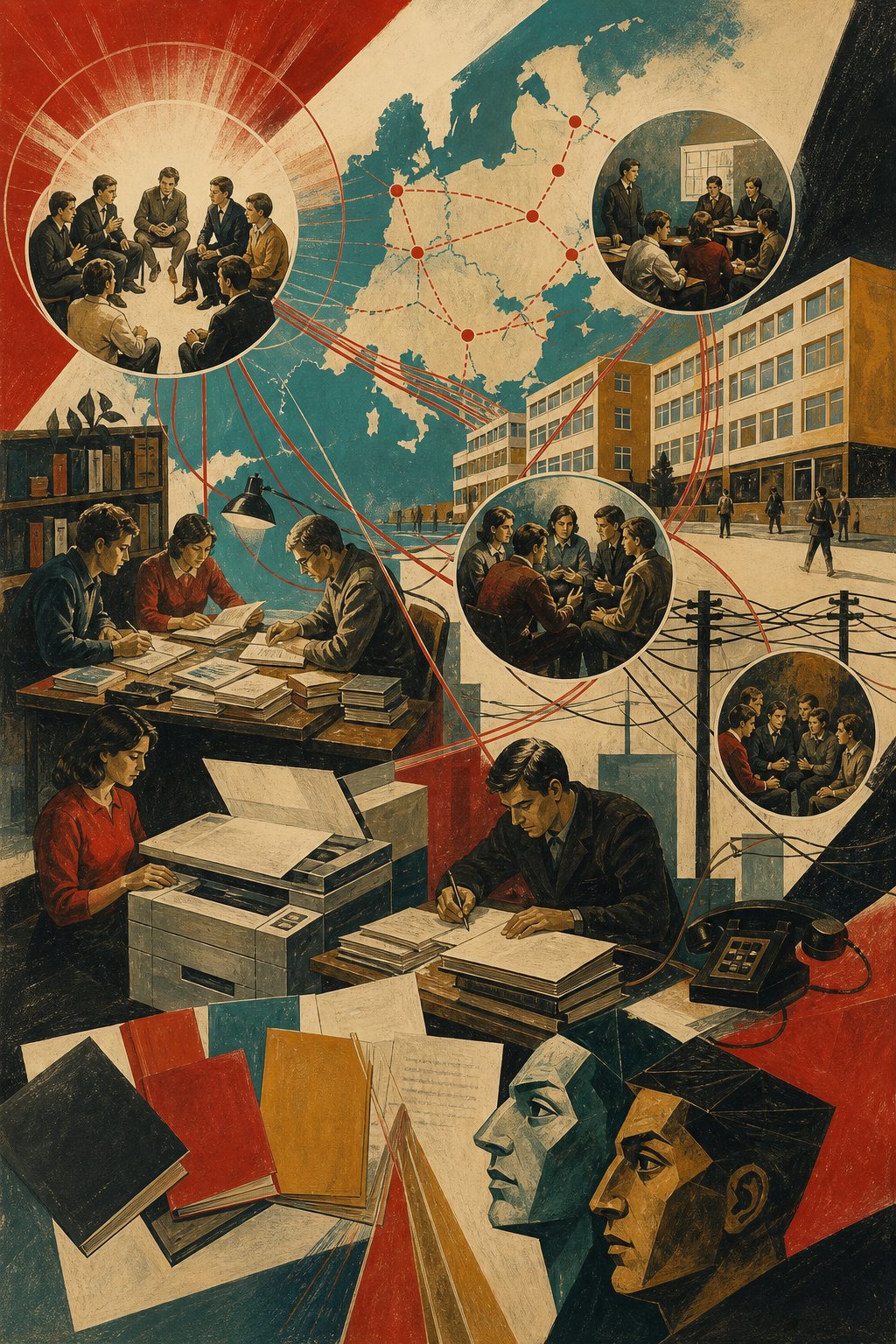
The late Soviet and post-Soviet period turned Socionics into a plural movement. Kyiv, Moscow, St Petersburg, Vilnius, and online English-language communities did not simply preserve a single uniform doctrine. They developed schools, diagnostic practices, diagrams, vocabularies, and extensions.
Grigory Reinin is associated with additional type dichotomies. Viktor Gulenko developed Humanitarian Socionics and Model G. Aleksandr Bukalov and the International Institute of Socionics played a major role in journals and institutional self-description. Vladimir Ermak's System Socionics gives another formal account. These traditions belong in the history, but they should not all be back-projected into Augustinaviciute's earliest work.
English-language Socionics adds one more layer. "Function", "aspect", "element", "information element", "suggestive", "vulnerable", "extravert", and "extratim" are not neutral word choices. A readable history should keep a translation register alongside the narrative, especially when a modern English page is translating a Russian edition of a Lithuanian source.
A school is more than a website or discussion group. It normally has a recognisable theoretical corpus, a diagnostic method, teachers, publications, and continuity of practice. A model, a publisher, an archive, a forum, and a school can overlap, but they are not interchangeable categories.
A fair comparison asks which model is taught, how a type is diagnosed, which early sources are treated as authoritative, and which concepts the school claims as later additions. This makes differences visible without pretending that the field has one timeless vocabulary or requiring the history to declare a winner.
These source-led episodes accompany the later-schools section. They reconstruct particular proposals and their evidence; they do not turn the history into an endorsement of any one school.
Victor Talanov: Model T & the Reinin Dichotomies
A reading of Talanov's early Model T proposal, the Reinin tetrachotomies, and the limits of the surviving evidence.
A source-led examination of Mironov's 140-aspect proposal and the evidential bridge between a Reinin subgroup, a shared semantic field, and an information aspect.
No short history can discuss every Socionist equally. Omission from the narrative is not a judgement of insignificance, and inclusion is not endorsement.
Models And Formal Theory
Alongside Aushra Augustinaviciute, important formal and institutional contributors include Grigoriy Reinin on additional dichotomies; Aleksandr Bukalov on publishing, institutional development, and theoretical extension; Vladimir Ermak on System Socionics; Viktor Gulenko on Humanitarian Socionics and Model G; and Igor Shulman on the periodic structure of the socion.
Portraits, Diagnosis, And Application
Ekaterina Filatova developed influential photographic and type-portrait collections. Viktor Talanov pursued questionnaires, trait research, and visual identification. Valentina Meged and Anatoly Ovcharov wrote on subtypes, masks, relationships, education, and management. Vera Stratiyevskaya produced unusually extensive type and relation portraits. Tatyana Prokofyeva, Vladimir Mironov, Irina Eglit, Vera Novikova, and Elena Udalova represent further diagnostic and teaching traditions.
Publication, Translation, And Western Development
Researchers and editors including Olga Karpenko and Galina Chikirisova contributed to institutional publication. Dmitri and Marianna Lytov became crucial bilingual interpreters. Sergei Ganin, Rick DeLong, Peter Bartl, Jack Aaron, Ibrahim Tencer, Kimani White, and Aleesha Lowry appear later in the Western account because they built different websites, archives, schools, practices, and models.
English-language Socionics formed through several crossings: migration, translation, websites, forums, meetups, and new theoretical work.
Early English Web Bridges
Sergei Ganin's socionics.com, established in 1997 according to later community profiles, was among the first widely visible English-language gateways. Its four-letter presentation, visual identification material, and accessible relationship pages helped readers familiar with MBTI enter the system, while also encouraging codes from different traditions to look more interchangeable than they are.
Dmitri and Marianna Lytov supplied another bridge through bilingual explanation, bibliography, and contextual work. Their writing presented Socionics as a historical and theoretical field rather than only a test or compatibility chart.
Forums And Reference Archives
The16types.info, founded in 2004, became an important English-speaking forum and translation culture. Community histories associate its stewardship with Jimmy Cartrette, Reuben McNew, and He Mu. A forum is not a theoretical school, but years of collaborative translation, public typing, and argument strongly influenced Western vocabulary.
Rick DeLong's socionics.us appeared in 2006, and Wikisocion began in 2007. Peter Bartl and other contributors helped turn scattered translations and school descriptions into a reference tradition. Wikisocion became indispensable, but it is a layered Western synthesis rather than a facsimile of classical Socionics. Spencer Stern's Socionics Demystified, also published in 2007, was one of the early English books devoted to the subject, while benchmark projects and London meetups helped move the field offline.
Schools And New Models
The World Socionics Society emerged through a formation process across roughly 2012-14 rather than a perfectly clean founding event. Jack Aaron became its most visible teacher, and Peter Bartl participated in the developing English reference and meetup culture. WSS systematised a particular interpretation of Model A, diagnostic practice, and English vocabulary.
Ibrahim Tencer's Sedecology developed independently, first privately around 2015 and publicly from 2016 according to its own history. The School of Classical Socionics and Augusta Project later represented an originalist response to accumulated Western layers, returning attention to Aushra's texts and translation provenance.
Within the WSS milieu, Kimani White and Aleesha Lowry developed Model L from the late 2010s, with substantial public documentation appearing in 2025. Model L is a contemporary extension with sixteen monadic elements and its own block terminology. It should be credited to its authors rather than back-projected into Model A or treated as identical with all WSS teaching.
Today YouTube channels, Facebook groups, Reddit, Discord servers, tests, and personal sites often reach newcomers before books or primary texts. These platforms are historically important distributors of attention and vocabulary, but a channel or server does not automatically constitute a school.
English Socionics is not a transparent window onto one Russian original.
Jung wrote in German; Kepinski in Polish; Aushra wrote in Lithuanian and Russian; most current readers meet all three in English. A responsible citation therefore gives the language, source edition, translator where known, and publication or revision date. A shared title does not prove that two online texts contain the same version.
Information aspect and information element are not used consistently across schools. One common distinction treats an aspect as a category of information in the world and an element as the corresponding form of psychic processing. Other authors do not preserve that division. English "function" is more troublesome still: it can name a Jungian faculty, an information element, or a numbered position in Model A.
Logic and ethics correspond broadly to Jungian thinking and feeling, but they do not mean formal logic alone or moral goodness. Extravert and extratim, suggestive and suggestible, vulnerable, painful, and PoLR each preserve a different emphasis. Relation names such as benefit, social request, and order can also imply different directions and obligations.
TetraTypes uses information element for Ne, Ni, Te, Ti, Fe, Fi, Se, and Si, and position or function position for a place in a model. Historical passages retain source-specific vocabulary where it matters; contemporary innovations are credited separately.
This is a working historical spine. It separates publication, manuscript evidence, and later reception rather than flattening them into one origin date.
1921
Jung Publishes Psychologische Typen
The typological precursor: attitudes and four functions. Not yet Socionics, Model A, or intertype relations.
1970s
Socionics Forms In Lithuania
The common "invented in 1970" claim should be treated cautiously. Formation during the 1970s is safer than a single completion date.
1980
The First Secure Printed Landmark
"Informacinio metabolizmo modelis" appears in Lithuanian in Mokslas ir technika, no. 4.
1982
Theory of Intertype Relations
Bibliographically attested as a 116-page manuscript. This is manuscript evidence, not a conventional public book publication.
1983
The Dual Nature of Man
Recorded as a 77-page manuscript and printed later. Important for duality and complementarity.
1990s
Publication And School Formation
Foundational materials appear in journals and collected editions while different schools develop their own vocabularies and methods.
Evidence And Open Questions
Historical reconstruction and empirical validation are different tasks. Socionics may be historically influential and conceptually elaborate without every psychological prediction thereby being confirmed. A fair assessment first asks which claim is under discussion: the usefulness of information categories, the existence of sixteen discrete types, typing reliability, position-level predictions, or the effects of intertype relations.
Reliable type assignment is the bottleneck. If practitioners disagree about type labels, a failed relation prediction can be attributed to mistyping while a successful anecdote is retained. A credible programme would publish operational criteria, use multiple independent raters, report disagreement, state predictions in advance, compare with simpler alternatives, and permit independent replication.
Karol Pietrak's peer-reviewed paper is a valuable English exposition of the conceptual foundations; it is not independent validation of typing reliability or relation effects. Bogomaz treats intertype relations as theoretically important while reporting limited experimental support and insufficient verification of many claims. Specialist journals, conferences, awards, patents, or recognition by non-state academies establish activity and institutional life, not scientific consensus by themselves.
The historical archive has its own agenda: the complete 1980 Lithuanian issue, critical editions of the 1982-83 manuscripts, the first dated use of "Model A", Lithuanian institutional records for Aushra's biography, and preserved correspondence and seminar notices. Western history would also benefit from recorded oral histories checked against contemporary documents before websites and forum archives disappear.
Jung and Kepinski are genuine precursors. Augustinaviciute is the central founder of the distinctive Socionics programme. The 1980 Lithuanian article is the earliest secure printed landmark found so far. The early 1980s manuscripts are central to the relational model.
Careful Claims
What Needs Qualification
The exact invention date, Augustinaviciute's biographical titles, the first use of the name "Model A", and some later school concepts need careful sourcing before being stated as settled history.
Editorial Rule
Do Not Back-Project Later Vocabulary
Modern terms can be useful for teaching, but historical writing should distinguish the early structure from later names, diagrams, dimensional theories, signs, subtypes, and school-specific interpretations.
Methodological Caution
Wrong Turns And Seductive Shortcuts
A history of Socionics should record not only conceptual development, but also methods that have outrun their evidence.
Visual Typing Covers Different Claims
A static photograph, a face in motion, a person's posture, their clothing, their speech, and their behaviour during an interview do not provide the same kind of evidence. Speech content and interaction can reveal interests, habits, values, and strategies. Voice, expression, gesture, and response timing are behaviour too, although their interpretation remains vulnerable to culture, situation, disability, masking, mood, and observer expectation.
The strongest and least defensible version of visual typing is morphological: the claim that a stable Socionics type can be read from facial structure, body proportions, eyes, or resemblance to previously typed people. That is physiognomic reasoning. It should be separated from the more modest claim that a long video supplies behavioural information.
Who Has Promoted It?
Sergei Ganin's socionics.com calls visual identification the fastest and most reliable typing method and explicitly claims that people of the same type share facial and bodily features. The site also advises combining it with functional analysis, but its celebrity galleries and physical descriptions helped make single-image typing highly visible in the English-speaking community.
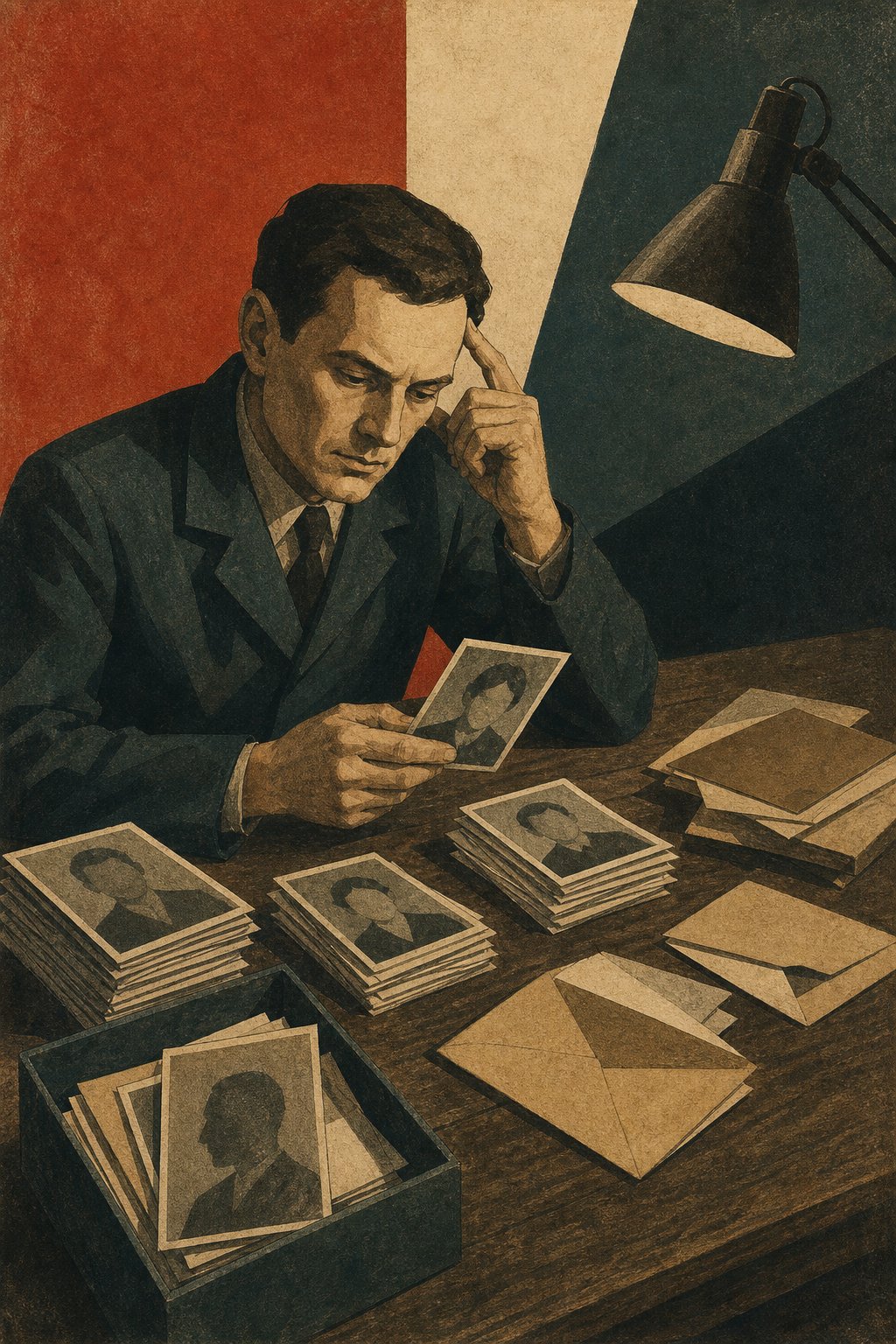
Ekaterina Filatova assembled more than a thousand portraits of people she had already typed and reported apparent "twin" series. The Lytovs' Socioniko account is notably more cautious: it says that no valid visual-identification methodology existed and that Filatova photographed people only after diagnosis. The archive may generate hypotheses; it does not validate a classifier.
Viktor Talanov has published a visual-identification approach. Viktor Gulenko's Humanitarian Socionics also uses what it calls analog or non-verbal data. Its current remote procedure, however, asks for spoken self-presentations, follow-up answers, gestures, facial expressions, eye movement, and voice. That is a broad video interview, not simply a claim that skull or face shape reveals type, though appearance-based inference remains part of the advertised method.
The first problem is circularity. If a practitioner assigns the types and then learns what each type "looks like" from those same assignments, the labels provide no independent ground truth. A mistaken prototype reinforces itself: new faces are accepted when they resemble the learned examples, while discordant cases are retyped, called unusual subtypes, or forgotten.
Selection and confirmation bias deepen the circle. A large archive offers countless opportunities to find striking pairs while ignoring equally striking cross-type resemblances. Flexible prototypes make almost any face fit one of several "looks" for a type. Celebrity galleries add uncertain biographies, curated photographs, makeup, lens effects, ageing, and no consent or opportunity for diagnostic correction.
Facial-impression research shows why the method can feel persuasive. People rapidly agree that some faces look trustworthy, dominant, warm, or extraverted. Agreement about an impression is not accuracy about the person. Much of the effect follows resemblance to emotional expressions, broad approachability and dominance impressions, or perceiver-specific associations. Age, sex, ancestry, weight, health, attractiveness, occupation, fashion, subculture, expression, and photographic conditions can all become hidden predictors.
Some studies find small above-chance signals for selected broad traits, especially extraversion, under particular conditions. Even if those effects replicate, they do not establish sixteen discrete Socionics types, the ordering of eight information elements, or the validity of a practitioner's visual prototypes. A weak correlation with one broad trait cannot carry that much theoretical structure.
A meaningful test would define the visual rules before examining the test set; establish type labels independently of appearance; use a large held-out sample; balance age, sex, ancestry, and other visible variables; compare accuracy with type base rates and simpler trait models; measure agreement between independent visual typists; and replicate across cultures and schools. The method must be allowed to fail without retyping the targets after the fact.
The same discipline applies to other seductive shortcuts: typing celebrities from curated fragments, treating disagreement as proof of another person's weak self-knowledge, inferring relations from whether two people seem to get along, explaining every counterexample with subtype, and turning probabilistic type descriptions into destiny. These moves protect a theory from correction by making every outcome compatible with it.
The Ethical Cost Of Looking Certain
Appearance-based diagnosis is not harmless entertainment when it influences hiring, relationships, education, or judgements of character. It can launder stereotypes about ethnicity, sex, disability, age, class, attractiveness, and body shape through technical vocabulary. A responsible Socionics practice should explain its evidence, report uncertainty, seek consent where people are identified publicly, and never treat a face as a transparent display of an inner type.