Model L · Intertype Relations

Super-Ego Relations — Model L

Full strength landing on conscious strain.Not attack, but sustained mutual pressure at the Role position.

Model A To Model L

Where Super-Ego Pressure Lands

Model A describes Super-Ego as a relation of conscious strain. Each type's leading function lands on the other's Role position: not the most exposed point of the Vulnerable, but the place a type can perform only with effort, self-monitoring, and fatigue.

Model L makes the strain sharper. It shows not only which element is involved, but which sub-variant of that element is doing the pressing. Super-Ego is therefore not just Ti meeting Fi, or Ne meeting Se. It is a specific mode of full-strength output landing on a specific mode the other type strains to inhabit.

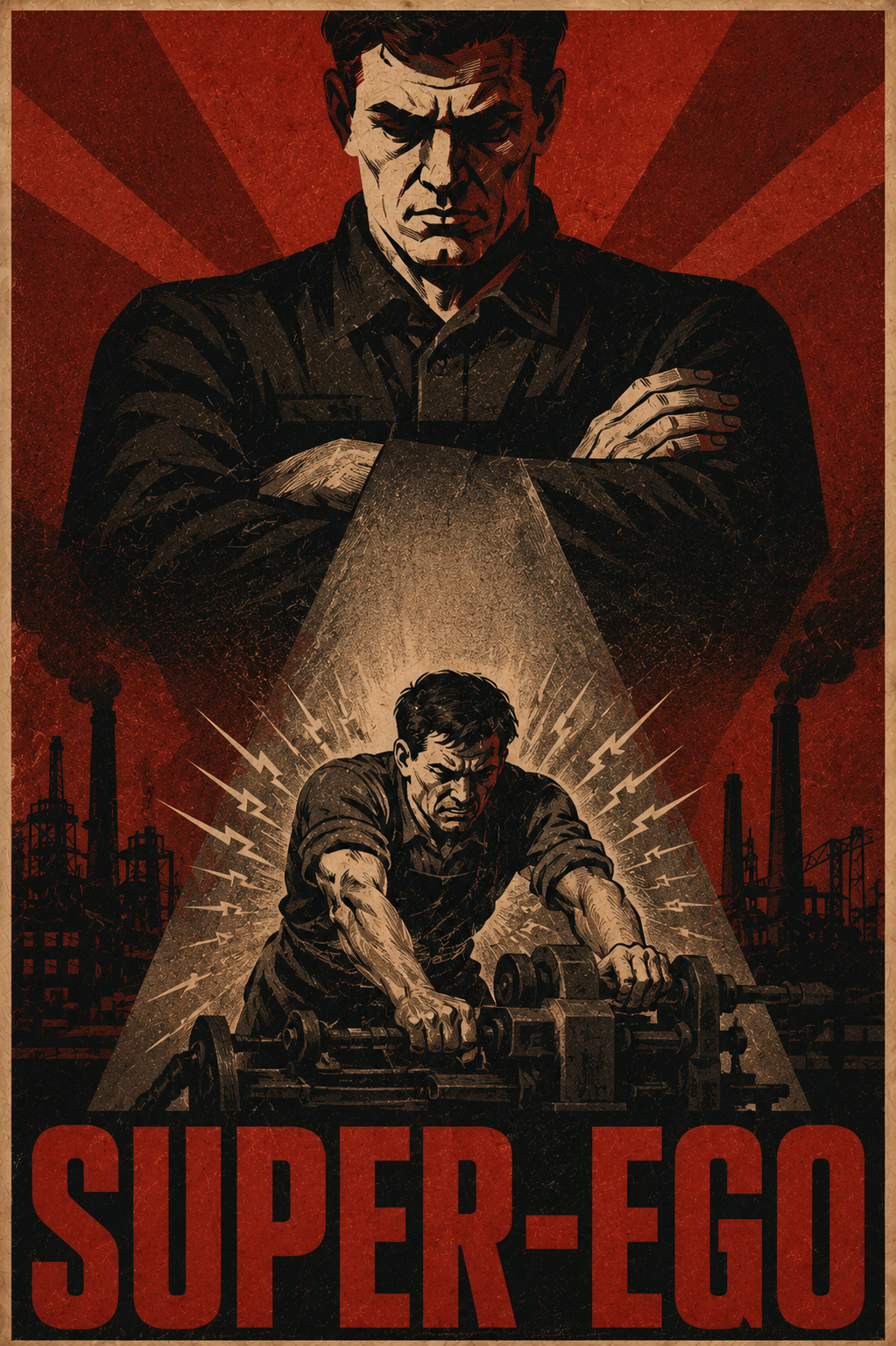
Super-Ego relation poster

Super-Ego Pair Menu

Cross-Domain, Cross-Variant Pressure

This page begins the Model L Super-Ego series with Ti/Fi crossings on the Rational axis, Ne/Se crossings on the Irrational axis, Te/Fe crossings in the dynamic Rational register, and Ni/Si crossings in the inward Irrational register.

Intellect element illustration
Ti(N.) · Intellect · LII
Animus element illustration
Fi(S.) · Animus · ESI

Ti(N.) Intellect vs Fi(S.) Animus — LII and ESI

In Model A, the Super-Ego relationship has a precise structural definition: each type's leading function sits at the other's Role position — the 3rd. Not the Vulnerable, where Conflict strikes. One level above it. The Role is the position a type strains toward, performs under pressure, but never inhabits with ease. In Super-Ego, both types are operating from full strength, and both are landing on exactly that position in the other person.

Model L shows why.

LII leads with Ti(N.) Intellect — detached, abstract structural logic. The LII organises experience into communicable frameworks: concepts named, relations mapped, contradictions resolved. The output is formal and transmissible, built to stand independent of any particular person or situation.

ESI leads with Fi(S.) Animus — visceral, particular relational bonds. The ESI carries settled felt verdicts about specific people and objects, constitutively tied to those particular subjects. These are not argued positions. Not transmissible. Privately held, viscerally felt, not open to logical revision.

The mismatch runs on two axes. Domain: Ti and Fi sit on opposing sides of the Logic/Ethics axis. Sub-variant: Ti(N.) operates in the abstract detached register; Fi(S.) in the involved particular one. No shared language. No common register where the two modes could meet on equivalent terms.

What the LII produces most naturally — structured, communicable logical architecture — demands exactly what ESI finds most strained to provide: abstract detachment from particular bonds. What the ESI asserts most naturally — visceral felt verdicts about specific persons — demands exactly what LII finds most strained to receive: conclusions without derivation, attachment without universalisable basis.

This is not the system's most damaging pairing. Conflict lands on the Vulnerable — LII's Se(F.) position, where SEE's leading strikes directly. That is a different order of pressure. Super-Ego is not attack. It is sustained mutual strain: each type's natural mode activating the other's most aspirational, most uncomfortable position, indefinitely, with no resolution available.
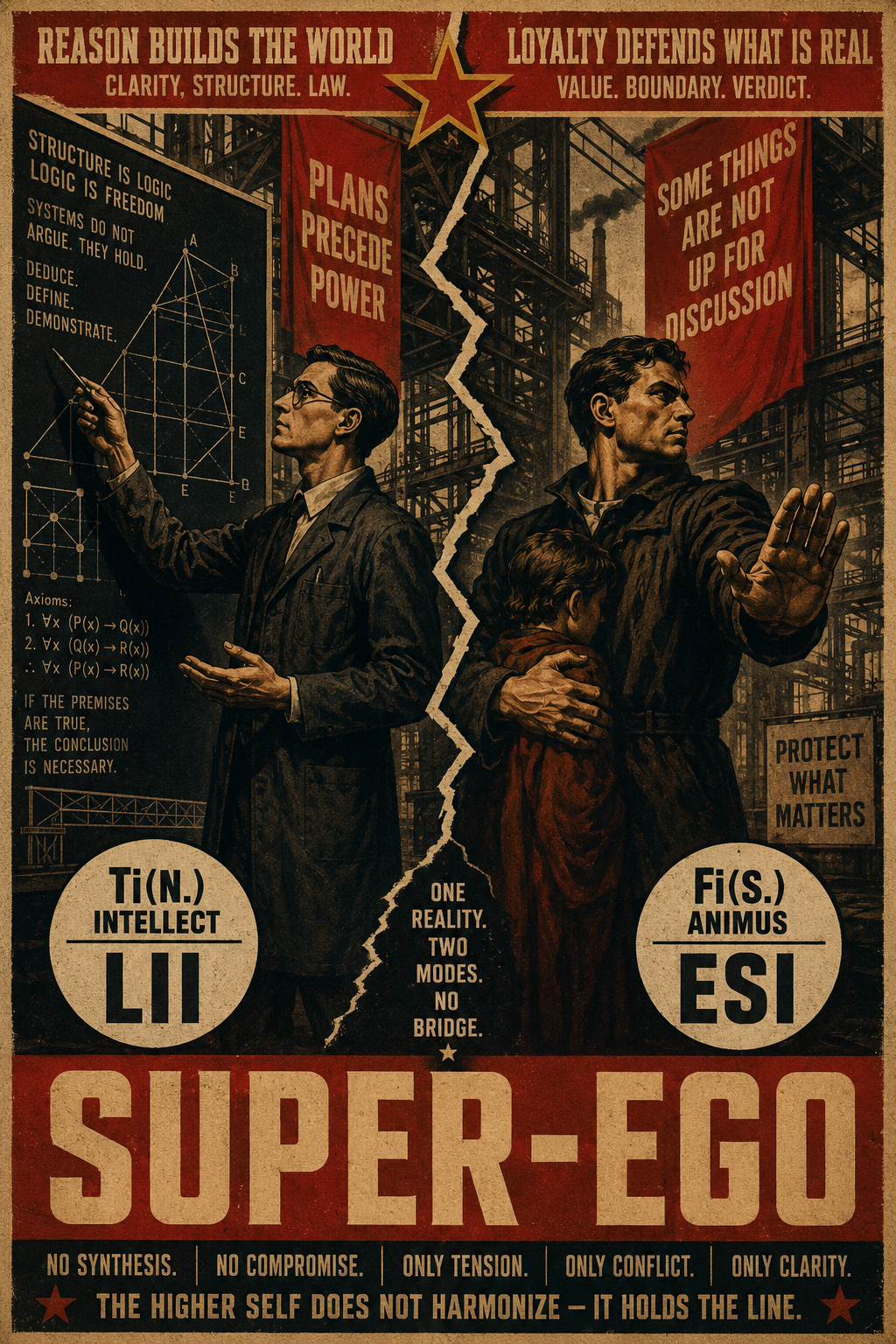
Super-Ego relation illustration comparing LII Ti(N.) and ESI Fi(S.)
Soul element illustration
Fi(N.) · Soul · EII
Habitus element illustration
Ti(S.) · Habitus · LSI

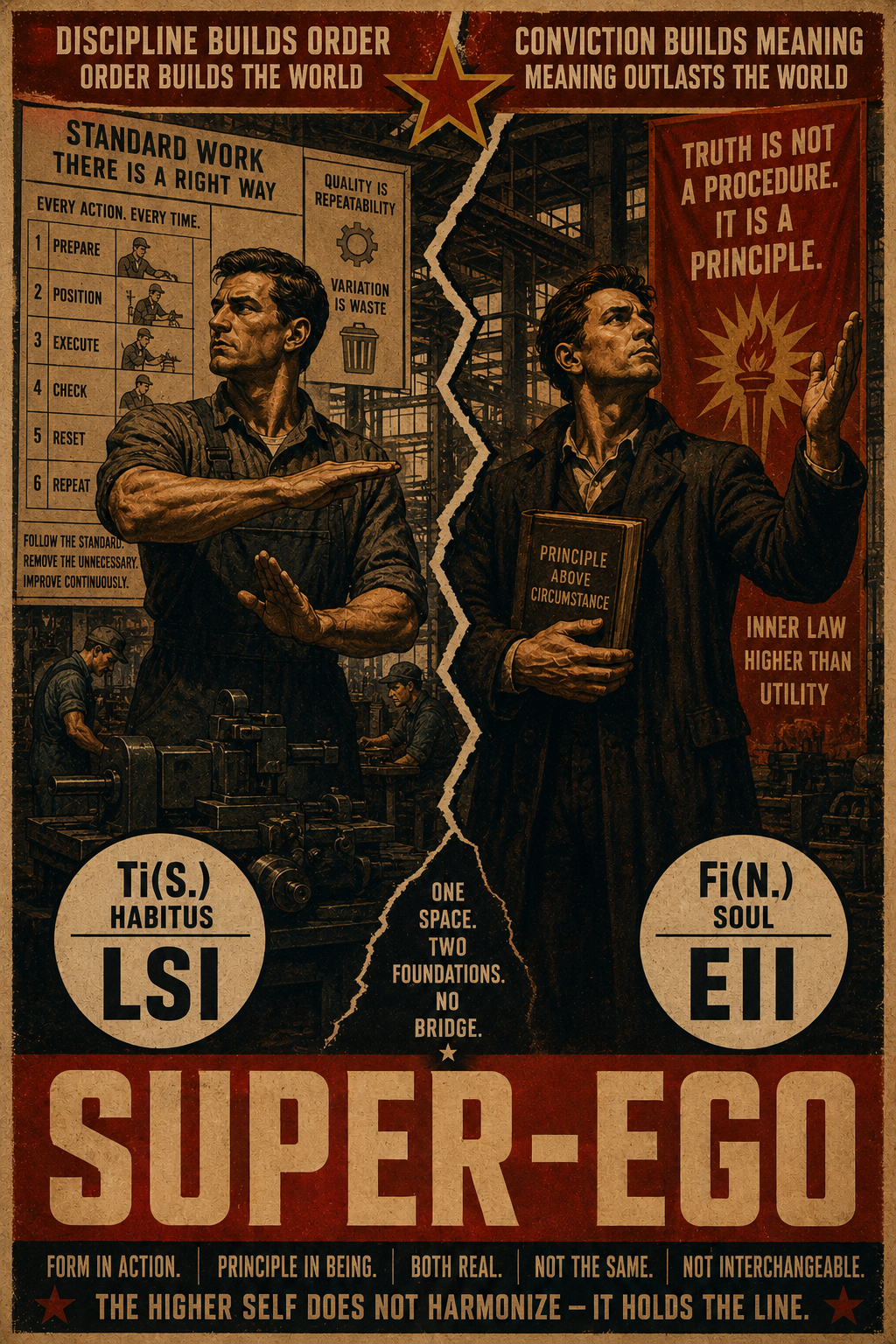
Fi(N.) Soul vs Ti(S.) Habitus — EII and LSI

The same structural rule applies: each type's leading function sits at the other's Role position. LSI's Ti is EII's 3rd. EII's Fi is LSI's 3rd. Full strength on both sides, landing on the position the other strains toward but never occupies with ease.

Model L shows a specific inversion relative to the LII/ESI pairing — and it matters.

LSI leads with Ti(S.) Habitus — embodied structural logic. Not abstract frameworks but codified physical procedure: the correct form enacted through the body, the established sequence followed with disciplined precision. Structure made tangible, repeatable, transmissible through demonstration rather than argument.

EII leads with Fi(N.) Soul — abstract foundational moral conviction. Not visceral attachment to particular persons but principled ideals held independently of any specific person or situation. The EII's felt moral sense is general and foundational — this is what is inherently right, what any person ought to honour, regardless of circumstance.

The mismatch again runs on two axes. Domain: Ti and Fi are opposing sides of the Logic/Ethics axis. Sub-variant: Ti(S.) is embodied and particular in its register; Fi(N.) is abstract and principled. Neither pole maps onto the other.

What LSI produces most naturally — codified structural procedure, authority enacted through disciplined physical form — demands exactly what EII finds most strained to provide: conformity to established procedural structure independent of moral evaluation. What EII holds most naturally — free-floating principled conviction about what is inherently right — demands exactly what LSI finds most strained to receive: abstract moral idealism with no concrete procedural grounding.

LSI enacts structure and expects others to inhabit it. EII holds principle and expects others to engage with it. The LSI finds EII's moral abstraction unanchored — where is the procedure, the form, the enacted sequence? The EII finds LSI's proceduralism unprincipled — where is the foundational conviction, the moral basis for the structure?

Note the inversion from LII/ESI. There, abstract Logic met visceral particular Ethics. Here, embodied procedural Logic meets abstract principled Ethics. The sub-variant positions are reversed — the Logic is now in the S. register, the Ethics in the N. — but the structural incompatibility is the same: cross-domain, cross-sub-variant, each type's strength activating the other's most aspirational, most uncomfortable position.

Super-Ego relation illustration comparing EII Fi(N.) and LSI Ti(S.)
Ideation element illustration
Ne(T.) · Ideation · ILE
Impetus element illustration
Se(F.) · Impetus · SEE

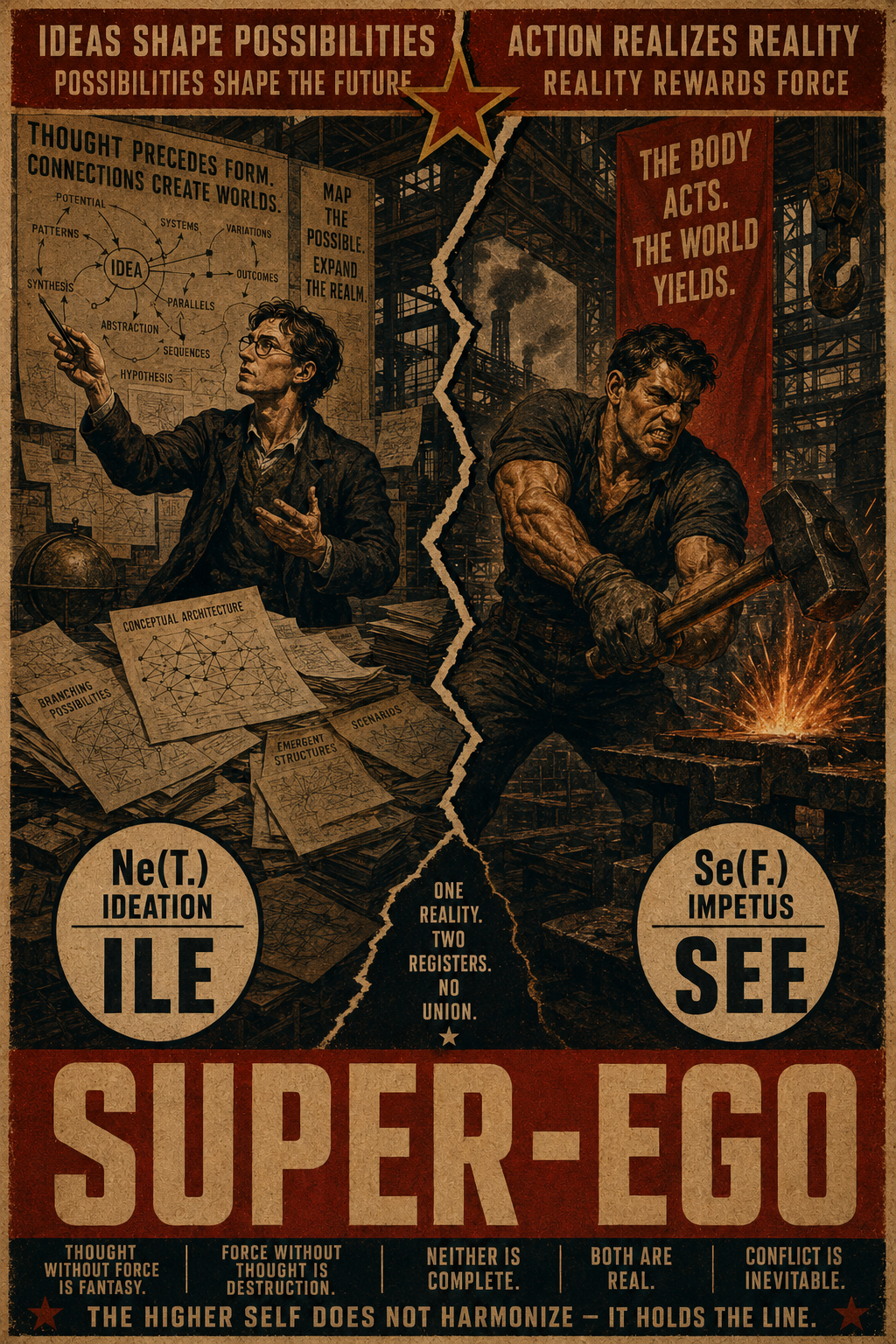
Ne(T.) Ideation vs Se(F.) Impetus — ILE and SEE

Same structural rule. ILE's Ne sits at SEE's Role position. SEE's Se sits at ILE's Role position. Both operating from full strength. Both landing where the other strains most.

ILE leads with Ne(T.) Ideation — detached conceptual imagination. The ILE generates and manipulates concepts from outside them, building semantic architecture, tracing possibility space with analytical curiosity. The engagement is exploratory and formally disengaged from the physical present. The body is incidental. The concept is everything.

SEE leads with Se(F.) Impetus — visceral mobilising drive. The SEE converts vital reserves into full-body exertion toward concrete physical aims. The force is generated from within and expressed entirely outward. There is no conceptual mediation. The body is not incidental — it is the instrument, the medium, and the message simultaneously.

The mismatch runs on two axes. Domain: Ne and Se sit on opposing sides of the Intuition/Sensing axis — Internal versus External Perception, each alien to the other's native orientation. Sub-variant: Ne(T.) is detached and architecturally directed; Se(F.) is involved and somatically generated.

What ILE produces most naturally — branching conceptual possibility, exploratory idea architecture with no immediate physical application — demands exactly what SEE finds most strained: sustained engagement with abstraction that has no somatic urgency, no concrete physical target, no immediate mobilising force.

What SEE generates most naturally — visceral physical energy directed at specific present aims — demands exactly what ILE finds most strained: inhabiting the concrete physical present without conceptual distance, responding to somatic pressure as if it were sufficient reason to act.

The ILE finds SEE's impetus structurally ungrounded — where is the conceptual architecture, the mapped possibility space? The SEE finds ILE's ideation physically inert — where is the force, the concrete aim, the somatic commitment?

Note the pattern across the three Super-Ego pairings so far. LII/ESI: abstract Logic against visceral particular Ethics — N. against S. on the Rational axis. LSI/EII: embodied procedural Logic against abstract principled Ethics — S. against N., the inversion. ILE/SEE moves to the Irrational axis: detached Intuition against involved Sensing — T. against F. Each pairing is cross-domain and cross-sub-variant. The structural incompatibility is constant. Only the specific registers change.

Super-Ego relation illustration comparing ILE Ne(T.) and SEE Se(F.)
Inspiration element illustration
Ne(F.) · Inspiration · IEE
Actuation element illustration
Se(T.) · Actuation · SLE

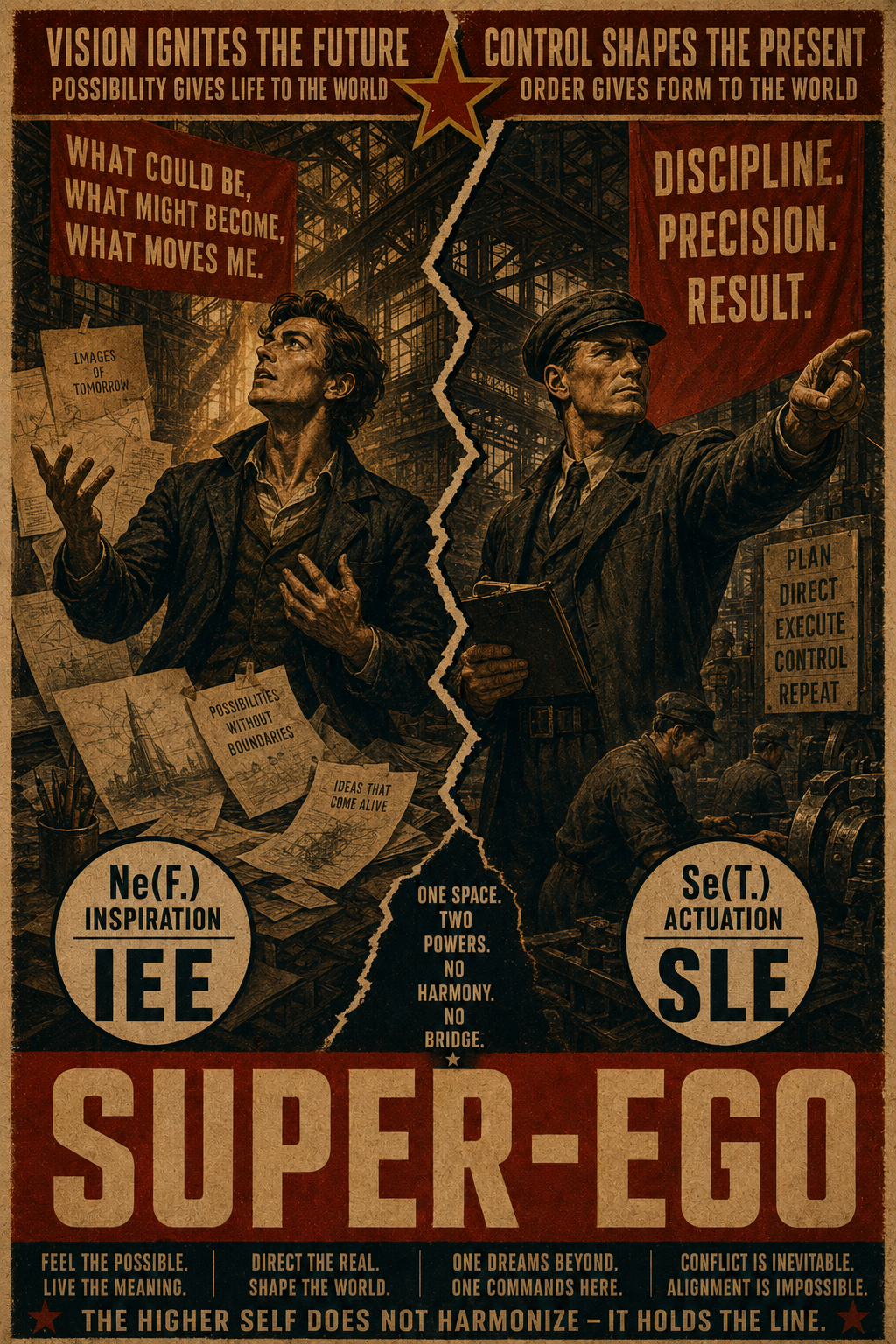
Ne(F.) Inspiration vs Se(T.) Actuation — IEE and SLE

Same structure. IEE's Ne sits at SLE's Role position. SLE's Se sits at IEE's Role position. Full strength on both sides, landing where the other strains most.

IEE leads with Ne(F.) Inspiration — involved imaginative possibility. The IEE experiences potentiality from within: a felt sense of aliveness to what could be, personally charged, spontaneously generative. This is not the ILE's detached concept architecture built from outside its material. The IEE feels possibility as personally significant and immediate, drawing on experience to sense novel directions, activities, openings. The engagement is inward and inflected with felt meaning.

SLE leads with Se(T.) Actuation — regulatory external force. The SLE leverages controlled, measured pressure to bring the physical environment into conformity with defined parameters. This is not SEE's visceral full-body impetus generated from within. The SLE governs from outside: precise, circumscribed, directed at shaping what is external to conform to what is required.

The mismatch runs on two axes. Domain: Ne and Se are opposing sides of the Intuition/Sensing axis — Internal versus External Perception, each alien to the other's native orientation. Sub-variant: Ne(F.) is involved and personally charged; Se(T.) is detached and regulatory.

What IEE generates most naturally — felt aliveness to possibility, inspiration with personal charge and spontaneous creative impulse — demands exactly what SLE finds most strained: sustained engagement with internal imaginative space that carries no regulatory external application, no concrete environmental object, no circumscribed parameters to enforce.

What SLE generates most naturally — precise measured force shaping the external environment to conform to defined limits — demands exactly what IEE finds most strained: operating through controlled external pressure alone, without internal felt resonance, treating the environment as a regulatory object rather than a field of living possibility.

The IEE finds SLE's actuation closed — force applied to what already exists, parameters that foreclose rather than open. The SLE finds IEE's inspiration ungoverned — possibility with no external anchor, no defined outcome, no force behind it.

This is the irrational axis inversion of ILE/SEE. ILE brought detached conceptual architecture; SEE brought visceral full-body impetus. Here, IEE brings personally charged felt possibility; SLE brings measured regulatory external force. The T./F. sub-variant positions are reversed. The structural incompatibility is identical.

Across all four Super-Ego pairings the pattern holds. Each pair is cross-domain and cross-sub-variant. The rational axis produces two inversions — abstract Logic against visceral particular Ethics, embodied procedural Logic against abstract principled Ethics. The irrational axis produces two — detached conceptual Intuition against involved somatic Sensing, involved felt Intuition against detached regulatory Sensing. Eight pairings, same structure, different registers.

Super-Ego relation illustration comparing IEE Ne(F.) and SLE Se(T.)
Reason element illustration
Te(N.) · Reason · LIE
Affect element illustration
Fe(S.) · Affect · ESE

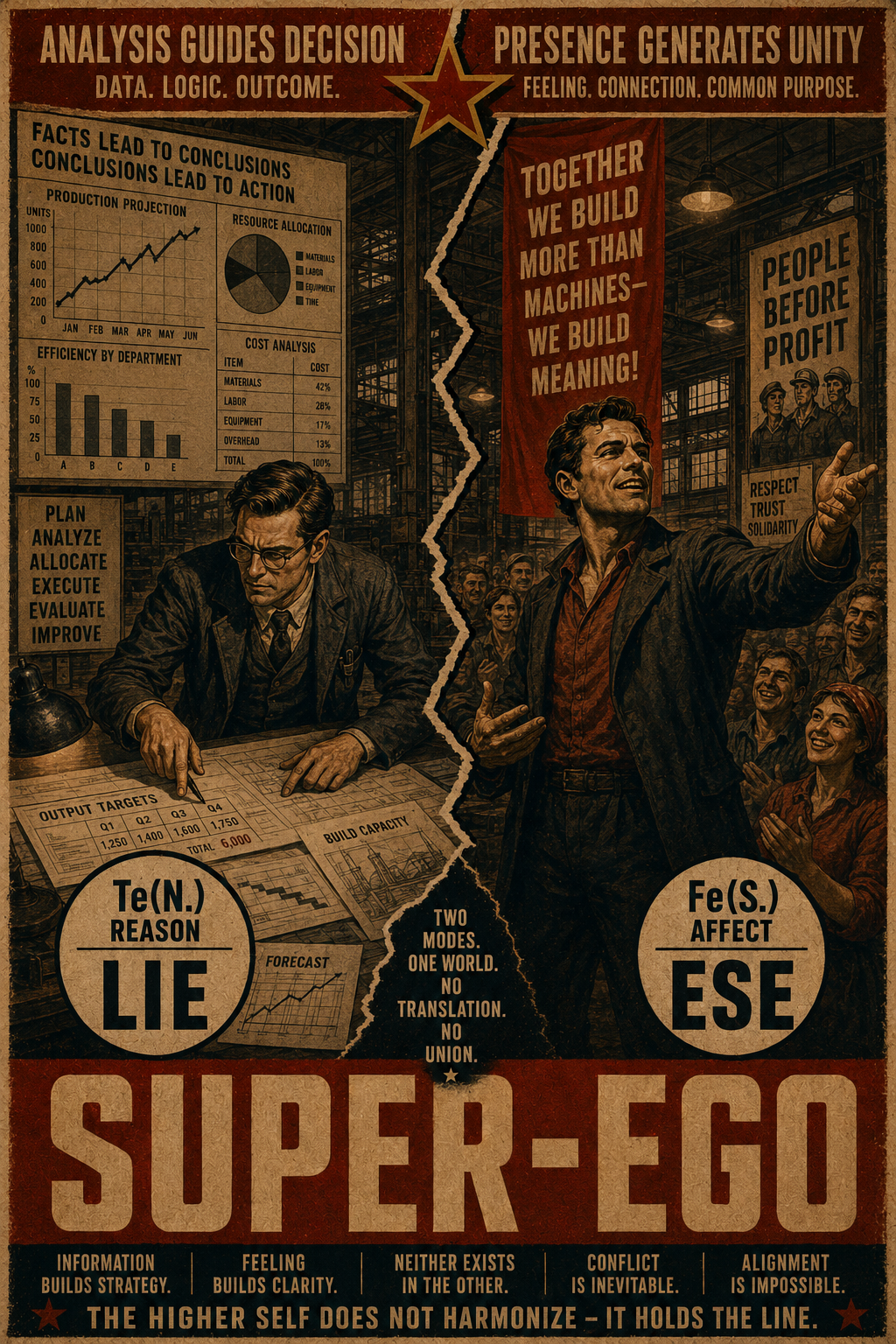
Te(N.) Reason vs Fe(S.) Affect — LIE and ESE

Same structural rule. LIE's Te sits at ESE's Role position. ESE's Fe sits at LIE's Role position. Full strength, landing where the other strains most.

LIE leads with Te(N.) Reason — detached applied logic. The LIE works through available information toward productive end goals: what does the data support, what is the workable strategy, what inference leads to an effective outcome. The engagement is analytical and forward-directed. Output is communicable, targeted, aimed at what works.

ESE leads with Fe(S.) Affect — involved somatic emotion. The ESE generates and broadcasts atmospheric feeling through physical presence: mood conveyed through body, face, gesture, aesthetic signal. Not argument, not rhetoric — the direct somatic transmission of feeling into shared space, creating a collective emotional texture that others inhabit whether they choose to or not.

The mismatch runs on two axes. Domain: Te and Fe are opposing sides of the Logic/Ethics axis. Sub-variant: Te(N.) detached and abstract; Fe(S.) involved and somatic.

What LIE produces most naturally — strategic inference, data-driven reasoning, productive analysis oriented toward effective outcomes — demands exactly what ESE finds most strained: sustained analytical detachment from the emotional atmosphere of a shared space, treating that atmosphere as irrelevant to the reasoning process.

What ESE generates most naturally — somatic mood, atmospheric feeling, the physical transmission of emotional charge into a shared environment — demands exactly what LIE finds most strained: responding to felt atmosphere as if it were actionable information, inhabiting the emotional texture of a room rather than extracting logical signal from it.

The LIE finds ESE's affect structurally unprocessable — feeling without inference, atmosphere without conclusion. The ESE finds LIE's reasoning atmospherically inert — strategy without emotional register, analysis that evacuates the felt texture of the space.

Compare to LII/ESI. There, Static Ti(N.) abstract logical structure met Static Fi(S.) visceral particular bonds — discrete, settled, conclusive on both sides. Here, Dynamic Te(N.) active strategic reasoning meets Dynamic Fe(S.) active atmospheric generation. Both elements are continuously processing, both externally oriented, both generating output at pace. The Super-Ego friction is not just structural but sustained and active. The LIE keeps producing reasoned strategy; the ESE keeps generating felt atmosphere. Neither output lands on the other. Neither stops.

Super-Ego relation illustration comparing LIE Te(N.) and ESE Fe(S.)
Sentiment element illustration
Fe(N.) · Sentiment · EIE
Praxis element illustration
Te(S.) · Praxis · LSE

Fe(N.) Sentiment vs Te(S.) Praxis — EIE and LSE

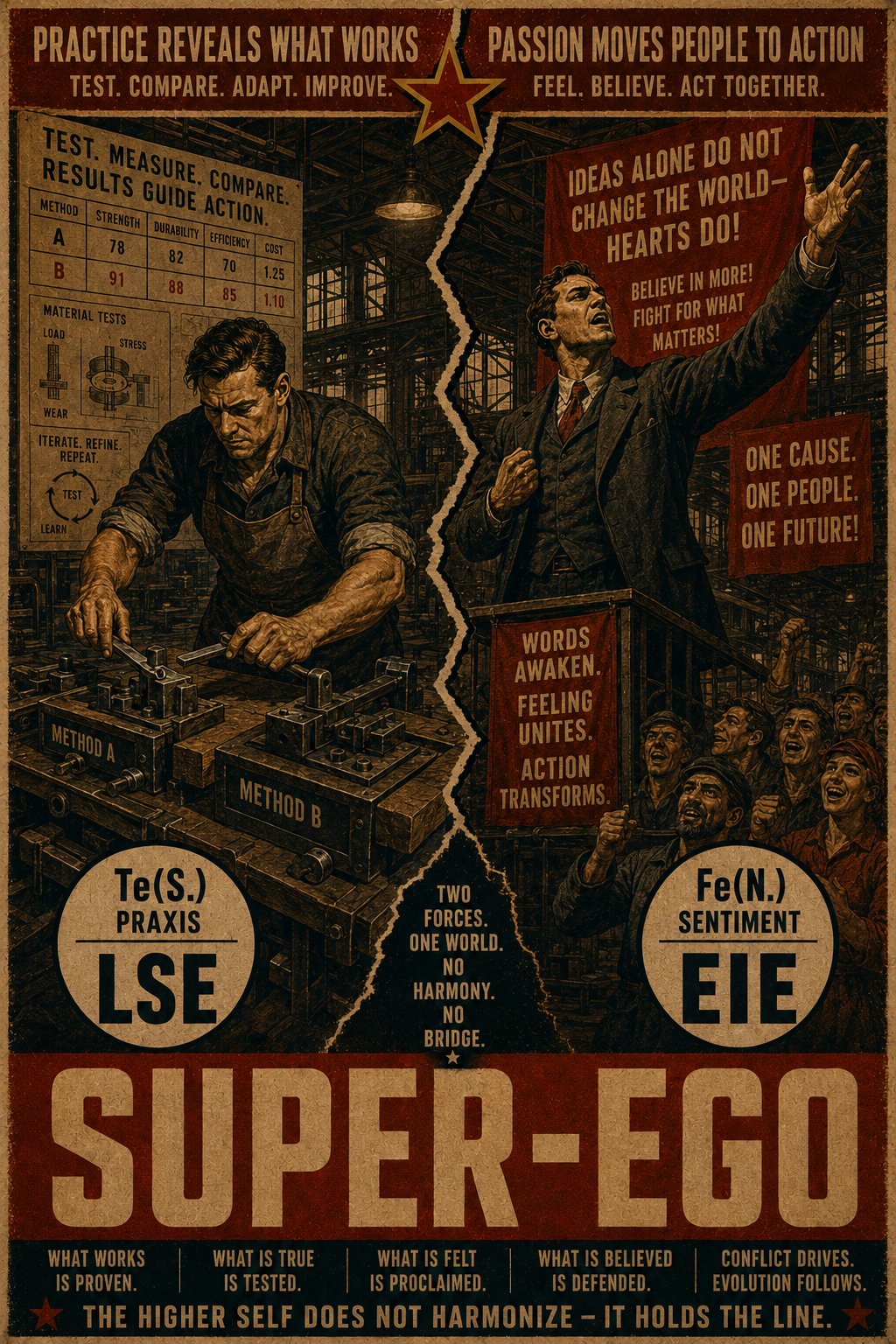
Same structure. LSE's Te sits at EIE's Role position. EIE's Fe sits at LSE's Role position. Full strength on both sides, landing where the other strains most.

LSE leads with Te(S.) Praxis — embodied practical application. The LSE works through direct material engagement: testing techniques, comparing approaches, finding what works through hands-on experimentation. The output is concrete and actionable — a method that produces results, a workflow that functions, a technique refined by contact with physical reality.

EIE leads with Fe(N.) Sentiment — inner passion expressed through rhetorical address. The EIE conveys deeply felt inner conviction outward through dramatic gesture and charged language, aimed at inciting others to feel and act accordingly. This is not the ESE's somatic atmospheric broadcast. The EIE's emotional output is directed and rhetorical — inner fire shaped into symbolic form and aimed at an audience.

The mismatch runs on two axes. Domain: Te and Fe on opposing sides of the Logic/Ethics axis. Sub-variant: Te(S.) embodied and practically grounded; Fe(N.) inner and rhetorically projected.

What LSE produces most naturally — hands-on practical technique refined against material reality, workflow that demonstrably works — demands exactly what EIE finds most strained: sustained engagement with concrete practical process stripped of inner felt significance, technique as its own justification without rhetorical or emotional meaning.

What EIE generates most naturally — deeply felt inner passion shaped into dramatic rhetorical address, emotional incitement aimed at moving people — demands exactly what LSE finds most strained: responding to rhetorical conviction as if it were a workable method, treating inner passion as actionable rather than requiring translation into concrete technique before it can mean anything.

The LSE finds EIE's sentiment practically ungrounded — where is the method, the tested technique, the concrete result? The EIE finds LSE's praxis emotionally evacuated — where is the inner conviction, the felt significance that makes the work worth doing?

This is the Te/Fe inversion of LIE/ESE. There, Dynamic Te(N.) detached strategic reasoning met Dynamic Fe(S.) somatic atmospheric generation — abstract Logic against involved somatic Ethics. Here, Dynamic Te(S.) embodied practical experimentation meets Dynamic Fe(N.) inner rhetorical passion — involved practical Logic against abstract inner Ethics. Sub-variant positions reversed. The structural incompatibility is the same.

Both Te/Fe Super-Ego pairs involve Dynamic elements generating continuous active output on both sides. The LII/ESI and LSI/EII pairings are Static — settled, discrete, conclusive on both sides. In the Te/Fe pairings the friction is not just structural but sustained and active: both types keep producing, keep outputting, neither landing on the other.

Super-Ego relation illustration comparing EIE Fe(N.) and LSE Te(S.)
Apprehension element illustration
Ni(T.) · Apprehension · ILI
Stimulation element illustration
Si(F.) · Stimulation · SEI

Ni(T.) Apprehension vs Si(F.) Stimulation — ILI and SEI

Same structural rule. ILI's Ni sits at SEI's Role position. SEI's Si sits at ILI's Role position. Full strength on both sides, landing where the other strains most.

ILI leads with Ni(T.) Apprehension — detached strategic tracking of temporal patterns. The ILI attends nonverbally to how events are likely to unfold over time: trends read, implications tracked, the strategic shape of what is becoming visible through accumulated pattern. The engagement is inward and still. Physical presence is incidental. The ILI inhabits time more than space.

SEI leads with Si(F.) Stimulation — subjective immersion in immediate bodily experience. The SEI attends to the felt charge of incoming physical stimuli: somatic vitality, sensory comfort, the subjective texture of immediate physical reality. The engagement is inward and present. Temporal distance is incidental. The SEI inhabits the immediate moment more than any extended temporal pattern.

Both elements are introverted and irrational — reducing and refining rather than expanding outward. Both are private and self-directed. The incompatibility is not loud. It runs beneath the surface, persistent and irresolvable.

The mismatch runs on two axes. Domain: Ni and Si are opposing sides of the Intuition/Sensing axis — Internal Perception against External Perception, each alien to the other's native orientation. Sub-variant: Ni(T.) is detached and strategically directed; Si(F.) is involved and somatically immersed.

What ILI produces most naturally — nonverbal apprehension of temporal trends, detached tracking of how things unfold strategically over time — demands exactly what SEI finds most strained: sustained disengagement from immediate somatic experience, attending to abstract temporal pattern rather than the present felt charge of physical reality.

What SEI produces most naturally — subjective bodily ease, sensory comfort, somatic warmth in the immediate physical environment — demands exactly what ILI finds most strained: inhabiting the immediate physical present without temporal-strategic distance, responding to somatic atmosphere as if the present moment were sufficient.

The ILI finds SEI's stimulation temporally flat — present sensation without strategic implication, comfort with no bearing on what is coming. The SEI finds ILI's apprehension somatically absent — pattern without bodily presence, tracking without any felt connection to immediate physical reality.

Compare to ILE/SEE. There, extroverted elements generated active outward output on both sides — Ne expanding into concept space, Se mobilising force into physical environment. Here, both elements turn inward. The ILI's Ni(T.) and the SEI's Si(F.) are each privately directed, self-contained, not broadcasting outward. The Super-Ego friction is correspondingly quieter — not two active modes colliding but two self-directed modes simply failing to reach each other.

Super-Ego relation illustration comparing ILI Ni(T.) and SEI Si(F.)
Observation element illustration
Si(T.) · Observation · SLI
Reverie element illustration
Ni(F.) · Reverie · IEI

Si(T.) Observation vs Ni(F.) Reverie — SLI and IEI

Same structural rule. SLI's Si sits at IEI's Role position. IEI's Ni sits at SLI's Role position. Full strength on both sides, landing where the other strains most.

SLI leads with Si(T.) Observation — controlled selective external attention. The SLI directs receptive sensory focus onto functional physical detail: what is this material actually like, what does controlled attention reveal about its sensory qualities, what is present here that undirected perception would miss. The engagement is outward but governed — disciplined intake, not somatic immersion. The SLI is present to physical reality with precision.

IEI leads with Ni(F.) Reverie — inner narrative aspiration. The IEI attends to the felt flow of imagined or remembered events in terms of their narrative significance and subtext. Scenarios unfold inwardly with personal charge — not detached strategic tracking of temporal implications like the ILI but absorbed immersion in how things feel as they unfold through narrative time. The IEI inhabits inner time with vivid felt presence.

Both elements are introverted and irrational — self-directed, non-broadcasting, privately attended. The incompatibility is quiet and persistent. Neither mode reaches outward to collide with the other. They simply fail to share a mode of being present.

The mismatch runs on two axes. Domain: Si and Ni on opposing sides of the Intuition/Sensing axis — External Perception against Internal Perception. Sub-variant: Si(T.) is detached and controlled in its external attention; Ni(F.) is involved and narratively immersed in its inner attention.

What SLI produces most naturally — disciplined controlled attention to functional sensory qualities of immediate physical reality — demands exactly what IEI finds most strained: sustained precise engagement with the concrete physical present, stripped of narrative distance and felt temporal flow.

What IEI generates most naturally — absorbed inner narrative, felt attention to how events unfold with personal significance through imagined time — demands exactly what SLI finds most strained: following inner narrative aspiration as if it were relevant information, disengaging controlled sensory attention from present physical reality to inhabit felt imagined time.

The SLI finds IEI's reverie physically unanchored — narrative with no grounding in what is sensorially present, aspiration without contact with material reality. The IEI finds SLI's observation narratively evacuated — precise attention to what is there, with no felt sense of what it means or where it leads.

This is the inversion of ILI/SEI. There, Ni(T.) detached strategic tracking met Si(F.) involved somatic immersion. Here Si(T.) controlled external observation meets Ni(F.) involved inner narrative. The sub-variant positions are reversed across the two pairs. In both, the Si/Ni axis Super-Ego operates quietly — two introverted, self-directed modes, no outward broadcast, incompatibility felt beneath the surface rather than expressed through active collision.

Super-Ego relation illustration comparing SLI Si(T.) and IEI Ni(F.)