

Model L · Intertype Relations

Quasi-Identity Relations — Model L

Strong functions passing each other by.Recognition without convergence at the Demonstrative position.

Model A To Model L

Where Quasi-Identity Bypasses

Model A describes Quasi-Identity as a relation of strong but non-valued overlap. Each type's leading function lands on the other's Demonstrative position: strong, naturally available, and readily used without becoming the Ego's primary orientation.

Model L sharpens the pattern. It shows why the bypassing can feel so clean: the types may share a register and recognise something familiar in each other, while their leading outputs answer questions the other is not actually asking.

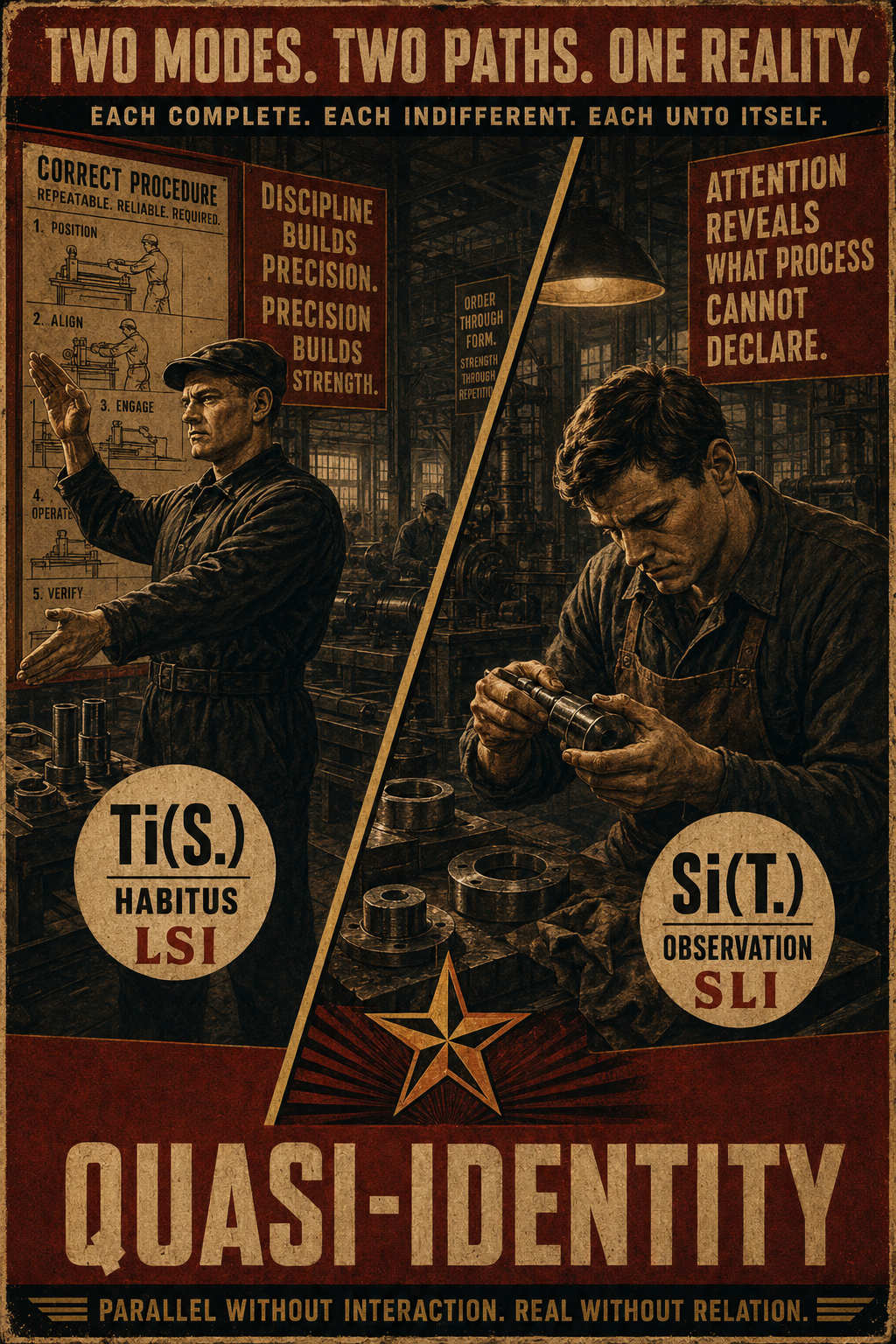
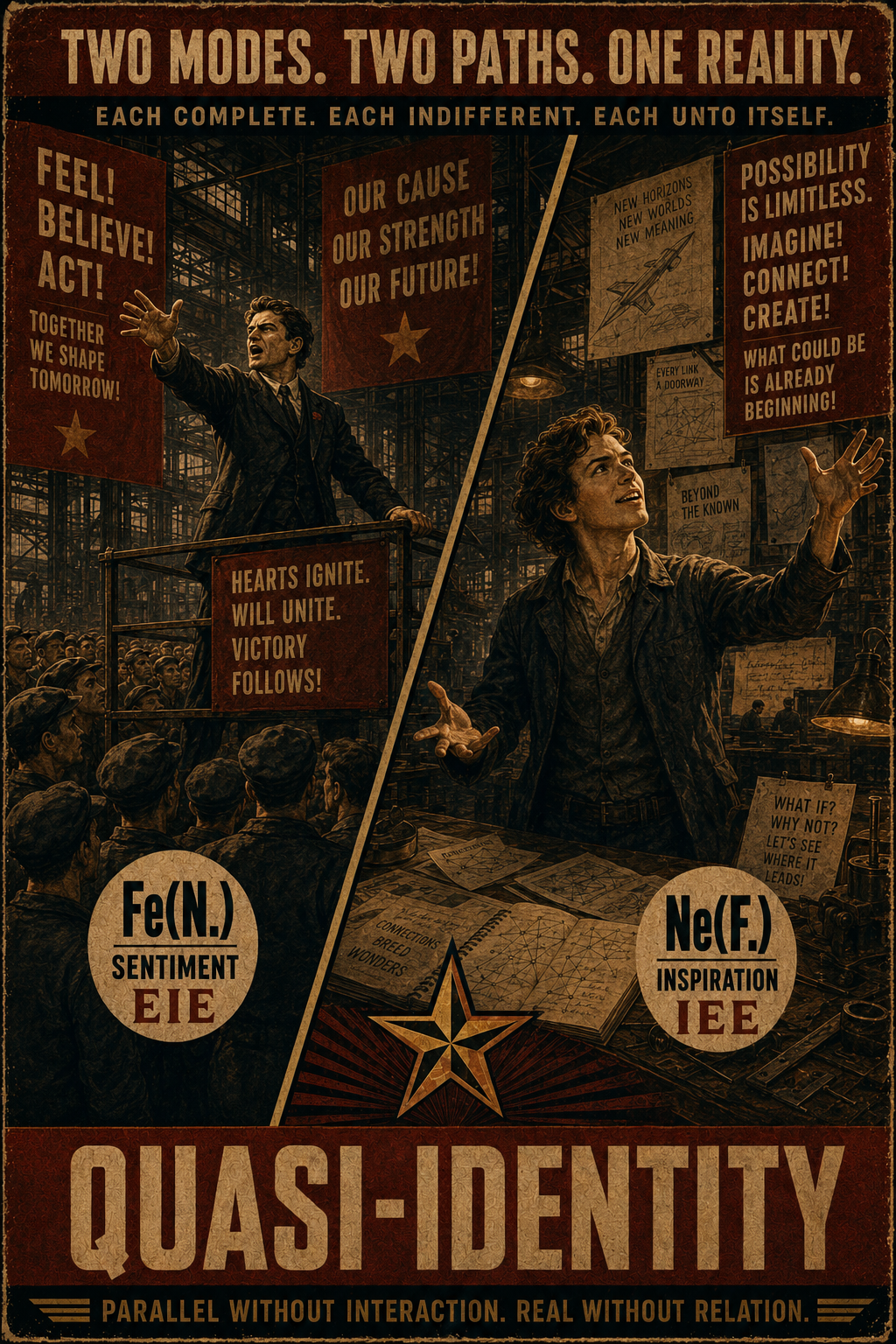
Quasi-Identity relation poster

Quasi-Identity Pair Menu

Shared Register, Different Questions

This page presents the Model L Quasi-Identity series: pairs that share a register closely enough to recognise one another, while each type uses naturally but does not orient toward the other's leading output.

Intellect element illustration
Ti(N.) · Intellect · LII
Apprehension element illustration
Ni(T.) · Apprehension · ILI

Ti(N.) Intellect vs Ni(T.) Apprehension — LII and ILI

In Model A, Quasi-identity has a precise definition: each type's leading function sits at the other's Demonstrative position — the 8th. Not the Role, where Super-Ego strikes. Not the Vulnerable, where Conflict lands. The Demonstrative function is strong — it belongs to the Id block, meaning the type uses it naturally and freely — but it is not what they orient toward as primary. It operates in the background, deployed readily in support of others, without being led with or sought out.

LII's Ni is at position 8 — used naturally, present in background operation, but not what LII orients toward. ILI's Ti is at position 8 — equally natural, equally present, equally not oriented toward. Each type's greatest strength is what the other deploys freely without making it their primary object of attention.

Model L shows why the dynamic plays out the way it does.

LII leads with Ti(N.) Intellect — detached abstract structural logic. The LII builds communicable frameworks: concepts articulated, relations mapped, contradictions resolved into coherent schema. The output is formal, static, conclusive — a structure that stands.

ILI leads with Ni(T.) Apprehension — detached strategic tracking of temporal patterns. The ILI reads how events are likely to unfold: trends followed, implications drawn, the strategic shape of what is becoming visible through accumulated pattern. The output is nonverbal, dynamic, conclusive — a trajectory that holds.

The shared sub-variant is N./T. — both detached. Both operate with analytical distance from their material. Both are inward, self-contained, non-broadcasting. Both are comfortable with abstraction. Both are quiet. On the surface, they can appear to be doing something similar. A kind of mutual recognition is possible — each senses in the other a familiar quality of absorbed, systematic, detached engagement.

But the domains do not connect. Ti(N.) builds static logical structure. Ni(T.) tracks dynamic temporal pattern. One arrives at a framework that is formally correct. The other arrives at a reading of where things are heading. These are not competing answers to the same question. They are answers to entirely different questions, pursued through modes that share a register but point in opposite directions.

The ILI uses Ti(N.) naturally — it runs in background operation, available and deployed freely — but does not orient toward it. Communicable logical architecture, explicit structural schema, the work of making a framework legible is not what the ILI is trying to do. The LII uses Ni(T.) naturally — it too runs in background operation — but does not orient toward it. Nonverbal temporal tracking, strategic pattern reading, the work of following implication through time is not what the LII is trying to do.

They can occupy the same space without friction. They may even admire something in each other from a distance — that quality of detached, absorbed precision which each recognises as cognate with their own mode. But sustained convergence is elusive. Each proceeds along their own axis. The LII keeps building structure. The ILI keeps reading pattern. Neither output is what the other is primarily oriented toward.
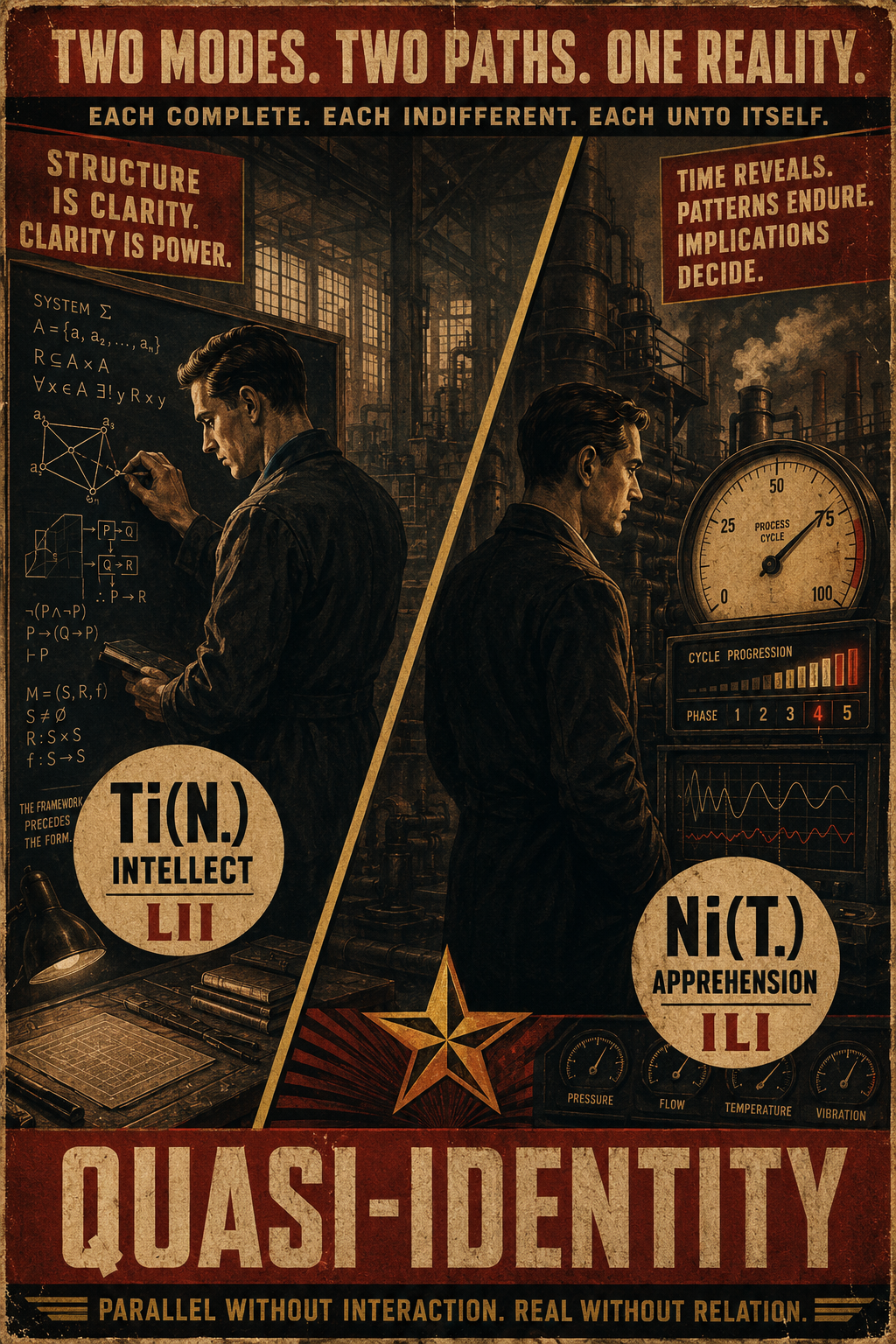

Quasi-Identity relation illustration comparing LII Ti(N.) and ILI Ni(T.)
Habitus element illustration
Ti(S.) · Habitus · LSI
Observation element illustration
Si(T.) · Observation · SLI

Ti(S.) Habitus vs Si(T.) Observation — LSI and SLI

Same structural rule. LSI's Si sits at position 8 — strong, naturally deployed, not what LSI orients toward as primary. SLI's Ti sits at position 8 — equally strong, equally natural, equally not oriented toward.

Of all eight Quasi-identical pairings, this one produces the most surface similarity. Both are physically present. Both are precise. Both are quiet and practically engaged with material reality. Both share the S./T. sub-variant — embodied, externally directed, detached in their mode of engagement. From any distance they can appear to be doing the same thing.

They are not.

LSI leads with Ti(S.) Habitus — embodied structural logic. The LSI enacts codified procedure through the body: the correct sequence, the established form, structural authority made physical and repeatable. The question the LSI is always implicitly answering is whether procedure is being correctly embodied. The body is the instrument of structure.

SLI leads with Si(T.) Observation — controlled selective external attention. The SLI directs receptive sensory focus onto functional physical detail: what is this material actually like, what does disciplined sensory attention reveal, what qualities are present in the physical environment that undirected perception would pass over. The question the SLI is always implicitly answering is what this is actually like in sensory fact. The body is the instrument of observation.

Both are hands-on. Both are physically precise. Both are quiet and non-broadcasting. The S./T. sub-variant they share produces a recognisably cognate quality — two people who inhabit practical physical reality with disciplined, grounded attention. The mutual recognition can be genuine.

But the attending is directed at entirely different things within that shared physicality. The LSI's hands enact a codified sequence. The SLI's hands feel for a sensory quality. The LSI's attention is on whether the procedure is correctly performed. The SLI's attention is on what the material is actually doing. Neither output is what the other is primarily oriented toward.
The SLI uses Ti(S.) naturally — it operates in background support, deployed readily — but does not orient toward it as primary. The embodied procedural authority of the LSI is available to the SLI, used freely when needed, but not what the SLI is trying to do. The LSI uses Si(T.) naturally — it too operates in background support — but does not orient toward it as primary. The controlled sensory observation of the SLI is available to the LSI, used freely when needed, but not what the LSI is trying to do.

The difference from LII/ILI is instructive. There, the parallel absorption was immediately visible — two figures withdrawn from physical presence, each tracking something abstract and self-contained. Here, the parallel absorption is hidden inside physical engagement. Two people working in the same space with the same quality of quiet practical precision, each proceeding along an axis the other uses naturally but does not lead with.

Quasi-Identity relation illustration comparing LSI Ti(S.) and SLI Si(T.)
Soul element illustration
Fi(N.) · Soul · EII
Reverie element illustration
Ni(F.) · Reverie · IEI

Fi(N.) Soul vs Ni(F.) Reverie — EII and IEI

Same structural rule. EII's Ni sits at position 8 — naturally used, present in background operation, not what EII orients toward as primary. IEI's Fi sits at position 8 — equally natural, equally present, equally not oriented toward.

Of the eight Quasi-identical pairings, this one produces perhaps the most convincing surface resemblance. Both types are quiet. Both are withdrawn from immediate physical and social reality. Both operate in an interior register, away from the concrete present. Both share a quality of felt inwardness — personally charged, non-broadcasting, self-contained. The mutual recognition can feel like genuine deep affinity, and in some respects it is.

Model L names the shared register precisely. Fi(N.) and Ni(F.) share the N./F. quality: both abstract rather than grounded in immediate physical particulars, both carrying personal inner felt significance rather than detached external application. Two types who inhabit an interior world with quiet intensity.

But the domains do not connect.

EII leads with Fi(N.) Soul — abstract foundational moral conviction. The EII holds principled felt certainty about what is inherently right — not tied to any particular person, not grounded in immediate visceral attachment, but free-floating and foundational. This is a settled inner verdict about what any person ought to honour, what constitutes genuine worth. It is Judgment arriving at a moral conclusion that stands independent of circumstance.

IEI leads with Ni(F.) Reverie — inner narrative aspiration. The IEI follows imagined or remembered events with felt attention to their narrative significance and subtext — scenarios unfolding inwardly with personal resonance, the thread of how things feel as they move through time. This is Perception tracking the shape of temporal flow from inside it, charged with felt meaning.

One arrives at a foundational moral conclusion. The other follows a felt narrative thread. These are not competing answers to the same question. One is Judgment settling into conviction. The other is Perception flowing through time. The modes are inward and personally felt on both sides, producing that convincing surface kinship — but they point toward entirely different objects.

The IEI uses Fi(N.) naturally — it runs in background operation, deployed freely — but does not orient toward it as primary. Abstract foundational moral conviction is available to the IEI, used readily when needed, but not what the IEI is trying to do. The foundational moral verdict is not what drives them. The EII uses Ni(F.) naturally — it too runs in background operation — but does not orient toward it as primary. Inner narrative immersion, felt attention to how events unfold through time, is available to the EII but not what the EII leads with. The principled moral conviction comes first and last.

The contrast with LSI/SLI is stark. There, two physically present, practically engaged types proceeded in parallel while attending to different things within shared physical reality. Here, two inwardly withdrawn types proceed in parallel while attending to different things within shared interiority. The quasi-identical parallel is not hidden inside practical engagement but inside the very inwardness each mistakes for common ground.

Quasi-Identity relation illustration comparing EII Fi(N.) and IEI Ni(F.)
Animus element illustration
Fi(S.) · Animus · ESI
Stimulation element illustration
Si(F.) · Stimulation · SEI

Fi(S.) Animus vs Si(F.) Stimulation — ESI and SEI

Same structural rule. ESI's Si sits at position 8 — naturally used, present in background operation, not what ESI orients toward as primary. SEI's Fi sits at position 8 — equally natural, equally present, equally not oriented toward.

The shared S./F. sub-variant produces immediate surface warmth. Both types are physically present. Both carry visceral felt charge. Both are somatically immediate — not withdrawn into abstraction like EII/IEI, not absorbed in procedural precision like LSI/SLI, but warmly, bodily present in the immediate physical and relational environment. An observer could easily mistake one for the other at distance.

Model L shows where the resemblance ends.

ESI leads with Fi(S.) Animus — visceral particular bonds. The ESI carries settled felt verdicts about specific persons and objects: affinity and aversion constitutively tied to those particular subjects, not transmissible, not abstractable, not open to logical revision. The ESI's felt life is directed — toward these people, away from those, with a specific relational weight attached to each particular. The warmth, when present, is not general. It is aimed.

SEI leads with Si(F.) Stimulation — subjective immersion in immediate bodily experience. The SEI attends to the felt charge of incoming physical stimuli: somatic vitality, sensory comfort, the subjective texture of immediate physical reality. The SEI's felt life is ambient — not directed at particular persons but suffused through the immediate physical environment as a whole. The warmth is general. It radiates outward into shared space without requiring a specific object.

Both are S./F. — visceral, involved, particular in register. But one is Judgment arriving at a settled conclusive verdict about specific persons and objects. The other is Perception flowing through the somatic present without arriving anywhere. One holds. The other moves.

The SEI uses Fi(S.) naturally — it operates in background support, deployed freely — but does not orient toward it as primary. Visceral particular bonding, settled felt verdicts about specific persons, is available to the SEI, used readily when needed, but not what the SEI leads with. The somatic present comes first. The ESI uses Si(F.) naturally — it too operates in background support — but does not orient toward it as primary. Somatic ambient immersion, the subjective texture of immediate physical reality, is available to the ESI, used freely when needed, but not what the ESI leads with. The particular relational verdict comes first.

The contrast with EII/IEI illuminates the axis. There, N./F. inwardness produced a quasi-identical resemblance hidden inside shared interiority — two types withdrawn from physical and social presence, each following their own interior thread. Here, S./F. visceral immediacy produces a quasi-identical resemblance hidden inside shared warmth — two types bodily present and somatically engaged, each attending to entirely different things within that shared physical aliveness.

Quasi-Identity relation illustration comparing ESI Fi(S.) and SEI Si(F.)
Reason element illustration
Te(N.) · Reason · LIE
Ideation element illustration
Ne(T.) · Ideation · ILE

Te(N.) Reason vs Ne(T.) Ideation — LIE and ILE

Same structural rule. LIE's Ne sits at position 8 — naturally used, present in background operation, not what LIE orients toward as primary. ILE's Te sits at position 8 — equally natural, equally present, equally not oriented toward.

Of the eight Quasi-identical pairings, this one produces the most energetically active surface resemblance. Both types are intellectually driven, outward-projecting, generative at pace. Both share the N./T. sub-variant — detached, analytically directed, comfortable with abstraction and disengaged from immediate physical or somatic concerns. Both are Dynamic and extroverted, continuously processing and producing rather than arriving at settled conclusions. Two people who appear to be thinking hard about something, fast, without stopping.

From any distance they can look like the same type doing the same work.

They are not.

LIE leads with Te(N.) Reason — detached applied logic. The LIE works through available information toward productive end goals: what does the data support, what inference leads to an effective outcome, what is the workable strategy given what is known. The intellectual energy converges. Everything gets oriented toward what can be done. The output is applicable, targeted, aimed at a result that functions.

ILE leads with Ne(T.) Ideation — detached conceptual imagination. The ILE generates and manipulates concepts from outside them, building semantic architecture, mapping possibility space, following conceptual connections wherever they lead. The intellectual energy expands. Everything gets opened outward into further connection and implication. The output is structural, generative, aimed at a conceptual map that holds together.

The shared N./T. sub-variant produces genuine recognisable kinship — each senses in the other a familiar quality of detached, fast-moving, non-somatic intellectual engagement. But the directionality is opposite. Te(N.) converges toward applicable strategy. Ne(T.) expands into conceptual possibility. One asks what works. The other asks what connects. These are not competing answers to the same question — they are different questions entirely, pursued through modes that share a register but move in opposite directions.

The ILE uses Te(N.) naturally — it runs in background operation, deployed freely — but does not orient toward it as primary. Applied strategic reasoning, convergent evidence-to-outcome logic, is available to the ILE and used readily, but not what the ILE is trying to do. The concept space comes first. The LIE uses Ne(T.) naturally — it too runs in background operation — but does not orient toward it as primary. Conceptual architecture, expanding semantic possibility mapping, is available to the LIE and used freely, but not what the LIE is trying to do. The strategy comes first.

Compare to LII/ILI. Both pairings are N./T. detached, both cross Rational/Irrational domains. But LII/ILI are Static and introverted — two figures absorbed in self-contained quiet, each withdrawn from the external environment. LIE/ILE are Dynamic and extroverted — two figures generating active intellectual output outward at pace. The quasi-identical parallel in LII/ILI is hidden inside parallel stillness. Here it is hidden inside parallel intellectual energy. The same register, considerably louder.

Quasi-Identity relation illustration comparing LIE Te(N.) and ILE Ne(T.)
Praxis element illustration
Te(S.) · Praxis · LSE
Actuation element illustration
Se(T.) · Actuation · SLE

Te(S.) Praxis vs Se(T.) Actuation — LSE and SLE

Same structural rule. LSE's Se sits at position 8 — naturally used, present in background operation, not what LSE orients toward as primary. SLE's Te sits at position 8 — equally natural, equally present, equally not oriented toward.

Both types are physically active and practically authoritative. Both are S./T. — externally directed, grounded in material reality, non-abstract, detached in their mode of physical engagement. Both exert something outward into the environment. Both appear to be running things. The surface resemblance is one of practical command, and it is convincing enough that the two types are regularly confused in typing.

Model L shows where the resemblance ends.

LSE leads with Te(S.) Praxis — embodied practical application. The LSE works through direct material engagement: testing techniques, comparing methods, finding what works through hands-on experimentation with physical reality. The authority is earned through demonstrated results — this method produces outcomes, this workflow functions, this technique works because it has been tested against reality and shown to hold. The question driving the LSE is always: what works?

SLE leads with Se(T.) Actuation — regulatory external force. The SLE leverages controlled, measured pressure to bring the physical environment into conformity with defined parameters. The authority is structural and immediate — not earned through demonstrated results but exerted through circumscribed governance. Things conform because the SLE applies exactly the force required to make them conform. The question driving the SLE is always: what needs to be brought into order, and how much force does that require?

The shared S./T. sub-variant produces genuine recognisable kinship — both types inhabit practical physical reality with grounded, non-abstract, externally directed authority. Each senses in the other a familiar quality of physically present, practically capable command. But the mode of that command is entirely different. Te(S.) discovers what works through iterative practical contact with material reality. Se(T.) governs what is present through measured application of regulatory force. One is Rational and adaptive, seeking effective method. The other is Irrational and directive, shaping environment to conform.

The SLE uses Te(S.) naturally — it runs in background operation, deployed freely — but does not orient toward it as primary. Practical experimentation, iterative method-testing against material reality, is available to the SLE and used readily, but not what the SLE is trying to do. Bringing the environment into order comes first. The LSE uses Se(T.) naturally — it too runs in background operation — but does not orient toward it as primary. Regulatory force, the capacity to govern the physical environment through circumscribed physical authority, is available to the LSE and used freely, but not what the LSE is trying to do. Finding what works comes first.

The contrast with LSI/SLI is instructive. Both pairs share the S./T. sub-variant and cross the Rational/Irrational axis. But LSI/SLI operate quietly and inwardly — embodied procedure and controlled sensory observation, two modes of precise physical attention that proceed in parallel without broadcasting outward. LSE/SLE are both extroverted and actively exerting — practical experimentation and regulatory force, two modes of physical authority that proceed in parallel while generating visible practical output. The quasi-identical parallel in LSI/SLI is hidden inside quiet precision. Here it is hidden inside active practical command.

Quasi-Identity relation illustration comparing LSE Te(S.) and SLE Se(T.)
Sentiment element illustration
Fe(N.) · Sentiment · EIE
Inspiration element illustration
Ne(F.) · Inspiration · IEE

Fe(N.) Sentiment vs Ne(F.) Inspiration — EIE and IEE

Same structural rule. EIE's Ne sits at position 8 — naturally used, present in background operation, not what EIE orients toward as primary. IEE's Fe sits at position 8 — equally natural, equally present, equally not oriented toward.

Both types are outward-broadcasting and expressively energised. Both share the N./F. sub-variant — inwardly sourced, personally charged, non-somatic, non-abstractly detached. Both generate felt output that moves into shared space and affects those around them. Both are Dynamic and extroverted. The surface resemblance is emotional-creative expressiveness, and it is sufficiently convincing that this pair generates persistent typing confusion.

Model L shows where the resemblance ends.

EIE leads with Fe(N.) Sentiment — inner passion expressed through rhetorical address. The EIE shapes deeply felt inner conviction into dramatic symbolic gesture and charged language aimed at moving others. The output is directed and inciting: this is what we should feel, this is what that feeling demands of us. The felt energy is structured into rhetoric, given a target, sent outward to produce a response. Judgment arriving at an emotional conclusion and broadcasting it with force.

IEE leads with Ne(F.) Inspiration — felt aliveness to possibility. The IEE experiences potentiality from within as personally vivid and meaningful: this is alive, this is significant, this opens somewhere extraordinary. The output is generative and spontaneous: creative impulse, enthusiasm for novel directions, felt sense of what could be radiating outward from inner personal charge. Perception moving through possibility space with felt excitement, not arriving at a conclusion but continuously discovering new openings.

The shared N./F. sub-variant produces genuine recognisable kinship — both types generate outward felt energy sourced from an inner personal register. Each senses in the other a familiar quality of inner felt charge expressed outward with personal intensity. But the mode of that expression is entirely different. Fe(N.) shapes inner feeling into rhetoric aimed at inciting a specific response. Ne(F.) radiates inner felt aliveness toward possibility without requiring a specific target or response.

One is Judgment — arriving at a felt conclusion and driving others toward it. The other is Perception — continuously opening into further felt possibility without concluding.

The IEE uses Fe(N.) naturally — it runs in background operation, deployed freely — but does not orient toward it as primary. Dramatic rhetorical address, inner passionate conviction shaped into emotional incitement, is available to the IEE and used readily, but not what the IEE is trying to do. The felt aliveness to possibility comes first. The EIE uses Ne(F.) naturally — it too runs in background operation — but does not orient toward it as primary. Felt enthusiasm for novel openings, spontaneous generative creative impulse, is available to the EIE and used freely, but not what the EIE is trying to do. The rhetorical incitement comes first.

The contrast with EII/IEI is the axis reversal. There, N./F. produced parallel inwardness — two figures withdrawn from physical and social presence, each following their own interior thread quietly. Here, N./F. produces parallel outward expressiveness — two figures broadcasting felt energy into shared space at pace. The quasi-identical parallel in EII/IEI was hidden inside shared interiority. Here it is hidden inside shared expressive energy. In both cases: the same register, the same felt quality of inner personal charge, the domain failing to connect beneath a convincing surface resemblance.

Quasi-Identity relation illustration comparing EIE Fe(N.) and IEE Ne(F.)
Affect element illustration
Fe(S.) · Affect · ESE
Impetus element illustration
Se(F.) · Impetus · SEE

Fe(S.) Affect vs Se(F.) Impetus — ESE and SEE

Same structural rule. ESE's Se sits at position 8 — naturally used, present in background operation, not what ESE orients toward as primary. SEE's Fe sits at position 8 — equally natural, equally present, equally not oriented toward.

Both types are physically present and somatically energised. Both are S./F. — visceral, involved, non-abstract, warm in immediate physical space. Both are outward-broadcasting, generating somatic charge into the shared environment at pace. The surface resemblance is the most physically vivid of the eight Quasi-identical pairings — two types whose presence in a room carries the same quality of warm, bodily, immediately felt aliveness.

Model L shows where the resemblance ends.

ESE leads with Fe(S.) Affect — somatic atmospheric emotion. The ESE generates and broadcasts physiological mood through physical presence: feeling conveyed through body, face, and aesthetic signal, creating a collective emotional texture that suffuses the immediate shared environment. The output is ambient and continuous — not directed at any particular target but enveloping the space as a whole. Dynamic: mood generated and maintained as an ongoing atmospheric condition.

SEE leads with Se(F.) Impetus — visceral mobilising drive. The SEE converts vital reserves into full-body somatic exertion directed at specific concrete aims. The output is explosive and targeted — not ambient but mobilising, converting inner somatic energy into vigorous directed force. Static: discrete bursts of visceral exertion toward a specific present aim rather than continuous atmospheric generation.

The shared S./F. sub-variant produces genuine recognisable kinship — both types are warm, somatically present, physically expressive in immediate shared space. Each senses in the other a familiar quality of visceral, involved, bodily aliveness. But the mode is entirely different. Fe(S.) is continuous and enveloping — mood broadcast into shared space as collective atmospheric texture. Se(F.) is discrete and mobilising — vital force directed outward at a specific concrete aim.

One is Dynamic Emotion creating ongoing atmosphere. The other is Static Drive generating explosive directed exertion. One suffuses the environment. The other moves through it toward something specific.

The SEE uses Fe(S.) naturally — it runs in background operation, deployed freely — but does not orient toward it as primary. Somatic atmospheric generation, continuous broadcast of collective emotional texture, is available to the SEE and used readily, but not what the SEE is trying to do. The mobilising exertion comes first. The ESE uses Se(F.) naturally — it too runs in background operation — but does not orient toward it as primary. Mobilising visceral impetus, the capacity for explosive full-body directed force, is available to the ESE and used freely, but not what the ESE is trying to do. The atmospheric mood comes first.

Quasi-Identity relation illustration comparing ESE Fe(S.) and SEE Se(F.)

Quasi-Identity Summary

Same Register, Different Orientation

PairSub-variantRegisterMode
LII × ILIN./T.Detached abstractQuiet, inward
EII × IEIN./F.Inner feltQuiet, inward
ESI × SEIS./F.Visceral particularQuiet, inward
LSI × SLIS./T.Embodied physicalQuiet, inward
LIE × ILEN./T.Detached abstractActive, outward
EIE × IEEN./F.Inner feltActive, outward
ESE × SEES./F.Visceral somaticActive, outward
LSE × SLES./T.Embodied practicalActive, outward

Every pairing shares a sub-variant. Every pairing crosses the Rational/Irrational domain axis. The four introverted Static pairings each have a Dynamic extroverted mirror sharing the same sub-variant — the same register operating in opposite modes of expression. The quasi-identical parallel is always hidden inside that shared register: two types who feel cognate to each other, proceeding in parallel, each using naturally but not orienting toward precisely what the other leads with.