
Start With Structure
The source document presents Model-L as a sixteen-function extrapolation from Model A, built from monadic elements and dichotomy families.
Model L Reference
A reading guide from Kimani White's source document into the TetraTypes pages and Explorer.
This page is not a replacement for Kimani White's Socionics: Model-L document. It is a companion map: where the source ideas appear on TetraTypes, which Explorer lens to open, and how the major Model-L families fit together.
Orientation
Kimani's source document is architectural. The site is arranged more like a learning environment. This map links those two reading experiences.
The source document presents Model-L as a sixteen-function extrapolation from Model A, built from monadic elements and dichotomy families.
TetraTypes separates that architecture into the bridge, glossary, learning path, type pages, Explorer, and practice tools.
The Explorer is the verification tool. Use it to move from a term such as R3 or Interest to the actual positions in a selected type.
Modern Socionics
Kimani White's Model-L document uses the phrase modern socionics for a higher-resolution continuation of the Model A project, not a rejection of the original eight-function frame.
Model A supplies the familiar eight information elements, eight functional positions, quadra values, and relation logic. Model-L keeps that frame visible instead of discarding it.
Modern socionics asks whether the classical elements are the final layer of resolution. Model-L answers by splitting each element into two monadic variants, producing sixteen exact elements.
The central A and D positions preserve the Model A bridge. The radial B and C positions describe additional functional territory that Model A does not explicitly place.
| Question | Classical Model A Answer | Modern Model-L Extension |
|---|---|---|
| What is being metabolised? | Eight information elements. | Sixteen monadic variants of those same element territories. |
| Where does the type live? | Eight functional positions. | Sixteen positions: central functions plus radial extensions. |
| How are differences derived? | Element, position, strength, value, and relation structure. | Reinin-derived source families, dimensionality, priority, capacity, and derived fourfold lenses. |
| What changes in typing? | Identify the broad type structure. | Check the exact monadic element and the position it occupies in the sixteen-position cross. |
How to read the phrase: modern socionics does not mean newer is automatically better. It means the source framework treats Model A as a foundation that can be extended into a finer structural map, especially through monadic elements, radial positions, and the eight source families.
Source To Site

The bridge and main Model L page explain how each classical information element resolves into two exact monadic variants.
Read the bridge See the elementsThe main page and glossary show how A/D preserve the Model A bridge while B/C add the radial layer.
Open Model L Position glossaryThe glossary keeps the G, U, R, and I codes visible, with the eight source families grouped together.
Family table Dichotomy codesThe Explorer lets you select a type and recolour the cross by U1, R1, I1, Interest, Occupation, or any other layer.
Open ExplorerThe learning path orders the material from Model A prerequisites through derivation, type pages, and relations.
Open learning pathThe practice drill is best for checking whether the source code system has become usable rather than merely familiar.
Open practice drillEight Source Families
These are the families to keep in mind when moving between the source document and the site. The Explorer drop-down now follows this same grouping.
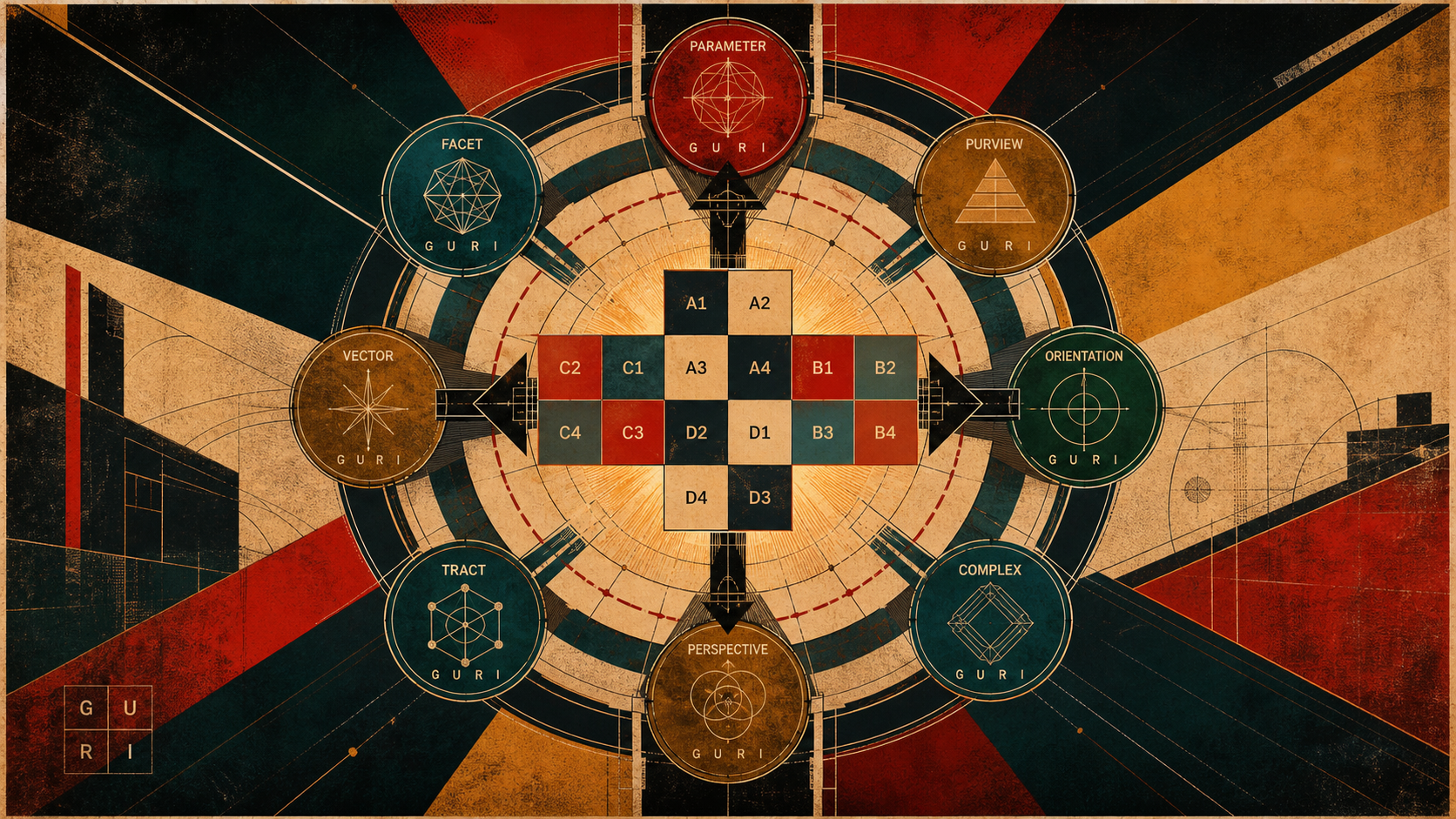
Set identity and metabolic axis. The first split between central and radial structure.
Central / RadialFacing and facility. The direct source of the four capacity regions.
CapacityPhenomenal state crossed with modal engagement: how a position appears or recedes.
VergenceAlignment crossed with polarity: valued movement, menial movement, prevalence, and restraint.
CurrentEach family gives either a source axis or a fourfold lens for reading the sixteen positions.
Frame crossed with requisite: how a position participates in the type's composition.
EnsembleExpressive emphasis crossed with selective approach: pressure, direction, and accommodation.
ArrayFocal concentration crossed with attentional concern: what gathers focus and relevance.
InterestPreceptive domain crossed with perceptual sphere: what becomes an ongoing work zone.
Occupation| Family | Source Codes | Derived Lens | Use On Site |
|---|---|---|---|
| Parameter | G1 Set Identity / U1 Metabolic Axis | Central / Radial | Use U1 and Capacity to see what belongs to the Model A bridge and what is radial extension. |
| Facet | R1 Longitudinal Facing / I1 Latitudinal Facility | Capacity | Use R1/I1 for foreground/background and facile/resistant placement. |
| Vector | G2 Phenomenal State / U2 Modal Engagement | Vergence | Use this to read how a function surfaces or recedes in awareness. |
| Tract | R2 Functional Alignment / I2 Directional Polarity | Current | Use this to distinguish valued, unvalued, prevalent, and subdued movement. |
| Perspective | G3 Dispensatory Frame / U3 Compositive Requisite | Ensemble | Use this to see whether a position organises, produces, accepts, or supplies. |
| Complex | R3 Expressive Emphasis / I3 Selective Approach | Array | Use this for assessment style and decision-making approach. |
| Orientation | G4 Focal Concentration / U4 Attentional Concern | Interest | Use this to read how strongly attention gathers and how relevant the concern is. |
| Purview | R4 Preceptive Domain / I4 Perceptual Sphere | Occupation | Use this to read what becomes a consistent or situational field of activity. |
Model A Bridge
The central/radial distinction is the cleanest way to stop Model L feeling like a second, unrelated model.
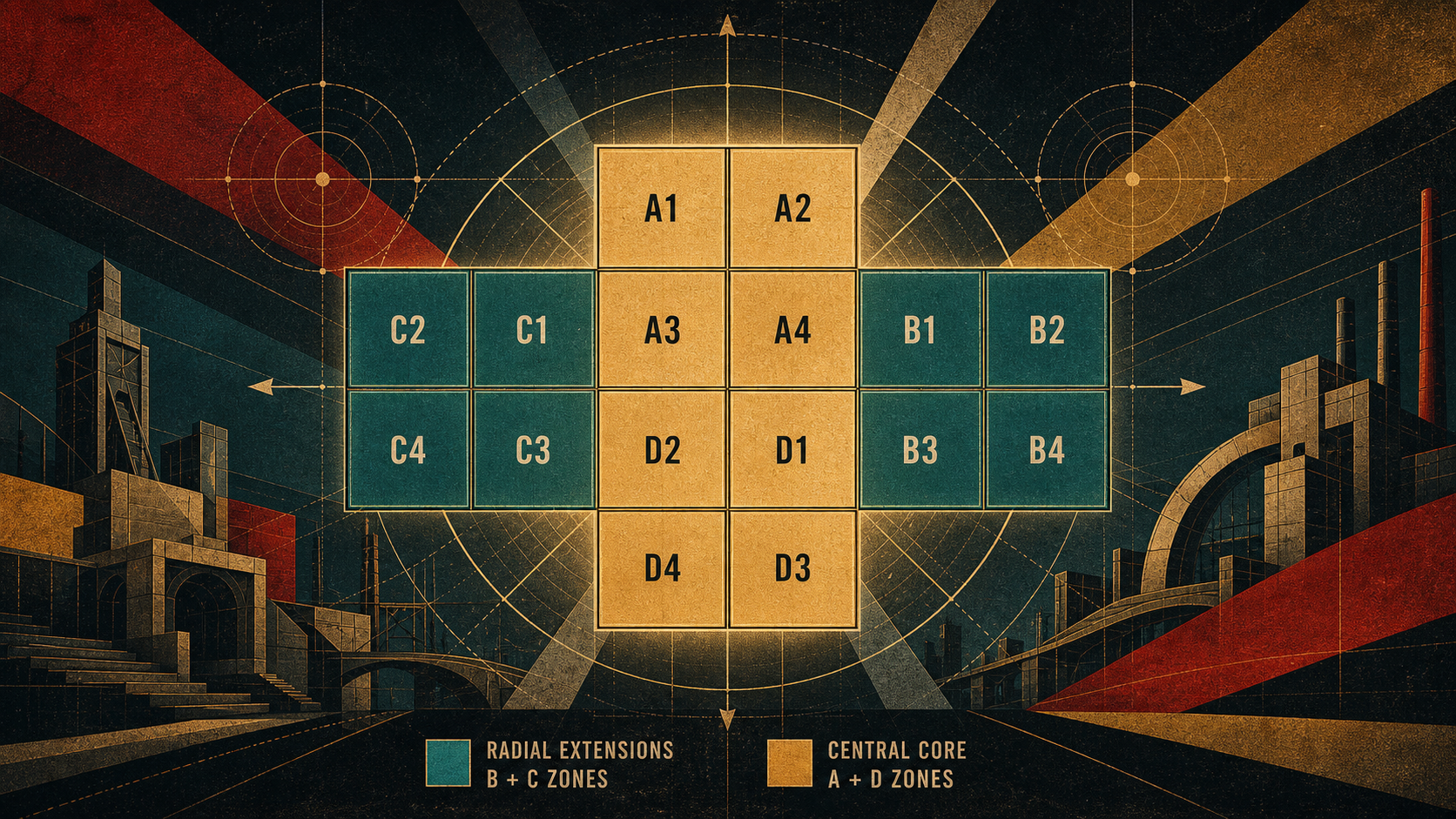
Central, foreground, and facile. These are the strongest type-defining functions and map most cleanly onto Model A strength.
Radial, foreground, and resistant. These are available and visible, but not effortless in the way A functions are.
Radial, background, and facile. These quietly shape output from the periphery rather than announcing themselves as main tools.
Central, background, and resistant. These retain structural importance while carrying the hidden strain and vulnerability of the type.
In practical reading, treat A and D as the central Model A bridge and B/C as the radial extension. That keeps the familiar eight-function structure intact while making room for the full sixteen-position field.
How To Use This
Read the bridge first if the sub-variant notation is still new. Then use the glossary family table as a decoder. Finally, open the Explorer and select the same family in the drop-down so the source terms become visible on an actual type cross.