TetraTypes Blog ·
Why Some Functions Feel Like Hidden Twins
Elemental Overlap in Model-L
A TetraTypes essay on elemental overlap: why certain Model-L functions resemble one another without becoming the same thing.
Opening Frame
Opening Frame
Socionics often begins by teaching the functions as if they were separate boxes.
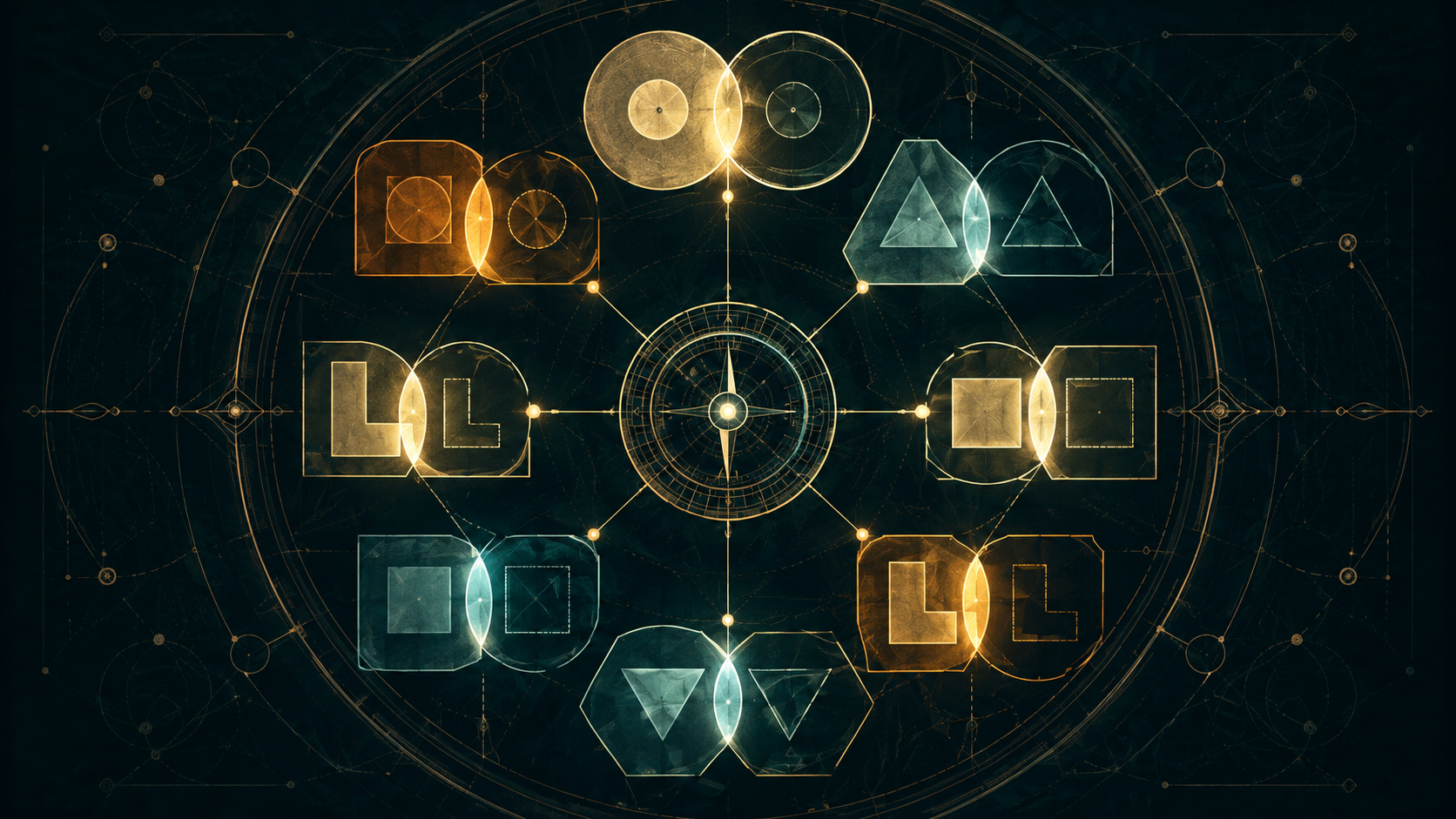
Si is comfort. Se is force. Ni is foresight. Ne is possibility. Ti is structure. Te is effectiveness. Fi is relation. Fe is expression.
That is useful at the start. It gives beginners a map. But it also creates a false picture. Real people do not experience the functions as sealed compartments. Comfort bleeds into liking. Bodily charge becomes mood. Personal value becomes life-story. Conceptual insight becomes articulated structure. Practical reasoning becomes inventive possibility.
Model-L gives us a way to explain this without dissolving the distinctions.
Kimani White and Aleesha Lowry call the relevant idea elemental overlap. Information metabolism elements can overlap through co-dimensional sub-elements. These pairs share deeper structural qualities, but they still differ in how they operate. One may be static while the other is dynamic. One may be perceptual while the other is preceptive. One may carry the content while the other supplies the medium.
So the two functions are not identical.
They touch.
That is why some functions feel like hidden twins: close enough to be confused, different enough to matter.
Elemental Overlap
The problem with sealed boxes
A lot of typing mistakes come from treating function labels too literally.
Someone enjoys food, comfort, atmosphere, familiar places, and bodily ease, so we call it Si. But perhaps the important thing is not sensation as such. Perhaps the person is registering visceral affinity and aversion: I like this. I dislike that. This suits me. That person feels wrong. Now we are closer to Fi(S.) Animus.
Someone is energetic, loud, animated, and physically expressive, so we call it Se. But perhaps the main operation is not forceful exertion. Perhaps the person is generating mood, aesthetic signal, shared arousal, and social atmosphere. Now we are closer to Fe(S.) Affect.
Someone sees the implication of an idea before everyone else, so we call it Ti. But perhaps they have not yet built a clean conceptual frame. They have an intuitive grasp of where things are going. That is Ni(T.) Apprehension. Conversely, someone may not merely see the implication but turn it into a crisp distinction, a definition, a model. That is Ti(N.) Intellect.
The model is not vague here. The phenomena are adjacent.
The overlap explains why the confusion is tempting.
Elemental Overlap
What elemental overlap means
Model-L divides the eight familiar information metabolism elements into sixteen monadic elements. So Si becomes, depending on its monadic form, Si(T.) Observation or Si(F.) Stimulation. Ne becomes Ne(T.) Ideation or Ne(F.) Inspiration. Ti becomes Ti(S.) Habitus or Ti(N.) Intellect, and so on.
Elemental overlap then shows that these sixteen elements are not simply lined up like isolated beads. Some of them stand in paired relation. They share a metabolic neighbourhood.
The easiest way to think of it is this:
An overlap pair is two different operations carried out at the same structural junction.
One element may receive what the other stabilises. One may project what the other expresses. One may grasp what the other articulates. One may generate what the other reasons into a workable plan.
This is why surface resemblance can mislead. Resemblance does not always mean identity. Sometimes it means overlap.
A twin is not a clone.
Elemental Overlap
Harmonization: Si(F.) Stimulation and Fi(S.) Animus
The most accessible overlap is Harmonization: Si(F.) Stimulation with Fi(S.) Animus.
Si(F.) is involved sensation: the subjective experience of bodily stimuli, vitality, comfort, pleasure, discomfort, and physical ease. It is not raw sensation in the abstract. It is sensation as lived and felt.
Fi(S.) is involved character: stable visceral attitudes of affinity and aversion toward particular people, objects, places, and experiences. Not abstract morality. Not a detached theory of good and bad. A concrete pattern of yes and no: I trust this; I reject that; this person is mine; that person is not.
This is where comfort meets liking.
Not a reasoned judgement. A bodily yes or no.
This chair is right. That restaurant feels wrong. This person puts me at ease. That jumper irritates me. This house has a good feel. That tone makes me recoil.
At a beginner level, we might call the first set Si and the second Fi. But lived experience is not so tidy. Bodily sensation arrives already coloured. The body does not merely register temperature, texture, taste, pressure, hunger, fatigue, or brightness. It registers welcome and unwelcome. It registers whether something can be settled into or must be kept at a distance.
That is Harmonization.
It helps explain why SEI and ESI material can sometimes appear close on the surface. Both may care about comfort, preference, atmosphere, taste, irritation, and aversion. Both may have strong reactions to the felt quality of a person or place. But the centre of gravity differs.
Si(F.) Stimulation receives and modulates the lived bodily field. It notices what eases, pleases, stimulates, drains, irritates, or restores. Its question is: How does this feel in the body?
Fi(S.) Animus stabilises preference into character. It marks the object with affinity or aversion. Its question is: What is my settled attitude toward this?
Si(F.) says: "This feels good." Fi(S.) says: "This is right for me."
Those sentences often arrive together.
They are not the same sentence.
Elemental Overlap
Animation: Se(F.) Impetus and Fe(S.) Affect
The second overlap is Animation: Se(F.) Impetus with Fe(S.) Affect.
Se(F.) is involved drive: mobilising somatic impulse, converting reserves of energy into active exertion toward concrete aims. It is the bodily push that says go, take, move, do, press, act.
Fe(S.) is involved emotion: physiological mood and expression, the physical conveyance of somatic feeling through aesthetic signal, creating atmosphere, intensity, warmth, humour, excitement, irritation, or "vibe."
Both move bodily charge outward.
That is why energetic people can be hard to type. A person may enter a room with volume, movement, laughter, urgency, colour, pressure, and momentum. Is that Se(F.)? Is it Fe(S.)?
The answer depends on what the energy is doing.
Se(F.) pushes. Fe(S.) animates.
Se(F.) converts bodily charge into exertion: act, move, take, press, overcome. The energy goes into the object, the task, the obstacle, the concrete aim.
Fe(S.) converts bodily charge into atmosphere: laugh, warm, excite, signal, brighten, stir. The energy goes into the field between subjects.
This distinction matters in typing.
A SEE-like energy may look expressive, warm, lively, and entertaining. But if the core operation is Impetus - desire translated into direct pursuit - then the atmosphere is secondary. The charge is going somewhere. It wants a response, a movement, a win, a concrete change in the field.
An ESE-like energy may also be loud, vivid, physical, and lively. But the centre is Affect. The person is not primarily applying force to the situation. They are shaping the shared mood. They make the room more alive. They turn bodily feeling into social weather.
Se(F.) says: "Move." Fe(S.) says: "Feel this."
In life, both can arrive at the same volume.
Elemental Overlap
Comprehension: Ni(T.) Apprehension and Ti(N.) Intellect
The third overlap is Comprehension: Ni(T.) Apprehension with Ti(N.) Intellect.
This one matters for intellectual typing.
Ni(T.) is detached insight: a direct, often nonverbal grasp of conceptual information, temporal trends, implications, and strategic direction. It sees where things are heading. It senses the latent trajectory. It often knows before it can fully say.
Ti(N.) is detached structure: the linguistic formatting and interpretive schema of the mind. It frames concepts, defines terms, separates distinctions, and articulates ideas in a coherent, communicable form.
Both can look like intelligence. Both can look like understanding. Both can make someone seem theoretical, detached, insightful, and difficult to fool.
But they understand in different ways.
Ni(T.) apprehends. Ti(N.) articulates.
Ni(T.) has the silent grasp: this leads there; that implication matters; this pattern is not finished; the present contains a future shape. It may not yet have the words. The insight comes as direction, trajectory, strategic implication.
Ti(N.) builds the frame. It says: here is the distinction; here is the definition; here is the model; here is the principle; here is how the concepts fit together.
This helps explain why LII and ILI can be confused by outsiders. Both may seem cerebral, detached, conceptual, and far-seeing. Both may notice implications that others miss. But the base standpoint differs.
For ILI, Ni(T.) is not merely a useful assistant. It is the mode of apprehension itself: the sense of where things are going, what is latent in the present, what the trend implies.
For LII, Ti(N.) is the central operation: concepts must be framed, refined, named, placed into relation, and made intelligible.
The LII may have strong Ni(T.). The ILI may have strong Ti(N.). The hidden twin is available. But availability is not identity.
Ni(T.) says: "I see where this leads." Ti(N.) says: "I can state what this is."
One grasps the implication.
The other gives it form.
Elemental Overlap
Innovation: Ne(T.) Ideation and Te(N.) Reason
The fourth overlap is Innovation: Ne(T.) Ideation with Te(N.) Reason.
Ne(T.) is detached imagination: the active generation and creative manipulation of concepts. It brainstorms, reframes, recombines, and explores semantic possibilities.
Te(N.) is detached application: informal logic, fact propositions, available data, productive end goals, and workable strategies. It reasons from what is known toward what can be done.
Both can sound clever. Both can sound inventive. Both can produce plans, arguments, hypotheses, models, and strategic language.
But the direction is different.
Ne(T.) multiplies possibility. Te(N.) reasons toward use.
Ne(T.) asks: what else could this mean? What assumption can we invert? What possible interpretation has been missed? What new concept can be generated here? What if the frame itself is wrong?
Te(N.) asks: what does the data support? What follows from the facts? What is the workable strategy? What plan gets us from here to there? What can be stated clearly enough to act on?
This is useful for ILE/LIE confusion.
Both types may appear quick, verbally inventive, strategically alive, and drawn to systems of possibility. Both can produce ideas at speed. Both may enjoy argument, technology, business, science, systems, or strategy. But the centre of gravity differs.
The ILE tends to live in ideational expansion itself. The point is the new possibility, the conceptual move, the reframing. Practical plans may appear, but often as another expression of possibility.
The LIE uses conceptual movement in the service of reasoned action. The point is what follows, what works, what can be pursued, what can be built, what can be made productive.
Ne(T.) says: "Here is another way to think about it." Te(N.) says: "Here is what follows from what we know."
Both can produce innovation.
One opens the field.
The other operationalises it.
Elemental Overlap
Why this matters for typing
Elemental overlap gives us a better method.
When two functions look similar, do not immediately merge them. Ask what kind of operation is taking place.
Is the person receiving bodily valence, or stabilising preference? Is the person pushing through the world, or charging the atmosphere? Is the person grasping an implication, or articulating a structure? Is the person multiplying possibilities, or reasoning toward a workable plan?
These questions cut more cleanly than slogans.
They also make Model-L more forgiving. Many real examples are mixed. A person's speech, behaviour, taste, decisions, and style may carry traces of several nearby operations. That does not mean the model has failed. It means the analyst must stop typing from the surface noun and start looking at the metabolic verb.
What is the function doing?
That is the question.
Elemental Overlap
The twin is not the type
The most common mistake is to see the hidden twin and mistake it for the centre.
An LII with strong Ni(T.) may look ILI for a moment. But if the person keeps returning to definitions, distinctions, structural clarity, and conceptual articulation, Ti(N.) remains the centre.
An ESE with vivid Se(F.)-like bodily energy may look SEE for a moment. But if the energy mainly warms, signals, animates, and creates shared atmosphere, Fe(S.) remains the centre.
An ESI with pronounced Si(F.) sensitivity may look SEI for a moment. But if the core is stable affinity and aversion - who is trusted, what is rejected, where loyalty and disgust settle - Fi(S.) remains the centre.
An ILE with sharp Te(N.)-like planning may look LIE for a moment. But if the plan is mostly a vehicle for conceptual exploration, Ne(T.) remains the centre.
The hidden twin can support, colour, and echo the base operation.
It does not replace it.
Elemental Overlap
Close enough to confuse, different enough to matter
Elemental overlap gives us one of the most useful corrections to crude Socionics.
It tells us not to treat functions as boxes with brick walls between them. But it also tells us not to dissolve them into mush. The overlaps are structured. The twins are paired for reasons. They share a neighbourhood, not an identity.
That is exactly the kind of distinction Model-L is good at making.
Si(F.) and Fi(S.) both live in the territory of bodily valence, but one receives sensation while the other stabilises preference.
Se(F.) and Fe(S.) both channel somatic charge outward, but one drives exertion while the other creates atmosphere.
Ni(T.) and Ti(N.) both concern understanding, but one apprehends implications while the other articulates structure.
Ne(T.) and Te(N.) both move through conceptual space, but one generates possibilities while the other reasons toward workable ends.
The functions touch.
That is why they can fool us.
The distinctions remain.
That is why the model still matters.
Elemental Overlap
Source note
This article is based on Kimani White and Aleesha Lowry's discussion of elemental overlap and co-dimensional sub-elements in Socionics Tweaks, together with the monadic element definitions in Kimani White's Socionics: Model-L. It is written as a TetraTypes explanatory essay rather than a formal reproduction of the source notation.