Te vs Ti
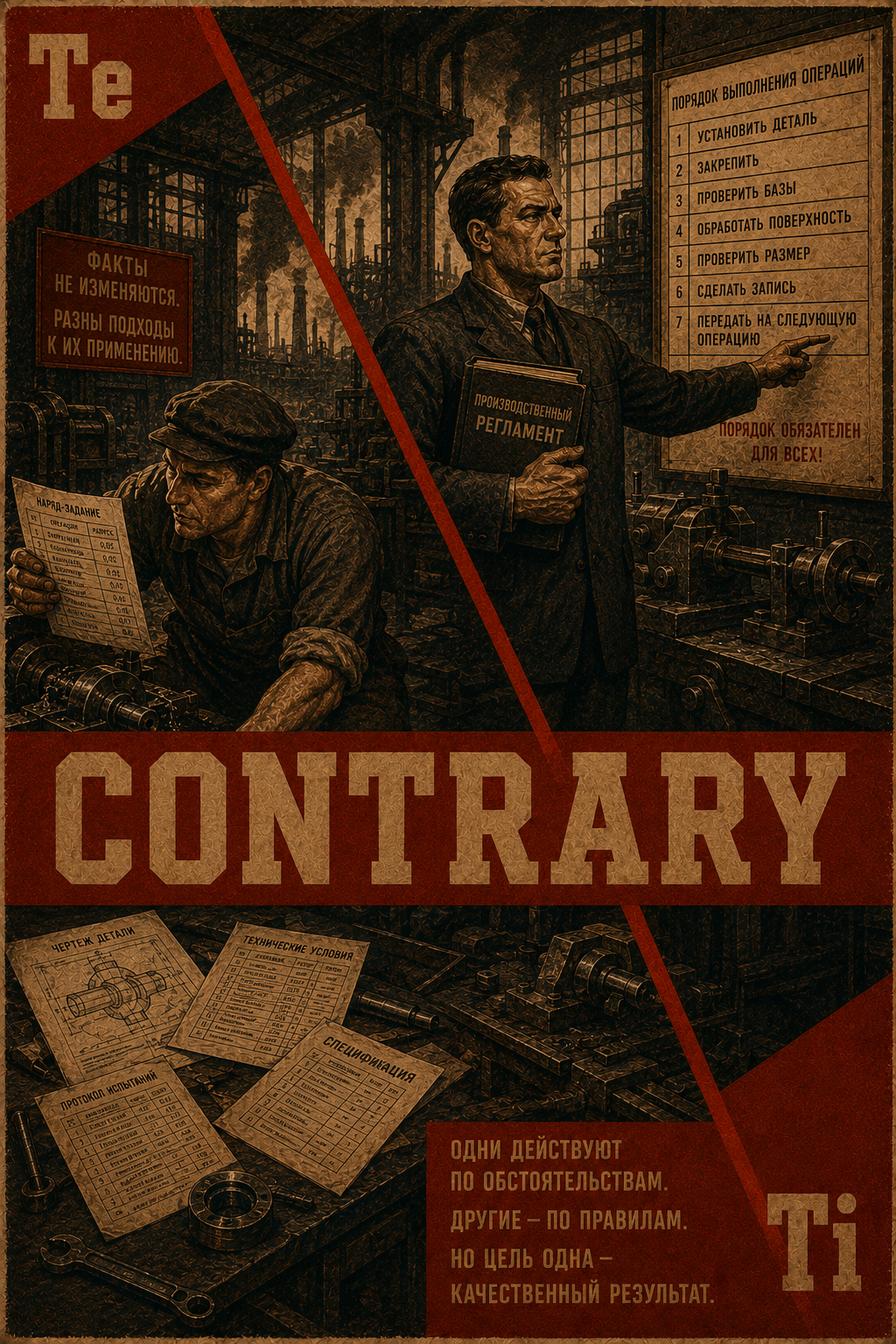
The image shows a single factory floor. Same machinery, same information, same objective reality on both sides of the line.
On the left, a worker crouches beside the running equipment with job sheets scattered around him. He is comparing what the sheets say against what the machine is actually doing right now, adapting his approach in real time to the specific conditions he finds. No fixed method governs him — only the question of what works here, in this situation, with these particular variables. If the context changes tomorrow the approach changes with it. Te moves through objective information the way a good mechanic moves through a fault — situationally, responsively, never married to a procedure that no longer fits.
On the right, a foreman stands upright and immovable, rulebook pressed to his chest, arm extended toward a wall-mounted procedural chart where every step is numbered and governed. The system applies regardless of what the machine is doing. The procedure is not a suggestion — it is the structure that makes the work trustworthy and consistent. Ti does not adapt the framework to the situation. It applies the framework to the situation. That is not rigidity. That is what a principle actually is.
Each sees the other and does not like what it sees. Te reads Ti as someone so committed to the chart that he would follow it off a cliff rather than look at what the machine is telling him. Ti reads Te as someone so willing to improvise that nothing he produces can be relied upon. Both diagnoses are accurate. Neither misses. Some people operate mainly with questionable dynamic improvisation, others with conclusive static procedure, some with one approach completely lacking, still others with both approaches operating effectively in tandem, but more usually it cannot be run by both simultaneously without something giving way because the two approaches are contrary; one will always be favoured.