This is an updated version of an earlier post. After it first went up, Kimani White responded with two corrections that reshaped the framing, and I have rewritten it to follow his account. Where the first version organised everything around the supervisee's Vulnerable and proposed my own names for the two forms of supervision, this version drops both: Kimani points out that each relation is defined by its own functional projection rather than by reference to the blind spot, and that the two forms already have names — the Collaborative relation and the Rectifying relation. The structural findings are unchanged; the way of telling them is his, and the better for it.
In Model A, supervision has a tidy story. The supervisor leads with the element that sits on the supervisee's weakest point. Strongest function meets blind spot. One arrow, one collision, and the same story told sixteen times over with only the names changed.
It is a good story. It is also, under Model L, not quite what is happening.
When you lay the two psyches out at full resolution — all sixteen positions on each side, not the four blocks Model A draws — the single arrow gives way to something more precise. Supervision turns out not to be one relation at all but two, each defined by where the supervisor's leading element actually projects, and the difference between them explains a fact every supervisee already knows in their bones: that being supervised feels nothing like supervising, even though the relation wears one name.
This post sets out the two supervision relations as Model L defines them, contrasts them with the Model A account, and uses them to explain why the chair you sit in changes everything.
How Model A frames supervision
Model A describes a type with eight functions in four blocks, and it frames supervision through two correspondences, both running between the conscious cores of the two psyches.
The first is Leading against Vulnerable. The supervisor's Base — their leading element, the strongest and most valued thing they do — falls on the supervisee's Vulnerable, the unvalued one-dimensional element the supervisee can neither defend nor develop. This is the collision everyone pictures: the supervisor effortlessly doing the very thing the supervisee cannot.
The second is Creative against Leading. In the other direction, as a universal rule, the supervisee's Base falls on the supervisor's Creative — the supervisee's own leading element meeting a valued, conscious position in the supervisor's leading block.
So Model A draws supervision as a meeting of two Egos. The supervisor's leading function presses on the supervisee's weak point; the supervisee's leading function is received into the supervisor's creative second. Both correspondences are anchored in the Central, Overt positions — the parts of each psyche held in full waking attention. And because every supervision pair gets the same four-block geometry, every pair gets the same story. An LII supervised by an SLE and an LII supervising an IEE are, in Model A's telling, the same shape of relationship.
Anyone who has sat in both chairs knows that cannot be the whole truth. The trouble is that Model A does not have the resolution to say why. With only four blocks, the difference between supervising and being supervised has nowhere to live. It is felt, but it cannot be drawn.
How Model L reframes it
Model L resolves each of the eight classical aspects into a pair of distinct monadic elements — sixteen in all, not eight aspects with variants attached. Each element occupies one of sixteen positions, and each position carries its own profile: an axis (Central or Radial), a vergence (Overt, Tacit, Apparent, or Persistent), a dimensionality, and a priority.
The reframing that matters is this. Model A reads supervision off the Central axis — Leading against Vulnerable, Creative against Leading, both anchored in the conscious cores. Model L reads it off the Radial elements instead. A relation, in Model L, is defined by its own functional projection: by where the active, leading element actually lands in the other psyche, not by what happens to the blind spot. This was Kimani White's correction to the first version of this post, and it is the hinge of the whole account. The Vulnerable need not enter the description at all. What defines each supervision relation is the Radial position the supervisor's Base projects onto — and there are two of them.
The two relations
Set the two psyches side by side and ask one question: when the supervisor's Base appears in the supervisee, where does it land? Do this for all sixteen pairs and the answer is always a Radial, Apparent, two-dimensional, three-priority position — never a Central one, never the Vulnerable. But that Radial-Apparent landing comes in two forms, and the two forms are two distinct relations.
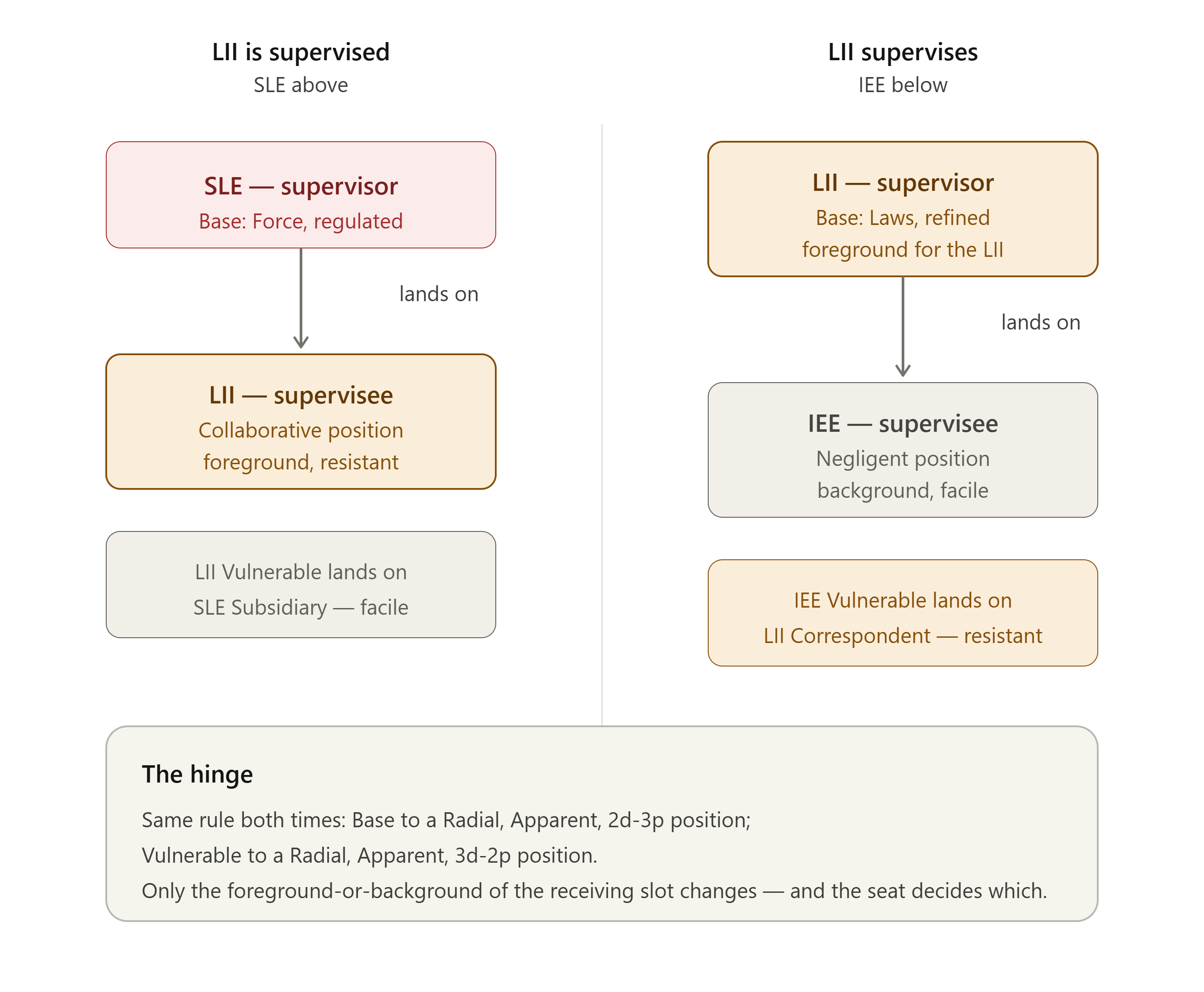
In the first, the supervisor's Base lands on the supervisee's Collaborative — the B2 position, a foreground element in the resistant Consultative material the psyche holds in active view. Kimani White and Aleesha Lowry call this the Collaborative relation.
In the second, the supervisor's Base lands on the supervisee's Negligent — the C2 position, a background element in the facile Diverting material the psyche runs without effort or attention. The relation defined through it is the Rectifying relation. (Note the deliberate distinction in Kimani's terminology: the C2 function is called Negligent; the relation that projects onto it is called Rectifying. The two names are not interchangeable.)
Both are supervision. Both project the supervisor's leading element onto a Radial, Apparent, two-dimensional, three-priority position of the supervisee. They differ in one thing only: whether that position sits in the foreground the supervisee actively defends, or the background it runs on autopilot. The Collaborative relation strikes the foreground; the Rectifying relation strikes the background.
What the contrast comes to
The Model A picture and the Model L picture can now be set directly against each other.
Model A anchors supervision in the Central elements. Leading meets Vulnerable; Creative meets Leading. Two conscious cores, clasping. And because the anchor is the same for every pair, the relation has only one form.
Model L anchors it in the Radial elements. The supervisor's leading element projects onto the supervisee's Radial-Apparent material, and depending on whether that material is the foreground Collaborative or the background Negligent, the relation is Collaborative or Rectifying. The blind spot does not define anything. The projection does.
This is why the single Model A arrow dissolves. The supervisor's Base never reaches the supervisee's Vulnerable — the Vulnerable is Central, and the Base lands on Radial ground. Nor does the supervisee's Base reach the supervisor's Creative; across all sixteen pairs, that Central-to-Central correspondence never occurs in Model L. Both leading elements work on the other psyche's Radial periphery, and neither touches the other's conscious core. The clasp of two Egos that Model A draws was an artefact of drawing in four blocks. At sixteen-element resolution it opens, and what is left is two leading elements projecting onto Radial material — which is exactly the pair of relations Kimani names.
Two chairs, one type
Here is where the two relations earn their keep, and where my own experience of supervision finds its explanation.
Take an LII. An LII is supervised by an SLE, and an LII supervises an IEE. Same person, same type, two relationships, two chairs — and the two relations are not the same relation.
When the LII is supervised by the SLE, this is the Collaborative relation. The SLE's leading element arrives in the LII at the Collaborative, a foreground, resistant position. The incoming pressure strikes material the LII holds in active view and is already invested in handling — and finds that handling outmatched in the open. The LII feels it as friction at the front of the psyche: a competent, valued, foreground concern being bettered in plain sight.
When the LII supervises the IEE, this is the Rectifying relation. The LII's leading element arrives in the IEE not at a foreground position but at the Negligent, a background element the IEE runs effortlessly and attends to not at all. The pressure does not bite at the front of the IEE's psyche the way the SLE's pressure bit at the LII's. It works on ground the IEE does not consciously occupy.
So the asymmetry is not a matter of degree. It is a difference in kind, and it is the difference between two named relations. As supervisee in the Collaborative relation, the LII takes the incoming projection on foreground, resistant ground. As supervisor in the Rectifying relation, the LII lands their own projection on the supervisee's background, facile ground. The chair is not the same chair, because the relation is not the same relation.
And this is not particular to the LII. Which relation you receive from above and which you give below is fixed by your rationality. Every rational type is supervised through the Collaborative relation and supervises through the Rectifying relation; every irrational type does the reverse. There are no exceptions across the sixteen types. The LII simply shows the pattern that all eight rational types share — supervised in the foreground, supervising into the background.
The rings
Model A already recognises that supervision runs in directed rings. Every type has a supervisor above it and a supervisee below, and the chain closes into a loop of four. There are left-hand and right-hand rings depending on which way the chain is traced, but in every case the relation is asymmetric: the supervisor sits in the better position, the supervisee in the worse one.
Model L keeps that asymmetry and gives it structure. Trace any supervision ring in its directed order and the two relations alternate, strictly, link by link — Collaborative, Rectifying, Collaborative, Rectifying, and back to the start. No ring is all of one kind. Each type receives one relation from the type above it and hands the other to the type below. That is why the two cannot be prised apart: they are the two faces every link in the ring necessarily wears, one looking up and one looking down. You sit at the hinge between them.
It is worth being clear that the asymmetry survives the split. Both relations keep the supervisor better-placed. In the Collaborative relation the supervisee meets the projection in their foreground, but cannot answer it from strength. In the Rectifying relation the projection lands in the supervisee's background, but the one-sidedness is the same. Neither relation hands the supervisee the upper hand. They are two ways of being on the lower side of an asymmetric relation, not an escape from it.
What is settled and what is not
The intertype pairings are taken as given. The sixteen supervision pairs are fixed by the type relations as they have always stood; nothing here revises who supervises whom.
The structural reading is corroborated directly against the Model L position map for all sixteen pairs: the supervisor's leading element always projects onto a Radial, Apparent, two-dimensional, three-priority position of the supervisee — the Collaborative or the Negligent — and never onto a Central position, never onto the Vulnerable, and the supervisee's leading element never reaches the supervisor's Creative. That much is firm and checkable against the positions themselves.
The framing of those facts — that each relation is defined by its own projection rather than by the blind spot, and that the two forms are the Collaborative and Rectifying relations — follows Kimani White directly, in correspondence about the earlier version of this post. The names are his and Aleesha Lowry's, not coined here. The first version of this post proposed names of my own for the two forms; those have been retired in favour of the source terms, which is where they belonged all along.
TetraTypes is independent and not affiliated with WSS. Model A here follows WSS conventions; Model L is the work of Kimani White and Aleesha Lowry.