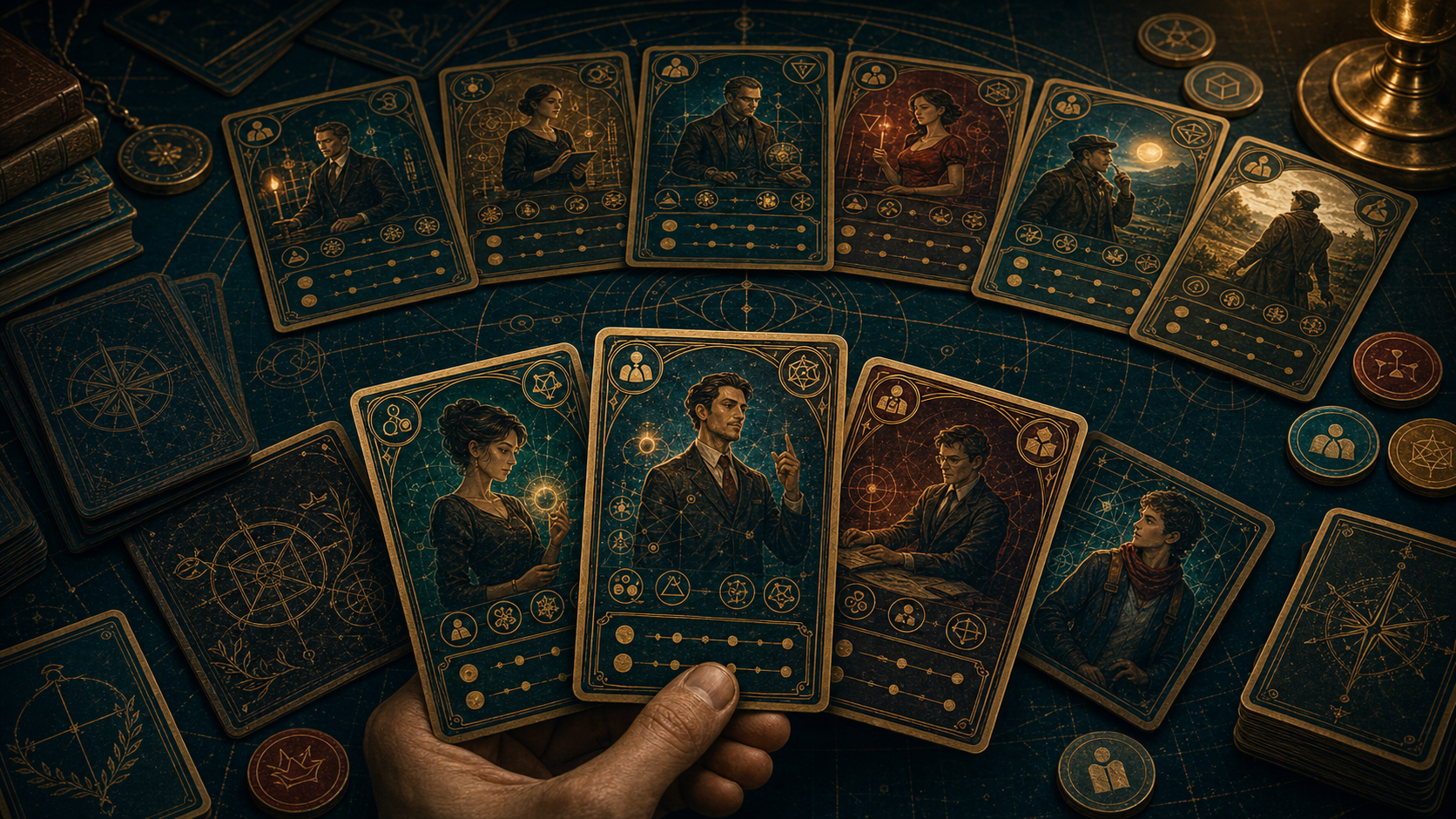
A satirical TetraTypes field guide to the 16 types, written in the voice of the 45th and 47th President of the United States, who has been briefed on socionics for approximately nine minutes and is now the world's leading expert.
People come up to me — and these are very smart people, okay, very high-level people, people with PhDs, people with diagrams, people who frankly have too many diagrams — and they say, "Sir, what is Socionics?" And I look at them, and I say — and nobody says this better than me — I say, "Socionics is tremendous."
Maybe the most tremendous personality system ever developed. Ever. In history. The other systems? Weak. Very weak. Low-energy systems. You get four letters and suddenly everyone thinks they're a genius or an empath or a tortured strategic mastermind because they didn't answer a text message. Pathetic, frankly. Very sad.
Socionics gives you sixteen types. Sixteen! Not four. Not nine. Not twelve with a wing and a childhood wound and a podcast nobody listens to. Sixteen Types of Information Metabolism. TIMs. Great word. TIM. Strong word. Sounds like someone who could fix your boiler and explain the Reinin dichotomies while doing it. I know a lot of Tims. Very reliable people, the Tims.
Now, Socionics — and I understood this immediately, the first time I heard about it, I said, "That's right, that's exactly right" — Socionics is not about who you are "deep down." Nobody knows who they are deep down. Most people don't even know why they opened the fridge. I know why I open the fridge. But most people? No idea. Very confused. Socionics is about how you process information. What you notice. What you value. What you're good at — I'm good at everything, but most people have specialities. What exhausts you. What you pretend you don't need while secretly needing it very, very badly. Very badly indeed. Believe me.
Some people lead with logic. Very dry. Some people lead with emotion. Very loud, frankly. Some people lead with force. Winners, mostly. Some people lead with comfort. Very sofa-oriented. Some people see possibilities everywhere — I see possibilities everywhere, by the way, I've always seen possibilities, it's a gift — and some people see the future, usually a bad future, and they insist on telling you about it during a beautiful lunch. I've had lunches ruined by these people. Tremendous lunches. Ruined.
That is Socionics.
And because this is TetraTypes — which is a fantastic site, by the way, really terrific, very well-run — we don't treat types as sacred identities. We treat them as conjectural maps. Useful maps. Beautiful maps. Probably the best maps. But maps. If your type becomes a prison, that's on you. Very sad. You had a map and you built a cage. Loser behaviour, frankly.
So today we're going to look at all sixteen types as if they were Top Trumps cards. Everybody loves Top Trumps. I used to win at Top Trumps. I always won. Ask anyone. Who has the best energy? Who has the worst lunch vibes? Who is dangerous in a committee? Who should never — and I mean never — be allowed to explain their feelings using a spreadsheet?
Let's go. This is going to be big. Maybe the biggest.
ILE — The Tremendous Brainstormer
The ILE — tremendous type, by the way, very creative, I know many ILEs — leads with Ideas and Laws. Possibilities and logical structures. These people see ideas everywhere. You give them a paperclip and they invent a theory of civilisation, a new voting system, three startups, and a board game nobody will ever play. And then they tell you about all of them. At dinner. While you're eating.
Very clever people. Often too clever. The ILE is what happens when curiosity escapes supervision. Completely unsupervised curiosity. They don't enter a conversation — they open seventeen tabs in human form. They love debate, speculation, paradoxes, clever reframings, and saying "yes, but what if…" until everyone else wants to lie down. I've been in rooms with these people. Exhausting. But also brilliant. I hire them, I just don't let them run the meeting.
Actual Socionics point: ILEs are strong at generating possibilities and structuring them conceptually. They are often exploratory, inventive, and intellectually playful.
My judgment: tremendous brain, terrible project manager. Needs someone nearby saying, "That's fascinating, but have you paid the council tax?" I would never hire them for accounting. Never. But for ideas? The best. Maybe the best ever.
SEI — The Luxury Armchair Diplomat
The SEI leads with Senses and Emotions. Sensory comfort and pleasant emotional atmosphere. These are the people who know the room is wrong before anyone else. The chair is wrong. The lighting is hostile — and frankly, bad lighting is a form of aggression. The soup is almost right but needs something, and they know what it is, but they won't make a big thing of it because making a big thing of it would ruin the mood. Very diplomatic. Too diplomatic, some would say.
SEIs are gentle operators. They don't conquer the world. They adjust the cushions until the world stops being so unpleasant. Very underrated. I've always said that. I'm probably the first person to say SEIs are underrated. They are very good at making people feel relaxed, included, and physically at ease. Which sounds minor until you spend time with someone who can't do it. Then you realise civilisation depends on these people. I realised that years ago. Years. Before anyone.
Actual Socionics point: SEIs are often skilled at managing comfort, sensory harmony, and soft emotional rapport.
My judgment: very good people to have in a home, café, or very expensive hotel. Not ideal for storming a fortress unless the fortress has bad lighting and needs emotional softening. Then, actually, perfect.
ESE — The Human Announcement
The ESE leads with Emotions and Senses. Emotional expression and sensory hospitality. These people don't merely have a mood. They export the mood. They distribute it. Aggressively. They make sure everyone has received the mood and knows what to do with it. Very organised about feelings. Possibly too organised.
The ESE is the person who turns "a few people coming round" into decorations, snacks, music, messages, reminders, scented candles, a new outfit, and a moral obligation to enjoy yourself. And you will enjoy yourself. They'll make sure of it. Very warm. Very animated. Very physical. Completely unable to understand why the quiet people are hiding in the kitchen with the cat. "Why are they with the cat? We have a party! We have entertainment! We have dips!"
Actual Socionics point: ESEs are strong at shaping social atmosphere and enlivening the sensory environment.
My judgment: tremendous hosts. The best hosts. Dangerous before Christmas. If an ESE says "just a small gathering," evacuate immediately. Don't even pack. Just go.
LII — The Department of Definitions
The LII leads with Laws and Ideas. Structural logic and conceptual possibility. This is a very logical type. Too logical. Way too logical. You ask, "Do you want tea?" and they say, "That depends what we mean by want." Terrible. Maybe accurate. Probably accurate. But terrible.
LIIs want things to make sense. They want definitions, distinctions, clean categories, coherent models. They are the people who can take a perfectly good argument and patiently disassemble it until the room has lost the will to continue. They're not necessarily trying to be annoying. They are trying to be precise, which, in my experience, has exactly the same effect. I've met many LIIs. Some of them work for me. I don't always listen to them, but they're always right about the structure. Very annoying.
Actual Socionics point: LIIs are oriented toward internal logical consistency, conceptual systems, and abstract explanation.
My judgment: excellent theorists. Very useful for building frameworks. Completely useless when everyone else has already decided and just wants to order the pizza. "But what kind of pizza? And by what criteria?" Nobody cares. Get the pepperoni.
SEE — The Personal Empire Builder
The SEE leads with Force and Relations. Initiative, force, personal bonds, loyalty, influence. These people don't sit around wondering whether they're allowed to want something. They want it. They go get it. Other people become involved, sometimes voluntarily. Great type. One of my favourite types, frankly. Reminds me of someone.
SEEs know people. They know who likes whom, who hates whom, who can be persuaded, who can be pressured, and who's pretending to be neutral while clearly scheming. They know all of it. Instantly. They're socially tactical. They can be charming, direct, opportunistic, generous, ruthless, loyal, dramatic — all before breakfast. Very high-energy people. Winners.
Actual Socionics point: SEEs combine forceful action with skill in managing personal relationships and alliances.
My judgment: tremendous movers. Beautiful movers. Very dangerous in friendship groups. If an SEE says "I'm not getting involved," they're already in charge.
ILI — The Grim Forecasting Department
The ILI leads with Telos and Pragmatics. Long-term implications and factual reasoning. These are the people who can ruin a beautiful sunny day — and I mean a perfect day, blue sky, not a cloud, tremendous weather — by accurately explaining why the roof will need replacing in seven years.
ILIs see trends. They see consequences. They see the bit everyone else is ignoring because everyone else wants to be happy for ten minutes. Is that too much to ask? Apparently yes. The ILI is there. With charts. They often sound negative, but sometimes — and I hate to admit this, I really do — sometimes they're just early. Too early. Annoyingly early. They warned you and you didn't listen, and now they're sitting there with that face. The ILI face. I know that face. I've fired people with that face. The "I told you so but I'm too tired to enjoy it" face. Very unpleasant.
Actual Socionics point: ILIs are strong at forecasting, strategic implication, and analysing factual trends over time.
My judgment: extremely useful before a disaster. Slightly unbearable after one. "I told you." Yes. You told us. Thank you. Very helpful. Please stop.
LIE — The Walking Performance Review
The LIE leads with Pragmatics and Telos. Efficiency, facts, outcomes, strategy. These people love results. Tremendous love of results. They love measurable progress. They love a plan that goes somewhere. They look at a family picnic and ask whether there's a more efficient sandwich distribution model. I respect that, actually.
LIEs are practical visionaries. They want to know what works, what scales, what fails, what wastes time, what produces value. This can be inspiring — very inspiring, I find it very inspiring. It can also make you feel like your entire personality has been entered into a spreadsheet and found underperforming. Believe me, I've seen it happen. To other people. Never to me.
Actual Socionics point: LIEs are oriented toward factual productivity, strategic planning, and efficient execution.
My judgment: tremendous achievers. Very dangerous if you're trying to relax. Never tell an LIE you have "no plans for the weekend" unless you want plans. Detailed plans. With milestones.
ESI — The Boundary Enforcement Unit
The ESI leads with Relations and Force. Personal judgment, loyalty, boundaries, firmness. These people know who they trust, who they don't trust, and who has been behaving strangely since 2018. They have files. Not physical files — although, honestly, possibly physical files. Moral files. Spiritual files. Files you can't subpoena but that are more damaging than anything in a courtroom.
ESIs are serious about loyalty and character. They may be quiet, but they are not vague. They know where they stand. They know where you stand. If you don't know where you stand, that's probably very bad news for you. Very bad. I've always respected ESIs. Tremendous judges of character. The best.
Actual Socionics point: ESIs combine strong relational evaluation with the will to defend boundaries and protect what matters.
My judgment: tremendous allies. Terrible enemies. Do not betray them unless you enjoy consequences. Long consequences. Consequences that follow you to other social circles.
SLE — The Tactical Bulldozer
The SLE leads with Force and Laws. Force and structure. These people see the world in terms of leverage, control, hierarchy, position, tactics. They don't ask, "How does everyone feel about the obstacle?" They ask, "Why is the obstacle still there?" And then they remove it. Sometimes with the obstacle's consent. Sometimes not. Great people. Very effective.
SLEs can be decisive, commanding, practical under pressure, and very comfortable with conflict. Some people avoid conflict. SLEs walk toward it. Briskly. This makes them extremely useful in a crisis and slightly alarming in a book club. They like systems, but not soft decorative systems. Not systems with cushions. Systems with teeth. Systems that do things. Systems that win.
Actual Socionics point: SLEs combine assertive force with structural logic, often making them tactical organisers.
My judgment: tremendous in emergencies. Very tremendous. Less tremendous when the "emergency" is choosing a restaurant. "We're going to that one. No discussion. Move."
IEI — The Velvet Apocalypse
The IEI leads with Telos and Emotions. Temporal meaning, symbolism, mood, emotional atmosphere. These people don't just experience Tuesday. They experience Tuesday as a sign, a portent, a turning point, perhaps the final delicate whisper before everything changes forever. Very dramatic. Beautiful, actually, but very dramatic.
IEIs are attuned to subtext. They sense where things are going emotionally and narratively. They can be poetic, evasive, deeply insightful, theatrical, and mysteriously absent when practical tasks appear. Very absent. You need someone to move a sofa and the IEI has dissolved into symbolism. They won't move the furniture, but they will explain what the furniture represents. At length. Beautifully.
Actual Socionics point: IEIs are strong at perceiving narrative flow, future implication, emotional tone, and symbolic meaning.
My judgment: tremendous vibes. Very cinematic. Do not ask them where the screwdriver is. They don't know. They've never known. They will never know. Accept it.
EIE — The Revolutionary Theatre Director
The EIE leads with Emotions and Telos. Emotional mobilisation and dramatic vision. These people don't have conversations. They stage events. You mention the bin collection schedule and suddenly it's a speech about the collapse of civic responsibility and the long twilight of community values. Incredible. Absolutely incredible. Not helpful, but incredible.
EIEs are expressive, intense, persuasive, and oriented toward the big narratives. The huge narratives. They understand collective emotion. They can inspire people, alarm people, seduce people into causes, and make everything feel more important than it probably is. I know this skill very well. Very, very well.
Actual Socionics point: EIEs use emotional expression in connection with vision, timing, and symbolic direction.
My judgment: tremendous speakers. The best speakers. Dangerous with a microphone, stage lighting, and unresolved historical grievances. Keep them away from all three simultaneously.
LSI — The Iron Filing Cabinet
The LSI leads with Laws and Force. Structure, discipline, enforcement. These people like order. Not "good vibes" order. Not "let's all get along" order. Real order. Defined terms. Clear rules. Stable systems. If you move one item in their carefully arranged world, they know. Before you've finished moving it. They know. Don't touch their things.
LSIs can be principled, reliable, firm, and impressively consistent. Very consistent. Nobody is more consistent. Except me. They're good at maintaining systems and enforcing standards. They are less good when the system itself needs to be questioned by someone wearing colourful trousers saying, "But what if we did it completely differently?" The LSI does not want to do it differently. The LSI wants to do it correctly. Which means the way it was already being done. Very rigid. But very reliable.
Actual Socionics point: LSIs combine structural logic with forceful maintenance of boundaries and order.
My judgment: tremendous order. Very strong drawers. Everything labelled. Everything aligned. You may borrow the stapler, but emotionally you never truly borrowed it. You took it. And they remember.
IEE — The Human Possibility Brochure
The IEE leads with Ideas and Relations. Possibilities and personal connection. These people see potential everywhere. In people, in places, in hobbies, in strangers, in a half-formed idea someone mentioned once at a barbecue in 2009 that everyone else forgot. They didn't forget. They made a vision board.
IEEs are often charming, curious, encouraging, scattered, and relationally perceptive. Very perceptive. They can see what someone might become and then get personally invested in it for about three days, which may still be enough to change your life. Very powerful. Also very chaotic. Three days of life-changing inspiration followed by complete radio silence. "Where did they go?" "They found another person with potential." Of course they did.
Actual Socionics point: IEEs combine exploration of possibilities with attention to personal values and individual potential.
My judgment: tremendous encouragement. Dangerous near major life decisions. An IEE can make you believe you should move to Lisbon and become a sculptor by Tuesday. And you'll believe it. And then Wednesday comes.
SLI — The Silent Competence Machine
The SLI leads with Senses and Pragmatics. Practical comfort, sensory observation, hands-on efficiency. These people are quiet because they're busy noticing what's actually wrong. While everyone else is discussing the emotional symbolism of the broken shelf — and some people really do discuss the emotional symbolism of a shelf, believe me, I've seen it — the SLI has fixed it. Quietly. Efficiently. And gone home. Without telling anyone. Tremendous.
SLIs tend to be practical, self-contained, observant, and allergic to fuss. Very allergic. More allergic to fuss than any other type. They like things that work, tools that work, processes that work, and people who stop talking long enough for work to happen. Very reasonable demands. I agree completely.
Actual Socionics point: SLIs combine sensory attunement with practical method and efficient hands-on adjustment.
My judgment: tremendous competence. Very low drama. If civilisation collapses, find the SLI. They'll have batteries. And a knife. And opinions about your generator that are, unfortunately, correct.
LSE — The Productivity Weather System
The LSE leads with Pragmatics and Senses. Practical productivity and stable maintenance. These people get things done. Then they improve the way they got things done. Then they ask why you're still sitting there. Very energetic. Very managerial. Very capable of making rest feel like a personal failing. A moral failing. "You're resting? Again? Didn't you rest yesterday?"
LSEs love useful activity, reliable procedures, proper standards, and tangible improvement. They can be caring, but the care arrives in the form of instructions. "Have you eaten?" "Take a coat." "Send the email." "Why is this still on the floor?" That is love, apparently. Very efficient love. No wasted sentiment.
Actual Socionics point: LSEs combine practical efficiency with attention to physical wellbeing, order, and routine maintenance.
My judgment: tremendous organisers. Slightly terrifying on a Sunday morning. Never say "I might do it later" within their hearing. Never. They hear "later" the way a dog hears a squirrel. Something activates. You can't stop it.
EII — The Soft-Spoken Moral Tribunal
The EII leads with Relations and Ideas. Inner values, sincerity, empathy, potential. These people seem gentle. Very gentle. Soft-spoken. Wouldn't hurt a fly. And then you discover they've quietly evaluated the moral quality of everyone in the room and found several people — not all, but several — deeply disappointing. And they won't tell you. They'll just know. And you'll feel it. The temperature drops. You won't know why. But it's because of the EII.
EIIs care about authenticity, conscience, personal meaning, and human growth. They often dislike force and harshness, but that does not mean they lack standards. Oh, they have standards. Their standards are invisible until you violate them. Then the silence becomes very loud. Very cold. The loudest silence you've ever experienced.
Actual Socionics point: EIIs combine deep relational ethics with openness to alternative possibilities and personal development.
My judgment: tremendous sincerity. Very kind, until you are filed under "ethically troubling." There is no appeals process. The ruling is final.
Intertype Relations: Deals, Disasters, and Psychological Trade Agreements
Now, individual types are only half the story. Maybe less than half. Maybe 47%. Very precise number. Nobody gives you a number that precise. I do, because I'm honest.
People are not isolated units floating in space. Although some LIIs would probably prefer that. Tremendous floating. Very peaceful. No one asking imprecise questions. But the rest of us interact. And Socionics has intertype relations, which are — and I've said this many times, I was probably the first person to say this — they're basically the trade deals of the psyche. Some good deals. Some terrible deals. Some deals where you didn't even know you were in a deal.
Duality is the famous one. Everybody wants duality. Beautiful relation. Maybe the most beautiful. Very strong. Your strengths cover their weaknesses. Their strengths cover yours. You value what they naturally provide. It's like finding someone who brings exactly the thing you've been pretending you don't need for twenty years. Very emotional moment. Very suspicious at first. "Why are you giving me exactly what I need? What's the catch?" No catch. It's duality. Tremendous deal. The best deal in Socionics.
Conflict is very different. Terrible deal. Maybe the worst deal ever negotiated. Horrible terms. Conflict partners hit each other's weak, unvalued areas. One person says, "Why can't you just do the obvious thing?" The other says, "Why are you attacking the foundations of my existence?" Nobody wins. The furniture feels tense. I've seen it. Very sad. Very, very sad.
Supervision is nasty. Very nasty. I've told people about supervision and they say, "Sir, that can't be real." It's real. Believe me. The supervisor naturally sees and pokes at the supervisee's most vulnerable area. Naturally. Without trying. The supervisor thinks they're being helpful. "I'm just saying." No. You're not just saying. You're psychologically strip-searching someone at a garden centre. Very unfair. Bad deal.
Activation is exciting. Tremendous energy. The activation partner wakes you up. Gets things moving. Makes life interesting. But restful? No. Not restful. It's less like a peaceful home and more like someone has installed fireworks in your motivation system. Very sparkly. Very exhausting.
The point isn't that one relation is good and another is bad. That would be stupid. Very stupid. Even I wouldn't say that. A dual can be awful. A conflictor can be decent. A supervisor can be kind — rarely, but it happens. A person is not reducible to the relation. But the relation tells you what kind of information pressure exists between you and the other person. Some relations feel like fluent translation. Some feel like badly dubbed television. Some feel like being audited by someone who doesn't know they're an auditor. Very important to know which is which.
Model A, Model L, and the Very Strong Letter
Now, I hear there's Model A and Model L. And I have to say — and I say this as somebody with great instincts, probably the best instincts — Model L sounds stronger. Much stronger. A is the first letter. Very basic. Very kindergarten. Apples start with A. Model A is fine, everyone respects it, very classic, but L? L is later in the alphabet. More developed. More luxurious. L has length. L has leverage. L has very strong lobby architecture. If letters were candidates, L would win in a landslide.
Now, maybe that's not the formal reason. The formal reason involves Reinin dichotomies, central functions, radial functions, monadic elements, capacities, and many other words that sound like they were invented in a very impressive laboratory by very impressive people who definitely didn't get enough sunlight.
But the serious point — and I do have a serious point, people never give me credit for the serious points — is this: a model can be useful and incomplete at the same time. Model A gives us eight functions, four blocks, a powerful classical structure. Very elegant. Very compact. Good genes, that model. But Model L asks whether the full dichotomy structure implies a richer architecture than Model A explicitly shows. More rooms. More wings. Bigger building.
That's a legitimate question. Maybe the traditional model is a half-map. Maybe the radial positions matter tremendously. Maybe the sixteen monadic elements give us a more complete picture. Or maybe parts of the expanded structure still need better observational grounding. That's fine. We can ask. We can test. We can conjecture. Very smart approach.
We don't say, "This model is beautiful, therefore it is true." Many beautiful things are false. Many ugly things are also false. Truth doesn't care about looks. Very unfair. I've always said that.
A good typological model should expose itself to correction. Should help you notice something you'd otherwise miss. Should clarify real differences between people without becoming a costume shop for the ego. Very important point. Probably the most important point in this whole thing.
Because some people — and I know these people, I've met many of them — use typology very badly. They say, "I'm an intuitive type, therefore I cannot answer emails." No. Answer the email. Right now. They say, "I have weak sensing, therefore I live in filth." No. Disgusting. Clean the kitchen. They say, "I'm an ethical type, therefore my feelings are evidence." Absolutely not. Feelings are witnesses. Sometimes useful witnesses. Sometimes drunk witnesses. Very drunk. Unreliable witnesses. You wouldn't put them on the stand. I wouldn't.
Socionics is a map, not an excuse.
Final Verdict: Tremendous, But Handle Carefully
So there we have it. Sixteen types. Some brilliant, some exhausting, some useful in emergencies, some useful in cafés, some useful only after three cups of tea and a long written apology to everyone affected. All of them? Tremendous. In their own way.
The ILE invents things and forgets lunch. Sad.
The SEI makes life bearable. Beautiful.
The ESE turns bearable into a party. Loud, but beautiful.
The LII defines the party until it ends. Unfortunate.
The SEE gets what they want. Winners.
The ILI tells you why what they want will decay. Depressing but accurate.
The LIE improves the decay curve. Smart.
The ESI remembers who caused it. Forever.
The SLE takes control of the situation. Immediately.
The IEI gives the situation tragic meaning. Poetically.
The EIE makes a speech about it. A very long speech.
The LSI writes the rules. In triplicate.
The IEE sees a new possibility. Another one. And another.
The SLI fixes the actual object. Quietly.
The LSE creates a maintenance schedule. For everything.
The EII quietly judges whether any of this was morally acceptable. It wasn't.
And that, frankly, is humanity.
Socionics is funny because people are funny. People are lopsided. Tremendously lopsided. They're brilliant in one place and hopeless in another. They solve abstract problems while failing to book a taxi. They run companies while being emotionally destroyed by a badly worded text message. They understand the future of civilisation but not the washing machine. Many such cases. Very common.
The types help us see those patterns. Not perfectly. Not finally. Not even close to finally. But usefully. Very usefully. Maybe the most usefully of any system. Many people are saying that.
Treat them as conjectures. Treat them as maps. Test them against reality. Let them be wrong where they're wrong. Improve them where they can be improved. Laugh at them, especially when they describe you too well. That's the sign of a good map. When it's so accurate it's slightly insulting.
Because the moment you take your type too seriously, you become the worst stereotype of it. The LII becomes a walking footnote. The ESE becomes a foghorn with snacks. The ILI becomes a haunted spreadsheet. The SEE becomes a nightclub with legal representation. Nobody wants that. Nobody. I've seen it happen. Very unfortunate.
Types are maps. Very beautiful maps. Some of the best maps ever drawn. Many people are saying they've never seen better maps. But the person is the territory.
Never forget the territory.
And if you do forget, there's probably an SLI nearby who remembers. Ask them. They'll tell you. Then they'll fix something. Then they'll leave. And you'll be better for it.
That's Socionics. Tremendous. Believe me.