This post replaces an earlier one built around the Model A Benefit relationship. In correspondence about that draft, Kimani White made a correction that dissolves its entire premise: at full sixteen-function resolution there is no Benefit relation at all. What Model A draws as one asymmetric arrow is, in Model L, two distinct symmetric relations. The structural data is unchanged; the conclusion is his, and it is a cleaner result than the one it replaces.
In Model A, Benefit is one of the two asymmetric ring relations. The Benefactor gives; the Beneficiary receives; the exchange runs one way. The Beneficiary admires, the Benefactor is mildly drained, and the relation is told the same way sixteen times over with only the names changed.
It is a tidy story, and under Model L it does not survive contact with the full structure. At sixteen-element resolution the asymmetry disappears. What is left is not a weakened Benefit but two entirely symmetric relations that Model A could not tell apart, because at eight functions it did not have the resolution to see them.
This post sets out what happens to Benefit when you draw both psyches at full resolution, why the asymmetry was an artefact of Model A's four blocks, and what the two relations that replace it actually are.
Where the asymmetry came from
Model A describes a type with eight functions in four blocks, and it frames Benefit through two correspondences. The Benefactor's Creative falls on the Beneficiary's Suggestive — the Benefactor effortlessly supplying what the Beneficiary is hungry for. And the Beneficiary's Leading falls on the Benefactor's Mobilising — the Beneficiary's defining strength meeting a position the Benefactor aspires to but cannot command.
Crucially, the reverse of each does not hold. The Beneficiary's Creative does not fall on the Benefactor's Suggestive; the Benefactor's Leading does not fall on the Beneficiary's Mobilising. The two correspondences run one way only, and that one-way running is the whole of the asymmetry. It is what makes Benefit directional, and what makes "Benefactor" and "Beneficiary" distinct roles rather than two names for the same seat.
At eight functions, that is a complete and consistent account. The trouble is what happens when you add the other eight.
What the full structure shows
Model L resolves each of the eight classical aspects into a pair of distinct monadic elements — sixteen in all, each occupying one of sixteen positions. The eight that Model A names are the Central positions, the conscious core. The eight Model L adds are the Radial positions, the periphery the psyche runs without holding in full attention.
Take the standard case from the old account: an LII and their IEI benefactor. In Model A, the IEI gives and the LII receives. Lay both psyches out at full resolution and ask where each type's elements actually land in the other, and the giving turns out to run both ways at once.
The IEI's Creative, Sentiment, lands on the LII's Prompting — feeding it, as the old story said. But the LII's Creative, Ideation, lands on the IEI's Prompting in exactly the same way. The IEI's Base, Reverie, lands on the LII's Galvanizing — and the LII's Base, Intellect, lands on the IEI's Galvanizing, identically. Every projection the Benefactor makes into the Beneficiary, the Beneficiary makes back into the Benefactor, onto the same position. There is no element the IEI commits that the LII does not commit in return. The LII is galvanised by the IEI's Reverie and galvanises the IEI with their Intellect in the same motion.
So the picture the old post painted — the Beneficiary nourished, the Benefactor quietly drained by exposure — cannot be right. Nothing flows one way. At sixteen-element resolution the relation is mutual, more like Duality than like the directional arrow Model A drew. The Benefactor is not drained, because the Benefactor receives exactly what they give.
This is not peculiar to the LII and IEI. As Kimani White puts it, every intertype relationship becomes symmetrical once the full sixteen-function structure is in view. The asymmetry of Benefit was never a feature of the relationship. It was a feature of looking at the relationship with only half its functions drawn.
Why Model A saw an asymmetry that is not there
The asymmetry was real at eight functions because Model A's two correspondences genuinely do run one way. But they run one way only because the elements that would complete the symmetry are the eight Model A does not draw.
When the IEI's Creative meets the LII's Suggestive, that is a Central-to-Central correspondence Model A can see. The matching return — the LII's Creative meeting some position in the IEI that does the same work — lands on a Radial element, invisible at eight functions. Model A sees the forward arrow and not the return, and reports an asymmetry. Add the Radial elements and the return arrow appears, pointing back along the same line. The asymmetry closes.
This is the same lesson the Supervision analysis reached by a different road. There too, the single Model A arrow turned out to be one half of a symmetric structure that only the full resolution could show. Benefit and Supervision are the two relations Model A most insists are asymmetric, and they are exactly the two that Model L reveals were symmetric all along.
What replaces Benefit
If Benefit dissolves, something must take its place, because the sixteen pairs Model A labelled Benefit still stand in some relation to one another. Kimani White's principle for naming them is this: an intertype relationship is defined, first of all, by the function on which the two types' Base elements coincide. You find where each type's leading element lands in the other — and because the relation is symmetric, both land on the same position — and you name the relation after that position.
Do this across the sixteen old Benefit pairs and they do not form one relation. They form two.
In half of them, the two Bases coincide on the Instrumental position — the B4 function, a foreground element in the resistant material the psyche holds in active view but does not lead with. Kimani White calls this the Augmenting relation. The LII and SLI stand in it: each one's Base lands on the other's Instrumental.
In the other half, the two Bases coincide on the Galvanizing position — the C4 function, a background element the psyche runs without effort or direct attention. This is the Galvanizing relation. The LII and IEI stand in it: each one's Base lands on the other's Galvanizing.
Both are symmetric. Both are mutual. They are distinguished not by who gives and who receives — neither does, both do — but by whether the two leading elements meet in the foreground material each type actively works with, or in the background material each runs on quietly. The Augmenting relation joins two psyches at their Instrumental; the Galvanizing relation joins them at their Galvanizing.
The ring, re-read
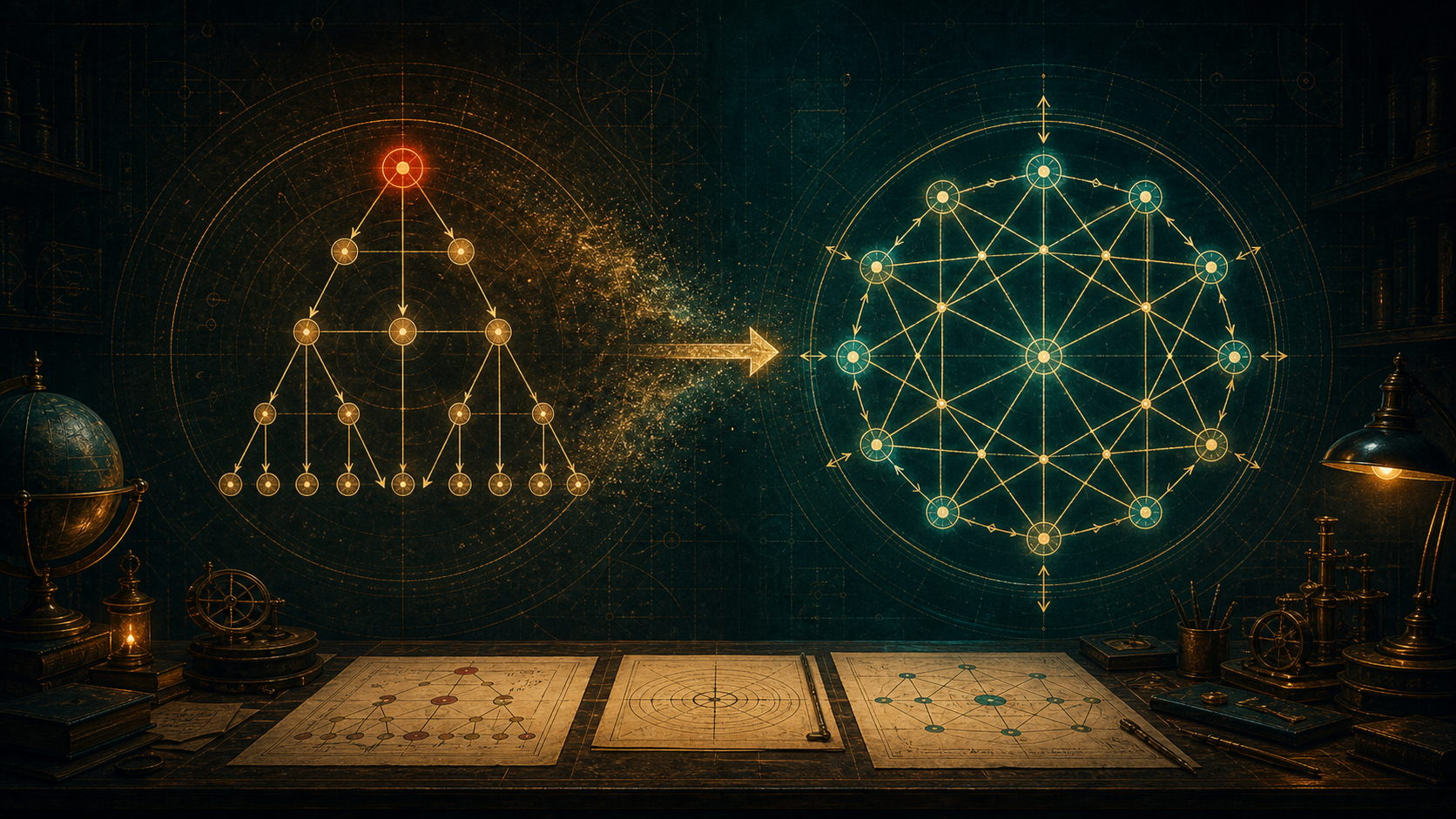
Model A draws Benefit as four directed rings of four types each, every arrow pointing from Benefactor to Beneficiary. That directionality was the artefact. What the ring actually contains, read at full resolution, is an alternation of two symmetric relations.
Take the old ring IEI, LII, SLI, ESI. In Model A it is a one-way loop: IEI benefits LII benefits SLI benefits ESI benefits IEI. In Model L it is not a loop of one relation but a chain of two, alternating link by link. The IEI and LII stand in the Galvanizing relation. The LII and SLI stand in the Augmenting relation. The SLI and ESI are Galvanizing again, the ESI and IEI Augmenting. No arrow, no direction — each adjacent pair simply shares one of two symmetric relations, and the two alternate around the ring.
So the LII does not have "a benefactor above and a beneficiary below." The LII has a Galvanizing partner in the IEI and an Augmenting partner in the SLI — two different symmetric relations with two different types, neither of which has an up or a down. The ring that looked like a hierarchy of giving was a chain of mutual relations all along.
What is settled
The intertype pairings are unchanged. The sixteen pairs Model A called Benefit are the same sixteen pairs; nothing here revises who stands in relation to whom.
The structural reading is checkable directly against the Model L position map for all sixteen pairs: each type's Base element lands on the other's Instrumental or the other's Galvanizing, symmetrically, and the relation divides cleanly into the eight Augmenting pairs and the eight Galvanizing pairs with no exceptions. The symmetry is not an interpretation; it is what the position map says once both halves of each psyche are drawn.
The framing — that all intertype relationships become symmetric at full resolution, that a relation is named by where the two Base elements coincide, and that the two relations replacing Benefit are the Augmenting and the Galvanizing — follows Kimani White directly, in correspondence about the earlier version of this post. The names are his and Aleesha Lowry's. The earlier post's whole apparatus of asymmetric Benefit, of a Benefactor who gives and a Beneficiary who is drained, has been retired, because at sixteen functions there is no such thing.
TetraTypes is independent and not affiliated with WSS. Model A here follows WSS conventions; Model L is the work of Kimani White and Aleesha Lowry.