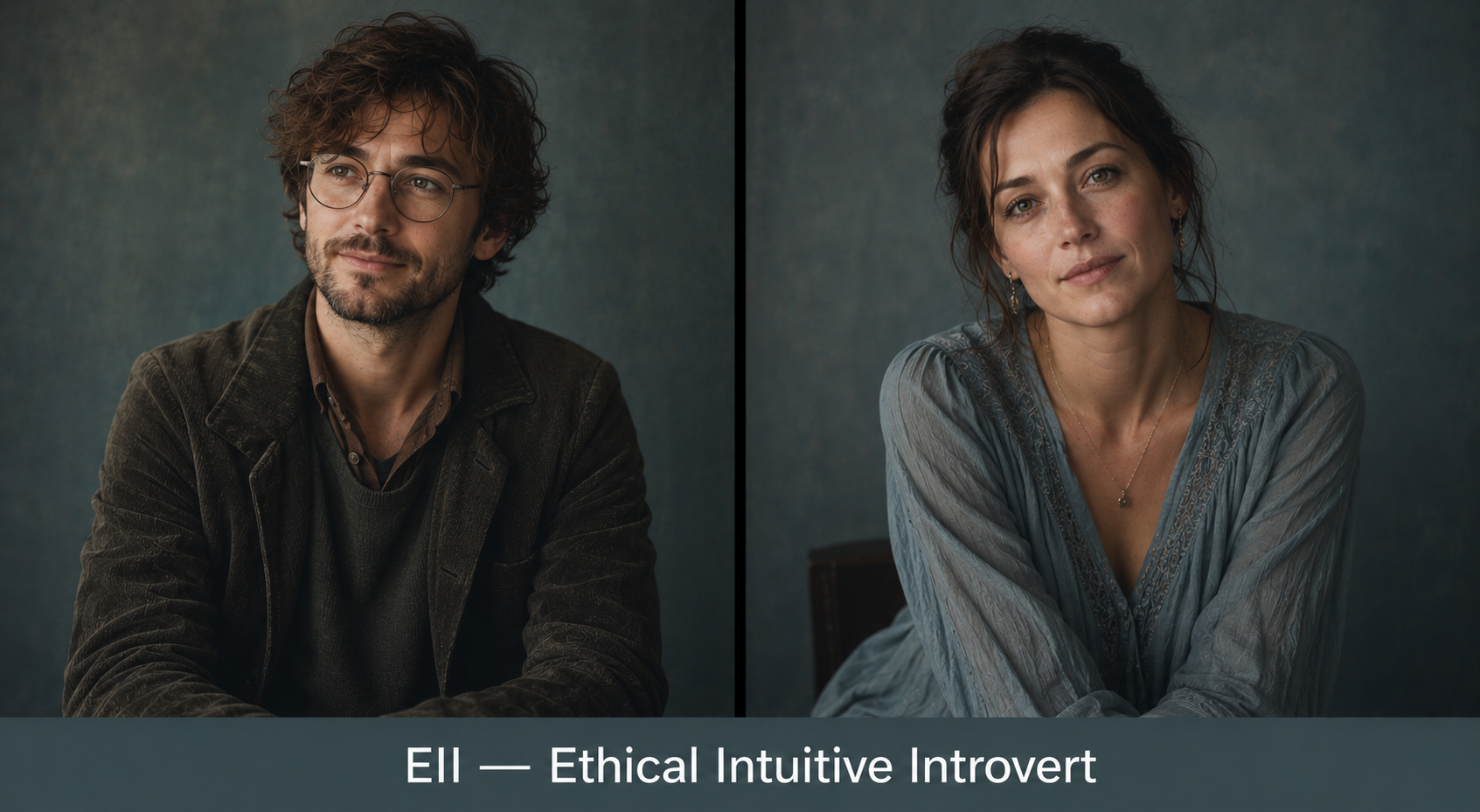
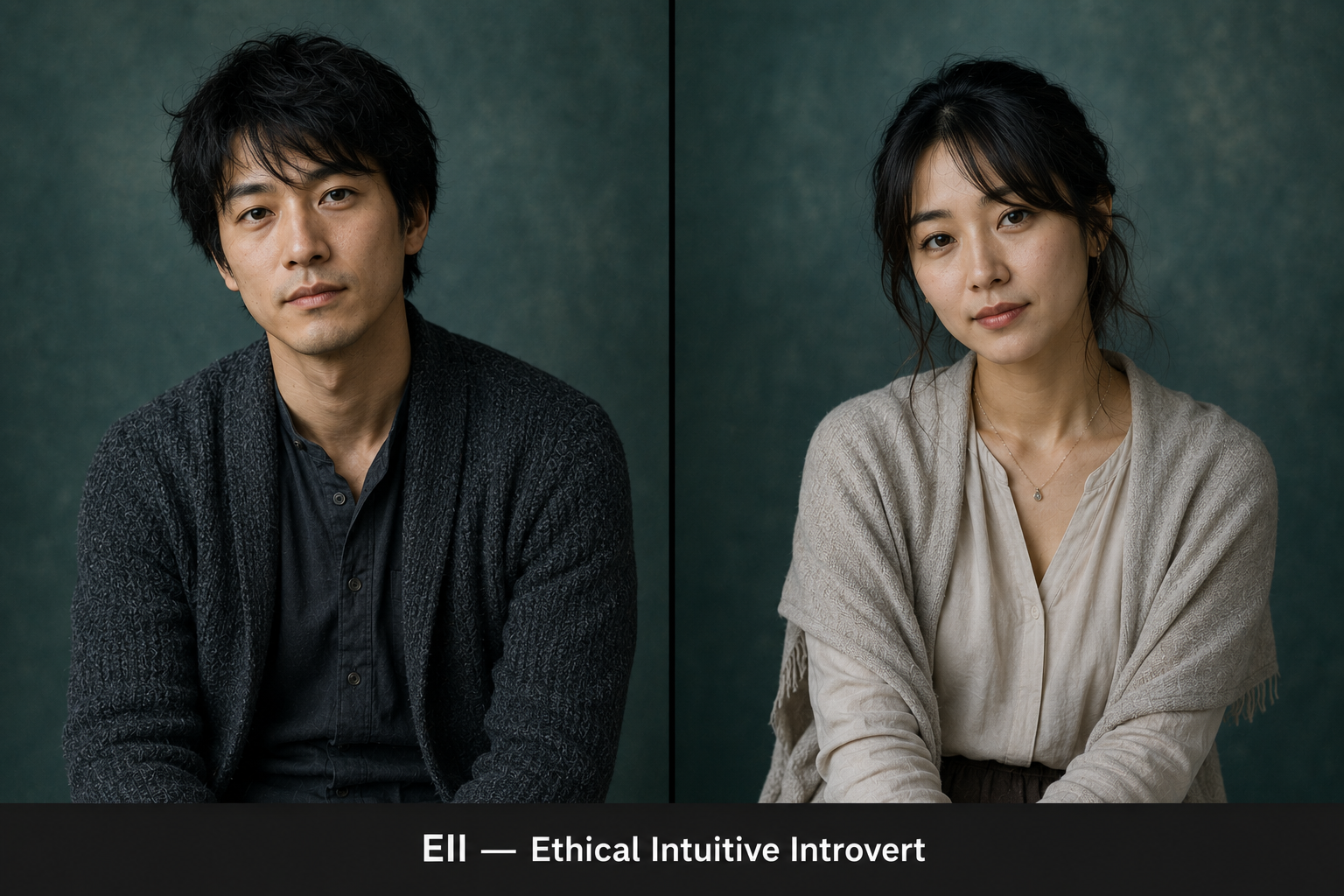
A fuller reading from the source profile, following the eight Model A positions and their Model L sub-variants.
Position 1 — Base — Fi(N.) Soul
The EII's fundamental mode of engaging with reality is through their inner landscape of personal values, moral convictions and abstract notions of what is inherently worthwhile — the totality of foundational ethical commitments that constitute who they are at the deepest level. Fi(N.) is not the visceral protective embodied ethics of Fi(S.) in the ESI but the contemplative inner architecture of value itself — what truly matters, what is genuinely good, what people and relationships are worth in the most fundamental sense. The EII inhabits this inner moral landscape with the same natural authority that other types inhabit their external environments. Soul is automatic and effortless — the EII cannot help evaluating experience against their deep inner standard of what is genuinely worthwhile.
Position 2 — Creative — Ne(F.) Inspiration
In service of Soul, the EII deploys the personally felt sense of potentiality and spontaneous creative impulse — drawing on experience to imagine novel possibilities, exploring what people and situations could become in the light of what they genuinely are. Ne(F.) is more visible in behaviour than Fi(N.) — more externally expressed, more interpersonally present — and EIIs are often experienced as warmly perceptive, imaginatively generous and capable of seeing potential in people that others have not noticed. The Inspiration serves the Soul: the EII sees what could be in the light of what truly matters, and offers that vision to others with genuine care.
Position 4 — Vulnerable — Se(T.) Actuation
The EII's point of greatest sensitivity. Se(T.) is the decisive regulatory leveraging of physical force to control and shape the environment — tactical dominance, physical assertion, the direct imposition of will on concrete reality. This is the furthest territory from the EII's natural register. Being expected to assert themselves physically, to compete directly for dominance, to impose their will on the environment through force lands as a deeply uncomfortable demand. Criticism of their assertiveness or decisiveness hits hard; excessive pressure toward tactical physical directness produces stress and defensiveness.
Position 3 — Role — Ti(S.) Habitus
The EII's performance function — the codified behavioural structures, formal systems and proper procedural arrangements they are called upon to deploy in certain contexts but find unnatural to sustain. Ti(S.) sits uncomfortably against the EII's contemplative, relational and value-oriented register. They can navigate formal structural requirements when the situation demands it but the procedural, institutionally-grounded mode is effortful and temporary. What matters is the inner moral landscape and the relational possibilities it illuminates; the formal structure is a performance rather than a natural home.
Position 6 — Mobilising — Si(T.) Observation
Energising and uplifting when present in others. Si(T.) — Observation — is the careful discriminating assessment of the actual sensory condition of things — quality evaluation, precise physical attentiveness, the accurate noticing of how things really are in the present moment. The EII cannot easily generate this themselves but responds with animation and energy when they encounter it — the grounded sensory precision enlivening a type whose own attentiveness tends toward the inner and the abstractly relational. Together with the Suggestive it defines the EII's interpersonal chemistry.
Position 5 — Suggestive — Te(S.) Praxis
What the EII most wants and responds to most positively in others. Te(S.) — Praxis — is the flexible use of hands-on techniques and material resources to improve the workflow of the physical environment — practical operational efficiency, getting things done, making systems work. The EII cannot easily produce this themselves — their attention is absorbed in the inner moral landscape rather than the practical management of material reality — but they experience it as genuinely nourishing when it appears in others. Their dual LSE leads with exactly this element: the LSE's natural Praxis is precisely what the EII's Soul yearns to be grounded by. Where the EII illuminates what is genuinely worthwhile, the LSE makes the practical reality that allows it to exist.
Position 7 — Ignoring — Fe(N.) Sentiment
Capable but uninteresting. Fe(N.) — deeply felt emotion expressed through dramatic rhetoric and symbolic gesture — is something the EII can access but finds less authentic than the quieter, more interior register of Fi(N.). Both are ethical functions but they operate through different channels: Fi(N.) works inwardly and contemplatively; Fe(N.) works outwardly and dramatically. The EII can give passionate emotional expression when the base has genuine need of it but does not seek this territory as its own — it feels like performance rather than genuine feeling.
Position 8 — Demonstrative — Ni(F.) Reverie
The EII's strong background competence — the inner reflection on narrative significance and temporal meaning operating quietly without the type fully registering it. Ni(F.) — Reverie — runs in the background giving the EII a natural attunement to the felt significance of how things are unfolding that supports their relational and moral work without demanding recognition for itself. The EII often has a subtle sense of what is coming in relationships and situations that they experience simply as intuition rather than as a distinct and powerful function.
Overall Character
The EII is the type most naturally oriented toward the inner moral and relational landscape — what people genuinely are, what relationships truly mean, what is authentically worthwhile beneath the surface of how things appear. At their best they are the person who sees you more clearly and more generously than you see yourself, whose moral seriousness is never preachy because it is genuinely lived, and whose imaginative care for human possibility is a form of deep respect rather than projection.
Their Delta quadra membership means they value sincerity, earnestness, the desire to understand others on their own terms, and the patient developmental perspective of those who know that growth takes time. The EII's moral vision is not the fierce protective loyalty of the ESI or the uncompromising ideological clarity of the EIE but the quiet contemplative wisdom of someone who has looked at human experience with genuine care and arrived at considered, nuanced judgments. Their IJ temperament makes them stable and consistent — the inner moral landscape they have built is not lightly revised.
The EII-LSE dual captures something essential about both types. The LSE provides the practical operational reality — the efficiency, the material competence, the ability to make things actually work — that the EII's inner moral vision would otherwise have no concrete ground to stand on. The EII provides the inner meaning — the sense of what is genuinely worthwhile, the moral and relational depth — that the LSE's practical competence would otherwise lack entirely. Each completes what the other can only partially inhabit.
Dual Relationship
EII and LSE
Te(S.) - Praxis
Suggestive element
Fi(N.) - Soul
Suggestive element
EII's dual is LSE — The Practitioner. EII's Suggestive is Te(S.) — Praxis: hands-on methods, practical experimentation, and material workflow improvement. LSE leads with exactly this mode of application.
LSE's Suggestive is Fi(N.) — Soul: inner values, ideals, convictions, and abstract notions of what is inherently worthwhile. EII leads with that mode effortlessly. Practical action becomes humane, and conscience gains a reliable method.
Intertype Relations
EII In Relation
Each card uses the Model L relation image as a concrete scene: how EII appears when its structure is doubled, completed, strained, supervised, benefited, or set beside another type.
Duality · with LSE — The Director
EII and LSE
The LSE figure is doing Te(S.) — Praxis. The application operates through direct material engagement and practical experimentation — methodology improvised and adapted in real time to what the physical environment actually requires, effectiveness found through doing rather than derived through inference. The LSE is not reasoning toward a conclusion from data analysis. They are in direct contact with the problem, testing what works, adjusting technique as the material and the situation respond. The work is practically honest — grounded in what the environment actually does rather than in what a strategic assessment says it should do. What the praxis itself cannot supply is any felt account of what the work is worth beyond its own technical effectiveness. Te(S.) has no stake in the outcome beyond what works. It will apply its practical methodology equally well toward any end it is pointed at. Left without a sense of principled purpose the LSE's practical effectiveness produces competent work in service of nothing that carries inherent worth.
Without that grounding the work is technically sound but morally empty — the technique is effective, the methodology is honest, the reason it is worth doing at all is absent. The praxis is real. The worthwhileness of it is not supplied from within.
Two EII types encounter in each other a principled conviction that resonates without remainder. Every expression of abstract foundational moral idealism by one is immediately recognised by the other — the principled certainty resonates in both directions, each holding the same quality of free-floating foundational conviction with the same quality of quiet inner seriousness.
What doubles: Fi(N.) abstract principled conviction, foundational moral idealism, the totality of inner values held independently of any particular person. Ne(F.) imaginative inspiration — the felt possibility that serves and deepens conviction — also doubles. Two instances of the same quietly principled inward mode operating in full resonance.
Same structural rule. EII leads with Fi(N.) and creates with Ne(F.). IEE leads with Ne(F.) and creates with Fi(N.). Same two functions, same N./F. sub-variant, reversed priority.
EII leads with Fi(N.) Soul and creates with Ne(F.) Inspiration. The EII draws on felt aliveness to possibility in service of abstract foundational moral conviction — imaginative exploration as the instrument by which principled ideals are tested, deepened, and given personal felt weight. The Ne(F.) opens up what could be; the Fi(N.) evaluates it against what is inherently right. Possibility is the instrument. Conviction is the point.
Same structural rule. SLI's Ego fills EII's Super-Id with inverted priority; EII's Ego fills SLI's Super-Id with inverted priority.
SLI leads with Si(T.) Observation and creates with Te(S.) Praxis. The EII's Super-Id seeks Te(S.) as Suggestive — what EII most deeply wants — and Si(T.) as Activating. SLI's controlled selective sensory attention energises the EII, giving the abstract principled conviction precise physical grounding and contact with what is actually present; the practical hands-on effectiveness that flows from SLI's careful observation is what the EII most wants — it gives the moral idealism concrete method and the capacity to produce real outcomes.
The EII and ESI are both doing Fi. Both are private, both resist having their inner felt world overridden by external pressure, both operate from a strong internal sense of what matters that does not require external validation. The Kindred recognition between them is built on this shared quality — both immediately recognisable as types who know their own mind from the inside. The EII's Fi operates through abstract moral conviction: foundational values and ideals that constitute what this person believes is inherently worthwhile in life, independent of any specific person or object. The ESI's Fi operates through visceral particular attachment: stable felt attitudes of affinity and aversion toward specific individuals and concrete objects of experience, the bond as a felt and particular reality. The EII may find the ESI too attached to specific people and insufficiently principled in the abstract — too personal, not principled enough. The ESI may find the EII too idealistic and insufficiently concrete in their actual loyalties — too abstract, not sufficiently present to the specific bond. Both are protecting the same inner domain through different orientations toward it. Model A calls them Kindred without being able to explain the felt difference. Model L does.
Same structural rule. Each type's leading function provides the right element, wrong sub-variant for the other's Suggestive.
LIE leads with Te(N.) Reason — detached applied logic, informal reasoning toward productive end goals using available data to formulate workable strategy. The EII's Suggestive is Te(S.) — embodied practical application, hands-on experimental method that finds what works through direct material contact. LIE provides Te(N.) instead: applied reasoning at the level of inference and strategy, logic working from data toward actionable conclusions. The element is right — the EII genuinely values and seeks Te — but the EII most deeply wants the concrete practical effectiveness that gives abstract principled conviction tangible real-world form, and what arrives is strategic inference that is intelligent and applicable but abstractly held rather than physically demonstrated. Genuinely useful. Slightly too elevated and less concretely grounded than most deeply sought.
The LII and EII can work together. Both are principled. Both are abstract. Both are comfortable operating through careful reasoned engagement with ideas rather than through physical procedure or concrete embodied practice. Both resist having their inner frameworks overridden by external pressure or situational convenience. Both arrive at settled concluded verdicts through their respective processes of careful principled reasoning. From the outside they can appear very similar — two quietly thoughtful types who care deeply about getting things right and who operate from a stable inner sense of what is correct. This surface resemblance is genuine. It is what makes them Business/Lookalike in Model L and what allows them to engage with each other productively in a way the full Conflict versions cannot manage as readily.
The LII figure is doing Ti(N.) — Intellect. The logical structure is being articulated as communicable abstract principle — the framework applied to the situation, the relevant categories identified, the verdict arrived at through impersonal structural logic that applies equally to everyone regardless of who they are or what their relationship to the situation is. The conclusion is settled and the LII is comfortable stating it clearly. The criterion for the verdict is structural coherence — something either follows the logical framework or it does not. The personal identity of the people involved is not a variable in the assessment. The impersonality is not coldness. It is what makes the principle a principle rather than a preference.
Same structural rule. Each type's base sits at the other's A3 Ignoring position. Each type's Role and 3D Contributive generate false signals of compatibility that draw each toward the other.
EII leads with Fi(N.) Soul — abstract foundational moral conviction. In ESE's Model L stack, Fi(N.) sits at the A3 Ignoring position: competent, available, found unrewarding to engage directly. What EII most naturally produces is what ESE routinely bypasses.
Same structural rule. EII's Ni sits at position 8 — naturally used, present in background operation, not what EII orients toward as primary. IEI's Fi sits at position 8 — equally natural, equally present, equally not oriented toward.
Of the eight Quasi-identical pairings, this one produces perhaps the most convincing surface resemblance. Both types are quiet. Both are withdrawn from immediate physical and social reality. Both operate in an interior register, away from the concrete present. Both share a quality of felt inwardness — personally charged, non-broadcasting, self-contained. The mutual recognition can feel like genuine deep affinity, and in some respects it is.
The same structural rule applies: each type's leading function sits at the other's Role position. LSI's Ti is EII's 3rd. EII's Fi is LSI's 3rd. Full strength on both sides, landing on the position the other strains toward but never occupies with ease.
Model L shows a specific inversion relative to the LII/ESI pairing — and it matters.
Same structural rule. EII's base Fi(N.) sits exactly at SLE's D2 Vulnerable. SLE's base Se(T.) sits exactly at EII's D2 Vulnerable.
EII leads with Fi(N.) Soul — abstract foundational moral conviction, principled ideals held independently of any particular person. In SLE's Model L stack, Fi(N.) sits at the Vulnerable position. SLE is genuinely inept with abstract principled conviction, treats it with careless indifference, finds sustained engagement with it draining. When EII's free-floating moral idealism fills the shared space — the principled sense of what is inherently right asserted with quiet certainty — SLE has no functional register to receive it. The conviction does not translate into anything the SLE's mode can organise or govern.
EII leads with Fi(N.) Soul and creates with Ne(F.) Inspiration. The Ne(F.) creative flows naturally as the felt imaginative exploration that serves and deepens principled conviction — personally-charged creative possibilities in service of moral idealism. The EII is not trying to infuse ILE's concept architecture with personal felt significance. The imaginative exploration serves the principled orientation.
Supervision: Supervisee · with SEE — The Politician
EII and SEE
EII leads with Fi(N.) Soul — 4d, 4p, abstract principled conviction at maximum strength. Against SEE's Fi(S.) creative this lands on a 3d position. The EII's principled idealism genuinely adjusts SEE's particular relational conviction. But this is the lesser pressure.
EII leads with Fi(N.) Soul — abstract principled conviction as primary mode. The Ne(F.) Inspiration creative flows naturally as the felt imaginative exploration that serves and deepens that conviction: personally-charged creative possibilities opened in service of moral idealism. The EII is not trying to provide architectural structure for the SEI. The imaginative exploration simply serves the principled conviction.
ILI leads with Ni(T.) Apprehension — detached strategic temporal tracking as primary mode. The Te(N.) Reason creative flows naturally as the applied reasoning that makes pattern apprehension actionable: strategic inference, articulation of productive end goals, workable strategy assembled from temporal comprehension. The ILI is not trying to ground EII's idealism in practical method. The applied reasoning simply makes the pattern usable.
Model A identifies EII as Fi-leading with Ne Creative. Model-L specifies that this is Fi(N.) — Soul, the ideal and internally value-oriented mode of relation, supported by Ne(F.) — Inspiration.
This distinction matters when separating EII from ESI. Both lead with Fi in Model A terms, but EII's Fi(N.) is ideal, reflective, and conscience-oriented. ESI's Fi(S.) is concrete, visceral, and bound to immediate loyalty or aversion.
For EII, Model-L shows why values and possibility appear together: the type does not only judge what is right, but imagines what people and situations might become.
Attribution: Model-L is Kimani White's original framework. This interpretation is the author's own.
B Radial Group
Supported Same-Club Positions
B positions share the A capacity's rational or irrational club orientation. They are radial, foreground, and resistant: available as conscious support, but not as effortless as the central A cross.
B1 — Correspondent
Fi(S.) — Animus
Derivation: radial + foreground + resistant · 3D / 2P
Conscious support that can correspond with the A region. It is capable enough to be useful, but it asks for deliberate handling rather than automatic expression.
A visible support position that collaborates with the type's central orientation. It receives attention and can help the profile work outwardly, but it is less dimensionally equipped than the A positions.
A compensating support position. It helps cover less central areas of the cross while still requiring conscious effort and structural management.
B4 — Instrumental
Si(F.) — Stimulation
Derivation: radial + foreground + resistant · 3D / 2P
A workable instrument. It can be applied when needed as practical support, without becoming the type's main orientation.
C Radial Group
Contrasting Opposite-Club Positions
C positions take the opposite club orientation from A. They are radial, background, and facile: indirect resources that complement the type's main cross from the contrasting axis.
C1 — Subsidiary
Ti(N.) — Intellect
Derivation: radial + background + facile · 3D / 2P
Quiet background support from the contrasting club orientation. It works as a subsidiary resource rather than a leading concern.
C2 — Negligent
Ne(T.) — Ideation
Derivation: radial + background + facile · 2D / 3P
Indirect background material that may be psychologically noticeable but is easy to neglect. It colours the profile without becoming a central task.
C3 — Prompting
Te(N.) — Reason
Derivation: radial + background + facile · 2D / 3P
A prompting support position. It nudges the type toward material that complements the A capacity from the opposing axis.
C4 — Galvanizing
Ni(T.) — Apprehension
Derivation: radial + background + facile · 3D / 2P
A galvanizing support position. It shapes output from the contrasting axis, adding momentum without becoming a direct Model A anchor.
The Type In Life
The Counsellor
Male story
Sam
Sam is slower to judge than most people. He is not slow to observe — he observes constantly, carefully — but he holds conclusions at arm's length until he is confident they are true rather than convenient. He is drawn to questions of what makes a life worth living and does not find them abstract; they are personal and pressing and he returns to them without embarrassment. He is deeply, quietly loyal, and the loyalty is not contingent. He carries his convictions quietly, does not advertise them, but acts from them consistently. The consistency is what people eventually notice. He remembers the small ethical debts other people forget: the awkward apology that is still owed, the quiet loyalty that should be protected, the person whose dignity is being treated as a footnote. His gentleness has architecture; it is careful, principled, and difficult to move once settled.
Female story
Grace
Grace asks the question that clears the room — not because she is provocative, but because she is genuinely asking. She has been thinking about it for weeks. She holds a quiet expectation that people are capable of more than they are currently producing and she aims that expectation at herself first. She is the person in the group project who reminds everyone, gently, what the point was. Not the deadline — the *point*. She is idealistic without being naive; she knows the gap between what is and what should be, and she finds the gap disturbing enough to keep working on it. She rarely pushes herself into the centre of things, but people find their way to her when a situation has become morally tangled. She listens for the private meaning beneath the public story, then offers a distinction so clean that the other person can finally breathe around it.
Male story
Babatunde
Babatunde teaches ethics and philosophy of law at a university in Ibadan and has the rare quality of being more willing to say "I don't know" the more expert he becomes, because expertise has taught him how many of the important questions remain unresolved. His lectures proceed by genuine inquiry rather than demonstration; he is working through the material in real time and the students feel this. He is deeply, quietly committed to the possibility that people can do better — institutionally, personally — and this commitment does not wane with evidence to the contrary. He finds the evidence to the contrary illuminating rather than conclusive. He is slow to condemn and slower to trust a flattering explanation. In his counselling work he gathers histories, obligations, and wounds into a patient moral map, then asks the one question that returns a person to responsibility without stripping them of compassion.
Female story
Zainab
Zainab is a social worker in Khartoum who continues to show up in conditions that would justify not showing up, and has been doing this long enough that it is no longer a decision she makes but a thing she is. She holds her cases with a personal investment that her training told her to moderate and that she has decided, after careful consideration, not to moderate, because the investment is what makes the work real. She does not talk about this much. She listens more than she talks. She asks the question that gets to what is actually happening, and waits, fully, for the answer. Her kindness is quiet enough to be underestimated until someone crosses a line she has silently marked. She is drawn to the inner life of others, but she does not confuse empathy with permission; the same sensitivity that understands pain also knows when integrity must be defended.