Independent Socionics Reference
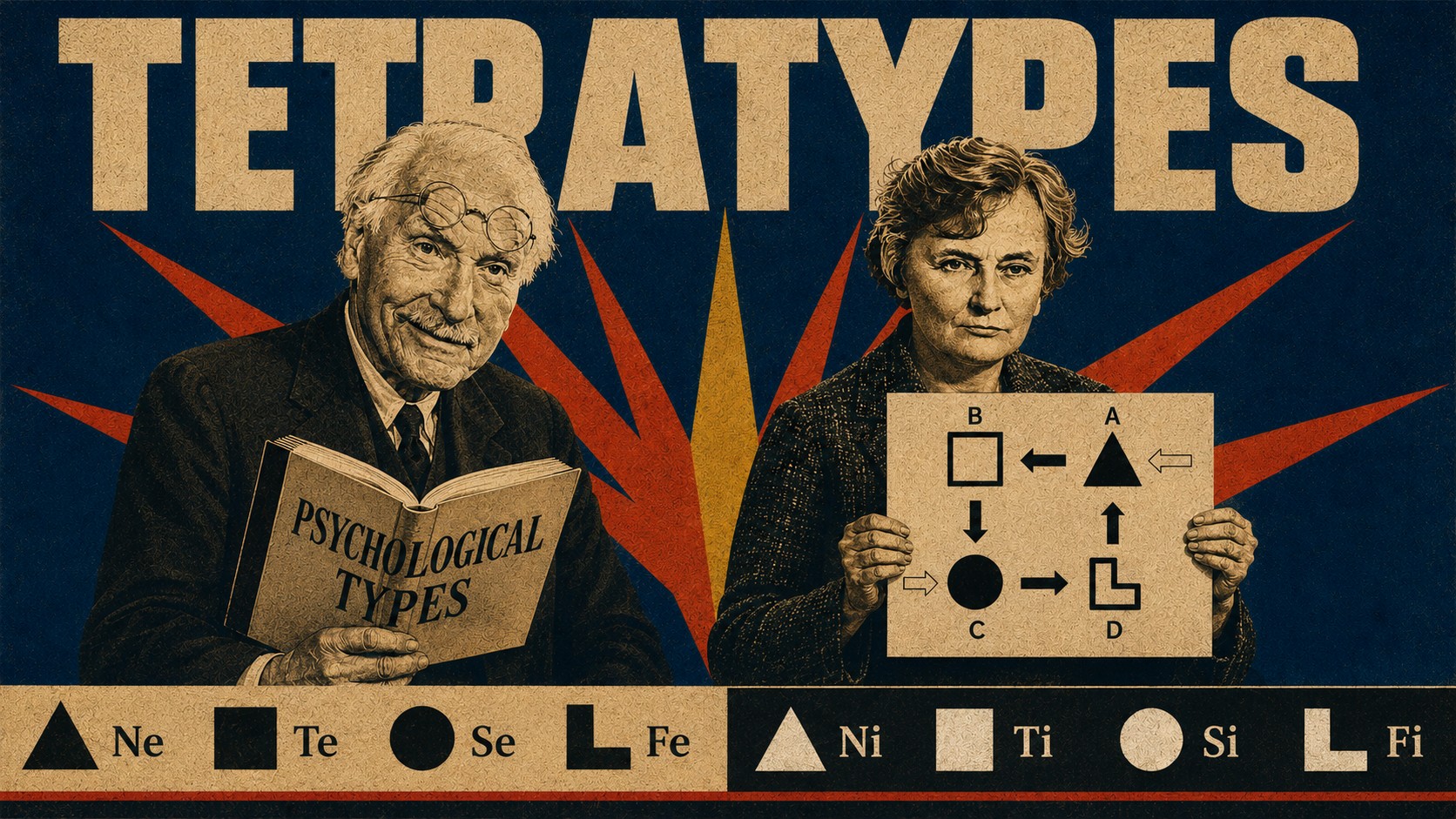
TetraTypes
Four natures. Sixteen types. One socion.
The sixteen types and the fourfold architecture running beneath them.
Why TetraTypes
The Socion Is A Mandala
Numbers have meaning. Jung knew this better than most. After working with what he estimated as tens of thousands of dreams over decades of clinical practice, he kept returning to the same observation — that the psyche insists on four. In the mandala, that ancient image of wholeness, the fourfold structure emerges unbidden. Jung observed in his patients' dreams a persistent, unsolicited return to the quaternity — not as a cultural borrowing, not as a conscious preference, but as something the unconscious produced on its own authority. He concluded that the quaternary was a spontaneous expression of the psyche's own architecture. Not a convention. Not a convenience. A fact about the structure of mind itself.
His typology honours that fact. "Sensation establishes what is actually given, thinking enables us to recognise its meaning, feeling tells us its value, and intuition points to the possibilities of the 'whence' and 'whither' that lie within the immediate facts" — four functions, irreducible, each completing what the others cannot provide. (CW 6, §983) The mandala symbol, he observed, appears in crosses, stars, squares and octagons — always the same fourfold grammar wearing different clothes. He found it in his patients' dreams, in medieval alchemy, in the architecture of cathedrals and mandalas from cultures that had never spoken to each other. And in the alchemical tradition he returned to it as a riddle: the axiom of Maria Prophetissa — out of the one comes two, out of two comes three, and from the third comes the one as the fourth — struck him as a description not of chemistry but of the psyche's own movement toward wholeness through differentiation.
When Aušra Augustinavičiūtė took this inheritance and built socionics from it, the four didn't disappear — it ramified. Four quadras crystallised, each with its own values and its own sense of what is real and worth attending to. Four clubs. Four temperaments. The sixteen types arranged in a four-by-four grid, not because sixteen is a convenient number, but because four times four is what you get when you let the logic run to its natural conclusion. The socion is a mandala. Augustinaviciute may not have described it that way, but the architecture is unmistakable.
TetraTypes takes its name from that four. Tetra, from the Greek — four patterns, four natures, the quaternary skeleton that holds the whole system upright. It is a name that tries to point at the structure underneath, at what socionics fundamentally is before it becomes sixteen labels and a grid of intertype relations.
This site grew from years of quiet obsession with that structure — with Model A, and latterly with Kimani White and Aleesha Lowry's Model L extension of it, with the way each new framework reveals another layer of the same underlying architecture. It carries no institutional endorsement. It is one person's attempt to make the invisible structure visible — to build tools and write descriptions that do justice to the strange, precise, genuinely illuminating system that Augustinaviciute raised on Jung's foundations.
The four quadras are the heartbeat of it. Alpha finds wonder in ideas and warmth in people. Beta burns with intensity and prophetic vision. Gamma moves through the world with force and clear-eyed purpose. Delta believes in the slow, patient work of becoming — in people, in craft, in the quiet accumulation of what is real and worth doing. Sixteen types. Four natures. One socion.
Welcome to TetraTypes.
A Note on Method
How To Use This Framework
Karl Popper once challenged Adler on a case he felt the theory of inferiority feelings could not straightforwardly explain. Adler was unmoved. His confidence, he said, came from his thousandfold experience. Popper's reply was dry: and with this new case, I suppose, your experience has become thousand-and-one-fold. The remark was more than a joke: it exposed the problem. Every new case became confirming evidence. No conceivable observation could count against the theory. That, for Popper, was the signature of pseudoscience: not that it was wrong, but that it had made itself immune to being wrong.
Socionics is vulnerable to the same charge. Typists who are sufficiently fluent in the framework can usually find a way to explain any behaviour retrospectively through any type. That is worth acknowledging rather than deflecting.
But Popper's later work complicates the picture. In The Myth of the Framework he argued that frameworks are not epistemic traps — they are the necessary starting point of rational inquiry. All knowledge begins as myth, as imaginative conjecture, before it is subjected to critical scrutiny. David Deutsch makes the same point in the language of explanation: good theories are not derived from observation. They are creative leaps that precede it. Observation is what you use to test a conjecture, not what generates one.
Socionics may simply be at that stage — a highly developed conjecture, rich enough to illuminate experience, not yet formalised enough to be falsifiable in Popper's strict sense. That is a legitimate position for a framework to occupy, provided it is held honestly. The typist who treats every observation as confirmation has made Adler's mistake. The one who holds typings as hypotheses — revisable, defeasible, always accountable to the person in front of them — is doing something closer to genuine inquiry.

Epistemic Note
What Is Established and What Is Not
Model A has been developed and refined over several decades within the socionics community. Its core structure — the eight elements, the eight positions, the four blocks, the quadra system — is well-established and widely agreed upon within the WSS tradition.
Model L is a more recent framework, developed by Kimani White and Aleesha Lowry within the WSS diagnostic community. Its core insight — the sub-variant distinction — is structurally grounded and practically useful. The capacity group architecture extends Model A's block logic in a coherent direction.
Neither framework is empirical in the sense that trait-based theories like the Big Five are empirical — measuring behavioural distributions across large populations and submitting those measurements to statistical testing. Socionics is doing something different: it is a conjectural framework for understanding how the human psyche organises its relationship to information. Claims of that kind are not falsified by data. They are assessed by whether they illuminate — whether the distinctions they draw correspond to something real in experience, whether the account coheres, whether it deepens understanding or merely complicates it.
On those terms, Model A is well-tested. Decades of application within a practitioner community have sharpened its descriptions and stress-tested its intertype predictions. Model L is younger and its distinctions finer. The risk that comes with greater granularity is not unfalsifiability but interpretive overreach — the finer the distinction, the more skill and care is required to apply it honestly, and the easier it becomes to find what you are looking for rather than what is actually there.
Both frameworks are presented here in good faith as analytical tools, not as definitive verdicts on persons.

Reference Paths
Six Ways Into The System

The Classical Frame
WSS-aligned Model A foundations: information elements, functions, blocks, dimensionality, and position mechanics.

Two Resolutions
How Model A and Model-L relate, what Model-L adds, and where sub-variant resolution matters.

The Sixteenfold Cross
Kimani White's Model-L extension, with A/B/C/D capacities and monadic IM element notation.
The Sixteen Types
Model A sociotypes, quadras, clubs, temperaments, Reinin dichotomies, and profile pages for all sixteen types.
The Sixteen Relations
Duality, supervision, benefit, conflict, and the structural dynamics between every pair of types.
The Explorer
The existing interactive Model-L reference tool, moved into the site as a standalone study workspace.